
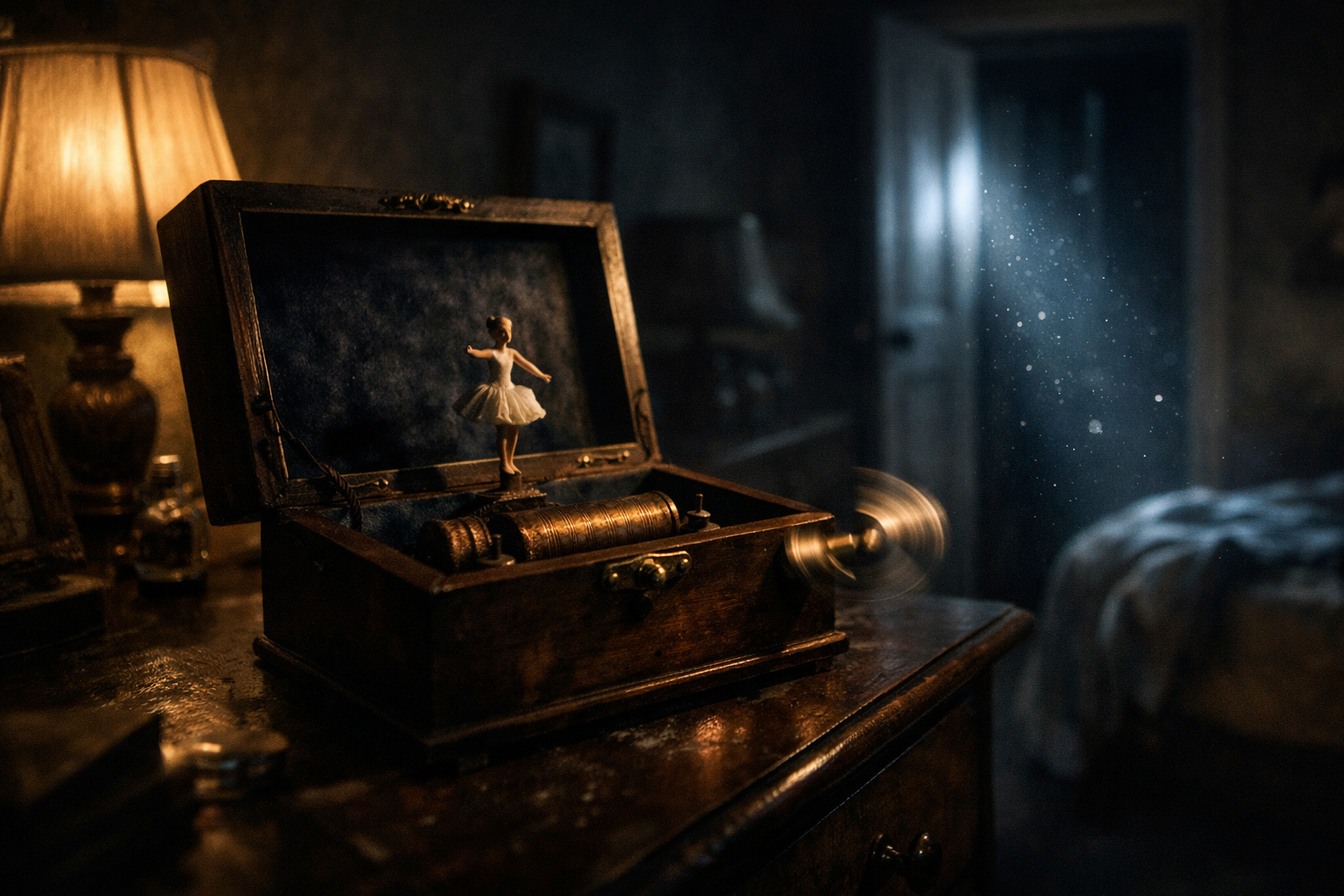
The Music Box Played Only When We Lied
We kept the box at first because it felt wrong not to. It arrived in a paper-wrapped bundle from my aunt with a folded note and a single stamp, the way people used to send jars of jam. My mother’s handwriting on the outside had been replaced by my aunt’s neat, teacherly script: For you—she wanted you to have this. The box itself was smaller than I expected, the wood pale under old polish, the kind that left the faint slick scent of lemon behind. Inlay of darker veneer made a simple border, a patient hand’s work from a time when that mattered. The lid creaked. Inside, a strip of threadbare blue velvet lined a shallow tray, and beyond a little brass frame, there was an oval mirror cloudy with age. The dancer wasn’t a dancer after all but a porcelain figure, a girl in a dress with hands clasped. She faced the mirror in permanent expectation. The winding key resisted a full turn and sprang back with a dull, gummy release that made a gritty sound in my fingers.
We decided the mechanism was shot. The cylinder that should have pricked the tune with silver pins looked tarnished, as if someone had breathed on it and never wiped it clean. My wife said it was still nice to look at, that it contained the room the way a lamp does when the bulb is warm but the shade is empty. We placed it on the bedroom dresser, between my loose change dish and a framed photo of the four of us at the lake. It had weight and sat flat, the felt circles on its feet worn to fuzzy moons. I closed its lid and rubbed my thumb once over the little nickel latch out of habit, as if that small pressure could teach old things to behave. That night, I walked past it twice in the half-dark and each time the mirror gave back the room in a slow, underwater way.
The first time it moved was a week later, late enough that the house had taken its last deep breath for the night. I had gone upstairs to fold laundry and make the kind of piles that never remain. The kids had finally settled after a circuitous route through tooth-brushing and protests about math homework. My wife came up behind me, soft-footed, and leaned in the doorway. Are you still mad about the e-mail? she asked in a tired voice that avoided the word angry, the way we skirted words with a history. I stared at the neat ridge of folded towels and said, No, I’m not mad. Which wasn’t strictly true, or even gently true. The last thread of that lie hadn’t left my mouth when a small skeletal sound ticked from the dresser—soft as a pin dropped on carpet—and the key at the back of the box made a shiver.
It wasn’t a full turn; it couldn’t have been. It twitched like a muscle, then another, then found purchase. The lid tremored against the latch in a delicate clatter. We both watched without speaking, and then the cylinder inside turned, the pins caught, and a thin, reedy melody climbed into the room as if it had been hiding in the dust and finally remembered the light. The little porcelain girl pivoted to face nothing, her dress catching once as if practical physics had to remember how to let the trick happen. The sound wasn’t pretty. It was old, the way a familiar voice over a phone line swims through miles of wire.
We stood as if either of us were quick enough to stop what we had already started. When it wound down—the tune halting mid-phrase with a breathless stop—I reached for the key and tried to turn it. It was stubborn. It resisted like before, one grudging tooth at a time, then sprang back like a held cough. We looked at each other longer than the moment needed. She asked, Was that you? In a way that tried to make it a joke. I shook my head.
The next day I couldn’t stop thinking about it. The house was ordinary in the bright hours. My son’s sneakers lay by the back door, half-full of playground dust, and the coffee filter had dried into a perfect paper flower in the trash. The box sat quiet, refusing to be the thing we had heard the night before. When the kids came home from school with their backpacks open like mouths, my daughter craned up on tiptoe at the dresser. Does it work? I said, It’s broken. And as if I had put a coin in a slot meant for that word, the key nudged itself and spun a single tepid measure—just two notes and a third that failed, a stanza like a shrug. My daughter laughed with her hand over her mouth. See? she said. It works if you say it doesn’t.
It would have remained a family anecdote if not for the way it kept answering. We didn’t set out to test it. You face a thing, and because you are alive and found your way this far with your own strange collection of rituals, you poke the thing to see if it breaks. That evening, after dishes, we stood around the dresser in the spill of the hallway lamp like people who aren’t ready to turn in. My wife said, This box is red. It was not. It was the color of bread crust. Nothing. My son, emboldened, said, I ate my vegetables. The key uncoiled half a turn as if relieved. The dancer’s porcelain shoulders moved, and the same thin melody unwound.
We learned its appetite quickly. When my daughter said she loved math—her effort at gaming it—the box hesitated, then gave a discouraged plink, like a piano in a summer house where the windows are never shut. When I said I wasn’t tired, only a little, it stirred willingly, the tiny machinery catching like a breath drawn in satisfaction. We tried truths. Today is Thursday. Silence. We live in this house. Silence. You had cereal for breakfast. The key remained inert, as if truth didn’t belong to its jurisdiction or as if truth, said aloud, is always only part of a larger thing. In the way of family games, it repeated itself until it became something else. We stopped saying The word, we joked—lie—because saying the word seemed like turning a handle, like naming a ghost gives it shape. We instead called it it, as in, Does it make it go?
As the week lengthened, when the house stretched and settled at night and the crickets sewed a thick seam of noise outside, the box volunteered more often without our summoning. I heard it while sorting mail, thin through the hum of the kitchen light. My wife’s voice floated from the living room—Just one glass—and the first little measures rose and fell before her sentence had the decency to find an ending. When my son told the dog to go out and added, I already fed you, the box replied from down the hall as if in polite dissent. What started as wonder pulled at the edges of all our sentences, a net you don’t feel until you rise and cannot see the shore.
On Friday, my sister came by with a stew she’d made too much of and stayed long enough to sit on the end of our bed and pick at the edge of the velvet. She touched the porcelain girl and winced. Careful, I said, chill prickled the back of my neck. It doesn’t like that, my daughter whispered. That it, again. My sister laughed and said she loved Mom’s note—how perfectly vague and kind—and the moment she said it, the key began its dry, whispering turn. We all stopped, even the dog, who cocked his head and made a sound I don’t hear from him often, something close to a word. My sister closed her eyes and said, Okay, okay, I didn’t love it. It scared me the way she wrote. Like she was saying goodbye again. The box wound down, satisfied, as if it had been presented not with a lie corrected, but a confession loosened from where it had been stuck.
After that, our testing wasn’t a game anymore. There are things in households that don’t like the air: polite refusals, small abdications, the white-lie gauze you place around the day to stop it bleeding too much. We heard it more when we tried to spare each other. My wife said, I don’t mind doing the bills, and the key answered in a steady climb. The kids fought and both announced, simultaneously, I didn’t start it, and the box’s lid clicked under its latch in little impatient fingers. More than once, it moved in the silence after a question hung in the room. We learned the shape of that silence fast.
The worst was the night we fought in earnest, when the dog had an upset stomach and there was bleach under all our noses. It was late enough for the neighbors’ houses to be black, the street pressed flat and thin as a piece of felt. We argued in low voices from habit, but habit doesn’t make the words kinder. I stood by the dresser, if only because it had become a station in that room where the air felt different, and said a thing I’d said before: I didn’t read your messages. That isn’t who I am. The box startled like a spooked animal, the key whirring as if it had been pushed hard. But before my sentence could finish riding the breath that carried it, before my wife had a chance to throw back her own defense or confession, it began—unbidden, immediate, the tune leaping into the room at full measure. I hadn’t reached out. No one had. The dancer’s face turned toward me, and for the first time, the box slid a fraction of an inch toward the edge of the dresser, a soft scuff on wood I felt in my knees.
We both stopped. It’s making a mistake, she said, but it kept going, bright and brazen, carrying on in a way that felt public when you want privacy most. I tried to stifle the lid with my hand, but it fought me with the stubborn mechanical rhythm of something set into motion long ago. I listened to the dry click of the pins and my own heart tramp around my chest. I hadn’t read her messages. She had read mine. The music made that admission patently unnecessary. Or maybe it made any next sentence—whatever it would have been—moot.
After, neither of us wanted to touch it. I wiped a ring of dust from where it had jerked forward and thumbed the smeared mirror as if it were a mouth that needed closing, then turned the key without thinking and felt it resist with a strength it hadn’t had since we unpacked it. I put it in the hallway closet, under quilts in a hard plastic bin, and shut the door. The kids peeked into the empty space on the dresser like it was a missing tooth. The room seemed larger for a day, then wrong the way a sentence sounds wrong if you lose a small word and don’t know why it won’t balance.
In the quiet that followed, we behaved better, or differently. We made fewer claims. We traded certainty for description and a handful of pauses. If I caught myself about to lie the way people lie casually—No big deal, I’m fine, it’s nothing—I changed the angle and said, Give me a minute instead, or I don’t know yet. It kept the rooms softer. There were nights I walked past the closet and listened to the muffled ordinary noises of a house: refrigerator hum, a clock with a single bad beat, the soft plastic tick of laundry settling in its basket. Nothing else. The bin under the quilts made no sound.
It went on like that long enough for the strangeness to dull at the edges and become part of the furniture of thought, the way you add a chair to a corner and forget how bare it looked before. We told a friend, as a joke over beers, and I watched his face earnestly expect something from me that I couldn’t give. We didn’t bring it out again. We promised the kids it was too old, that old things require gentleness we didn’t have. The house returned to its catalog of old annoyances, the scrape of the back door, the way the upstairs bathroom made the pipes moan like an animal waking. I found I didn’t look at the top of the dresser as much anymore. Threads on things pull less when you don’t put your hand there.
Weeks later, I took a call in the kitchen after dinner, the kind where you stand because sitting admits you to a length of time you don’t want. It was my boss, or friend, or a person who needed something in a voice that wanted me to say I had it. I could see the kids’ plates still flecked with sauce in the dim light over the sink. The window made a black square of the backyard, and a moth tested the glass with soft, sincere thumps. The hallway behind me was pale and patient, the closet door not quite flush with the frame the way it has never been, no matter how I sanded it.
Are you on track? he asked through the line’s small fuzz—the sound of distance too eager to be helpful. Yes, I said, without thinking. Yes, of course. It’ll be ready in the morning. I meant, It could be. I wanted it to be. The word slipped slick as a fish.
The first measures unfurled from the hallway at a shy volume, the way a child hums when they think no one is listening. The moth tapped the glass again, polite. I could hear the key, too, the dry, decisive ratchet of it turning under quilts and the hard lid’s patient insistence against plastic. Above me, the ceiling light hummed louder, as if it, too, were straining to hear. In my ear, my caller kept talking, filling the space I wasn’t. I watched my own hand grip the phone too tightly, whitening the knuckles I only notice when I do that. The tune found its middle, those familiar notes thinning as they rose, and it played and played, answering the room we had tried to make quiet.


