The Choir Sang After the Church Was Demolished
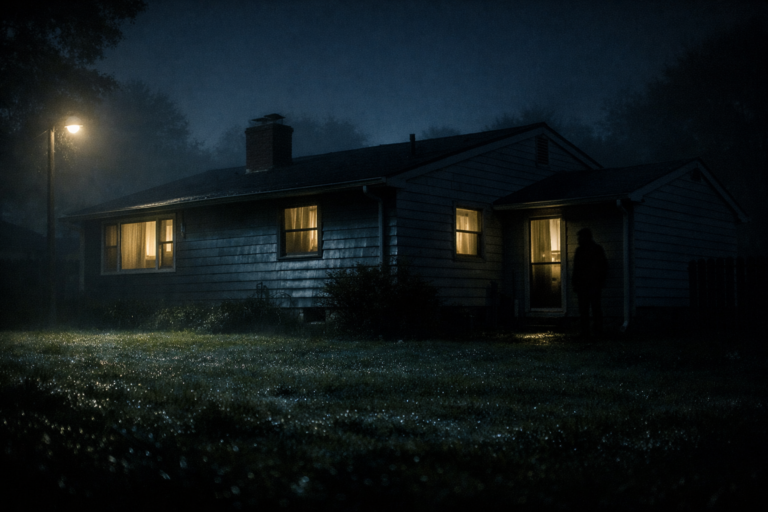
I was hired to survey a parcel at the edge of town where they planned to put up a small retail strip and parking lot. The land had sat vacant for as long as I could remember, a shallow depression with a few caved-in foundations and piles of broken brick under weeds. The job was routine: GPS the corners, run the elevations, mark utilities, then return each week as they built forms and poured footings so our stakes didn’t get chewed up by machines. It was early spring, with that clean, metallic smell the air carries when the sun drops and the ground is still damp from thaw.
The first Thursday I worked late there, I heard singing. It was faint, a rise and fall like wind lifting a tarp and then letting it settle. I figured one of the workers had a radio going in his truck, or that a car on the road had the windows down. The melody threaded between the birch saplings along the fence line and then away again. I didn’t place it right away, just that it was many voices at once, the way voices can braid into a single note that isn’t quite any of them. I could make out no words, and I had a crewman waiting on a corner shot, so I didn’t chase it. I let it be a radio in someone’s cab and called out a grade.
Before the second week, I dug into old maps to verify some right-of-way questions from the city planner. We needed to know if a utility easement jogged across the lot. I pulled up county plats and a 1950s aerial and then the older Sanborn fire-insurance map scans. There, against a neat grid of parcel lines, the block I’d been walking was drawn with a heavy little square. “Calvary Methodist Church,” someone had written in a serif script beneath a symbol that looked like a cross atop a rectangle. The map’s legend marked the cross as a steeple. The street names had shifted over time, but the measurements lined up: forty feet from the east boundary to center, sixty from the north property line to the south wall. Our proposed access drive cut directly through what had been the nave. I printed it and slid it into my packet like any other document. I told myself it didn’t matter.
That second Thursday, at the same slanting hour when shadows from the excavator boom stretched across the muck, I heard it again. Voices rising, thinning with distance, then returning, only this time I could catch the tune. I’ve never been much for hymns, but I recognized “Abide with Me” from my grandmother’s funeral, the way the ending holds on and then lets go. I turned toward the road because that’s where it seemed to be. Our operator Malik lifted his head at the same moment and glanced the other way, toward the old hedgerow.
“You hear that?” I asked.
He wiped his sleeve over his face and squinted west. “From over there? Yeah. Someone got a church going behind those houses?”
There aren’t any houses directly behind the hedgerow. There’s an empty municipal lot, a pair of light poles that buzz when it’s humid, and a seasonal produce stand that wouldn’t be open for another month. I shrugged, because sometimes sound does strange things over flat land. We worked until the site lights clacked on and the gnats began finding our ears. When I packed up the prism and threw the strap across my shoulder, it reached me again, as if it drifted closer reluctantly. Even in the slop and rebar and diesel air, the sound was clean, human.
By the third Thursday, the crew knew to ask for overtime. The foreman, Carl, liked to compress pours ahead of rain. We had string lines everywhere and those neat orange survey flags pulling at their wires like small fish. The dozer blade had shaved the lot to a uniform plane, and in that blandness the choir, if that’s what it was, had nowhere else to hide. It came in on a long breath and seemed to settle along the rebar cage for the footing like it could catch and gather there.
It wasn’t just me. Marcus from the concrete subcontractor, who wore his hearing protection like jewelry around his neck until the machines fired, called across to me, “Hey, what station is that?” I shook my head. He cupped a hand by his ear and rotated slowly, a weathervane in a high-visibility vest, as if he might point to the source. He finally stabbed his finger toward the southeast tenants’ lot. I’d have sworn the sound came from the northeast, across nothing but a cracked sidewalk and a swale where cattails bent.
We compared and disagreed. Tasia, one of the flaggers, said she heard it directly above us, like a PA system, only there was no metal grain to it, nothing man-made in the texture. Miguel said he could pick out a woman’s voice lifted slightly above the others, and he said it was as if she stood by the old fire hydrant that no longer functioned. We all heard the same tune—the same places where the song lifted and then held—yet we all insisted it came from different corners of the empty space. The more we turned and listened, the more it seemed like the sound ran to avoid being caught.
Carl finally barked, “It’s a radio, or a wi-fi speaker, or some kid’s TikTok, I don’t care, we pour in fifteen.” But he couldn’t hide the way he avoided the center of the lot when he said it, or how he kept glancing down the gravel access road as if someone would appear holding a boombox to apologize.
We tried to pin it down. I set my phone to record while I stood with the rod. On playback, while we still heard voices as clear as if they were behind the screen of trees, the little black waveform on my phone stayed low, jittering only in the breeze. I turned the gain up and heard wind gnawing at the microphone, the distant scuff of my boots on crushed limestone, a few intermittent pings from the total station when it found prism. No singing. I handed the phone to Malik, and he laughed softly. Then he stood facing toward the sound and hummed along in that tuneless way he has. On the recording, his humming was there, wavering and thin, but nothing held it up, nothing wove under it. The paradox bothered him more than I think the music did.
We set one of the site security cameras to capture audio, even though they’re meant for motion. The lens would wide-angle the lot, the boom of the mixer nosing in, the slow dance of the chute back and forth. All that night, while we worked and then picked up and finally shut the gate, the camera listened. The next morning, the footage had sound: crickets when the lights went off, a gust or two that shook the poles, the tailpipe growl of a truck on the main road. No voices that any of us could hear, and yet I could tell you to the minute when the choir took us in hand, held a line, and then released it.
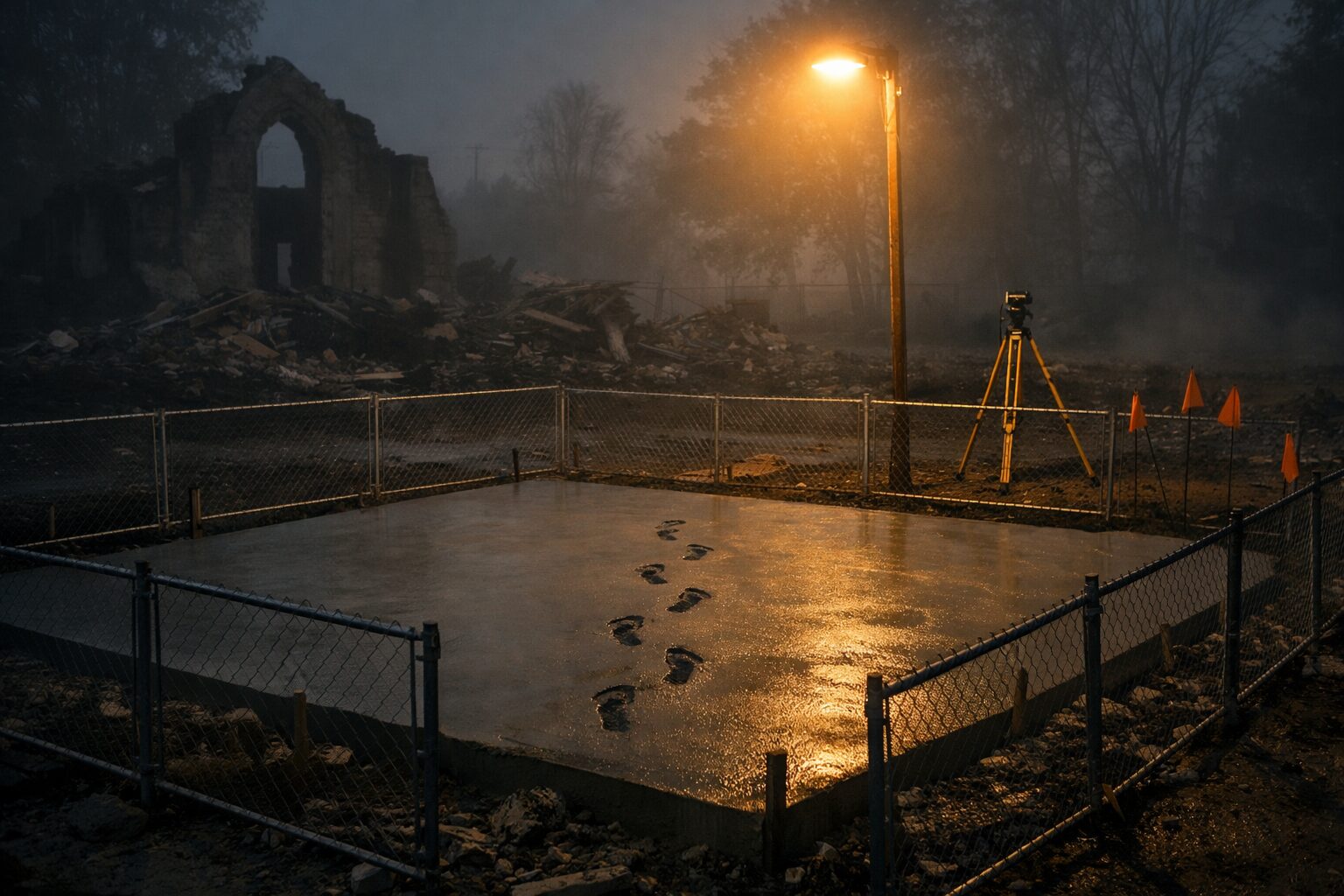
Week four, another Thursday. The pour was for a pad where a transformer would sit, a perfect square boxed with form boards, cross-screeded smooth and shining under the last of the daylight. We floated it until the surface looked like lake water and roped it off, left a web of caution tape, and posted the usual signs. There had been petty vandalism on other jobs, so Carl had the bright idea to let the concrete cure behind a folded fence panel locked to the corner posts. He told the guard at the gate to keep an eye and left a sodium light humming above the pad, its circle pale and leaving everything beyond it in a dim kind of suggestion. I took a last walk around, shot the corners, marked my stake distance on a fluorescent tag that glowed even in near-dark. I paused by the map in my bag. My thumb smudged the place where the church square nested perfectly under the pad. I told myself it was coincidence and I let the paper rest.
Morning laid a brittle frost over the gravel. When I parked, two trucks already idled, their exhausts making white ropes. Miguel stood inside the panel fence, hands on his hips, not touching anything. He looked at me and didn’t look down.
“Do you see that?” he said.
I stepped in beside him. There were footprints in the slab. Not across from an edge, not traceable to any place a person could have come from. The first print simply existed about three feet into the pad, as if someone had placed a foot there, not stepping down from anywhere. The toes showed clearly, the little ridge of concrete pushed ahead where they’d pressed. The arch had a slight inward roll, a flatness that made me think of cheap Sunday shoes taken off after a long hour and someone standing in their socks. The second print overlapped the first slightly, then three more, each lighter than the last, walking toward the exact middle of the square and then away from nothing. No edges scuffed, no bird prints, no scattered grit from a climb over the fence. The form boards bore no scratches. The caution tape still bowed as it had when we left it. The camera had not tripped for motion.
We circled it. I took photos because that is what you do when something is wrong on a job; you document. The images, later, looked like any image of marred concrete looks: a mistake, a repair job in the making. What they did not carry was the feeling we had standing around it, the feeling that those prints hadn’t pressed down into our work from above but had come up, as if the pad had simply chosen to remember that a foot had been there once, in that exact place, at that exact angle, and now the memory was showing through.
Carl swore under his breath for a long time and then said, “Nobody touches it.” He called the developer. He called the inspector. He called the fence company and told them to add another panel just because. The inspector squinted at the prints and tapped the form board with his pen and then asked about laborers. We all shrugged or shook our heads. He put the lid back on his pen and nodded once. Construction paused not for ghosts, because you don’t say that, but for “site control” and “surface integrity.” There was talk of grinding out the center in a square and patching. There was talk of pouring new. There was a silence where no talk fit at all.
That evening I stayed behind to tighten a few stakes that the day’s thaw had loosened. It was Thursday again. The sun thinned and slipped behind the old maple that had somehow survived every wave of this town’s making and unmaking. The sodium light came alive with its lazy gold. There was a moment, always, when the noise of work had fled and the noises of night had not taken courage yet. In that slit of quiet, the singing came back.
It began far but sounded close, like breath against your collar while someone speaks softly behind your shoulder. I leaned my hip into the fence and felt its chill. I looked through the diamonds in the wire at the pad and the prints, each still as a fossil. The voices rose, men and women together, no words I could pin to a lip. The tune was as it had been, only I could hear the inside of it now, the wobble where a tenor reached a little too far, the way someone’s alto bent to knit them together again. I don’t know music, not beyond children’s songs and the radio, but I knew the way that line pulled, and the way it made the space feel less like a lot and more like a room.
I took out my phone and hit record again even though we’d proven the point. The red circle smoldered at the bottom of the screen. The waveform traced wind. The voices did not arrive anywhere I could save them. They kept to the air. I hummed along without meaning to, a private thing, and my voice fed dutifully into the little rectangles on the screen. When I stopped humming, the air felt full of someone else’s breath for another half-second and then not.
I stood there until the song lifted into its last long note, the way a hand hovers open for a goodbye that will not quite be taken. I could have stepped forward then and put my boot heel in the center of the first print and marred it out of existence. I didn’t. I backed away instead and let the fence fill my view between me and the pad until the metal itself became pattern and then blur.
The developer put the job on hold officially the next morning under the reason of “design alteration in progress.” We took flags and stakes out of the wind and rolled up line like thread at a bedside. The map went back into my packet. I have, for what it’s worth, the urge to fold it in such a way that the little inked church square lines up again under the pad, but I do not do it. I set it flat and do not let the paper remember.
I’ve been told that churches used to hold choir practice on Thursday nights. It’s the sort of detail that makes the hair stand up only if you’re already thinking in that way. I wasn’t, not at first. Now, when Thursday comes around, I catch myself listening out my kitchen window to the ordinary sifting of cars on the roads, to dogs, to a neighbor calling her kid in from the sidewalk. Sometimes I hear nothing more than that and go to bed. Sometimes I hear something like a thread, tugging through space where nothing seems to be.
When I drive past the lot, the fence still draws its beige rectangles around the pad, the light still frames that circle that the moths enter and depart. The prints are there when there’s frost and there when the day is warm, their edges not softening as quickly as they should. If you stop your car, roll the window down, and let the engine idle, the air is the same air you’ve always known. If you step out and stand just so and say nothing, the evening may hold itself at the corners, and the sound may step in, and it may seem to come from the road, or from the hedgerow, or from directly above you. It may not come at all. If it does, I don’t know what you’ll hear in it. I don’t know what the pad will choose to remember next.