The Scratches Were Too High for Any Animal
I’d come for an easy weekend, the kind where you set up the small tent close enough to the water pump to hear it clack, then wander the trails until your legs feel hollow and the pine duff has found its way into your socks. This campground sits at the end of a blacktop that goes nowhere, just a loop of sites swallowed by mixed forest—hemlock, red maple, a few tired birch leaning over a low swale that cradles fog until almost noon. Paper schedules at the board by the entrance say quiet hours after ten, no firewood from outside counties, report bear activity to the host. The standard stuff.
That morning the sun came up as a pale disc, the air cool enough to sting teeth if you breathed too fast. I took the footpath behind the last numbered site, the one that loses itself under ferns and then finds itself again at an old fire road. It’s a place I know just well enough not to worry, only to watch my footing and mind the bramble. Deer had moved through in the night—the tracks were everywhere, the neat twin crescents pressed into the damp. I found raccoon hands by a rivulet, their fingers deciphering whatever had passed before them. A coyote had left a dull rope of scat threaded with mouse fur; it lay in the center of the road like a warning flag. One alder had snapped low where something heavy shouldered through; the clean break shone pale, sap gleaming.
It was the sort of morning that makes you feel polite in the woods, like you’ve arrived late to something already in motion. I took my time. The light had a glassy quality. Down in the ditch, mushrooms like little moons had burst along a rotting log. The wind pressed the hemlock boughs into a breathy hush. Somewhere far off a hammering woodpecker kept a steady rhythm.
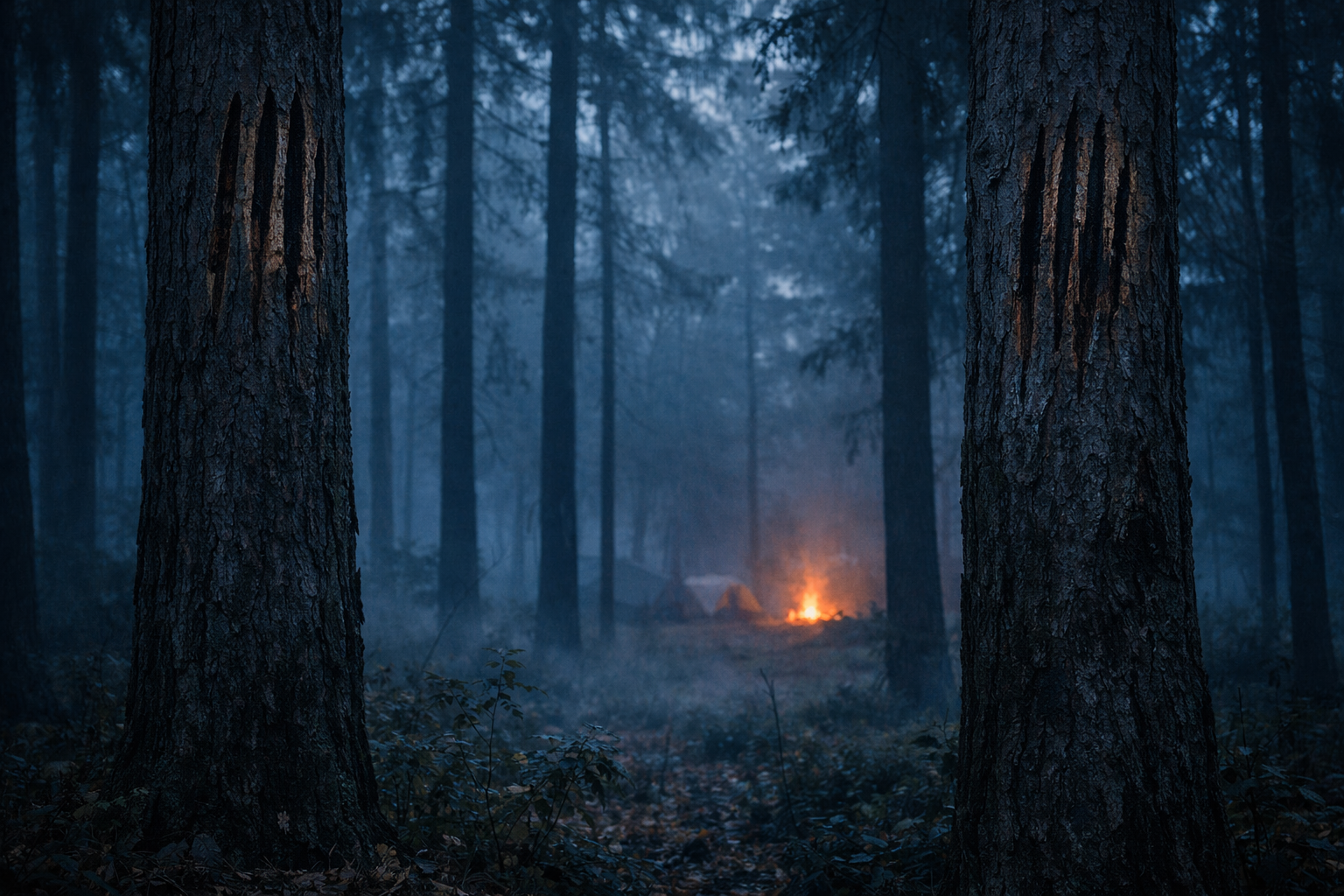
There’s a point where the fire road gives up pretending to be a road and becomes a corridor between trunks, a long aisle of white pine and straight ash that march up a gentle grade toward a rocky hump. I stepped into that aisle and stopped before my second foot found ground. A trunk stood to my right, and halfway up the bark—seven, maybe eight feet above the leaf litter—ran a vertical set of gouges. Four deep cuts, clean and parallel like fingers dragging down soft cake. Resin oozed fresh and amber. Beneath them, the bark had spat out in curls, bright as new rope.
I put my palm against the trunk and craned my neck. Too high. That was the first thought, simple as that. Bears scrape bark, I’ve seen the gentle ribbing they leave when they stand and pull. It’s messy, diagonal sometimes. Deer rut and rub, but always low, their antlers working in tight arcs against saplings until the cambium shines. This was neither. The spacing was unnervingly even, the depth a uniform bite. I looked for a fallen log beside the tree, some thing to climb from and reach. Nothing. The needles at the base had been kicked around by squirrels and wind, but not by boots or paws in any clear pattern.
I backed up to take a photo and caught the second trunk. Same gouges there, same height, a twin signature cut neatly into weathered gray. Another stood past it, and another—five in a row, close enough that your eyes could jump line to line without losing the thread. It was as if something had walked that aisle and, at precise intervals, reached out and marked its place in the world with the same untroubled hand. The resin on them all was still fat, sticky when I touched it. In one of the curls a thread of fine hair had snagged, light in color, almost translucent. It slipped away when I tried to pinch it and vanished against my skin.
I walked the length of those trees twice, looking for scuffed soil, some sign of a stepladder logic I could use. Nothing. Just needles, a few black drupes dropped by a dogwood, the tiny comets of squirrel droppings, a dry husk of cicada. The air in that aisle felt cooler than it ought to have been, and I told myself it was the shade pooling in the trench of it. I took more pictures than I needed and left, feeling like a person who has stepped somewhere that someone else considers a room.
Back at the loop, a family had crowded into the site beside mine. Weekenders. A kid in a red hoodie difficult not to trip over while they sorted coolers and milk crates. The father looked like he’d rather be anywhere other than coaxing fire from damp wood. I thought about whether to mention the marks or not. I didn’t. By late afternoon you could hear laughter at the shoreline, a couple of unsupervised canoes drifting too near the reeds. The smoke took on that sweet tang from sap and old pallets. The pump clacked. Normal camp life folded over the day.
After dark it got odd. At first it was only that everyone went quiet at once, as if a movie had paused. I could hear insects, the crickets working their saws in steady metronomes, but their rhythm fell into a thinness that made the spaces between their notes feel too long. Then, from the far side of the loop where the numbered sites peter out into scrub and a tangle of blackberry canes, came a sound that didn’t fit any animal I knew. It arrived as a question none of us had words for—flat at the start, then rounding up into a long, hollow shape that seemed to pour itself between the trunks and hang there, bell-like. It wasn’t coyote. Coyotes have that yip and skein of laughter they throw like Christmas lights up a slope. This was singular and unhurried, low enough to tick in my bones.
I heard one of the kids whisper Does a wolf do that? and an adult shushed them. The howling came again, exactly the same length, which I only noticed because I found myself counting, the way you might with a metronome. I stood, listening, and realized it wasn’t stationary. The sound moved—not closer or farther as far as loudness went, but along the tree line in an even, measured way, like a thing pacing the property line. A dog on a chain walks the end of its tether and leaves a raw crescent of beaten earth. That’s how the sound felt, drawing and redrawing an arc above the darkest part of the ground.
We all waited for the third call that animals never give when they’re wild—repetition without modification is a human habit. It came. The same hollow tube of a note. From the same arcing position. Then the smell hit. It wasn’t rot, it wasn’t skunk, it wasn’t the bitter of fox urine or the rank press of bear. It had a tin to it, a coin held too long in your fist, laid over with wet dog and a sourness I couldn’t place, like crushed milkweed. My eyes watered. The woman in the next site said, That’s not right, and scooped the kid into their canvas chair like she could put him into a bag. The father threw an extra log onto the fire, a gesture that sounded big to him, I guess, against whatever was practicing that patient loop.
Someone walked the gravel to the host site. A flashlight stammered into life. The host, a college kid with a jacket that looked too thin, explained something about no wolves being seen here this far west, only maybe a transient. We nodded because we wanted this to be small. If it ended there, it would have been a camp story for a friend’s porch. But the next morning, people were hunched over the brush at the tree line, pointing. That’s where the family’s cooler had sat, on a patch of mint and goldenrod. The stems had been crushed in a flat mat for the length of a pickup and wider than my outstretched arms. Not the messy settle of people feet. Clean, pressed, like someone had spread their weight with intent. In the dirt beyond I saw impressions I couldn’t settle into any single creature. They were long and leaf-like, with a sloping heel, no clear claws in this soil, and the stride between them made me glance back to the picnic table and decide not to fetch my tape. When I finally went to pace it out, I got nervous halfway and pretended to be counting something else.
I walked back to my aisle of trees. The resin had clouded on the first gouges. On the fourth trunk, a drop of sap trembled like a held breath in the groove, and I realized I was holding mine too. The morning was already warmer, the insects louder. I caught the tail of the smell again, lighter, drifting, and wondered whether it had clung to the needles from the night. Bees nosed at the sap. The ranks of trunks watched me in their slow, tree way. I told myself I’d be practical, note the GPS in my phone, tell someone. The phone blinked a bar of reception so thin it felt like a lie.
That evening I sat with my chair turned toward the ridge. The sun went down tired and gray. The ridge makes a kind of broken smile where the pines finally quit and low rock takes the pitch. The birds quit early, and what wind there was got stuck in the net of the branches above us. I kept expecting coyote to lift and scatter the quiet, but the quiet held, heavy as a blanket. The smell came before the sound this time, that coppery-sour seam sliding under the smoke and anchoring itself at the back of my tongue. Then there were the steps—where the ridge breaks, just upslope of the aisle of marked trees. Crisp, slow. Not in the leaves so much as on the stones, a hollow knock that made the noise of bone on rock. Four. Stop. Four again. Pacing not in a line but back and forth along a contour, like something deciding which side of the darkness it preferred.
By then everyone was watching the blackness they couldn’t see into. Someone’s lantern popped and flared too bright and got turned down. I stood. It was impulse and stupidity, both sharing my muscles. I walked to the edge where the road gives to fern and then to the aisle. The first tree with the scratches stood like a post. I could feel that open run of trunks pulling me forward. From the ridge came the long note. Not loud. Even softer than the night before, but because it was softer, it sounded closer. In it was space, like the hollow of an empty can. It slid down over the needles and hung level with my knees, then my waist, then somehow a little above me, though it hadn’t moved at all. There’s no language in me for that. Only the sensation of being measured, of being called to height.
I didn’t step into the aisle. I didn’t move at all beyond my breath thinning itself into something a rabbit might produce when it’s made shape out of surprise and decides to go still. The note ended where it had begun, and the footsteps continued—stone, stone, stone—in that patient metered way that is not how animals walk when they’re making and unmaking their minds. The stink swelled, the pennies-in-mouth taste of it, then dulled, receding like perfume in a room you leave. I backed up three steps and realized I had my hand raised in a shape like soothing a dog you don’t know. I don’t know how long I stood there after the last step, but I remember my knees aching in that exact, humiliating way you get when you’ve locked them for too many minutes.
The next day a truck with a state seal on the door bumped into the loop. Two rangers climbed out, both in uniforms too crisp for the dust, one older, one with a sunburn line across his forehead. Someone had called them the night before and asked for a look. They were polite, as if they already had a form in mind and were simply looking to fill it without overcomplicating their Saturday. The older one stepped into the aisle with his tape and his pen and did his work. He traced a finger down one of the grooves. Sap stuck and stretched like a filament when he pulled away. He looked up without moving his head, just his eyes. “How tall are you?” he asked me, maybe because I was closest. I told him. He stared at the gouges again. He didn’t write anything for a moment. Then he did.
They stood at the crushed patch at the tree line, bent over once, stood again. No scat nearby, no hair to bag. The younger one asked if anyone had brought in a dog. People with dogs raised their hands. He nodded like that explained the impressions and the smell and the note that had held the air like a bowl. The older one didn’t say anything at all about the sound. When the paper moved back to the truck he said to me, low enough not to carry, “We see bear rakes. These aren’t that.” Then he shrugged as if he’d just told me where the restrooms were.
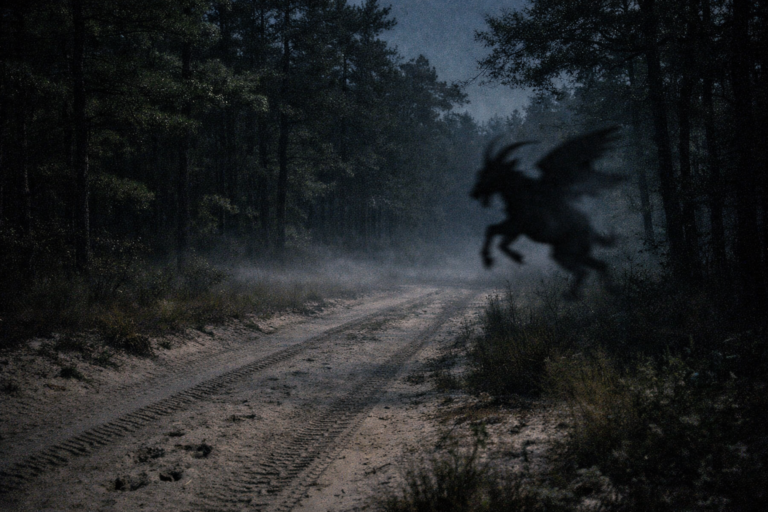
By afternoon the family beside me was packed. The kid’s red hoodie swung from a bungee on the back of their SUV like a soft-serve cone melting toward the bumper. I watched them leave and felt ridiculous for staying. One site over, a man with a line of old fishing stickers on his cooler told me he grew up two towns over and that this ridge had a thing that showed itself to hunters once in a while. “You hear it, mostly,” he said, flipping the cooler latch with a finger. He wouldn’t say more than that. A woman walking a small terrier wouldn’t take the dog beyond the gravel. She said her grandfather used to tell stories about hearing the “church bell wolf” up in the state game lands in the seventies when there were no wolves left to hear. Another couple claimed a thing with legs too long had crossed the fire road ahead of their bikes last fall and taken the ditch in one step. They all said it like you say a child’s name you’re not sure you’re allowed to speak aloud in public—soft, quick, embarrassed about the shape of it.
Before I left I went back once more to the aisle. The gouges had darkened, resin clotted and ambered. A bluebottle fly traced a sticky path and argued with itself. Pine shade pooled like cool water. I held my hand above my head toward the marks and felt small in a way that had nothing to do with height. The wind moved in the crowns and didn’t come down. I waited for some final note to tie a bow on it, some animal logic to settle over the last two nights like a blanket. Only the faint smell remained, tucked into the bark itself, something penny-bright and wrong. I turned and walked out between the trunks and did not look back until I was on gravel again. When I did, nothing had stepped forward. The trees stood where I’d left them, inscrutable, marked.
I told myself that if I returned in a month, the sap would be hard and dull, the undergrowth risen to erase that mat in the brush, the impressions filled in by rain. Maybe the next time the sound would be an owl I’d missed, a coyote with a sore throat. Maybe the ranger would have a word for it he hadn’t had that day. I drove out slow, past the board with its quiet hours and its bear warnings, the blacktop unspooling between trunks that kept their own counsel. At the last turn, where the trees thin and the sky looks wider than it is, a long, thin note trailed the car like a thread I could choose to pick up or not, and when the air slipped through the vents it carried the memory of something I do not have a drawer for. The scratches, if anyone asks, were too high for any animal I know. Which is not the same as saying there was nothing there to make them.