The Lantern Festival That Counted One Extra Guest
I was at the river before the heat came up, with the insects still too sleepy to rasp, when we unpacked the thin wooden frames and folded washi shades. The community hall sits a short walk from the water, and that morning the hall smelled like starch and old tatami and the faint glue of pastings gone dry. We had two long tables set outside under a blue tarp, a coil of nylon rope for guiding, and four cartons of battery tea lights. When the others arrived—Mrs. Ito with her calligraphy pens, Riku with the clicker in his pocket—there was the soft rhythm I loved: cotton gloves tugged on, brush caps snapping, the careful work of turning names into light.
We were not a city festival, nothing with loudspeakers and food stalls. Ours was intimate, mostly families from the neighborhood who came to let their lanterns go and watch them turn the river soft and gentle for an hour. Each lantern had a square of washi on which Mrs. Ito painted the name a family had written on the sign-up sheet: sometimes just a surname, sometimes a full name followed by the year, occasionally a pet name that made her smile a little before she brushed the characters. She let the ink lay wide and dark. I handed lanterns down the line for assembly, letter by letter. Dragonflies traced low arcs out over the water and the sky held the flat white of a day with no attention for drama.
The list had been printed the night before. I kept it on a board with a little cord looped through so the paper wouldn’t take the damp. I had numbered names in pencil along the margin, a habit from school committee days that always felt needlessly serious, except it made the evening simpler. When Matsuda brought the LED lights from the storage room and we tested their little gold glows under the tarp, he said the current felt lower this year, and I glanced at the high-water lines on the concrete steps left by last autumn’s typhoon and hoped he was right. We stuck thin stickers on the underside of each lantern base with the registration number, made sure the guiding line had no knots, and stacked the finished pieces on plastic crates until they were columns of quiet breath—the faintest movement showing how easily current can make anything sway.
By late afternoon the air thickened and cicadas found their pitch. Children ran the bank in soft-soled shoes, their voices never quite breaking the surface of the water noise. People arrived steadily: older men in linen hats, women in cotton dresses and sandals, a few kids in bright yukata hand-me-downs. At our table I checked off names. I greeted the ones I knew, helped explain the order of things to the ones I didn’t. Riku stationed himself by the footbridge with the clicker, the silver kind you hide in your palm, and made a mark for every person who crossed to our side. The bridge gave a gentle tang to each footstep, so you felt the counting in your body more than heard it.
It was not until the line thinned and the shade stretched long that the first wrongness made itself neat and small. I had reached the last page of names, empty boxes down to the corner, when Riku walked over and held up the clicker like a quiz he wanted me to check. “One thirty-eight,” he said. I looked down at my list. One thirty-seven. Every name was ticked, every correction we’d made—a canceled family, a late addition—was there. “Maybe I pressed it twice,” he said, a shrug that was honest because we’re not machines. He pressed once more deliberately, then pressed again to bring it back down. But it stayed in my bones as if the river had found a cold seam and sent it through the ground. There were the same number of lanterns we’d prepared. There was one extra press of a thumb that suggested one extra shadow among us.
We busied ourselves with stray details. The evening was good for that. I set the guiding line along the shore with little stones so no one would trip, mats were unfurled on the steps for people to kneel on. The light slipped sideways and made the water into a brushed metal film except where it caught weeds, where it broke into small knotted shines. People took photos under the tarp—close snaps of the ink drying, wide shots of the river opening beyond. I took a few too with my phone, just to have something to send to the city page if they asked, a casual shot across the line of waiting boxes, and another by the upstream bend where the bank ran wild with reeds.
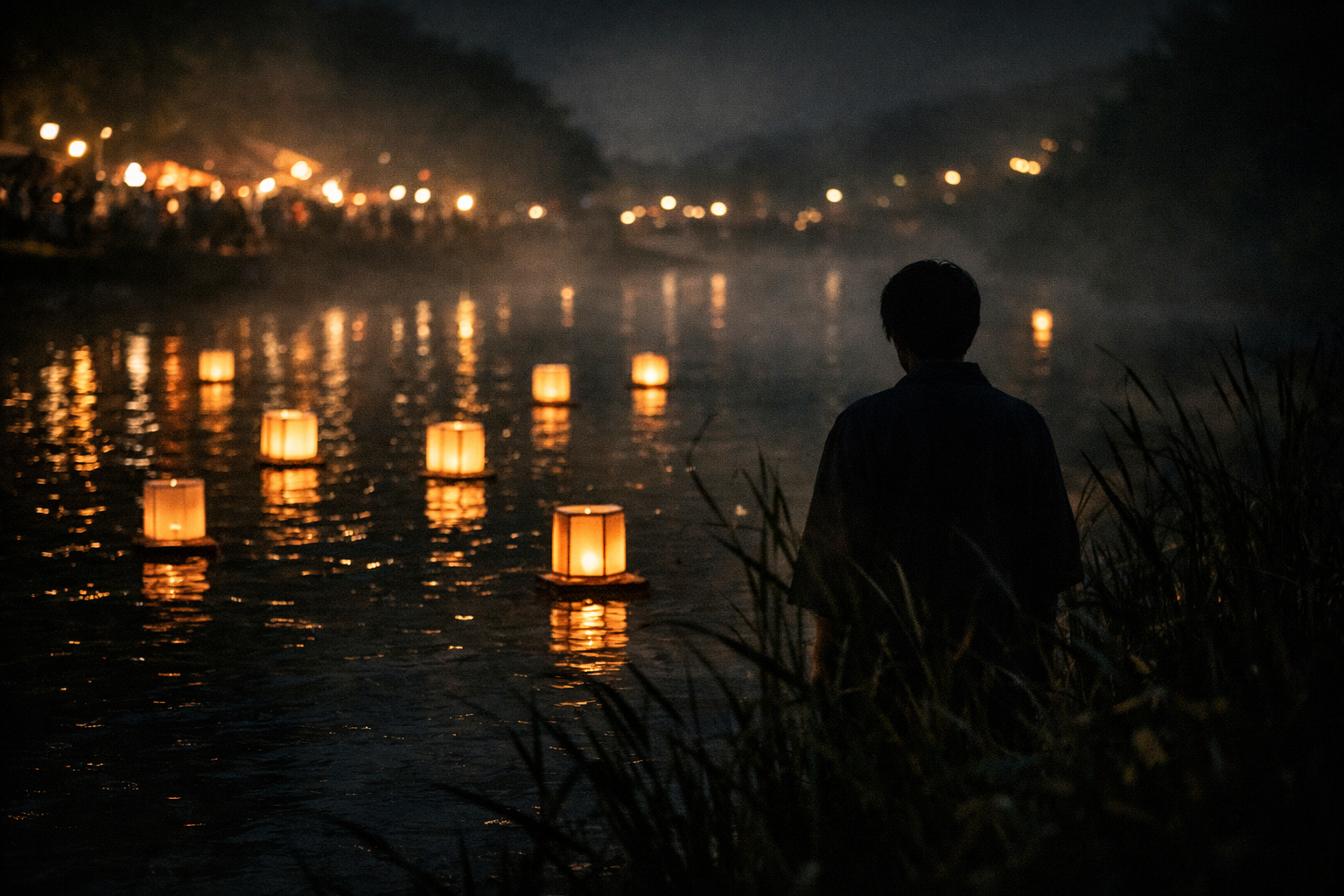
In my second photo, taken because the reflection on the surface made a stripe the color of wet copper, there was a figure near the waterline, two or three meters beyond where our rope said stop. The person was turned away, shoulders slight in a simple jacket, hands at their sides. Far enough to be a person like any other—not even an offense, just someone who wanted to step nearer than most—but near enough that I should have called out a polite reminder. I didn’t then. You tell yourself you didn’t because they looked settled, like they had reason, like an older man who has brought his memory to the very lip of it and doesn’t want to be told rules.
As the last families arrived, more photos came through our group chat. Mina, who teaches at the junior high, had brought her old DSLR and a nervous eye for low light, and she sent three pictures in quick succession to the volunteers’ thread: one from the downstream side showing the bridge girders going red in the sinking sun; one from far back under the tarp with a lens flare that made the tea lights look lit already; and one, a long shot taken on her way back to the table, of the bank with the rope line and the light just thinking about going blue. In that third one there was someone on the rocks near the deep section, back turned and head tipped as if listening for something at the surface. A few seconds later, Riku, who had snuck to the opposite bank to catch a wide angle from the road, posted his: the same river, same time stamp—down to the minute—but now that person appeared much farther upstream than Mina’s long shot, still facing the water. It could have been two different people, but the shape of the shoulders, the narrow waist, the way the elbows hung too straight—it turned on that thin hinge that makes coincidence feel like you’ve misheard a simple word.
We set the lanterns in two rows on the lowest steps, each on the stickered base, each dimmed tea light tucked inside. The plan, always the same so no one jostled, was to light the first few, lower them to the water gently, and let the rope draw them like syllables being spoken, our group of volunteers guiding them into the slow-slip midstream. Names would be read as they went. Matsuda’s voice for it was good, a way of making every name quiet without dressing it in sorrow. I checked the rows one last time. Between my “35” and my “36” someone had slid a lantern that wore no sticker. Its washi was blank, no ink, no faint imprint of erased characters where someone had changed their mind. I ran a finger under the base to check for a misplaced label and felt the bare wood. “Spare?” I asked, though we didn’t usually bring extras. “Maybe,” Matsuda said, counting with his eyes. “Put it at the end.” I set it to the side, away from the others, until I could puzzle it with the list and find where I’d made a small clerical sin.
Before we’d even called the first three families forward, the blank lantern moved. Wind had been all but absent; the tarp barely worried its own corners. Yet there it was, taking a small, unsteady slide over the slick of the step as if a hand unseen under the surface had caught the corner and wanted only to know its weight. I reached out to catch it. The base tapped my knuckles and then slipped away, straightening as if someone had turned it square to the current, and edged down into the river without the stumble and re-catch that means it will spin in place. I took a step in and stopped when the river wrapped ankles cool around my rolled trousers. The little box found the line where the pull was sure and it glided there, a breath quicker than anything else had glided that whole evening—no lights on, no name to answer when Matsuda looked at me, eyebrows lifting a question from across the steps. I watched it go. It passed the place our rope suggested, heading for the darker gleam midstream. Farther down, the shape I’d seen in my photo stood by the reeds, a darker impression against the darker water, not turning, not moving, as the box made its way toward whatever lay in the angle of those shoulders.
We were too busy after to stop for chills. Names were read. Lanterns were set. The river took them, made them plural, drew everyone into the habit of quiet that the ceremony asks. I spoke to a woman who’d brought her mother’s comb tied inside the lantern like a small anchor. I walked the bank and righted a lantern that had turned on its side. I let words like rope and knot and gentle take up the space where questions would only make noise. Still, when I looked from the bridge downstream, I saw a figure on the low stones near the outflow, back to me, watching nothing anyone else could see. When I turned and stood by the tarp poles, I saw what might have been the same person twenty meters upriver, shoulders set just the same. They were never turned even a fraction. If a child squealed and pointed, a parent put a hand on their head without knowing why.
After we packed cables and gathered the stray lanterns that had beached in the shallows, a few of us went back to the hall to drink sports drinks and sit on the cool floor. In our chat, photos bloomed like extra lanterns over and over on the screen. People praised Mina’s long exposures. Matsuda sent one by the downstream bend. I sent my copper-striped water shot almost as a joke. In them, again and again, there stood the lone figure near the water. Ten minutes apart, fifteen minutes, sometimes in the same minute from angles that could not be walked in time—from the road and from the steps—always the back turned, always a space between them and the rest of us. Mina joked about a ghost before she erased the message and replaced it with a little embarrassed face. Riku said his clicker still read one thirty-eight even though he’d made it behave earlier. “Dumb thing,” he wrote. I tapped my thumb hard against the table until the sting felt like something I could locate and name.
The next morning, I printed several of the best photos at the convenience store and brought them to the hall to clip on the corkboard by the door, the way we do after any festival so people who hadn’t come could see. The fluorescent lights hummed their winter sound even in summer. I laid the prints out on the folding table to sort by view: upstream, downstream, close-up of hands on lanterns. Something tightened in the way you notice your teeth are clenched without knowing when you decided to hold them so. In the one from my phone, the strip of water looked like polished steel. There was the place where the figure should have stood—just water, dim and simple, the stone they’d been near a little darker than the rest but no shape that could be called a person. In Mina’s two, dots of lantern light began gathering. The spots where the person had been were clear. If I squinted until my eyes watered, I could convince myself of a suggestion of a shoulder, but it was just the wish that a picture would tell the truth it told you last night on a tiny bright screen.
I tried not to be the kind of person who stands long in an empty room listening to the hum. I pinned them up anyway. When I stepped back, the board looked as it always looked after summer evenings like ours—soft and gentle and already beginning to go away. I thought of the blank lantern leaving without a name to be called, how it had moved on a surface that refused every other nudge we gave it until the word was read, and found my hands going still in my lap in the way of someone not wishing to invite anything to notice them.
At dusk, I went back because someone had left the paper cutter out. The door glass looked onto the river; at this hour the water kept only the last blue of the day. I put the cutter in the closet and then I took out my phone to snap a quick picture of the corkboard for the group chat, to show the display and be done. The camera opened in selfie mode by mistake, and the black glass of the screen held me pale in the humming light. Over my shoulder, beyond the ghosts of the hall reflected in the door, the river was a band of charcoal. In that reflection, small and far but undoubtable, someone stood at the edge of the water with their back to me, their back to everything, as still as stone and as thin as a mistake. I lowered the phone; through the glass, there was nothing but the sheen of slow water. I raised it again and lined the phone so the reflection of the corkboard filled the screen. In the glossy gloss of the prints I had pinned—the same prints where the person did not exist—there they were, a darker mark by the reeds, not any brighter or clearer than they had been in our pictures, only there again, patient as if all they had ever done was stand and wait for reflection to make room. I didn’t take the photo. It felt as if that would make something settle that preferred to stay just possible. Outside, a shape of current shifted and then was water again. I locked the phone without turning it around, and the last thing the screen returned was my own face blurred into evening, beside the river that counted one more of us than we had written down.