
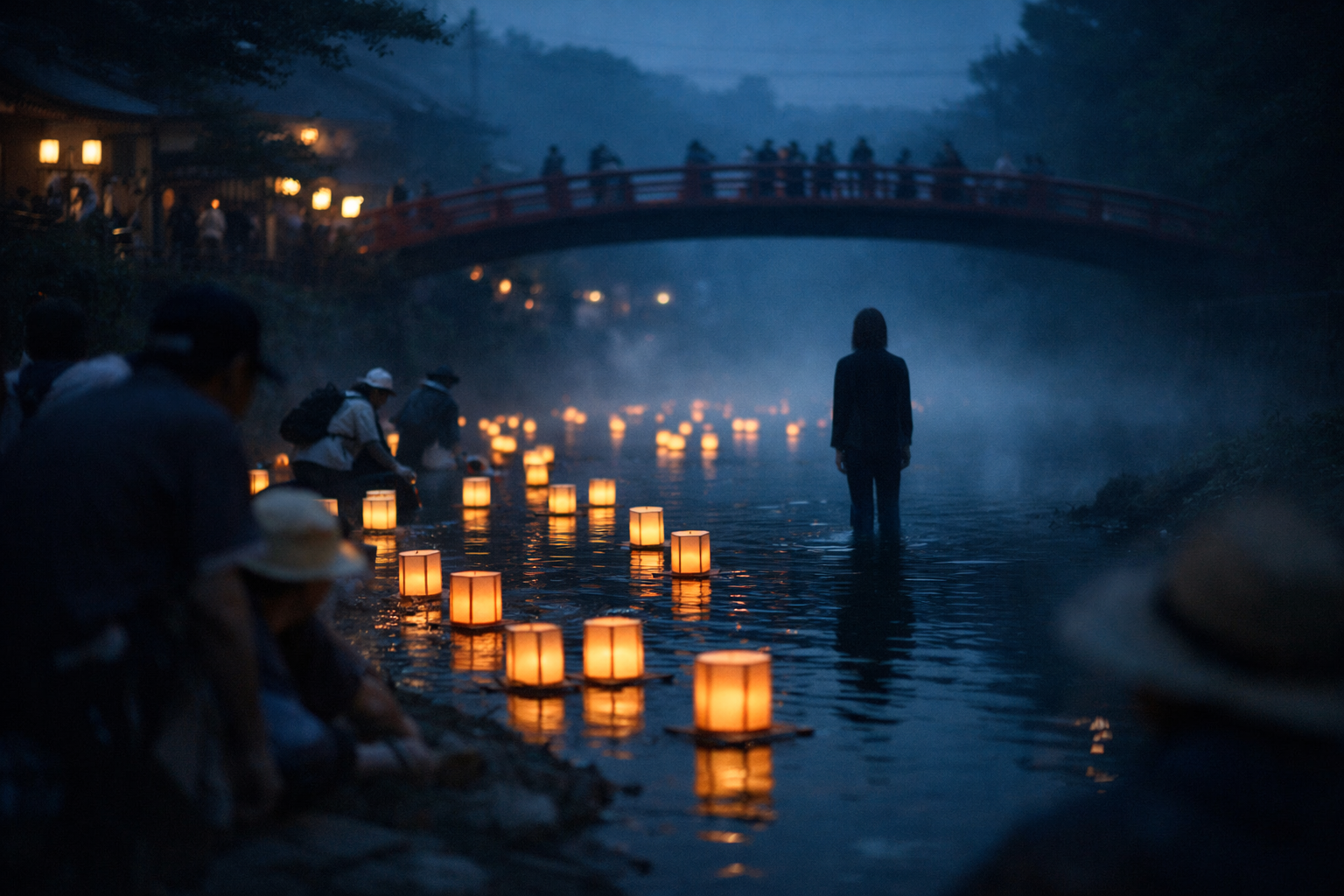
The Lantern Festival That Counted One Extra Guest
We started early, while the river still looked like hammered tin under the morning haze. The community center smelled of old straw mats and dish soap, and our shoes waited in a muddled line at the entrance. I was on lantern duty this year—writing names, folding the washi around the bamboo frames, pinching metal clips closed until my fingertips were tired of the motion. The others drifted around me in a quiet choreography: two men splicing extensions out to the floodlights, a trio of grandmothers gluing the last of the paper panels while gossip thinned to murmurs. Someone set out a tray of barley tea with sweating cups that left rings on the table.
The boxes of tealights were stacked like medical gauze, and the coils of insect repellent smoldered sweet and green in tin ashtrays on the windowsill. We had sixty-two registrations printed and taped to the wall by the time the sun tilted toward late afternoon. Each name, carefully brushed in black ink, would be a small square of light. I made a ritual of it: unfold, write, fold, tie. The spare ones we left blank but marked with a pencil dot on the underside of the frame, so we could find them in a hurry if a late name came.
By three I walked to the river to lay down tarps along the stone steps. The current was low, the water only whispering against the weed-studded rocks. Sun caught on beer-colored eddies that curled out from the pilings of the little red footbridge. Downstream, the bank sagged into reeds and debris, the place where kids usually caught crayfish. On the opposite side, thin apartment balconies hung like flags.
We always keep it small. The lanterns drift in a simple curve, and then they disappear behind the bend where the old plant used to be. There’s a rhythm to it that belongs to the town more than to anyone’s hands: line up, light, release. In the heat the air slows, and voices fall into that earlier century softness where people naturally step aside for one another. I like it best during that hour when nothing has started and members of the committee are simply busy. We nod, not speaking. We accept tape from a palm and press it into place; we twirl twine between the fingers and measure lengths without rulers.
Just before dusk we ran the register table. People approached in twos and threes, bowing, handing cash, correcting spellings. “My aunt used to come,” one woman told me. “Can I…? She passed in March.” We had extras. We always had extras. I wrote her aunt’s name carefully and handed the folded packet to a boy with silver hair clips who was ferrying them down to the steps.
As the line thinned, I did a final count. I like to check a list against a real face; it’s a habit from my old office job. I tallied the sheets and the boxes of paper, and I counted the people clustering near the rope we’d strung across the top of the steps. Names and faces don’t always match in my head, but numbers do. There were sixty-two written down. There were sixty-three standing there.
I counted again. I traced the names with my finger; none of the strokes looked doubled. The sheet with the long column of family names was complete and smudged where it always smudged—near the ornament of a rare character that made people lean and point—so I knew it hadn’t skipped. I looked up. The top of the stone steps was cleanly lit by a golden edge of sunlight, catching on a metal watchband here, a hairpin there, the silvered caps of two canes. People drifted back and forth to the vending machine. Everyone was ordinary, everyone a little hot. No one was missing, and yet one of them didn’t belong to the paper in my hands.
“Maybe someone came with a neighbor,” Mr. Sato said when I told him, flicking a mosquito off his sleeve without looking. “It happens.” He didn’t write anything down. He went back to tying the lanterns to their slender tethers so they wouldn’t jump the bank too early.
We had a group chat for the festival. It wasn’t official, but since the pandemic years everyone had gotten used to sending each other snaps of the preparations so those who couldn’t attend could still see. At first, the pictures were what you’d expect: a soft blur of hands loading lanterns, the river gray and harmless in the background, the cardboard tray of scissors and tape. Then someone sent a wider shot from the footbridge, and I saw a figure standing at the far end of the stones, near where the reeds start. Not near the crowd. Near the water. The figure faced the river—turned entirely away, shoulders a dark, narrow slope.
I held my phone closer. The figure wore something that was either a coat that didn’t fit the season or a long shirt that had darkened to the same color as the waterline. The hair, if that was hair, was short enough not to be moved by the faint breeze that made everyone else’s sleeves stir. There was nothing to say who it was. The angle, the distance—everything kept the figure pointed into the river.
Another picture pinged into the chat, a different angle taken from near the vending machines under the poplar tree. It had been taken seconds earlier, if the timestamp was to be believed. In this one, the figure was closer to the middle steps, still standing back and a little to one side, the same turned posture, the same exhausted, patient line of a back. I toggled between the two. The light on the water and on the rail told me the pictures really were the same moment—and yet the figure had shifted places enough that you couldn’t say it was just a trick of distance.
“Is that your cousin?” I asked the high school volunteer sorting extra batteries. He didn’t bother to glance up from his neat square stacks. “Which?”
“Never mind,” I said, and told myself what a person tells themselves in those blank places between explanations. Two similar clothes. A reflection I was reading wrong. I was switched into numbers, not faces; maybe I’d bent connections that were never there. The chat kept its river of dings. In one photo, the figure had stepped nearer the bulge of concrete under the footbridge’s shadow. In another, it stood where the current pulled tight toward the middle, turned away so completely the neck wasn’t even a silhouette—just a continuation of dark fabric and darker water.
Further down the steps, a few children practiced letting a lantern go and catching it again with the string. We hissed at them, and they scuffed away, shame written in the small motions of their sneakers. I knelt to attach name tags to their assigned frames. Our spares sat lined up beneath the bench in a careful, empty little company. One of the blank ones, the pencil-dot kind, had gotten its frame scuffed; I set it closer to me so we could keep an eye on that weaker joint. The last of the sun slid down and left a violet stripe along the river. Midsummer air collected under the bridges in a damp bowl. Sound traveled differently then, softer, as if it were half-absorbed by everything it touched.
“Let’s light one, just to check,” Mr. Sato said, and I nodded. He clicked a lighter, then shielded the tiny flame with his palm until it caught the low wick. The lantern brightened with small confidence. Our priest had not yet arrived. No one had been called forward. Names still rested in their paper sleeves. The rope across the top step remained in place. We had not, in any formal sense, begun.
I was bending to fix a tag when the lantern with the pencil-dot—marked for no one, with no name on its white sides—shifted. It was as if someone had pulled it gently by its string, except the string lay in a harmless coil where I’d set it down. The lantern tipped, then righted itself as it slid. The rims of its base made a wet squeak on the stone. Before my hand got there, it had slipped like a careful animal over the last lip and into the water.
It did not wobble much. It did not take water. It moved as if it had known the route for years. A murmur passed through the group nearest the rope; somebody, a grandfather by his voice, said something too soft to catch, then crossed his hands and looked down. A girl with pink sandals stepped as if to follow, but her mother caught her shoulder, and they both watched while the unclaimed light steadied itself in the pull of the river.
I looked up the line to our tethers. None were loose. Mr. Sato made a small face like a man remembering a chore. I waded one boot into the water and reached with the hook pole, but the lantern kept just out of range with an obedient distance that made the hair on my arm lift. By the time the priest arrived, it had gone to the slight bend where the reeds make a selvage, and then past it, toward the reach where you can’t stand and watch without craning your head around the bridge rail.
We put it aside with a shrug because there were things to be said and things to do. The rope was unhooked, and the priest murmured as if into his own hands. Names were called, candles lit. We touched flame to wick and squinted with the smoke. I handed out paper to people I recognized but didn’t know. The lanterns took to the water in an even, stubborn line. The extra count didn’t change. The figure by the river stayed part of that other conversation my mind was having while my mouth said the right festival words.
Later, after the last of us had tilted the final drips from the tarps and the floodlights buzzed their neon-insect whine, I walked the few meters to the footbridge and looked down. There were only weeds and the leaning reflections of the apartment balconies. My phone gone hot in my pocket chimed and chimed. In one of the new photos, taken by someone downshore near the plant, the lantern with the blank panels had traveled well ahead, its square of light snagged for a polite second on a root and then released. The lanterns with names made a braided tail behind it. On the near bank, at the very crease between lampglow and the wet dark of after, the figure had reappeared—still facing the river. It was close enough that single reeds stood out against its legs. In the next frame, by someone standing in almost the same spot, the figure was a smudge under the bridge instead. The time said they were taken in the same minute.
When I tried to pick the person out of the crowd, my eye kept catching on people who were turned to speak to someone else, or bending to tie a child’s shoe, or attending to a candle guttering at the edge of its base. When someone faces away, you don’t call to them. You look and you accept that their attention is on something other than you. I told myself that was all this was.
At home, just after ten, I put the kettle on and let my phone drain its last few percent over the sink light. The house smelled faintly of river water and tea and the inside of cardboard boxes. I scrolled through the day. In one picture, the figure was nearly lost to a flare of reflection—only a blacker piece of black where the water reared up against the stones. In another, taken by a boy who liked to shoot everything very low, the figure was cut at the waist, feet just breaking into the bright smears of the lanterns’ wakes. Every time, the shoulders were turned away, as if politely ignoring whatever was happening behind them.
In the morning, I took a handful of the clearest photos to the convenience store to print for the committee board. The machine hum felt louder than usual. I loaded my images and watched them slide out with their little clinks into the tray. The pictures were clean, sharp, well-contrasted. The river had that pewter sheen I love, and the paper carried it perfectly. The lanterns glowed in their squares, halos crisp. On the steps, you could see the smudge of someone’s knee where they’d knelt too long, a squashed bug on the concrete I hadn’t noticed yesterday. But in the places where I expected the figure—by the reeds, under the bridge’s lip, by the slab with the rusted ring—the bank was empty. The water was only water.
I tapped the machine’s screen and ordered the same ones again, thinking of some setting I had failed to notice. Prints repeated the absence neatly. I held the paper next to my phone, matching angles. On the screen, the figure stood there, slender, turned away. On the paper, the spot was innocent rock and ripples. The clerk at the counter glanced my way as if checking whether I’d finished. I slid the photos into an envelope and walked back out into the late heat, the cicadas a broad metallic whirr at ear height.
At lunch, I set the prints in rows across my table to make sense of them—river, bridge, reeds, rope, steps. My phone lay glass-down beside the neat columns, screen dark with smears of my fingers. I moved a print, then another, then leaned to align two almost-identical angles so one overlapped the other. My arm brushed the phone, and it woke with a dim gray of itself. The black glass showed the barest reflection of my ceiling light and the squares of white paper, angled like little roofs.
I shifted a photo so I could see its whole bottom edge. In the soft reflection on the phone’s screen, where the print’s lower margin mirrored against the glass, a small human shape stood against the trick of water and stone. It was placed exactly at the river’s bend where the pencil-dot lantern had slipped away. The reflection caught the figure perfectly—a back, a slope of shoulder, the ragged line where fabric met water—and yet when I lifted the print, tilting it so angle and light should have pulled that piece of picture into view on the paper itself, there was only a dull gleam of sun on the river.
I set the print down. The reflection shifted, and for a second the figure seemed a few steps to the left, tucked just under a shadow, as if the small current of my movement had tugged it. My hand left a damp crescent on the table from my tea cup. Outside, a delivery driver rolled by without hurrying. I did not take a picture of the reflection. I let the phone’s screen go black again and, for a moment that lengthened and lengthened, listened to the absence of anything at all.


