Footsteps in the Hall When No One Was Home
The first night I told myself I would enjoy the quiet. The house is familiar in the way an old coat is familiar—worn in certain places, your hands know where the pockets are without looking. My parents had driven out of state to help my aunt after her hip surgery, and my sister went with them, which meant I had several nights to myself. Just me and the low, clean hum of a refrigerator that has outlived three kitchen renovations. I turned off the porch light, made sure the deadbolt caught, and went through the house the way you do when the rest of the family is gone, clicking off lamps, touching doorframes, listening to the central air sigh alive and then fall still. Our street is a cul-de-sac lined with matching driveways and good grass. At night the sound drops out of everything, leaving only what a house can make on its own.
I settled in the room I used to sleep in when I came home from college. The lamp beside the bed still wore the shade I dented years ago. Through the blinds, the streetlamp drew a thin ladder of light across the wall. I read for a while, flipped to my phone, then blinked the screen dark around midnight. The air conditioner kicked once, and then the house wrote its quiet sentence of after-midnight: ice loosening in the freezer, the faint tick of cooling ducts, a car far off on the county road that doesn’t come down our way.
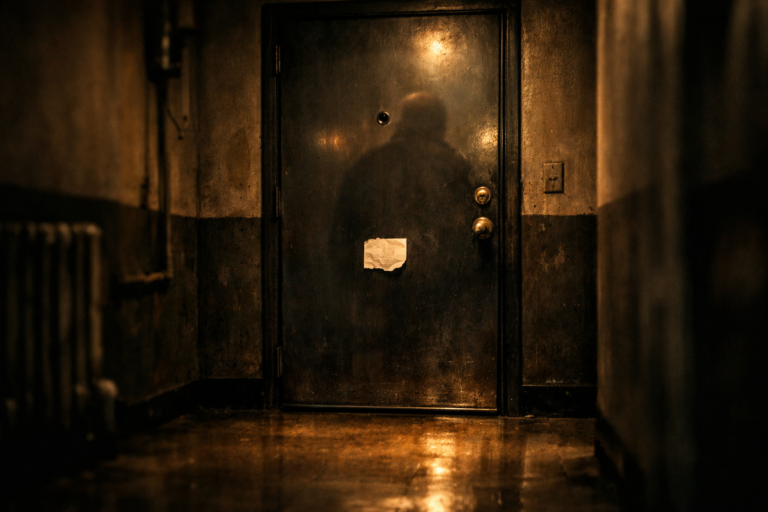
At 12:19, measured by the pale green clock on the dresser that has been five minutes fast my whole life, I heard footsteps in the hall. Not the random shuffle of settling wood. Not the pluck and sigh of a board expanding back to place. Footfalls—slow, even, crossing from the far end of the hallway where the guest bath is toward my door. Seven steps? Eight? I held my breath after five because the count did not matter; the pace did. Heel and then weight. A soft complaint from the runner by the linen closet. They stopped outside my door. The silence that followed had a shape to it, like someone considering the knob from the other side. I lay there too long before I swallowed and told myself it had been the house settling in a voice I hadn’t heard before. I made a note of the time because it felt like something that would make it smaller if I could write it down later.
In the morning I went back into the easy, helpful brightness of day and forgot it by half. I watered the two plants my mother worries over, I brought the rolling trash bin to the curb earlier than necessary, I ran a load of laundry for the sake of motion. But the house keeps its evenings. By nine I had made tea and rinsed the cup for no reason. I put a nightlight in the hall the way you might in a place you don’t know, even though I know where the baseboard nicks my ankle and which picture frame clicks when you tap its glass. At 12:19, I was awake and waiting without admitting that I was. The first three steps sounded exactly the same as the night before. The pause halfway where the hallway widens by the thermostat. The last two, precise, deliberate, and then the stop at my door, as if the door had a gravity I had never thought about until then.
I slid my feet to the rug and felt the old grain through the pile. The carpet runner in the hall has always had a ripple near the linen closet; it was there when my parents bought it at a discount and carried it in with laughing at themselves. You can trip on it if you aren’t careful. I put my hand to the door and felt nothing, not even the faintest draft. I pressed my ear to it. No breath, no cloth brushing wood, only the big listening hush of a house in the middle of the night, the kind of quiet that almost has a sound of its own if you pay attention to it too long. When I stepped back, the board under my heel clicked, and I flinched at my own noise. The hallway waited. It waited the way a person does when they get the feeling they’re being listened to from the other side. Then it was gone. Not footsteps away—just a lessening, like a thought dissolving.
By the third night, it had a schedule and a gait. I had stopped pretending I might not be awake at 12:19. I left my phone unlocked on the pillow with the time glowing to a digital beat that didn’t belong to anything in the room. I tried the trick of leaving the door slightly open, a breath of space where the latch would not click. The nightlight put down a puddle at the baseboard; the rest of the hallway went soft with it. The steps came as if cued. From the bathroom end, past the bedrooms, through the hour. Even through the small gap, I could see the pale runner and the legs of the hall table under the mirror. I thought I would see a shadow pass, the cast of something interrupting the light. There was nothing. The sound stopped at the same board just outside my room. The pause felt expectant and heavy. I watched the slit of light for movement and earned none. My hand closed around the knob without meaning to, skin remembering the shape of it.
I had a plan, in the dumb way you make plans about the unknown by adjusting the only things you can touch. I would open the door immediately, not after a breath or a question or any gathering of courage—the second the last step pressed the wood outside I would turn and pull. If it was a trick of the house, reality would rush in the way it always does when you open a door quickly and find a vacuum of ordinary there. If it wasn’t, I didn’t put words on the alternative. I watched the time reach 12:18 and do its quiet twist to 12:19. The first step came. The hallway, which in daylight is nothing but family pictures and an old thermostat, became a channel. When the weight settled on the board outside my door, I turned the knob and pulled with the same movement as drawing breath.
The hallway was empty from the front bedroom to the little table under the mirror that has a bowl for keys and a notepad with the emergency vet’s number written twice. The air was same-temperature as the room. The nightlight threw down its small circle, and the family photos peered at me unhelpful and benign. But the floor still moved. A run of soft, spaced creaks, not loud but unmistakable, like pressure easing up in slow, invisible increments—one near my feet, then near the linen closet, then the wider place by the thermostat. The sequence had the rhythm of retreat without any steps to carry it. I stood with my hand on the knob and felt the answer of the wood through my legs, like a memory moving underfoot, unsnapping without weight. When the last one sighed free somewhere near the bathroom, the house held its breath with me.
I did the rounds you do to make sanity out of a pattern. I checked locks again, I looked at the windows for any coaxed-open latch, even though the screens had their dust undisturbed in the corners. I listened by the attic hatch for any small creature, though I thought of the way small creatures sound, the scurry and the lightweight thrill of it, and I knew this wasn’t that. I placed a pair of shoes side by side outside my door before I went to sleep, as if placing anything real in the way of whatever I was hearing would name it. In the morning, the shoes were untouched. In the afternoon, I decided I would not tell anyone because saying it aloud felt like inviting it back.
That night the steps came the same, like the house wearing the same hour again. I surprised myself by saying Hello, in the politest voice I have ever used at a closed door. The hush ate the word. I opened the door slower this time, and in the stillness could hear the tiny crackle of photos on the wall adjusting to some temperature only they were aware of. The empty hall waited as if I’d interrupted something in it. I slept after that with the lamp on, and woke to the stupid, unstoppable fact that morning turns night into a trick even when you know it wasn’t.
On the last night I was meant to stay alone, my mother called after dinner to ask about the plants and the mail. I told her I was fine, which was both true and not. I told her—because the telling pressed against my teeth until it got out—that I’d been hearing footsteps in the hall late, around twelve-twenty. I made it sound lighter than it felt. There was a pause long enough for me to think the call had dropped. Then she said, in a register I haven’t heard from her often, Oh. You heard that too.
I asked her what she meant. She told me she used to hear them when my father worked nights, years ago, when I was small. Always late. From the bathroom end past the thermostat, always stopping at a bedroom door. Sometimes she would stand behind the door with her hand on the knob, exactly as I had, and not open it. She didn’t tell anyone because she thought it was the house getting older in a way she couldn’t explain without sounding afraid. She said my sister mentioned it once in high school and then laughed it off. It never came in, she said, like she was handing me comfort that had worked on her once. And then, so softly I had to ask her to repeat it: It always stopped to listen.
We kept talking about ordinary things. She reminded me where she keeps the good flashlight; I said I knew. She told me to lock the back door again just to be sure. We said goodnight, and her voice went away into the nothing that sits on the other side of a phone. I turned off the bedside lamp, let the green clock make its dim promise of order, and lay there with my eyes open to the thin ladder of the streetlight on the wall. The house settled, drew its breath. When the time turned over, the hallway outside my door gave one small, careful step in the dark.