My House Was on the Wrong Side of the Street
It was the kind of late summer evening that made the whole neighborhood sound damp and far away. The sky had gone the color of a bruise, and the last of the sun pressed flat across the roofs. I was driving my same route home from the office, right elbow warm from the door, radio low, that talk show murmuring about something I wasn’t listening to. The turn signal clicked its old wooden metronome as I passed the elementary school and the soccer field, past the two big oaks that always caught the wind first, past the stretch where the asphalt heaves in a long shallow swell that makes you feel briefly unmoored if you hit it at the right speed. The streets were the same pale concrete they always were, forgiving, and my brain was downshifting out of the day’s list-making and into the ritual of evening—mail, shoes off by the door, the citrus cleaner smell that clung to our kitchen counters.
Sprinklers hissed on the corner, making that thin bright smell that is both water and dust. The house on the left with the perpetually crooked American flag had its porch fan on, blades a soft blur. I made the turn onto my street without thinking. I know where the small pothole lives just past the storm drain, where one wheel, then the other, thuds through like a heartbeat if you forget. I went around it. I let the car coast. I was already seeing my own porch in my head: the doormat with the O worn off, the porch light that likes to flicker and then settle, the dent in the garage door from when I misjudged the ladder.
My porch light was on the other side of the street.
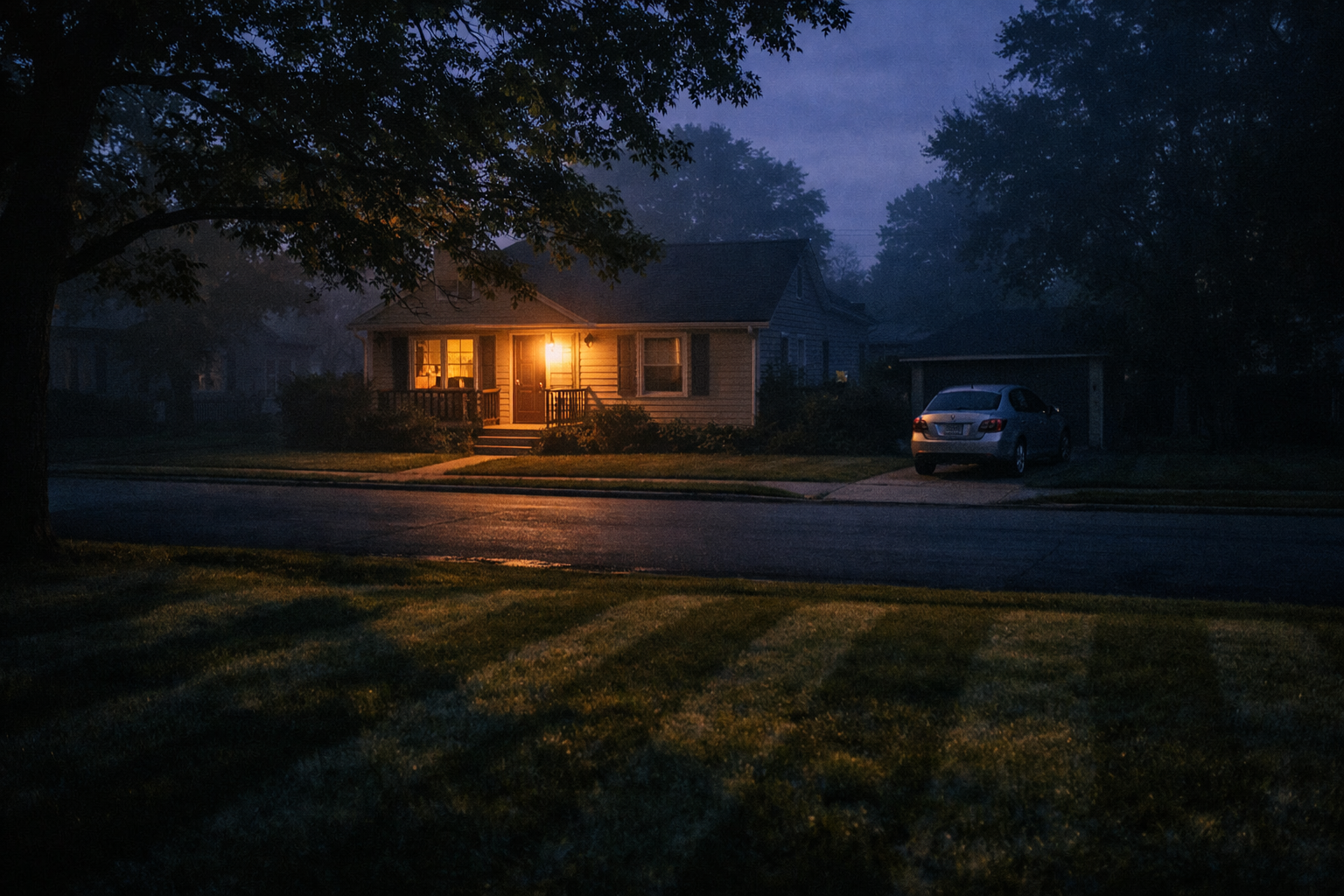
For a beat I didn’t understand what my eyes were reporting. My hands did that automatic little correct and recenter they do when something spooks you at forty miles an hour. Then I was no longer at forty. I was barely moving, creeping with the car in low, nose pointed down the middle of the road like it had lost the ability to choose a side. And there it was across from me where the red-shutter ranch should have been: our clapboard, a little sun-faded on the south face, the small hairline crack in the top right riser of the porch steps, the dead moths trapped against the glass of the porch light, already glowing. The numbers on the mailbox, in the reflective peel-and-stick set I’d put on too low last year, were our numbers. The silver Civic we never bother to put in the garage because the garage is chaos sat in the driveway at its familiar angle, back bumper kissed by the shadow of the maple. There was even the rust bloom on the bottom of the mailbox post where the weed whacker had chewed it up.
My brain grabbed at practicalities. Maybe someone on the homeowners’ group had posted about a street closure, a detour, some kind of repaving that had me coming in from a different angle that made everything mirror. Maybe I was drunk on the hour and the light. I actually looked down at my hands on the wheel as if I could see in them how they had betrayed me. But the car blinked the same tired green arrow. The radio murmured the same ad about kitchens. My mouth had that same cottony end-of-day taste. And across the street, my front doormat lay slightly cocked, the wrong-side-of-the-road doormat, and I recognized the corner of the welcome where the pattern had bleached into a lighter wedge.
I let the car idle against the curb. A boy in a helmet the size of a mixing bowl came scooting past, one sneaker squeaking on the pavement, and he lifted his hand without looking, the polite down-the-block wave he gave every car. Mr. Patel two doors down lifted two fingers from the hose and said, “Evening,” like you would say it to someone who lived exactly where I lived. The water made an arc in front of his legs and darkened the concrete in the same stippled way. A dog barked twice behind the fence by the mailbox. My mailbox.
The numbers painted on the curb in front of that driveway were ours, too. White stencils, messy where I’d tried to edge them under a piece of cardboard. Across from it, where my actual driveway should have dipped the curb into a sagging smirk, the curb was unbroken, a run of pale concrete with no scar. I swung my door open and stepped out. The sound of the car door in the evening, that heavy, rubber-sealed whump, sounded too loud. You could hear cicadas starting up in the strip of trees behind the houses. The air had the smell of clipped grass and warmed vinyl.
I crossed slowly, as if I might put my weight down wrong and fall through something. The porch light across the street buzzed with one high note before settling into its familiar hum. There’s a tiny wedge missing from the inner corner of our storm door where I caught it last winter with the ice scraper, and that wedge was there, the same plastic white chalkiness. My doorknob had a faint crescent of scratches around the lock from hasty keys, and those marks caught the light. The concrete of the bottom step, slick in damp weather, still had a darker area where a potted fern had sat and died in the heat, leaving a sad circle I kept meaning to scrub. It was all there, not adjacent, not approximate. There.
“You okay?” came a voice. Ms. Alvarez from next door stood at the edge of her yard with her terrier tucked under one arm, the dog peering with the same blank interest. She’d cut her hair short. I hadn’t noticed that before. “They finally got the mowing crew out. Everything looks nice,” she said. I looked past her to the lot across the way where my house should have been, and for the first time noticed the pattern of tidy stripes pressed into the grass. The smell of gasoline from a mower was a skin on the air. I said, “Did they—did they do something to the street?” It came out wrong, too casual and too strained at once. She squinted at me. “Street? No. Same as always. But that sprinkler head of yours is still leaking like crazy. I told you about it yesterday, didn’t I?”
I looked down, and at the corner of the wrong-side walkway, water feathered out from the base of the same broken head, making a fan-shaped dampness into the soil. I put my fingers there, as if I needed to confirm the wet. It soaked my skin and made a shallow, dark print when I pressed the pad of my thumb on the warm concrete. “Yeah,” I said. “I know.” I set my hand on the mailbox just to feel its weight. It wobbled with the same loose screw. The mail inside was my mail—credit card offers, a folded coupon flyer, a white envelope with my name typed in that small, unfriendly font. I had the idea that if I just inserted my key into my front door here on the left instead of the right, something in the air would snap, and this would rearrange itself back into comfort.
I stood with the key between my fingers for a long time, then slid it into the lock. It turned as easily as it had since I sprayed it last spring. The door swung inward and the smell of our house came out to meet me—a mix of laundry powder, a whisper of last night’s onions, the lemon oil I’d wiped along the banister on Sunday. The hallway runner was slightly buckled where the corner has been catching for a week. My key bowl on the little table caught the light. My shadow fell the wrong way, bent toward the street instead of toward the stairs. I stepped one foot inside and then stopped, suddenly pressed by the awareness of my own shape standing in a doorway that wasn’t where doorways go.
Across the street, where there should have been the chirping night of my own front yard and the hard square of my porch light on concrete, was a wide rectangle of grass, pale in the first dimming of evening, cut neat. I stepped down and crossed to it, shoes whispering on the road. The stretch was emptier than an empty space should be. The mower had traced perfect chew-lines into the lawn, interrupted only by the careful gap where a walking path would have gone if there had been one. I stepped into the spot where I knew my top step should have brought me level with the door, and my feet sank a little into the spongy soil. It was damp and cool through the soles. I bent and pressed my hand into the grass where our porch would have cast a shadow. There was no edge, no paver stones sunken into loam, no brick, just grass that smelled like every summer of my childhood. I could hear a robin somewhere up in the maple, complaining down at me. I could hear my car ticking as it cooled at the curb. Everything in my body said that if I reached just a little farther I’d knock my knuckles on wood. My fingers touched nothing.
“You lock yourself out?” Mr. Patel called cheerfully. He was still on his side of the street, barefoot now, the hose snapped onto a sprinkler head that jittered and spit. I straightened up too fast and got that grayness around the edges of my vision you get when you stand too quickly. “No,” I said. “No, I just—” Words didn’t line up. He nodded like that was fine. “Looks good over there,” he said, gesturing vaguely at the strip of grass where my life was not. “Cleaner when they cut it all the way down. Makes the street look nice.” His dog barked once more and then flopped belly-down on the damp sidewalk.
I went back to my door because I couldn’t stand in the middle of the not-yard and keep performing helplessness. The car in my driveway was motionless, glass dirty from pollen. The house lights were on the staggered timer we’d set—the lamp in the front room warm, the hall dim, the kitchen dark. I couldn’t see anyone moving inside. My phone, out of habit, bullet-tabbed itself to the map app when I unlocked it, and the blue dot sat perfectly on the little satellite square of our street. The map’s tiny icon of a house hovered over that blue dot. It did not know anything about sides. I thumbed at the street view like an idiot and got a grainy image with summer leaves at full size that wouldn’t quite load. I closed the phone and put it in my pocket like it had said something rude.
Dusk didn’t so much fall as thicken. Glass reflected sky instead of letting you see into rooms. The sprinklers changed corners and switched off with little coughs. In my living room, on the wrong side of the street, I sat on the edge of the sofa and listened to the refrigerator take a breath and run. The art on the far wall hung a little crooked the way it had been since we’d moved it for painting and never aimed a level at it again. Out the back window—our back window—the neighbor’s sycamore leaned in from the wrong direction, its leaves pattering against the fence like a reversed recording. I made it to the bedroom and back by pathways I knew and didn’t know. At some point I laughed, out loud, a short, ugly sound in the quiet. It didn’t change anything.
I didn’t sleep. The house made its night noises and I heard them all with the volume turned up. A cat moved through the hedges across the street and paused in the middle of the empty lawn as if something invisible told it to step up and then down again; it lifted its feet in a careful high way and then disappeared. A car went by, slowing as people slow when they’re not quite sure which drive belongs to which door. I sat on the couch with my knees up, hands around a glass of water I never drank, and watched the square of my front room window throw a pale rectangle onto the wrong grass where my neighbors’ lights usually fell.
Just after five, the light washed the color out of the sky and returned it in a different order. Birds rebooted the morning like nothing had happened. I stood and went to the window, and my house was where it belonged. It was a physical sensation, the rightness—like when you stand on a boat that’s been rolling and then step onto the dock and feel the unmoving underneath you in your knees. The driveway sat exactly where it should have, the curb dipped back into its silly grin. The little blue ceramic pot on the flower bed, chipped into a crescent at the rim, was once more under my window and not across from it. Across the street, Mr. Patel’s red shutters looked too bright in the early light. My car idled in the place I had left it, blade of shadow slicing the hood in two. The porch light, of course, had timed itself off just before dawn.
I did a stupid tour of the house, right hand to the banister, left hand to the doorframes, like maybe I could feel the seams of how it had been stitched back. Everything was as it had been. The dent in the garage door. The small nick in the paint at hip height just inside the hall where we’ve both walked too close for too long. The leak in the sprinkler head sent its fan into the same patch of soil on the side I’d always cursed it for. My coffee made the same scorched sound as it tried to decide if it was ready. I stood in the hallway with my mug and looked at the framed photographs we keep on that narrow ledge, the ones we say we’ll hang properly one day when we decide where they should go.
Halloween. Last year. The two of us on the porch, coats over costumes, paper bag pumpkins lined on the steps. The photo had been taken by our neighbor because her angle always caught our house straight-on without making anyone look five pounds heavier. I lifted it off the ledge. The smiles were the same tired happy I remember. The steps were wrong. The handrail descended from the left when I’m used to seeing it from the right. The crack in the riser ran from the opposite corner. Over my shoulder in the glossy background, the street should have sloped down to the mailbox, but the slope tilts in the other direction. The maple branch hangs in from the side it shouldn’t have. The doorknob is left-hand. I put my thumb against the lower edge where the tiny date-stamp lives, and the numbers were what they have always been. No one had printed this yesterday to mess with me. The paper had that little bend in the top corner from where it had slipped down behind the frame last winter and I’d fished it back out.
I took the photo outside. The air was thin with cool and the sun was still behind the rooflines. I stood on my correct driveway and held the frame up in front of my actual house, thinking stupidly about lining things up like a detective in a TV show. The picture didn’t align unless I turned slightly to look across the street. Then the angle of the siding, the drop of the railing, the curve of the path, all found their mates for a heartbeat before the light shifted and my hand trembled and it all broke again. I lowered the photo and for a second could smell, under the coffee, that sweet film of gasoline from the mower. Somewhere far down the block a truck backfired like a door slamming in another room. I put the photo back on the ledge inside. It leaned there, mild and reflecting a thin bar of morning light, showing two people smiling in front of a house that isn’t, wasn’t, couldn’t be where it sits in that rectangle. I left the blinds open so I could watch the street, and the picture watched me back, stubborn in its quiet, holding what it had seen.