Something Ran Beside the Car on Two Legs
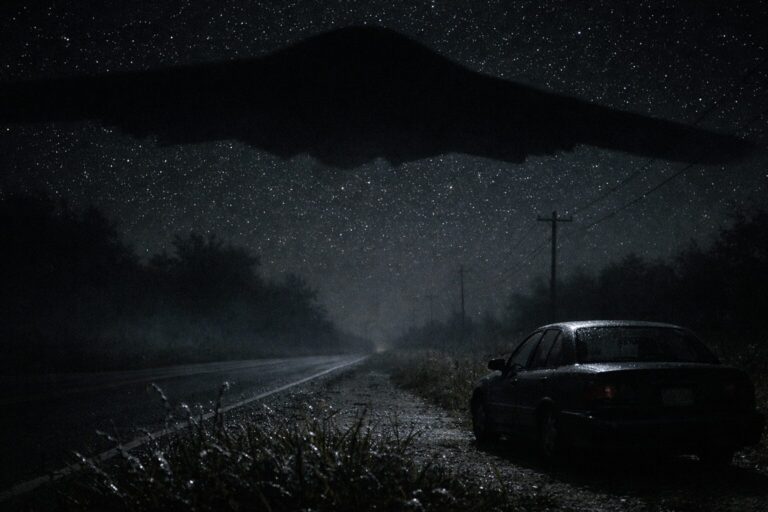
I was alone on County 14 after midnight, that stretch between the river bridge and the turn by the old cannery where the trees squeeze right up to the shoulder. It was the kind of night that makes the windshield feel like a lens more than glass, everything beyond it falling away if my headlights weren’t pointed at it. I kept them on low because of the curves, but even then the beam made a tight tunnel and the rest of the world pulled back. The heater ticked like it needed bleeding, and the car smelled faintly of damp leaves from my boots. I had one more town to pass before home and the fuel light wasn’t on, so I told myself not to stop anywhere between.
The blacktop ribboned and turned like it had been poured into the seam of the woods. No real shoulder, just a lip of gravel and then the ditch, deep and dark with meltwater that shone in places like a torn trash bag. I kept my speed just under fifty. There were hand-lettered signs on fence posts about a farm stand I’d never seen open, reflective eyes of deer sometimes hung up in the low spots if you caught them right. The radio was on low but the stations out there frayed into static, so it was more wind and engine than anything human.
Somewhere after the second little bridge where the guardrail still had yellow paint from harvesters, I saw movement in the ditch on my right. At first it was the kind of thing you write off: just the edge of the beam catching saplings, or a coyote skimming the grass. But it didn’t come and go like that. It stayed with me. I could feel it on that right-hand side—not close enough to the door to throw a shadow on the glass, but there in the edge of sight, keeping the same speed as the car like it had hooked a ride on my fender.
I told myself dog, or maybe someone’s stray that had learned a trick of running the drainage line. The ditch there was mostly smooth. The shape was low, shoulders sliding under the scrub, and every now and then something caught the light like an eye and then vanished. I reached down to turn the radio off without looking away from the road. The quiet that came after it made the car sound bigger, the tires stitching along the uneven seam. I rolled the passenger window all the way up though it wasn’t cold, a habit that felt like precaution more than comfort.
We came to one of those corrugated culverts where a farm driveway crosses the ditch, and the thing rose when it clambered over, the way a big dog does if it pops up to check something. But it didn’t go back to four again. It just stayed up. It matched my speed—not with the choppy, front-heavy bounce of a deer, not with the gallop of a dog—just…up, and level with the car. It ran in that strip of space the headlight didn’t quite fill, almost matching the line of the hood from my angle. The road turned a little and the beam should have cut away from it, but there it was, clearing the culvert and then moving alongside in the ditch, higher than it should have been. I slowed a touch without meaning to. It kept pace exactly.
The gait wasn’t right for any of the guesses. It was economical, too smooth for the uneven grade. There was a two-beat sound to it that reached me above the fan and the tires—a rhythmic slap of something that was not hooves, not pads. The way a person runs in boots if they are keeping their balance, only there was this reach to it, like the hips were made to flex farther than ours. Arms—if that’s what they were—were down and a bit forward, not swinging for speed. It didn’t need them. It almost ran the way an animal paces behind glass, a steady line held no matter what the terrain does, like the ground is what has to make the effort to meet it.
We passed a reflective county marker and white bled over the thing’s shape for a breath. Fur. No coat or cloth, not a jacket flapping. Nothing to break up the texture. The hair lay tight across the torso and then thickened around the head and shoulders as it rose and fell with me. Breath? I didn’t see steam, but the night leaned wet and when we hit a patch of colder air rolling down from the fields, something like vapor swayed out from it, too dense to be just the ground fog. I put my foot into it, easing the speed up five miles. It lengthened too, no extra labor, no slack in its pace, just there, at the end of where the light would reach if I dared to turn the wheel toward it.
There’s a place where the trees break back for a hundred feet on the right, a pasture with rusty gate panels hooked together and a galvanized stock tank tipped on its side. Before you get to that, there’s a stand of pines that pinches the road. I could feel them coming, that slight constriction of air, and then I was in the pinch, the scent of resin and the pavement going darker. That’s when the road flattened, and the ditch shallowed to almost nothing for a few yards, and I realized how tall it was when it straightened up to keep in that same line with me. Taller than a person standing out there. Tall enough that even with the ditch bottom out of play, the top of its shoulder rode level with the bottom of my window glass.
Some part of me knew better than to hit the high beams on a curve, but I did it anyway, thumb flipping the stalk. The light punched across the trees and washed the ditch and then slid all over that shape. It did not flinch. The fur went to the color of lake water at night. And then it turned. Not a head roll like an animal that won’t cross its own body with its eyes. It turned the head. The face found the car and kept on turning until it found me and I was looking into something that had a wolf’s long muzzle and a wolf’s forehead but a gaze that was not wild in the way that word means. The eyes took the light badly, sinking the glare and holding it, not flashing it back. The mouth wasn’t open. The lower lip—the line of it—hung heavier than a dog’s. Ears up, not pinned, triangles that made a shadow on the fur behind them. It looked at me the way you check a noise in your house at night, slow and with a patience that makes you hold your breath to keep from making a second noise.
I kept my hands where they were on the wheel because any other signal felt like invitation. The car drifted half a foot left and the tires ticked the dotted center line and came back. The heater clicked. The smell in that second was wet and bitter, not garbage and not musk, something like a paper mill when the wind is wrong. It didn’t bear its teeth. There was no lunge. It just looked, and there was an understanding in it of the glass and the motion and the narrowness of the night. I could see a line of old scarring at the side of the muzzle, white against the dark. I saw dirt crusted into the fur where the ditch had splashed. And then the pines opened out, and the brightness went soft again, and the world remembered wind and curve and the shrug of the car at fifty miles an hour.
When I pressed the gas, I didn’t stomp it. That would have been like yanking your hand away from a stove with company watching. I added just enough to feel the hood lighten and the lines on the road pass faster. The thing held for a breath or two more, matching the new speed like the difference didn’t matter. Then the ditch deepened again and a culvert announced itself with a dent in the grass, and I thought something like relief and something like dread at once, because the ground would force it back down or else make it climb all the way out to stay even. It chose neither. It dropped from my window line, and in my side mirror a darker dark flattened and then grew again in the corner, as if it had timed me and would meet me where the road bent around the next hedge.
There was a noise against the right side of the car. Not a bang. A scrape, a scaled-down sound like when the pump hose snakes along your fender at the gas station and licks the paint. Three quick strokes, maybe four, in a row that ran backward as if a hand had been held out alongside and dragged without hurry. I didn’t look. I couldn’t have made my eyes leave the lane even if I wanted to. The bridge came on—the little one with the iron rail—and I went over it too fast, the springs speaking and all the change in the cup holder doing a low, patient ring.
Past the bridge was the T with Route 9 where the sodium lamp makes a false daylight you can see from a mile off. I took the stop sign too slow because the sudden light made everything mean again. The mirror only gave me my own back glass and the wedge of dark above the trunk. I turned left toward town. The road opened to fields and ditch went to flat. Something unknotted in me then, not all the way, just enough that my jaw unclenched. I drove the last five miles at exactly the limit.
The convenience store at the edge of town had its lights like a ship. I pulled in and parked crooked and sat with both hands still on the wheel until the engine fan wound down and the ticking of hot metal under the hood took over. The glass doors slid open when I walked toward them and blew that tired warm air that always smells like burnt coffee and mopped tile. The kid behind the counter was watching a video on his phone and glanced up and said, hey, how’s it going, like my face wasn’t someone else’s. I walked the aisles just to sit my legs back into being legs again. I didn’t say anything about anything. I bought a bottle of water, left it on the seat unopened, and drove the rest of the way home with the radio all the way silent.
I didn’t check the car that night. The porch light catches only the steps, and the street lamp at the corner is always half asleep. I parked and went inside and stood in my kitchen with my palms flat on the counter until the tremor bled out of my hands and into the laminate. I slept a little and woke with the shape of trees in my eyes and the sense that the house knew me only because I told it my name over and over.
The next morning the light had that weak winter-yellow that makes even good paint look tired. Frost took the lawn and left the sidewalk clean. I came out with my keys spinning in my fingers and saw it before I meant to be looking for anything. On the passenger side, three long lines scored the paint from the front door seam back across the rear door and down over the flare of the wheel well. They were too straight to be from brush and too measured to be from a slide on ice. In the middle of them, spaced like a hand would space its fingers if a hand had too much reach, a fourth, fainter, ran its own course and nicked the chrome of the handle. The top of the longest mark started higher than my shoulder even with the car jacked a little by the frost-stiff tires. I lifted my hand and hovered it over the start of it and knew I couldn’t have made that angle from the ground without a ladder.
I pressed my fingernail to one of the lines. The paint curled up in a fine shaving like an apple peel and fell to the gravel. There was dirt worked into the scratch the way there is on the underside of a mower deck, sun-baked and rubbed glossy. Where the deepest line crossed the door seam, a sliver of something dark was caught—maybe a bristle, maybe a strip of tire from some other day the car had crossed a shoulder wrong—but when I picked at it, it freed with a tremor that felt like a word you don’t say out loud. I held it between finger and thumb and let the wind take it because the trash bin was too far and the idea of keeping it anywhere felt foolish.
No branch on that side overhangs the driveway. The right side of the car had faced the grass when I parked. I crouched until my head was level with the scuffed places and ran my palm under the mirror where the plastic meets metal. The mind does tricks when it wants to find ordinary answers, lining up the world like bottle caps on a shelf. A truck passing too close sometime earlier, an odd grouch of the car wash brushes, kids with keys going home from the park. Each idea fell apart at the same point where the lines peaked and came down, too long, too calm, too uninterested in the way things usually go wrong.
When I drove past the cannery road a week later in daylight, I stayed on the far right of the lane without thinking, my eyes on the ditch like you watch a sleeping dog you don’t want to startle. Puddles still gathered there and tatters of grass lay in flattened fans where winter had pushed them down. My focus pulled to the place where the culvert cut the ditch and the ground rose. I didn’t slow, and there was no movement, nothing but brush and a fence line thick with multiflora and old barbed wire with blue twine tied along it like a warning or a prayer flag. There were indentations in the mud near the culvert, old or new I couldn’t say, and they weren’t anything you could photograph without a story to lay over them. I kept the wheel straight and let the car take me past.
The scratches dulled with road dust and polka dots of salt that never quite wash out in winter, but even under the grime they were a script I didn’t have the right words for. The shape of the head turning is the part that wouldn’t wear down. It was not a mistake you tag with a name and put on a shelf. It was a moment that lived where the road pinches and the ditch climbs and something that should not move the way it moved came level with me and looked in through the glass. When the sun is low, those three lines catch it and shine like lines left by a child in wet cement, too high, too straight, starting in a place my hand can’t reach and ending where the paint gives up and the metal remembers being raw.