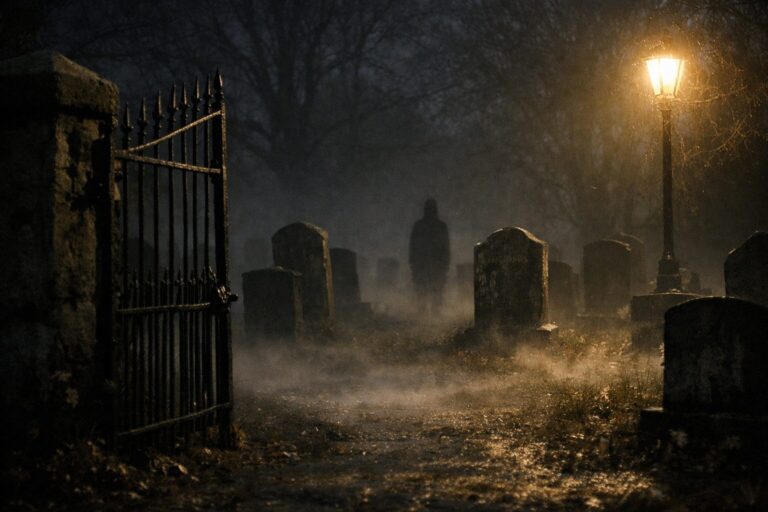
The Grave That Was Always Wet
There’s an old story about the cemetery along the ridge road, the one with the leaning iron gate and the two black cedars that meet over the path like a green archway. People say that one of the graves there never dries—not in July heat, not in wind that peels paint, not even when the creekbed across the field is white with clay. They don’t tell it with drama. It’s just one of those things that belongs to a place the way a certain field belongs to crows. If you’re local, you get told not to go looking for it. If you do, you’re told not to touch.
I never went looking. The cemetery wasn’t for looking—it held my grandmother and a clutter of names I heard only on Memorial Day. The stones there are the old kind: trimmed by hands, lid-lipped, dates that end in 7s and 3s. In the fall the grass lies flat like a pressed coat and a sound like paper runs across the whole place. In summer it’s too bright and you squint until everything seems to glow from inside.
By late August, the year my mother sold the house, we hadn’t seen rain in weeks. The pasture edges broke apart to talc, and the dog came back from a walk with dust rings on his legs. I drove to the cemetery with a jug of water and pruning shears because the crabgrass at my grandmother’s stone webs up if you don’t keep after it. I wasn’t thinking about the story. I was thinking about the way my mother said she didn’t like to come alone anymore, that the road shoulder felt too soft and the gate too old to hold.
On the path, my shoes raised little puffs. You could see where a rabbit had crossed because it left a fine scribble in the dry surface, hardly an indentation. I passed a patch of ground that had crazed into plates like old china. The cedars made their smell of pencil shavings and cool shade, but it didn’t take the heat out of the air. It was the kind of afternoon where even a breath seemed effort.
My grandmother’s stone sits near a row of older markers, lichen-scalloped, the names folded nearly closed by time. I clipped back the shoots that keep coming, ran my hand along the top to brush off the dust, and that was when I noticed the patch.
It was just there, a dark oval at the base of the next stone along. Not big, not dramatic, the way a ring of spilled coffee looks on paper. Everything else was baked—gray blades of fescue crisping into needles, ants marching over paths like faint pinpricks on a drum—but at that one stone the earth was dark and clumped, a thin gloss to it as if someone had just turned it with a damp spade.
I looked up at the sky by reflex. There was nothing to see: even the clouds had turned into long, white smears that never meant rain. I checked for a hose, for a flower vase overturned, for some caretaker’s trick. The newer graves sometimes had those metal cylinders sunk into the ground for bouquets, and every so often one leaked. But this was an old marker, squared off and simple, freckled with orange lichen like rust. The name was Harlan LeFevre, dates cut clean: 1890–1918. No vase. No caretaker’s cart nearby. The grass around it unchanged except for that oval like a shadow drawn with a heavy pencil.
It didn’t click right away. It was an out-of-place thing in a place already full of out-of-place things: dimes on stones, a wilted flag from July, a faded silk peony tucked along a base. I finished at my grandmother’s and carried the jug back to the car, and then for some reason I turned back. Maybe it was the name—LeFevre is not one you forget. Maybe it was how the sunlight made heat ripples that seemed to throb over that darker place while nothing else moved.
When I got close again, the dark wasn’t just under the front edge of the stone anymore. It had spread into the short grass, blade by blade, as though the soil had pulled a breath and exhaled with damp lungs. The line where wet met dry was too clean. It cut around tiny pebbles. It nicked the edge of a beetle’s path and brightened it. The dust around my shoes stuck in spots, then lifted off again when I stepped away.
I reached out. It’s not a brave thing, touching the ground. The top pushed in under my fingertips and came away chilled. Not just cool-from-the-shade chilled, but the way water pulled from a well feels different in the hand than water poured from a kitchen tap. The smell rose up, too—not rot or mud, but that stone smell from cellars and springhouses, a smell that doesn’t belong under a sky like that.
“Okay,” I said to nobody. Saying it didn’t change the outline of dark. It kept easing outward at a rate my eyes could pin to nothing in particular and still swear to later. If I stared at a tuft of grass, I’d look back and find it was glossed at the edges, as if someone had brushed it with a thin oil that caught the light. A little fly danced over it, tripped, and then scrambled away, wiping its front legs together like a man fussing with a napkin.
I crouched without meaning to, the way you do when you expect to hear something better if your ears are lower. The stone’s date was right there, 1918, the year of sickness, the year boys came home less than they’d left. The base of the stone had a chipped corner smoothed round by time, and without considered thought my knuckles pressed to it. The cold from it sucked tendrils up into my wrist and elbow. I held my breath then and bent toward the dark.
At first all I picked up was the neighborhood sound of the place: a distant truck from the state road, a locust drilling down into heat somewhere in the cedars, the dry blurt of a bird flipping a leaf. Then there was a regularity I didn’t recognize, a small punctuation sound too gentle to be insect and too singular to be breeze. I put my palm flat to the wet. I felt nothing different beneath my skin but soil’s mild push back, and still I heard it.
Drip.
It came thin and far away, like water into metal. A warehouse of air seemed around it that couldn’t possibly exist under those few inches of yard. I shifted and it paused. My own breath sounded like paper tearing. I lowered my head until my ear was almost to the earth, mouth turned sideways into the smell of old stone, and there it was again, the click-thread sound a drop makes when it lets go and finds its level.
Drip. Drip.
Between them, a pause that wasn’t quite regular and wasn’t quite random either, like a tired man’s footsteps down a dark hall. I thought of ceilings that sweat and caves that tick with water, and I knew how a body invents rooms where there aren’t any. I stayed there anyway. I don’t know how long. A minute feels like a ribbon you pull and it keeps coming, and all at once it’s the inside of your hands.
Something about the way the sound didn’t change frightened me. Wind changes a sound; so does a truck passing. So does your heart thumping when you’re in your own head too long. But this kept its small silence around itself like a cloche. I realized my knees hurt. I realized my palms had mud along the heel where I’d pressed into the dark. When I lifted my hand away, the wet patched my skin in an oval, sharp-edged as if the soil’s outline had printed me. The sun had slid an inch along the face of the stone and the date cut a line of gold into the shadow.
I stood and stepped back. My shoe soles made no sound on the dust save a faint papery scrape. I wiped my hands on the back of my jeans and they left two dark streaks that flashed dry almost instantly in the heat, except the chill in the skin underneath didn’t go away. I told myself that I had work to do, that my mother would want an update on the plot, that it wasn’t anything. I left by the side path, and halfway to the gate I stopped because a feeling like forgetting something tugged me. I didn’t go back.
At home I set my shoes by the door because they were marked green along the edges from the cemetery grass and because there’s always grit after that place that you don’t mean to drag into the kitchen. I washed my hands in hot water and the smell of cellar gave up easier than I thought it would; the faint cold stayed deeper in my fingers as if it had slid in along a line of tendon to wait there. It was one of those nothings that you carry into the next hour and then the next. I cooked and called and fell asleep in front of a program with the sound turned too low.
The next day the town siren went off for noon and one o’clock was bright and mean enough to show you where you’d missed dust on the floorboards. I don’t know why I decided to go back. An excuse arranged itself: my grandmother’s marble vase, the old one, had a hairline crack. I had meant to bring it in before it broke on a frost. I went to the door for my shoes and when I picked them up they flexed with a weight they didn’t earn, and the leather felt cold through to the lining.
I should have noticed before. I had stepped out of them on a dry mat, and by morning there should have been nothing but a faint trace of dirt left. But inside the right shoe, down in the heel cup, the fabric darkened with damp. I pressed my thumb there and it gave up a coolness into the pad of my thumb, and then the pad remembered it, the way fingers remember a rope burn. I listened stupidly for a drip that wouldn’t come and then laughed at myself and carried the shoes to the car anyway, because logic belongs to the errands you’ve already started.
I parked by the cedars, and the shade through them cut stripes on the path. The gate gave its little squeal, as always. Dust flew up from my ankles; it twinkled briefly, suspended in the slant of light, and then fell exactly where it should. I walked straight to Harlan LeFevre’s stone and put my hand out before I got close, the way you do when you expect a dog to come, though there was no dog. The grass around the marker was stiff and pale. The soil there was the same as anywhere else—flaked, paled, cracked into pretty little maps. No dark shadow oozed outward. No glassy sheen. The stone itself was hot to the touch.
I squatted anyway and tilted my head, feeling foolish there with traffic ticks on the state road beyond the hedgerow. I pressed two fingers down at the base where the damp had been. Little cakes of dust lodged under my nails and the smell that rose was nothing more than dry weed-crush and sun. I held my breath and heard only the noise of noon and a crow that used the air like it belonged to him.
When I stood, my shoes left neat, untroubled prints that would blow away with the next car that sped past the ridge. They didn’t squeak. There wasn’t any reason for them to, and yet as I turned, I felt the slide of moisture at my heel. It tapped once against the leather like a dropped pin.
Back at the car I slipped one shoe off to check the inside again and left a damp shape on the dust-mat. It sat there—it sat there against the heat and the light, a little oval of dark, crisp-edged like a thumbprint, like the outline I’d pressed into the grave. I touched it and brought my fingers to my face out of nothing more than habit, and the cold washed through the same channel it had used before. The field past the fence lay in a blond surrender. The cedars made their shade and that was all they made.
On the way out, I glanced once more down the line of stones. Names held themselves in pale letters and the ground between them held nothing. I slid my foot back into the shoe and felt the damp take me around the heel again as if I had stepped on something I couldn’t shake loose. By the time I got home, the mat in my car had a darker oval the size of my palm impressed where my foot had been. The sun fell on it all afternoon and it didn’t lift. That evening, when I went to move the shoes, the right one let go a small, cold drop onto the tile, and the round spot it made sat there, shockingly clear, long after the air had gone warm.