The Nurse Station Phone Rang in the Ruined Wing
They parked behind the tree line, just far enough that the old hospital wouldn’t catch the flash of their taillights. The asylum sat low and broad behind a slope of yellow grass, its windows blind with dust, ivy threaded into the brick like veins. They’d timed the visit late in the afternoon to catch that blue hour inside the halls, when the light moved thin and strange and the shadows gave up secrets. The man with the camera—Theo—was careful about openings. He had a way of finding them that didn’t sound like luck, and today he worked a rusted service door with a patch of foil and a slow pressure that made no noise.
They went in as they always did: two with lights forward, two with lights behind, and always a recorder running. No one spoke at first. The building had a smell that made words feel rude—wet plaster, medicine, rodent dust, and the long metal reek of rust coming off pipes that no longer held anything. They moved slowly, pausing to photograph things that hadn’t yet succumbed: a cork board of shift notes left under a film of soot, a hand-painted mural of clouds in a day room, the glass panes of an old medication cabinet gone soft with grime. Jun traced a finger through a drift of ceiling paint curled like old bark and caught flakes in her palm. “Touch all the lead,” Margo said, not unkindly, the kind of joke made on these trips to bleed off nerves. Jun rubbed her hands on her jeans and smiled into her scarf.
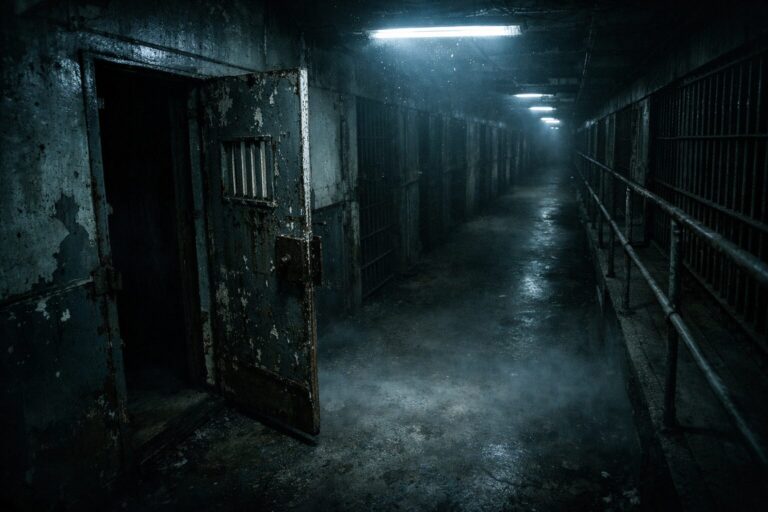
Past the admitting desk, the hall widened into the nurses’ corridor. It was a place meant to make watching easy: half doors with view panes, the administrative nest in the center. Here, pipes were unsheathed, cables yanked clean from the ceiling, conduits split and left like peeled skin. There was no question of power. Someone had painted red Xs over every wall switch years ago, and it gave the impression that the building had been graded harshly and found failing in some way that could not be fixed.
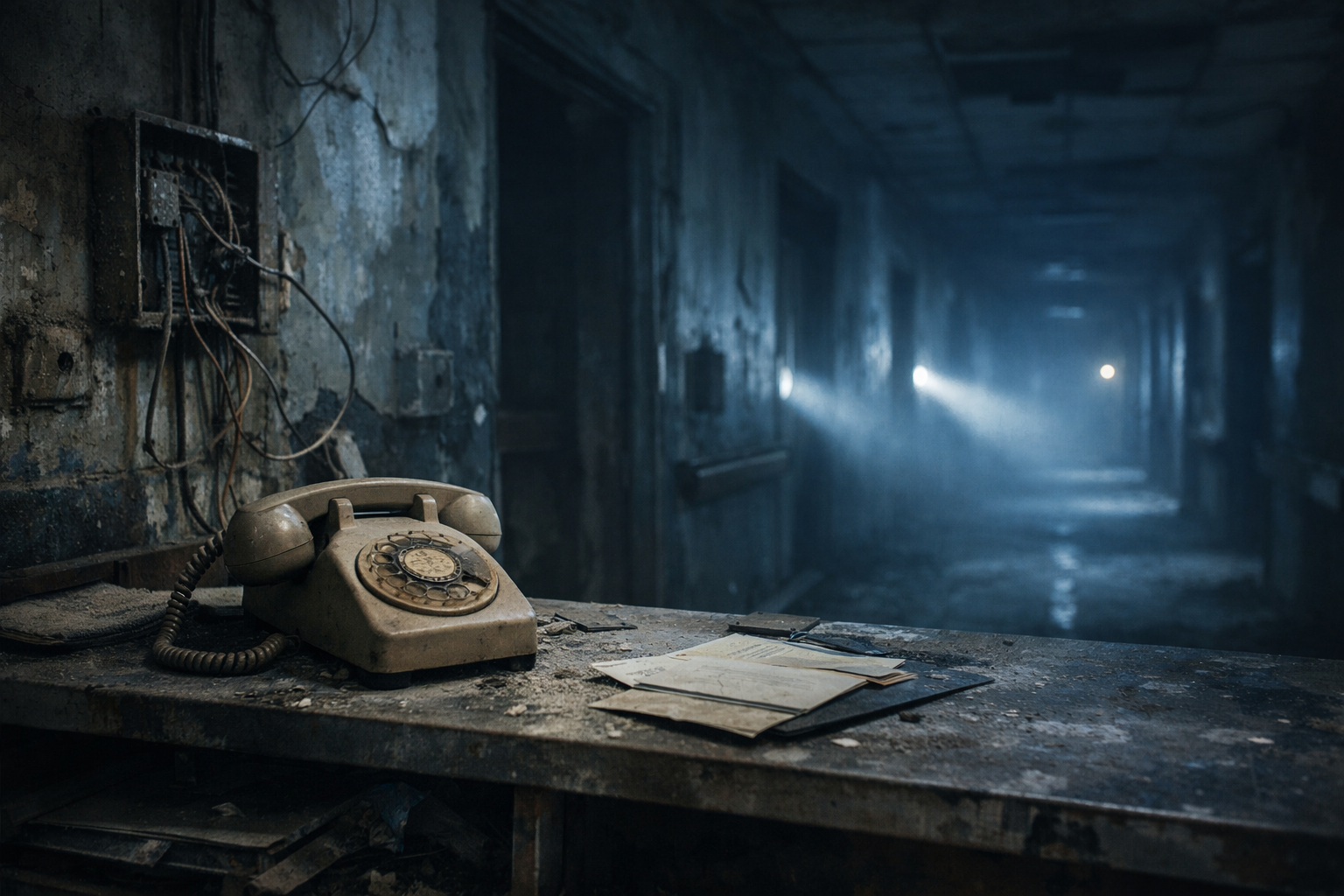
They were here for the records—photographs mostly, a few minutes of video to layer old floor plans over, to match rumor to angle. Theo took a long pan of the station with the camera on the tripod, the lens breathing in and out, while Dev set the ambient mic on the counter. It was the last thing in the room that looked like it could’ve seen gentle use: a low horseshoe of laminate, edges scuffed to tan. Behind it, on a little shelf that seemed to have been spared by vandal hands out of some reflex of respect, sat a beige desk phone with a cracked plastic cradle. It had its coil still, stretched into zigzags that looked playful and wrong in that place.
There was a day, probably in the 1980s, when an administrator cut service to that wing and it was done; the copper had been stripped in the 90s, and the switchboard was gone entirely. They’d seen the basement earlier, the wall where the cross-connects had lived with only broken nails and tags, a few paper flags still fluttering from their wires, no fibers left to hold.
Margo was photographing the laminated flipside of a duty roster when the room exhaled a sound so clean and ordinary that it took them all a second to fit it to anything at all. It was the ring of a desk phone. Not the trill of a mobile or the sterile two-tone of a hotel. A phone with a bell, in a workplace that had once been full of keys and clipboards and someone at the switch.
They froze. The sound did not come from the far halls. It came from the beige phone on the shelf, squarely in front of them, where no wire entered the wall. The first ring rode out across the battered floor and died into the hollow rooms. A second followed. It was crisp and somehow present, the way a thing sounded when it was happening where you stood. Theo’s mouth opened and didn’t shape anything. Jun’s light lifted and held tight to the phone as if the beam could nail it still.
They counted three rings. On four, the pitch shifted as if a finger had brushed the bell, a warmer half-tone that thinned at the top. Dev looked at the coil, at the spare jack rusted into a plate under the shelf—nothing, no light flicker in the cord, no trick of reflection. He moved to the wall beside the shelf and traced the line of where conduit should have been, tapping knuckles on plaster to feel hollows. When the fifth ring came, the recorder on the counter hissed a little, as though the sound were breathing into it.
Then silence. Not the fat quiet of an empty building—something more like a held breath. It lasted two long beats, like listening for a car to pass outside your house and discovering the night had its back turned to you. Margo touched the cradle with two fingers. It was cold, chalk-dusted. Nothing about it moved or hummed or waited.
They went on. That was the kind of rule they kept: if nothing was collapsing or burning, you kept working. Theo shot the corridor past the station. Jun called out door numbers softly so they would match the frames later. Dev ran the boom mic, slow as a fishing line. Margo photographed the signage and tried not to make the note in her head—how the air had tightened as if it were listening now too.
Footsteps came ten minutes later. Not theirs; they knew their own gait in headphones better than their own speaking voices. These were behind them, echoing off the curve of the corridor from the direction of intake, light and careful, soles reverent on tile. Theo turned and did the old call—anyone here? Security? He said it with the gentle firmness of someone who had once been asked to leave a place and had done so respectfully. Nothing answered. They stood still long enough for the dust in their beams to land. The steps faded in the half-world where sound remained and then thinned into the building’s old heartbeats—the ticks and drips and far-off settling that you could map, if you did this long enough, to the way the day stretched and the mortar cooled.
“Play it,” Jun said, small, nodding at the recorder. Dev slipped one ear cup off the boom headphones and thumbed the wheel back. The guts of the corridor unspooled into his ear, full of paper rustle and the white hiss of somewhere far away. He put the other ear on. Then he made a face that was almost a smile and wasn’t—something you make when you recognize yourself in an ugly reflection you didn’t expect.
He held the headphones out. Theo pressed his ear to one pad, Jun to the other. Margo stood so close to them she felt the heat of their coats at her ribs. The room came through the drivers like a version of itself, thinner, formal. Their own steps; the pause. Then, under it, as if a radio two rooms over were tuned to them, a voice. It was a woman, maybe. It was the shape of a woman in sound, syllables fast and careful, rolling under and over a sentence Margo couldn’t catch until Theo whispered it without meaning to: “Keep the door closed.” The words came again. Then: “No, no, he’s—” and it hinged into murmurs.
They stood like that a long minute, listening to a place that did not stop to meet them. The recorder caught a click then, small as a tongue to a tooth. The little light on its face pulsed. Dev leveled the boom back at the administrative nest out of simple instinct and nothing technical at all.
When the phone rang again, it did so with the same correct tone as before. Jun jumped and barked a quiet laugh that wasn’t laughter. Margo didn’t ask; she reached. The motion was practical, made by someone used to handling objects with a calm hand so the world would reveal itself. She set her fingers around the receiver and lifted, bone and earpiece and cord sagging in a way that was older than she was by decades. The mouthpiece found her face as if there were a correct place for it to be.
On the line there was a rush that wasn’t static, not electrical. It sounded like someone’s breath against a scarf in winter—familiar, human, imprecise. She had the animal urge to say hello, but her voice would have sounded like a guest at a wake. She held her breath. The others watched, bodies drawn in, lights tilted down so the counter and the phone were bright as an altar and everything else narrowed into shadow.
The breathing blinked out, came back. For half a moment she thought she could hear two patterns in it, one high and quick, one lower, counting. Then a sound came that had no distance to it at all. It wasn’t on the line. It wasn’t in the room. It found her. A word or three, a sting of air shaped through teeth so close that her ear remembered warmth that wasn’t there. She stood very still. The plea was not theatrical. It was the way you ask a stranger for water when your mouth is dry, the way you ask a nurse to stay a heartbeat longer when you don’t want to sleep. “Please…” The second word frayed. “Don’t—”
And then it quit as a switch does, mid-syllable, off with a certainty that made every other sound in the building feel dishonest. The cradle in her hand was just plastic again. The counter was laminate. Dust sifted from somewhere and came down in a slow, private rain.
They did not run. They were not that kind of visitor. The body learns in these places how to withdraw without turning its back. Theo closed the tripod and slid the camera into the bag, his hands acting like they’d rehearsed a fire drill no one said would ever be needed. Dev killed the boom and cased the recorder. Jun walked the lights backward, one last pass down the hall. They moved into the central corridor with the geometry of a retreat and let the building close behind them, clicking the door they’d opened soft against its frame like you would in a sleeping house.
Outside, dusk had settled hard enough that the asylum’s roofline had eaten the color of the sky. Their talk on the walk back to the car was saying what you have to say to come back to yourself: what are you doing later, I think we got it, I’ll pull the frames tonight. In the rearview, the hospital’s windows held the sky they no longer faced.
They listened that night in a little apartment kitchen that smelled like black coffee and vinegar from a too-clean cutting board. The recorder offered back exactly what it had taken without any of the tired pride of a machine doing its job. The footsteps were there, measured and light. The voice in the hall came across again, phrase clear enough now to hear the weariness in it, that grain of a person at the end of something and not yet at the beginning of anything else. There were other stray things: a hum like a light warming that never brightened; a short, hard exhalation that could have been air forced through a narrowing; a pop like a tongue clicking from the roof of a mouth; the sound of fabric distant and close at once.
The ring recorded cleanly. It was as it had been in the room. On the second instance, just prior to the receiver lift, there was a small shift in level that none of them understood—a rise and fall, as if the microphone were hearing the space lean toward the counter and then away. When Margo lifted the phone, the recorder gave the breathing its own shape. They played it too many times and it either was or wasn’t two people depending on whether you wanted it that way. The whisper was not quite as a memory had it, because memory softened the edges of certain syllables and the recorder did not. It gave them a s played too lightly and a d that had rubbed down to a th. It gave them a please worn into almost a plea. It did not give them anything beyond that.
They shared it without music and without a title, only a timestamp and a map segment with street names blurred, because the point had never been the theater of it. The file lived on forums and then in messages to strangers and then in rooms where people played it off cheap speakers and put their heads at the same angle as if that would let the sound come through at a better version of itself. No one could build a path for a signal to travel to that shelf. People who had taken the building apart for salvage said what they knew about the cut lines, about the switch closet that had been emptied clean in 1994, about the phone system that had been analog and then had not been anything for a long time.
By winter, locals who had never called the place anything but the hospital were back to saying the ruined wing had something wrong with it again. The new fence went up along the road in a line that looked more symbolic than useful. Teenagers drove slow on the nights after football games and parked too far away, the way the explorers had, and said they heard a bell when the wind fell off the trees and let the place speak for itself. A man walking his dog on the trail behind the property said on a morning of hard frost that he had stood under the power lines and listened to the air sing, and that when it stopped, something far inside had rung once as if to correct him.
They went back in spring and didn’t go that far into that wing. The building was changing with the thaw, lowering its shoulders in the damp, sag in the floors more pronounced. They did a room off the kitchen, a day room where someone had painted flowers with children’s names under them, and left before the light went down. The phone was not where it had been. The shelf was bare and the coil was not coiled there anymore. There weren’t new footprints in the dust on the counter. There was, though, a line sketched in by a fingertip across the laminate where a square base had sat, burned in by time and pressure and whatever that last ring measured against.
On the file that lives out in the world and is the simplest thing they have of that afternoon, the last seconds hold a sound that matters to no one who doesn’t already know it. It is small. If you listen too hard, you miss it. After the breathing cuts off and the room gives them back their own silence, there is a breath Margo didn’t take and a syllable that is almost a door closing and could be only the machine clearing its throat between jobs. There is the shape of a person left in the air, not caught, only pressed into it, the way a book leaves a rectangle in dust when you move it and the clean space looks like a thing shining on the table for a moment before it starts to gray to match everything else around it.