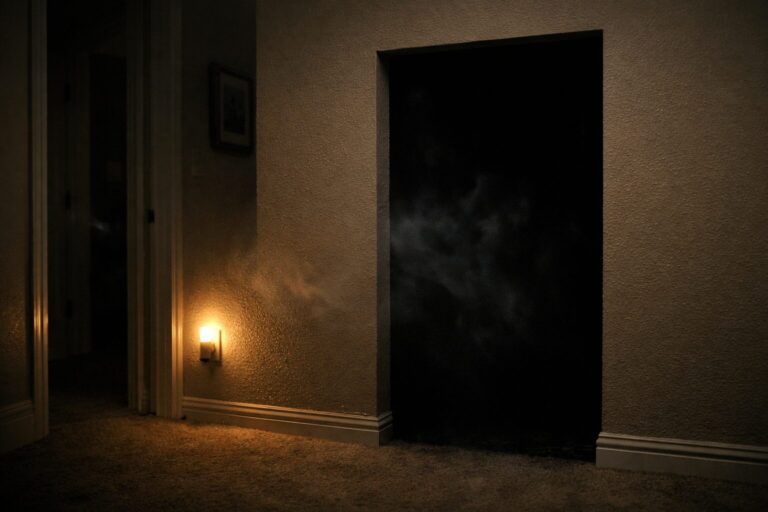
The Legend of the Lantern Man
Where I’m from, you learn the roads by flavor more than by name—the chip-and-seal ones that smell like tar when it rains, the switchbacks where the creek carves the hill into a throat, the straight, wind-burnt ones that cut fields until the earth gives up on pretending it’s anything but sky. And, if you grew up here, you also learn the old warning: after midnight, if you find yourself turned around in the hollows, don’t follow a light. People call it the Lantern Man, said with half a grin and something like caution behind the teeth. He’s been seen along County 12 and the Turner Hollow cut, a warm, low glow that keeps pace with a car. Ask six people and you’ll get six versions—he helps you home, or he walks you the other way; he’s a farmer from the flood years, or a deputy who disappeared; he’s a warning, he’s a dare, he’s a story you tell the new kids so they’ll leave the night alone.
I always figured it was coyotes’ eyes and imagination, or a stray ATV, or the kind of thing that happens when you drive tired and the radio goes to static between towns. That night, I’d finished a late shift unloading pallets at the grocery on the highway and taken the long way back. It was clean cold, the kind that turns your dashboard clock tiny and blue. The fields were slicked with frost, corn stubble glittering under the moon. My wipers stared at nothing; the heater coughed a dusty warmth at my knees. The dome light had cut out a month before, and the glove box, full of receipts and a single cracked map, rattled over the washboard sections. When I left the highway, the last orange of town pooled behind me and then the road swallowed it, two black lanes stitched down the middle with cat’s eyes that caught my beams and released them, bead by bead.
County 12 runs past a tree line that’s nailed in place by fence posts and woven wire, the kind of fence cows respect because their grandfathers did. There’s no shoulder to speak of—just where the blacktop collapses into ditch, then leaves, trunks, secret water. I know that stretch. I’ve walked it in daylight to return a runaway heifer, watched where deer cut a path between two sycamores leaning into each other like gossiping old men. There isn’t, and never has been, any sort of service road tucked into that timber. The first wrong thing was small: a glow, distant and honey-colored, moving along the tree line as if a person were walking with a lantern where there is no path. I saw it straight on through the windshield, then out of the corner as it kept pace for several heartbeats, the way a reflection follows a boat. It bobbed low, steady and warm—not a headlamp, not the hard white of LED, not the grassfire blue of a phone screen. I reached for explanations by habit. A neighbor checking fence. A kid setting coon traps late. A tractor, maybe, though the sound would have carried, and that color of light was wrong for a tractor by twenty years.
I eased off the gas until the whine under the hood turned into a hum. Gravel crackled under the tires where the county had patched the edge with a half-hearted stripe. I glanced away for a second to the rearview—the darkness there is a thing, a weight that sits in the back seat and waits—and when I looked forward again, the light was gone from the timber and had reappeared ahead of me, around the bend where the poplars thin. It wasn’t brighter or farther, just placed new, like a thumb lifted from one point on a map and pressed down on another. It kept its distance as I rolled on, always just beyond my high beams, a mouthful past where the road turned from what I knew into shadow someone else knew better.
Between songs, the radio hissed, the station falling to a faint beat like a heart behind a wall. The clock read 12:43 in pale segments. I told myself to stop being a child and to watch for deer. I raised and lowered the beams. The warm light glowed tolerantly, as if the road was mine to fuss over and it had nowhere urgent to be. When I sped up, it lifted a little over the shoulder, taken by the slight wind the car made, and when I slowed, it waited. The steering wheel felt heavier, or my hands did. In my head, I could see the county map pinned on the wall by the post office, fields squared, creeks named, the old railroad grade a thin memory line. There were no intersecting lanes here, no driveways. There was a shuttered tobacco barn a mile ahead and, to the left, only holler and ridgeline.
I came over that small rise where the sweetgum throws shade even in December, and for the third time the light had shifted, appearing not on the right near the trees but ahead, centered like a slow star just above the asphalt. The flame inside it seemed to move inside itself, a tongue testing glass. There was still no engine noise but mine. I tried to put my brain on work, on the forklift that stuttered in reverse, on whether I’d locked the stockroom, on the stain I’d never get out of the denim jacket warming my shoulders, but thoughts slipped off, fell behind the car like the paper cups skating in our tailwake every fall when kids toss them out the bus windows and they follow for a while, then give up.
I told myself I’d pull over, that I’d get out, that I’d look the nothing straight in the face and scrape whatever childish burr this was off my mind. The frost had spread a thin film over the road’s low places, and the air through the cracked window smelled like cut sumac and whatever lives under leaves asleep. I braked to a stop with the light ahead of me. The engine idled like a big animal trying to be quiet.
It took a full breath after I stopped for me to see the figure. It did not arrive; it was there in the beam-line as if it had been the whole time and I was only now learning the trick of looking. Adult-sized, not hulking or slight, wrapped in something that might have been a coat or just the dark hanging loosely. The lantern was old, the kind with a wire bail and a cage around the glass, the globe tinted with the smoke of a hundred nights. The hand—or the suggestion of where the hand would be—held it low so the pole of light laid itself across the wet in the road and picked silver out of the gravel. I could not see a face. I could see where a face would be if the light would lift, and I knew—I knew down in the place that tells you not to put your palm on a stove—that I did not want it to lift.
The world around the car drew tight. Crickets said what crickets always say, which is only more night. Somewhere far into the timber, a branch cracked, no louder than a knuckle. I thought of something dumb then, that if I leaned across and rolled down the passenger window I would let something in that was already in, or let something out that had nowhere to go. The heater’s fan changed note when I turned it lower, the only sound I made other than the rough wet of my breath. I said, as if to a trespasser checking fence with me in daylight, You all right out there? The voice I used was the voice my father used when talking to shy dogs, grain-sweet and cautious.
Nothing replied. The figure did not tilt when the night wind moved the roadside grass. The lantern’s flame did not gutter as if it were sealed in something the old world knew to make and we’ve forgotten. I tapped the horn, the smallest blip. The sound was ugly in that quiet. The figure did one thing only: a careful backward step, a sliding away of shadow from where shoe soles would peel off the grit. The lantern kept its plane, steady as if set on a table. A second step, and the road in front of me became only road again, the reflection of my beams on wet and not the trick of someone else’s light falling and taking itself back. If I dared say it blinked out, that’s not quite right. I simply couldn’t say, for a piece of time I won’t guess the length of, where it had gone.
I sat long enough that the dome of the moon shifted a notch in the black. The rearview held only the guttered tunnel of where I’d been. In the driver’s mirror, the ditch grass leaned and stood, leaned and stood. I put the car in gear because leaving was what my body wanted. As I rolled forward, a stripe of warmth brushed the passenger side like someone walking with me just off the shoulder, lantern carried low. I kept my eyes on the lane lines. The light, if it was there at all, always stayed one breath beyond my reach.
Town rose out of the road slow, the way it always does: first the billboard for tree removal, then the feed store’s motion light jittering over moths, then the gas station canopy scalloped in white. By the time I hit Main, the lights felt like something important I had almost forgotten the words to name. The stoplight at Oak turned green for nobody. I parked under the crooked arm of the streetlamp by my building, the kind that makes everything a little jaundiced and forgiving. My hands had prints of the steering wheel’s leather grain pressed into them. Upstairs, I almost laughed at the picture of myself afraid of someone out hunting raccoons, some old-timer waving a lantern because the batteries went dead. I made tea I didn’t want and let it go cold.
Morning made it easy. Sun climbed up through leafless branches and glazed the cars parked like dominoes along the curb. The air had that mild damp the ground keeps in its pockets all winter. I headed down for work early, hoping the hum of the walk-in cooler and the idiocy of stocking cereal would wipe out the bad taste in my mouth. I clicked the fob and the car hiccuped. When I rounded the front end to the passenger side to toss my bag in, I stopped. There, across the glass of the passenger window, was a wide, dark smear. At first I thought it was just the prints from kids’ hands, the greasy stamps you see in October when they draw ghosts with their palms and run, but when I touched it two things were wrong. It wasn’t greasy; it was dry, powder-fine, black that came off on my fingertip with a gritty shine. And it smelled like the inside of an old stove door, like the throat of a chimney that hasn’t drawn right in years—cold, stale soot, the old kind.
The mark wasn’t a hand. It arced low and narrow, as if the rounded base of something had rested there, then slid an inch as it was lifted away. I chased explanations the way a man chases his hat in wind—neighbors with oily hands, a truck’s exhaust belching close, something rubbed against it in the night. The woman in 3B had moved her potted mums to the sill and the soil was damp, but the dirt on my glass was the wrong kind of black. There isn’t a woodstove in our building. The nearest chimney is on the bakery two blocks over, and the wind had been still. I rubbed the spot with the cuff of my jacket. It only blurred, widened, pressed itself in as if that side of the car had been near something old and burning a long time ago.
I wiped my finger clean against the denim as best I could and got in on the driver’s side. When I pulled the door shut, the faint smell of it came with me and sat in the cabin, stubborn and tired. I drove to work careful and slow, paying attention to every intersection, like someone who has learned the difference between being led and simply going where the road goes. For a day or two the smear remained on the glass no matter how I tried to coax it away. In the mirror, when I backed into my spot behind the store, my own face floated faint over it, as if I were looking through one thing to see another, as if light has places it prefers to be and sometimes remembers them.