The Same Room Appeared in Everyone’s Nightmare
They were talking about sleep because everyone was tired in the particular way workers get tired by March, greyed out by overhead light and the recurring microwaved smell of lunch. Someone said the trains kept pausing in tunnels again. Someone else blamed the pollen count. The man who ran reports that no one read said his upstairs neighbors had started moving furniture at two in the morning. They were around the long table near the kitchenette, stirring yogurt into coffee, stabbing at hard fruit with plastic forks. Fluorescents ticked. A printer down the hall chattered and fell quiet.
She didn’t bring it up. The woman who always wore a shawl did. Hers was the kind of tired that finds a surface for itself in complaint and then sits a little easier afterward. “Bad dreams,” she said. “All week. Like, not even interesting ones. I wake up with my heart going but by the time I get the words for it, it’s gone.”
“Same,” said the new guy, flicking sugar packets between his fingers. “I’m running on fumes. Keep getting to that part where you realize you’re dreaming, but it doesn’t give you the off switch.”
A couple of them nodded. The office manager made a face about melatonin and said something about REM rebound she’d half remembered from an article. A beam of thin sun slid across the break room floor from the hazard window in the stairwell door, moving slow as the clock. The woman with the shawl pushed a napkin into quarters. “Mine keep ending in this empty place,” she said, almost as if the words were nothing until they left her, and then they were too much. “Like I’m in different stories, walking the dog or in the cereal aisle, then suddenly I’m in this room facing a closed door. And I can’t open it, and then I wake up.”
“Wait,” the reports man said. He had an accountant’s sort of voice, careful around numbers even when he was using words. “Empty room, no window? Beige carpet, kind of bubbly in one spot?”
Her hands stilled. “Yeah,” she said slowly. “That bubble by the corner. And that smell like a copy machine left on.”
“Okay,” the new guy said, not quite joking now. He set the sugar packets down as if they were heavier than they had any right to be. “I had that room two nights ago. The carpet felt gritty. The baseboards had that grey film on the top where the dust sticks and no one ever cleans. It’s not a dream, it’s—well, it is a dream. But it’s the same one.”
She listened to them describe the shape until she realized she was hearing her own private thing with her own private wrongness translated into other mouths. Her dreams were always different at the front end. One night she was late for a train. Another, she was in her childhood kitchen with a new calendar still wrapped in plastic. The doorbell would ring in one, a dog would run off in another, then a hallway would be longer than it should be, the light would have that stale violet tone fluorescents get when they’re about to go, and the edges of the hallway would blur. She wouldn’t remember the steps between; she never did. She knew only this: the last second always ended in the same space with the same door that would not open.
“There’s no window,” the reports man said. He had his eyes on his coffee, not looking at anyone. “But there’s always this square of light on the floor like there is one, you know? It’s not a shadow, it’s like something is pretending to be a window.”
She had never told anyone that. When she told herself the dream during brushing her teeth, during the elevator down to the street, she left that part out because it sounded ridiculous. There was no window. There was always a bright lozenge of light moving up the wall as if across the day, very slow, and it came from nowhere. She had been so certain that was the private strangeness she was bringing to it, some little flourish of the mind’s, something that belonged only to her.
“How many dreams?” the office manager asked, but her voice had softened. “What do you all mean the same room?”
They told her, each cutting off at the same point, each uncertain where sharing turned into something else. They did not say haunted. They did not say message. No one said curse. They said work was busy and maybe the light in winter did something to them. They said they had been watching too many crime shows, that they needed to put their phones in a different room at night.
“Let’s try it,” the new guy said then, and she could see a shiver under his humor, like a layer of ice in a glass. “We draw it. Without talking. Then we compare.” He was already riffling for paper; there were always pads of paper by the printer no one used for anything but doodles during meetings. He tore off sheets and flattened them with the heel of his hand. He set pens out like he was dealing cards.
“No cheating,” he said. “Eyes on your own psychic experience.”
She wanted to laugh. She did not. She drew the rectangle first: awkward, long, slightly not square because in the dream the room felt wrong, stretched by a thumb pressed into soft dough. She put the door at the short end opposite the place she stood. The lever handle was on the right. The hinge-side paint had a curl. She had never looked at it directly in the dream, but her skin had seen it on the way to her fingertips, and that was what she drew. A square of light went near the left baseboard and crept toward the middle—she put it there not as a window, just as a shape of light with no source. She drew the stain she had memorized by accident the same way you memorize bus schedules without wanting to: an uneven, darker halo in the carpet toward the corner, shaped like a lopsided island. She put a tiny circle on the ceiling because the room had a motion sensor whose green light ticked like breath. She added the place where the carpet failed at the threshold, where it left a bare strip of glue and concrete visible under the door. Without thinking she made a dot for a screw that was missing from the switch plate, a smudge that could have been a fingerprint or oil from a thumb.
Beside her, pens moved on paper. Someone sighed, then held their breath. A microwave rotated something and chimed, unnoticed. The printer down the hall chattered and fell quiet again. She drew the baseboard with that lint-grey stripe that comes from the way vacuums miss the edges of rooms. She shaded where the ceiling tile above the door was a slightly different white, water-marked in one corner like a bruise.
They turned their pages over at the same time.
The papers did not match in the way a copier would make them match. They matched in the way childhood recollections do when you and your brother sit at a kitchen table and argue and then realize you have the same wrong picture in your head. The door was in the same place. So was the motion sensor. Every one of them had put the light shape on the wrong wall for a window to cast it and not one of them had drawn a window. Three of them had remembered the missing screw from the switch plate, and two had remembered the paint ridge on the hinges where someone had painted over metal and the door had gummed shut a little at the top. The stain in the carpet was not an exact island on any two sheets, but the islands were all in the same corner. The baseboard scuff, the heavier dirt where feet turn in, were drawn with the casual authority of people reporting what they had learned by touch.
“I don’t like it,” the shawled woman said finally, in a voice like a hand on a tabletop during a late conversation. “I don’t like how the air feels in there.”
“It’s the humming,” the reports man said, and he swallowed. “You don’t notice it at first. You notice when it stops.”
They laughed a little then, as if that could make it dissolve back into the manila of office days. They told themselves it was a neat coincidence the way weather is neat when it happens to other people and does not ask anything of you.
In the afternoon, the light went a duller grey. People went back to their tasks and took turns looking up to see the little web of pens and sketches remain where they’d left them. The room of their dreams sat between the lip of a yogurt container and the office microwave. Ledger screens changed numbers. Phones buzzed with quiet insistence and were ignored.
It was nearly four when the bookkeeper came to stand by the long table and said, not loudly, “I heard something, last night. Behind the door.” She said it like it had only now, in daylight, become reportable. “I try the handle every time and it won’t give and that’s when I wake up. But this time I didn’t try. I stood there. And it knocked.”
She didn’t mean loud pounding. She held up her hand and tapped the table with one knuckle, measured and patient, the way someone in a waiting room might tap out their place in a thought. The taps were evenly spaced. She did them three times. Everyone watched her hand. Someone shifted their weight so their shoe made a sigh against the linoleum and then no one moved again.
“It wasn’t angry,” the bookkeeper said, almost apologizing. “It was just—like you do when you know someone is there and you want them to open up.” She shrugged and pressed her lips together. “I woke up after. I didn’t open it.”
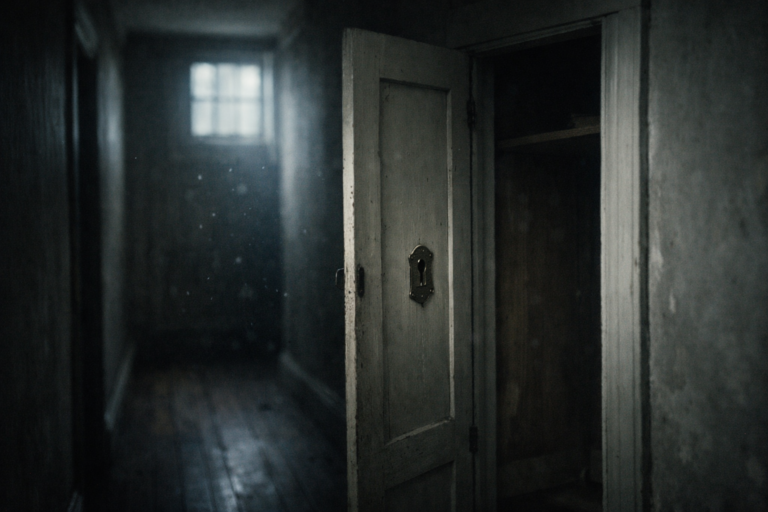
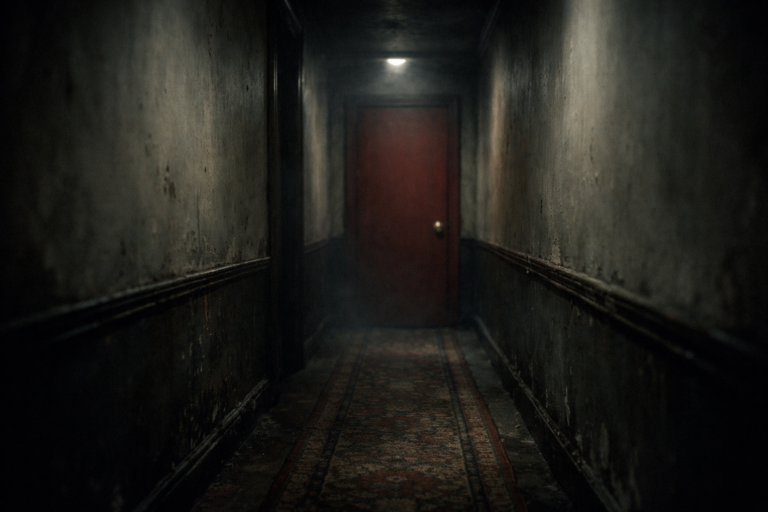
They had a meeting at five about next quarter’s projections. They had a deadline the following morning. They had emails from clients with mild urgencies in their subject lines. For an hour, they performed their jobs like people performing their jobs, and then one of them had to go to storage for paper towels and walked down the back hallway where no one went unless they needed a ladder. There, across from the supply closet, there was a door he had never noticed, the color of chewing gum, with a blank metal placard screwed into it that had never had a name plate slid into it. He stood a moment too long, then went to get the paper towels and said nothing until he came back through the kitchenette and set the roll down and said, as if the words were heavier than he’d calculated, “There’s an office down the hall I don’t think we use.”
They did not go, not at once all together with their sketches like children on a field trip. They went in twos, on pretexts: coffee and then the long way back; a question of where the catering invoices lived in the file system that no one liked; a stop to check if the old HR binders had been recycled yet. The door was there for each of them, exactly as a door is when it has always been there and has never once been seen. The placard was blank. The paint had a run in it near the hinges where someone had tried to hurry on a second coat. The threshold was raw where new carpet met old concrete in a little lip.
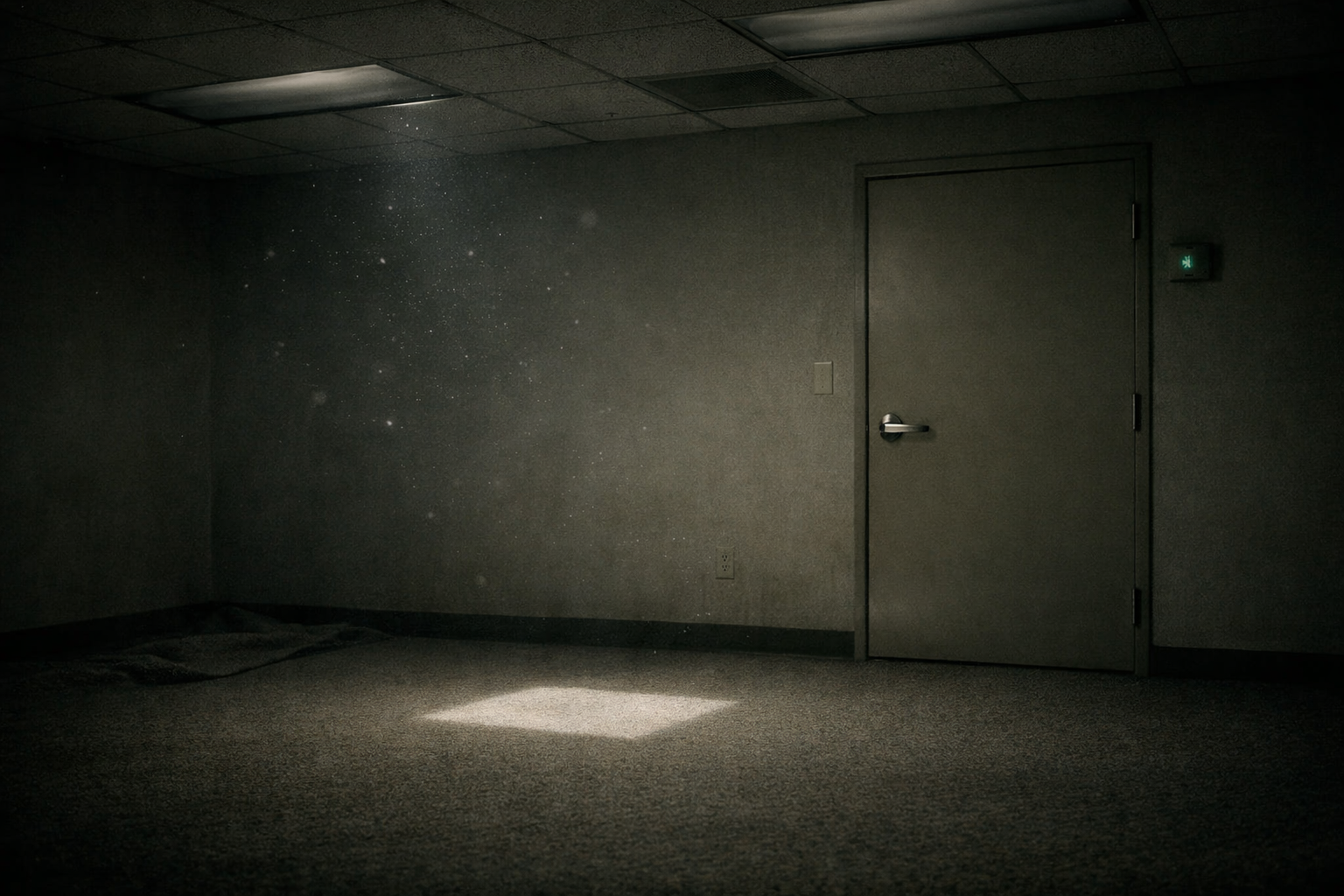
The office manager had keys, and she did not want to be the one to turn them. She did it anyway. The key slid in. The cylinder turned like a body deciding how to rise from a chair. The click was small and final. They pushed the door in. The motion sensor’s green eye blinked awake as if taking a breath, and the fluorescents came on with a hiccup. The smell was of paper warmed by light; of toner that exists even when the machine is off. The carpet was cheap and already tired in the corners where no one had walked. It was a beige that could be anything if you stood in it long enough.
It was, of course, hard not to look for every detail at once and find them all. The square of light was there and not there; a lighter square on the floor, not cast by anything, not moving now because time in offices at four-thirty in the afternoon is both fast and paralyzed. The baseboards were mounted fractionally crooked. A screw was missing from the switch plate. Someone had left a faint thumbprint in the paint near the handle sometime during installation. A ceiling tile toward the far end was bruised with an older leak. The carpet had a bubble in the corner, small, where it had been stretched badly and tacked worse. They were breathing too hard. They were not speaking.
And opposite them, in the short wall, was another door, closed, with a lever handle. The kind you could call a closet or a server room or that awful word “utility,” which makes any place seem less than it is. It was painted the same chewing-gum beige. The hinge paint had a curl to it. The lever had been caught by many jackets, it seemed, and had a scuff on the right where metal had scraped paint. In their drawings, in theirs and hers, she was sure it had been on the left. She was sure.
“I thought—” the new guy started, and then he didn’t know what he had thought. They stepped in because there was no other way to be in that room except to take a step in and feel the drag of that carpet that was exactly the drag in the dream, the grit that is less dirt than the memory of it. The door swung shut behind them with that Saturday-office weight. The motion sensor blinked. Someone’s phone tried and failed to find service and gave up.
She was the first to face the interior door because in her dreams she was always there already facing it as if she had teleported to that last place, as if the room only existed for her there. She looked at the handle. It gleamed a little in the office light with nothing like intention. She did not touch it. She did not intend to touch it. She realized, with the kind of calm that belongs to people who are not yet in their own story, that she had not intended to walk down the hallway either, not in any way she would have been able to admit to herself.
Behind the lever, at the edge of perception, there was a line of shadow on the floor. It was no thicker than the line you get when a door is closed and a light is on in the space beyond it. It might have been nothing. The fluorescent above them flickered and held. They had all made the same room without meaning to. The hum was steady. Then, like a breath taken in, the hum stopped for a fraction of a second. They felt it more than heard it—the way you notice silence when something that has always been there steps away.
Someone laughed too softly. The sound made other sounds shrink.
It was not urgent. It was not theatrical. It was simply there, at the place where the handle met the door, moving through wood with the patient mathematics of touch: knuckles, once; a space you could count; knuckles, again; another deliberate pause; then a third time, identical beat for beat to the sound the bookkeeper had tapped onto the break room table a little after four.
None of them reached for the handle. They didn’t step back either. The square of light did not shift. The motion sensor blinked its single green metronome. Every remembered wrongness snapped itself into rightness with a sound that was maybe only inside her head and maybe the air settling in the vents. Behind the closed door, something not unkind and not anything you could name waited in the way people in offices wait, sure you will eventually finish what you are doing and look up.
Somewhere out in the main room, the printer woke itself and chattered and fell quiet again. The light above them held. The knocking did not come a fourth time.