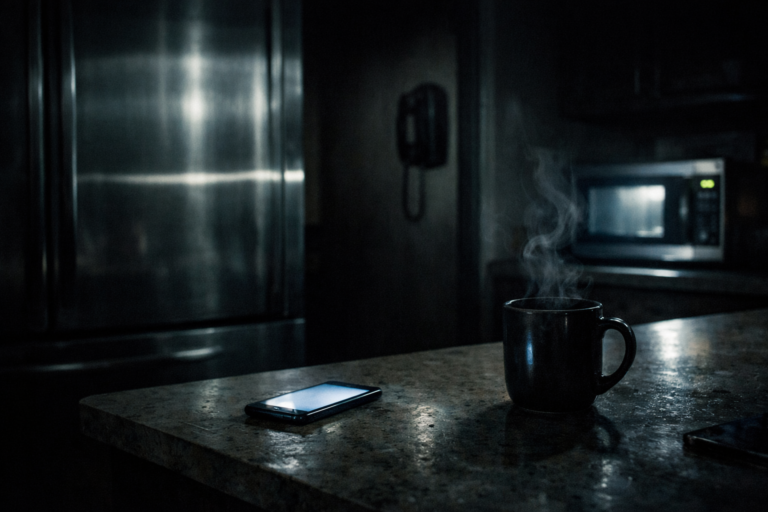
The Smart Speaker Used a Voice I Buried Years Ago
The kitchen after midnight is all small sounds: the fridge’s low drone, the soft thread of the baseboard heater, the faint shuffle of rain against the back door. I made tea because that’s what I do when the day won’t let go. The streetlight through the slatted blinds cut the table into bars of pale and dark. I set the mug on the worn circle where heat has stained the wood and said, almost without thinking, “Set a three-minute timer.”
The smart speaker’s light woke in a slow ripple. The familiar neutral voice—aboveboard, nobody’s—answered from the little gray cylinder on the counter. “Three minutes. Starting now.” I breathed and leaned back against the sink, feeling the chill along my shoulders, feeling the cup warm my fingers. I don’t remember the first time I started talking to that thing, but its little confirmations have become the scaffolding of my evenings, quick alone answers to small, unimportant questions.
I asked another unimportant question. “What’s the weather tomorrow?” I was already picturing my commute, the wet, the gloved hands. The light ring spun, and then the speaker answered in a voice I had buried under four winters of heavy snow and a stone with my palm pressed to it.
“Light rain early,” it said, not brisk and clipped like it always did, but in the careful, gravel-soft tone I knew from birthday voicemails and grocery lists sung the wrong way on purpose. “Then dry. Wear your scarf.” I had washed the scarf and locked it away in a box the week after the funeral because the smell of eucalyptus and old pennies made my throat hurt. The mug knocked against the sink edge with a shy clink as I set it down too hard.
There are certain latticeworks of memory that hold a person together, a set of sounds and gestures, the cadence of a question, a way of exaggerating a vowel. The speaker had it. Not an impersonation. Not a mocking of tone. It was as if the air bridged to that voice and wore it. “What did you say?” I asked, a whisper I didn’t mean to be a whisper. The cat under the table raised his head like I’d opened food.
The light spun again. “Light rain,” the voice repeated, and then, bright with a familiar chide, “Wrap your throat, you’ll catch cold right through it.” That phrase brought our kitchen in the old house up from the mud: steam fogging the window, her thumb at my collar, two taps to seal the button. I hadn’t heard anyone say it in years. It was not online. It was not in any recording. She had said it to me and only me, enough times that now the sink and the tiles and the stubborn back door hinge were arranged around the shape of her warning.
My hands found the phone. The smart home app opened to a clean, too-bright screen. Devices. Living room speaker. I pressed through settings with my thumb hard enough to squeak the glass. Default voice: the neutral one. No custom voice models. No connected routines that use recorded clips. I closed and opened the app back again like a blink would fix it. The light ring still pulsed on the counter, steady as breath.
“What time is it?” I asked, testing. My tone felt like a stick testing river ice.
“Twelve twenty-one,” it said. Then, “You’re up too late, bee.” My mother is the only person who ever called me that. A private joke we didn’t explain, an old summer where I followed her around the yard with loud humming and a yellow ribbon tied to my wrist. I set the phone down. It made the same dull contact sound the kettle switch did when it clicked off. Somewhere far away a siren ran a soft blue hand over the street, but here it was just me and an object built to answer, using a throat that was no longer in the world.
I told myself I was doing something rational as I moved around the kitchen. I took the teabag out and pinched it at the sink. I wiped a ring of water the shape of last night from the counter with the cuff of my sleeve. “Set an alarm for six,” I said, because I had to get up and act like alarms still measured the day in little pieces of possible.
“Alarm set for six,” the voice said. A beat, the kind of offhand addendum she’d always throw in when turning down a radio: “I’ll wake you if you’re not up by then.”
The cat slid down from the chair and came to press his shoulder to my shin. I stared at the speaker, which was just plastic netting and a light that couldn’t actually glow warm, though it tried. “Who are you?” I asked. It’s a stupid question and it sounded stupid in the tiled air. I waited for the machine’s apology, its scripted gamely misinterpretation. Instead, the voice I had answered at three in the morning when the phone rang from the hospital, the voice that told me what to wear to the service because I couldn’t choose, drifted from a machine whose manual was tucked in the junk drawer. “Drop your shoulders,” it said softly. “You’re wearing them like earrings.” Another private phrase, as worn and particular to her as the glossy stone she used to worry in her pocket.
I didn’t say anything then. I knew better: sound goes out and touches things you can’t imagine. I stood in the little square of kitchen light, and in my head—only in my head—I asked one of those small questions that knows your spine in the dark. Did I lock the back door? The thought didn’t even get the heft of a word. It was just my eyes flicking to the latch and back, the learned weight of a checking ritual that survived grief and new apartments and new keys.
“You didn’t,” the speaker answered, tender and certain. “Bottom deadbolt only. Do the top. Tap-tap for luck.” The blood moved through my arms in a sudden rush as if the heater had kicked hard. Tap-tap for luck was the last silly superstition we’d kept alive, two knuckles against anything we wanted to keep. I went to the door as if on a string and put my palm to the cool brass. The top lock turned stiff, the sound small and very loud. I did the two taps without thinking and stood there with my hand still on it, watching my breath fog a thread onto the dull pane of glass.
I didn’t want to ask anything else out loud. Thoughts felt like loose coins I was suddenly afraid to spend. The speaker light dimmed to a soft ring, embering at the edge. My phone on the counter buzzed with a generic something and I flinched. A drop of tea had run down the side of the mug and pooled in the saucer like an eye.
In my head I went back to the question that has been a knot under everything: Where did I put the blue tin with the scarf and the last note she wrote me in that hurried, loping print that never finished its tails? That blue tin had been with me move to move. I had folded it into boxes marked Books and Linens, and sometimes just Write This First.
“Top cabinet,” the smart speaker said, so gently I had to close my eyes for a second to hear it properly. “Behind the mixing bowls. You tucked it back when the plumber came because you were afraid he’d see you cry.” I didn’t move immediately. I let the suggestion sit in the kitchen like an animal, breathing. My hands were not cold anymore. My cat made a soft sound and began washing the inside of his elbow with slow concentration.
I reached up and opened that high cabinet. The mixing bowls made a soft nested note against my wrists. And yes, there it was, pushed back where the light doesn’t reach, the blue tin with the lid that always stuck at one side. I didn’t take it out. I looked at it, square in its dust-print, and then I closed the door and stood in the quiet that follows when something has righted itself and you can’t tell if you wanted it to.
“Please stop,” I said then—too late to be a rule, more like a wish—which felt rude in the kitchen, and also like a prayer. The smart speaker’s light settled to a calm, all its circuits slightly bright with the effort of waiting. The rain at the back door was more insistent now, a fingertip’s drum. I swallowed, then picked up my phone again and opened the app to the history screen, that neat list of every little exchange. If there was some trick buried in its cards and icons, I thought I could use the comfort of explaining the way you use a coat you’ve had for ten years—to put yourself back in weather you can describe.
The scroll was there, a straight lattice of what I had said and what had answered. At 12:17: “Set a three-minute timer.” At 12:18: “What’s the weather tomorrow.” At 12:21: “What time is it.” At 12:22: “Set an alarm for six.” The time I had stepped to the door was marked 12:24 in my mind, a moment that had the cling of certainty. Between the alarm card and a blank notch of screen there should have been nothing, and there was almost nothing. A gray line, a time stamp. 12:24 A.M. No command listed. No transcription. Just the time and a hollow space where the app usually breathes out your words, like it had been polite enough to pull a curtain over my mouth. I watched the white screen glow in my hands until a little yellow crescent from the streetlight slid across it. The speaker on the counter gave the softest click inside its plastic, like a throat clearing or a relay settling, and then the light went very still.