
The Voicemail Came From a Dead Man’s Phone
Content note: bereavement
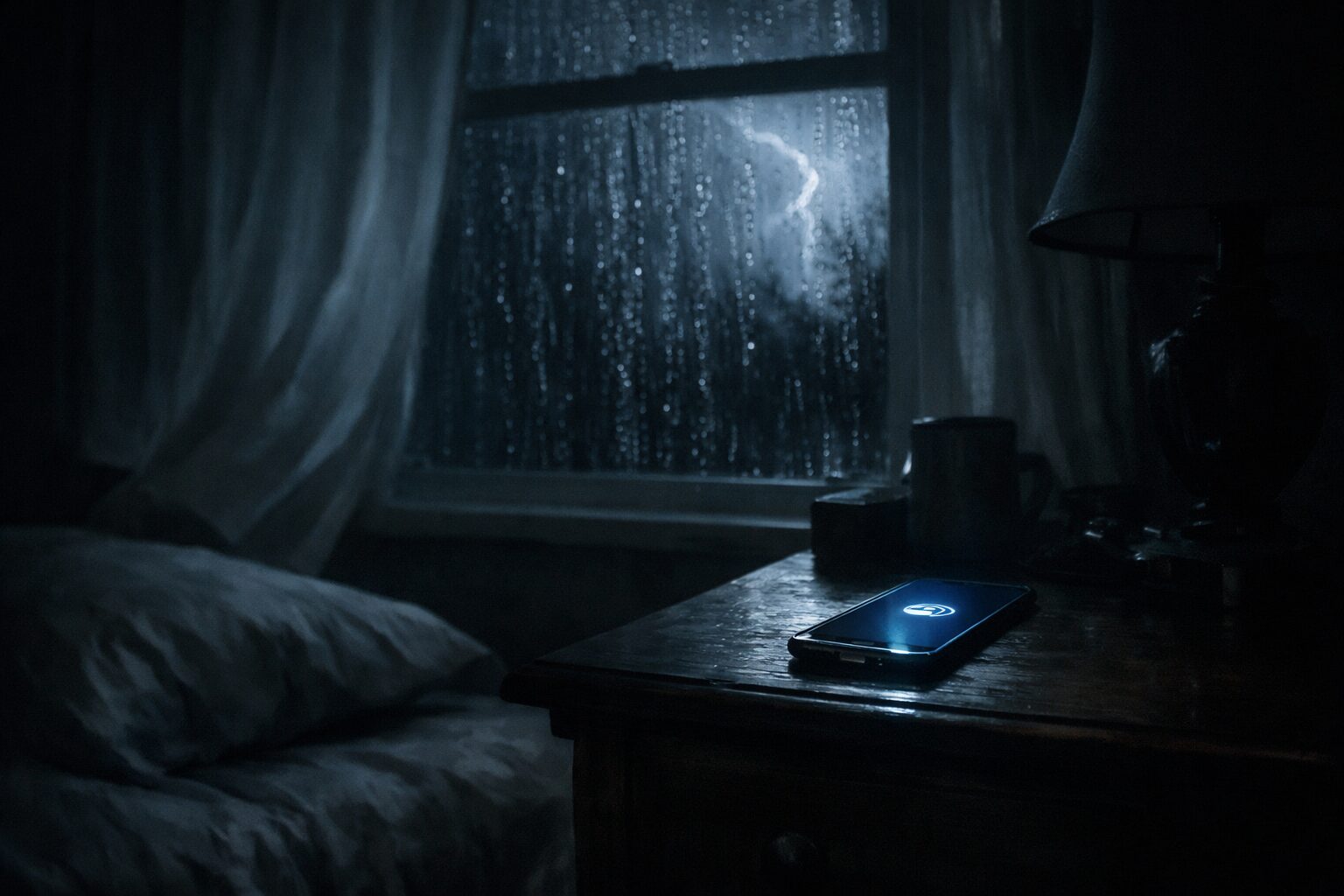
I couldn’t sleep. The storm crawled across the roof like something with too many feet, rain needling the windows in a rhythm that never matched my breath. The clock on my dresser said 3:14 a.m., red digits bleeding into the dark, and the room kept brightening in these soft blinks whenever lightning crossed the street and flattened all the trees into cutouts. I had left the window cracked earlier, before the rain turned mean, and now the curtains breathed in and out like the house was nervous, too. When I gave up on lying still, I rolled over and reached for my phone.
There’s a hush your body learns in those late hours, like if you move too hard you’ll scare off what calm you had left. My fingers fumbled at the charger, and that glow lit up the nightstand in a little pool. The storm made the old wood pop — a tiny gunshot every time the wind pulled. My lock screen was a collage I hadn’t changed because I didn’t know what to change it to. Notifications stacked there, harmless rectangles. A weather alert. A reminder I’d snoozed twice. The red bubble over the phone icon at the bottom showed a single ‘1.’
I tapped it without thinking much about it. Voice mail, the missed-call tab told me. The service in our neighborhood goes in and out when storms pass, like we’re part of the storm’s decision to linger or move. Usually anything that shows up at this hour is spam, or some wrong number getting drunk and sentimental. If I was honest, I was more interested in the act of doing something than what it was.
But when the voicemail screen opened, the name above the little audio bar wasn’t “Unknown” or a city I didn’t recognize. It was a ten-digit number I knew too well. That string hit me the way a certain smell can swing the room around you. The periods between the numbers arranged themselves into the shape of his name before my brain even caught up.
When Evan’s sister canceled his plan, she did it from his living room while I stood there pretending to read the postcards pinned to his cork board. The service rep’s voice on speaker was bright and practiced. “We’re so sorry for your loss,” she said, and then she made the line go quiet. I learned silence could be a sound that day. So seeing that number again — seeing it simple and dumb as ink — made the room shrink. The storm seemed to pause and press its ear to the window.
I told myself there are a hundred ways for numbers to reappear even when they shouldn’t. Old backups. Spoofing. Somewhere, someone keyed in digits and it landed here. But the red dot on the screen was breathing, and the little sideways triangle waited for my thumb. In the black mirror of the phone I could see my face look a decade older and then younger again when lightning stroked our street.
I pressed Play.
It started with the soft hiss of the world, as if the phone had dialed the inside of a seashell. No voice, not yet. The mic had eaten the storm, I could tell — that smeared, heavy sound like wind on an old tape. Every few seconds there was a shift, a catch, like a breath brushed too close to a microphone. I held the speaker to my ear because the room felt too big for speakers.
Static swelled and receded. A different sound threaded under it. Not speech at first, but the shape of it. The breath again, and then my own name surfaced from inside that ocean, not said yet but almost, the way you feel someone about to say your name and you turn before they do. I sat up. My room creaked, and the curtain lifted and fell against my hand. Thunder rolled downhill somewhere behind the apartments.
Then — very clean, as if someone leaned close enough that the machine couldn’t mistake it — I heard it. A single sentence carved out of the noise.
“You listening, kiddo?”
We used to sit on his porch on nights like this, beer sweating onto our knees, and if my brain went too far away from the conversation he’d snap me back with it. He’d tip his chin at me and say it in a way that made the world narrow into a lighter flick and a porch bulb and the shape of his grin: You listening, kiddo? No one else used that with me. It lived in his mouth and nowhere else.
On the voicemail it was thinner, like the wood of a door asked to hold a voice inside it. But it was there. I didn’t realize my hand had gone to my throat until I felt the ridge of my collarbone and remembered how much skin can feel like paper.
I replayed the message. First there was the ocean of static again, the dragging breath. A cough maybe, or the rain hitting something metal on a porch far away. Then, like someone reaching through two rooms and pulling the nearest thing that looked like me: “You listening, kiddo?”
I let it run out. The timestamp said 2:58 a.m. I never heard the call. Do Not Disturb eats what it can, but voicemail slides under doors. The bar reached the end and stopped. The triangle turned into two slim lines and then back again.
Maybe it was a recording of him, something old the system coughed back up. Maybe. I looked at the number again, bone-familiar. The last four digits on my brain like a song: 9183.
I don’t know why I did it. Grief makes you press buttons you told yourself you wouldn’t press. I hit Call Back.
The storm complicated the first ring; it was half there and then it wasn’t. The second was clearer, and with the third, my ear filled with that soft, wet sound of the line going live but not speaking. When someone answers without hello, you hear the math their mouth is doing, first. I didn’t hear the clicks. I heard the room on the other end finding its edges.
“Evan?” I said, and hated how it sounded in the dark. My own voice made me feel like I had reached across a river to touch something that couldn’t feel me anymore.
There was breath. Not the rhythm of a wind, but the small human betraying of it. Then something made of air, built at the back of a throat, slid across the wire and put my name in my ear. It said me the way he said me — the exact pause between syllables, the kindness soaked through it even when he was annoyed. My name arrived and folded itself into me like an animal finding its old bed.
I swallowed so hard the phone scraped my cheekbone. “Where are you?” I heard myself whisper, because a question with geography in it felt like a way to test if the world still had a map.
The call sighed. The faintest scrape, like someone turned against cloth. Then nothing so much as everything arranged in the shape of nothing. I listened until the listening became most of what I was. Lightning made the window gasp a white rectangle into the wall. The call timer climbed: 00:17, 00:18, 00:19. I didn’t breathe because I wanted to leave room for what might come next.
What came next was not a sentence. It was a breath close enough that I could’ve put my thumb where the mouth would be on the other side of the phone. It warmed my palm.
“You listening, kiddo?”
Only that. Soft as a fingertip on the inside of a wrist. Then the line cracked, made the small sound a jacket makes when you turn too fast, and went dead. My screen showed the call ended, then returned me to the voicemail page. The storm had moved a block in the time it took to change screens; rain now fell in a straighter pattern, like long black hair being tidied by a brush.
The voicemail wasn’t there anymore.
The list was clean, the way hospital rooms are cleaned. No red dot. No number. A white space like I had set a glass down and someone had spirited it to the sink while I blinked. I hit the tab for Deleted Messages, for all the little trash cans I could think of in the interface, for the places the phone keeps its embarrassments. Nothing. The only proof I could summon from the machine was the wet print of my own pulse on the corner of the case.
I sat on the edge of the bed until the room unclenched. The storm paced the block, reluctant to put its head down. Off and on, the building made that hollow wooden complaint of old things remembering they are old. I slid the phone under the pillow and tried to pretend it had never left the nightstand, tried to feel my way back into the plot of sleep.
It was the phone that found me again anyway. Around dawn — that thin gray hour when the world looks like it’s been erased and is waiting for someone to redraw it — I woke up to the unkind idea that maybe I had imagined all of it. Grief slings its weird flares that way. I fished the phone out, thumbed to the search bar because I didn’t know what else to do, and typed his number. The phone suggested recent items as if everything in a life can be filed: Messages, Calls, Voicemail.
The Voicemail line had nothing to tap. But under it, smaller, there was another thing. Transcription. The interface made it look like a shrug. I hit it and a white card slid up — the way everything on screens moves now, like paper you can push with your thumb. Most of it was blank. Where words should be there were brackets, and the polite word [inaudible]. At the top: 2:58 a.m. Under that: [static], [breath], [unintelligible].
I scrolled because I didn’t want to not find it. I scrolled like a person chases a thought through a hallway. There was so much white, so much [inaudible] the phone admitted and shrugged over and perfected into neat brackets. It was almost at the bottom, the line the machine had managed to catch.
You listening, kiddo?
It sat there plain, no punctuation, like it was waiting on an answer. Beneath it, one more bracketed apology, and then the line repeated, as if the software had been so sure and then unsure, as if whatever voice had been speaking had leaned closer to make sure it landed.
You listening, kiddo? You listening, kiddo?


