The Diner Served a Menu From 1978
I had been on that two-lane for hours, the kind of blacktop that floats through fields and under radio towers and—after midnight—feels like it might never intersect with anything but itself. The only color was the dash glow and the pale spray of my headlights on the road’s reflective dots. My travel mug was cold. I’d told myself I’d push through to the next town, then the next, and the next after that, watching the blue dot creep along a line the color of old ink on my phone. When the sign broke from the dark—DINER, arrow bending right—it startled me. I took the turn almost on instinct.
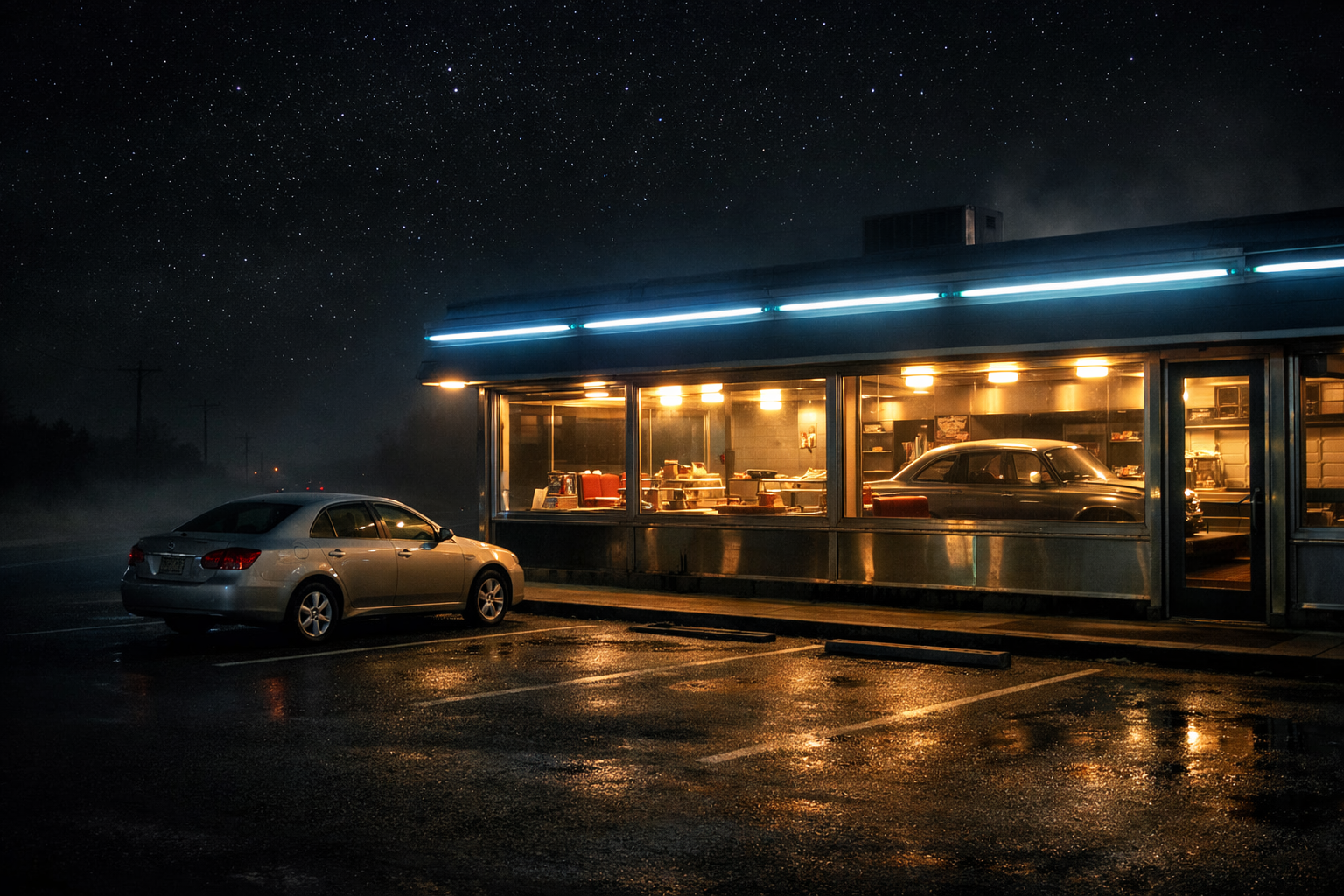
The place sat back from the road with a proper parking lot, fresh white striping and all. The building looked newer than the miles around it: brushed aluminum siding, clean windows without any of the usual hand-lettered specials, the kind of wide glass door you see on recently built chain places. A sharp LED OPEN sign glowed cherry red instead of the tired gas-neon hum I expected. There were a couple of picnic tables under new-looking string lights, empty. Bugs fuzzed around the security lamps and collected like a halo. I pulled in near the windows, killed the engine, and listened to the cool-down ticks under the hood. Through the glass, I could see the outline of the counter and the gleam of a pie case. It looked warm in there, and it looked clean.
The door gave that small hush of a good seal when I swung it open. Inside was warmer than I’d planned for, the air layered with the smell of coffee that had been poured a thousand times and a faint edge of bleach from mopped tile. A jukebox sat where a potted plant might have been, but this one was small, tucked between the bathrooms and a rack of mints. A clock above the grill wore a red rim and a white face with black numbers as tidy as a dentist’s, the second hand twitch-ticking forward. A woman behind the counter—late fifties, I guessed, with a careful brown bouffant and a pale blue uniform pressed crisp at the shoulders—looked up from polishing a mug and smiled without showing teeth.
“Sit where you like,” she said. Her voice had that soft county way of making it feel like you’d been expected. I slid into a booth by the window, the vinyl whispering. She brought me a water without asking, set down a thick white mug, and placed a menu in front of me. It was the first wrong thing.
The menu looked like it had survived a drawer for too long—laminated but somehow soft at the edges where fingers had tested it. I was halfway through a glance when the bottom line caught me: Effective June 1978. The date sat there plain as anything, not celebrating itself, not coy. The prices stacked above it had their own small shock. Coffee .35. Two eggs with toast .95. Hamburger plate 1.50. When I flipped it over, the back had a list of pies with a single-spaced line note about supply depending on deliveries. The phone number was local and began with two letters—EM 5-3311—as if a lark dreamed up by a graphic designer. A corner of my brain offered up the thought of a theme—some retro night with props hauled in for the crowd that wasn’t here. My fingers left a clean track in the laminate where a little film of dust had collected.
“Coffee?” the woman asked, already holding the pot. The pot was glass with a black handle gone soft at the edges, and the coffee came out dark and sure. The mug was heavier than I expected; I had to adjust my grip. The sugar packets in the little caddy had a cheerful logo I didn’t recognize. The waitress—her nametag wasn’t a plastic bar but rather her name stitched onto her uniform in looping thread: Evelyn—didn’t seem to think anything about this needed explaining. “You driving through?” she asked, pencil poised over a pad with blue lines, the carbon paper peeking from beneath it.
“Yeah,” I said. “Long night.” I tapped the menu. “These prices… you running a… throwback thing?” I tried to say it like I wasn’t some city person making fun. She just wrote 2 eggs, bacon, wheat in a neat hand and, without looking up, said, “Prices are what they are. You want jelly or butter?”
Somewhere plainly in the room, a radio fought a little static. Not the bold FM we’ve gotten used to, but AM with that tight focus that seems to make everyone sound like they’re speaking into a tin cup. A man’s voice—the DJ—was talking low, that companionable way that gets between dozing drivers and the road. He mentioned farm reports. When the song slid in after him it fit like a hand in a glove: a soul ballad I didn’t know by name but could have guessed the year on if I’d needed to. In the spaces between the notes, I could hear the kitchen’s hood fan and the sizzle of something finding the grill. I could also hear the dead, long miles outside pressing the windows, a kind of winter silence even though it wasn’t winter.
My coffee tasted right enough, strong and a little bitter. The second hand on the clock jerked forward. I took out my phone to check the time—a reflex more than a need—and saw 12:09 a.m. and a single bar stuttering on the signal, then going out. It struck me how bright the room was and how new the building had looked from the road. The countertop had no coffeeshop pen doodles on it, no gouges in the laminate. The tiles in the floor were uncracked. The stools didn’t squeak. The grill, though, wasn’t some chrome island; it was old iron, black and dignified, and Evelyn worked it with the easy grace of repetition.
She brought my plate with eggs whose edges crisped just right and bacon curled into little question marks. Toast came buttered under a napkin, the butter pale as cream. Salt, when I tapped it, came out reluctant and clumped as if it had spent a summer open. “Anything else?” she asked. I was about to say no when the radio broke for what sounded like an advertisement for cassette decks at a local hardware, the price low even for nostalgia. The DJ came back to remind folks about a Friday night dance at the fairgrounds. It occurred to me this was a lot of commitment for a theme night no one was attending.
Outside, through the clean plate of the window, my car sat alone under the pole light—a silver sedan wasting that small amount of heat that breathes up the hood when a machine cools. A moth flung itself against the glass and fell. I ate. The eggs cooled fast. A man in a cap at the far end of the counter had been there and hadn’t, in a way that I can’t explain better than to say I noticed him when he moved his spoon and not before. He was stirring coffee like he was unraveling string, slow and careful. His reflection in the pie case was steadier than he was.
It was in that same glass—the curved face of the pie cabinet—that my stomach gave out. The reflection of the window above my booth threw back the lot in a shallow arc. In it, I saw not my sedan but a boxier car, something with a big chrome smile and a squared-off roofline. It was the same dull silver as mine because that’s what first let my mind accept it. Then I noticed the shape was wrong, the way the window pillars met, the way the rear glass cut down. It wasn’t a trick of angle. In the reflected back seat, on the hump of old upholstery, lay my brown canvas jacket, the one I’d tossed onto my own backseat without thinking, cuff folded under itself where I’d snagged it on a door and never bothered to fix it. In the reflection, the jacket was exactly that, with the same thread pulled into a tiny loop at the left pocket. The second hand on the clock above the grill stalled against twelve and stayed there, a little red finger doing all its trying. I turned and looked out at the lot proper—the real lot—and saw my own car again, as it had been, jacket a muddled shadow in the back. When I looked back to the glass, the older car waited there quietly, as if it had never been anything else.
“You okay?” Evelyn’s voice came from the level of my table. A small coffee spill had bled into a dark ring around the base of my mug and cooled. I looked at my plate and found I had already finished the bacon. The toast was gone down to a triangle crust, like someone else had been pacing out their bites using my hands. The clock’s second hand gave up on its stall and began again, this time with a little hurry to it. I checked my phone: 1:47. The room seemed changed by nothing I could name. The radio mentioned a coming Friday as the second of July, the weatherman somewhere else talking about heat building back in and church picnics unexpectedly moving indoors. I felt heavy behind the eyes, as though I had been awake for a day longer than I had been. I drank what was left of my coffee and it tasted like it had been old for an hour.
I stood too fast and the blood moved out of my legs all at once. At the register, I slid a card from my wallet without thinking. Evelyn made a face I would have mistaken for politeness months earlier in my life but in that room felt like unfamiliarity. I tucked the card away and found a crumpled twenty instead. She dropped coins from a deep drawer into my hand, their faces worn flat with other fingers, and tore off the top sheet from her order pad with the flick of someone who had written that date so many times it had trained the muscles: 7/2/78 in the corner in small tidy numbers. The total came to $2.30. A purple stamp thumped the edge and left a mark that said PAID. “Drive careful,” she said, and it didn’t sound like a wish so much as a set of coordinates you had to hew to if you wanted the rest of your night.
The air outside felt cool and crowded, as if the trees had leaned in while I was in there. My car was my car again. When I opened the door, the dome light warmed and hummed. I sat a minute with my head against the rest, breathing, the paper receipt brushing my wrist when I reached for the belt. The clock on the dash said 2:17. I remembered the approach to the place like snapshots and the middle like a smudge. On the highway again, the tires whispered. I counted mile markers and miscounted them. The next town took an hour to rise up when it should’ve taken twenty minutes. I pulled into a rest area with vending machines humming behind glass and fell asleep in the seat with the belt still on.
At first light, the world had that bleached, tender color you only see when you haven’t really slept. I decided to backtrack, either to lay the story in my head to rest or to prove to myself I’d been clumsy with time and memory. The turnoff was where I expected it. The road in chopped to gravel sooner than felt right. The lot opened up into scrub with milkweed heads and a rectangle of concrete like a foundation had been started and then walked away from. Someone had set up a For Lease sign years back and then lost interest in it; the letters had peeled down the plastic in curlicues from heat. I parked anyway, put the windows down, and listened. There were birds and a far-off tractor. There was no smell of bacon grease holding onto the weft of a place, no bleached tile fume, no soft clink of ceramic on laminate. Just wind moving a bit of torn blue tarp on the other side of the lot so it made the sound of a sleeping animal turning in its bed.
I checked the cup holder for the receipt and didn’t see it. I patted myself down the way you do when you’ve misplaced any small necessary thing: pockets, jacket lining, between the seats. It turned up in my left jacket pocket folded twice, warmer against my fingers than paper should be. Junction Diner, the top said in a font that belonged to someone who’d practiced at a paintbrush. Underneath: 2 eggs, bacon, wheat, coffee. The ink was a faint purple as if it had barely survived these years. The date in the corner again, plain as before. A smear in the grease at the edge lined up with where my thumb would have rested on the counter. There was a phone number with letters. I stood in the empty lot and turned the receipt over like I might find the trick in it if I looked fast enough.
When I got back in the car, a sugar packet I didn’t remember taking slid off the passenger seat and into the footwell. It matched the ones from the little caddy I could still picture: cheerful font, brand I couldn’t place. I left it where it fell. The sun had pulled itself up beyond the line of pines and made the windshield a pale gold. In the rearview, the empty lot sat exactly where I’d left it. Somewhere on the floor by my heel, the paper receipt made the kind of sound old paper makes, noticing the turn of the key, like it wanted to say something but couldn’t find the words.