The Desert Gate Guarded an Empty Road
He took the detour because the light was dropping and the straight road was too long to bear. He had stopped at a single-pump station where the awning rattle sounded like something loose in a hollow jaw. The attendant had a wrist brace and a habit of counting coins twice. Wind moved dust into slow sheets across the concrete. He topped off, wiped the sun-bleached bugs from the windshield with the stale squeegee, and bought a bottle of water that tasted faintly like the freezer it had shared with bait. He told himself that if he cut west on the county road, then south by the wash, he could cheat an hour from the remaining three. The map on his dash flickered now and then, losing the thin blue thread, then finding it again like it was dragging it in by hand. It showed gray land and one pale line through it. That was enough.
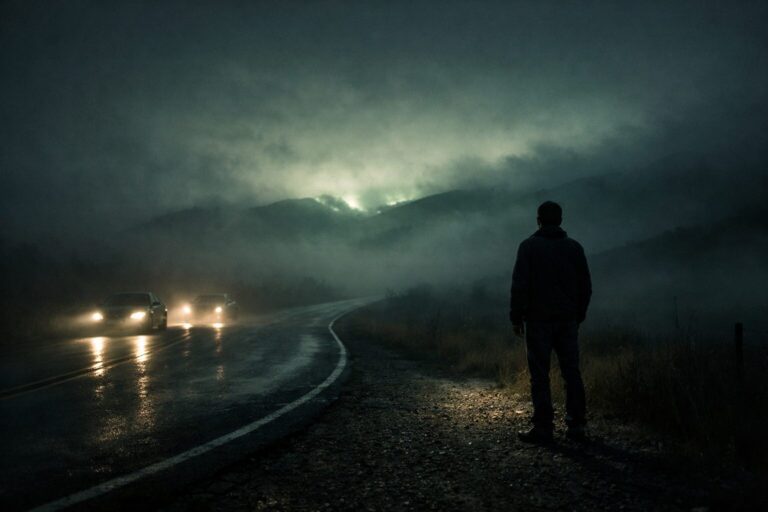
The highway narrowed to a two-lane that ran like a pencil stroke between low mesas and saltbush, the kind of open where sound goes flat. He rolled the windows down for the heat to rush past, because the air-conditioning had begun to wheeze when the car climbed grades, and he didn’t like how that sounded so far from help. Fenceposts passed with a metronome regularity; wires hummed quietly in the wind. He had a satellite phone in the glove compartment, meant for the once-in-a-while job that took him out where cell service never remembered him. It clicked against the owner’s manual as the car jostled over the washboard sections. A hawk hung on nothing some ways off, then dipped and was gone.
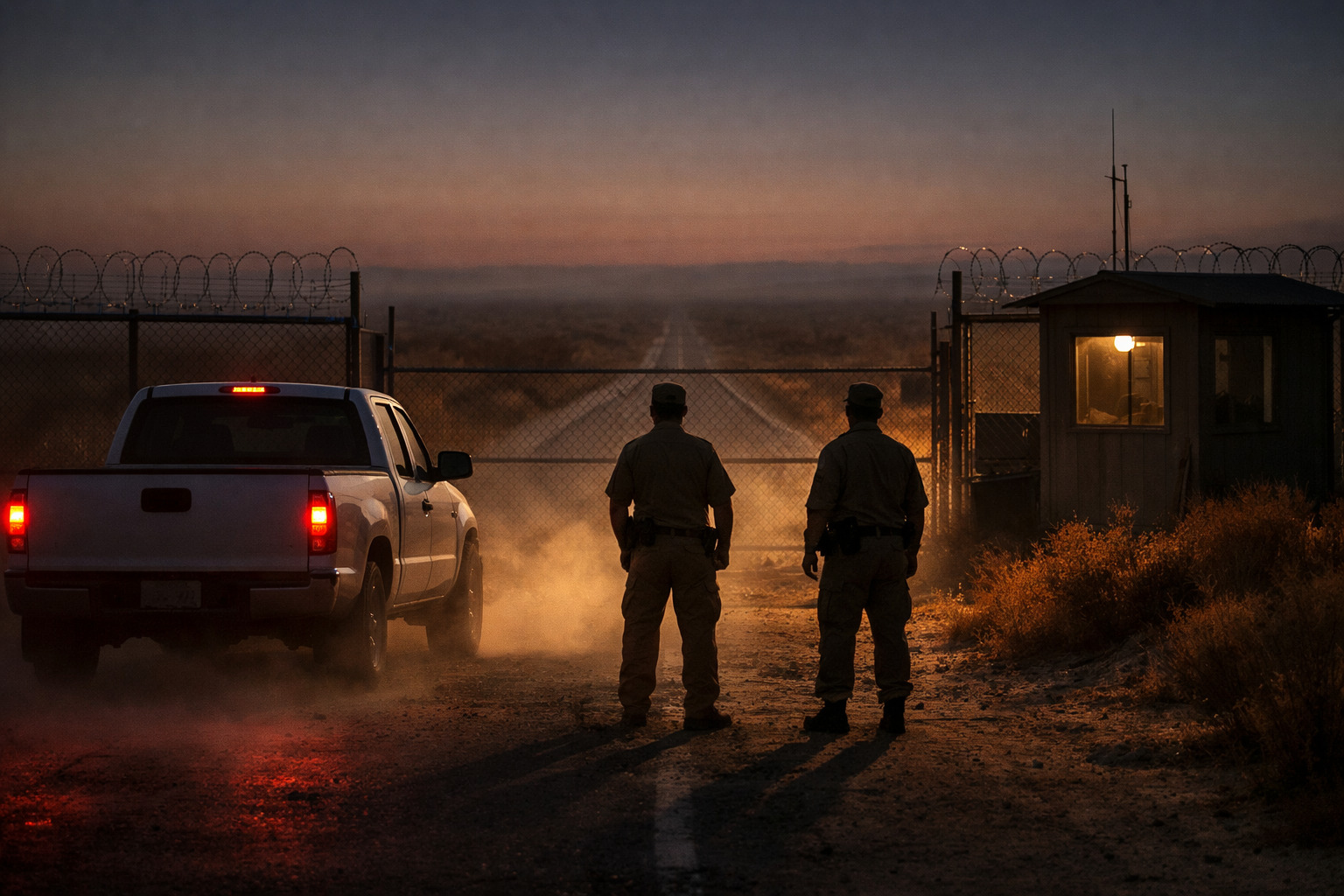
Turning off the county road, he came up on a cattle guard where the paint had nearly burned away, leaving the grating to raise a quick song under the tires. The land dropped out and rose in near-invisible ways. He didn’t see the fence at first. The vanishing lines of the blacktop squared their shoulders and went on, and then their motion stopped because there was a crosshatch of wire and steel stuck in their path like someone had stitched the horizon shut. There was a guard shack too, low and squat, with window glass that showed nothing but his car and sky. He braked. The dust behind him drifted forward to pat the car’s rear in a slow, soft hand.
The men in the shade stepped out without any hurry. Their uniforms were plain tan, without the little flags or rectangles you can count to know who is who. One wore his cap snug over his brow and tapped the brim twice as if to fix it in place. The other held a clipboard that had a laminated card clipped to it with a frayed bit of red cord. Neither of them smiled. The gate itself was high chain-link with a roll of razor wire at the top, except the wire was clean and new while the post feet were pitted and orange like they had been in the ground a long time. There were no signs that said anything beyond a metal NO TRESPASSING that had been bent, unbent, and bent again.
He rolled to a stop where a line painted on the road had once been, no longer visible except as a darker ghost in the asphalt, and put the car in park. The map on his dash still showed a line of road passing straight through, as if his windshield was an error. He could see through the mesh to more of the same: creosote, crusted flats, a hint of a dry arroyo cutting rightward and away. The man with the cap walked to his window, said, “Sir,” in the way that means no other words are going to matter, and added, “This road is restricted beyond this point.”
“Since when?” he asked before he could stop himself. The sun had pushed low enough that the shack cast a blue shadow across the front half of his hood. In the heat shimmer beyond the fence the road seemed to twist, straightening and unstraightening like a snake disturbed.
“You need to turn around,” the man said. His voice was quiet, a practiced sort of soft. The other one raised the clipboard a little, as if to show it had weight. There were lines on it, and a blank space where a seal usually goes.
He held up his map on the dash, the bright screen catching in the man’s sunglasses. “There isn’t anything here,” he said, and he heard how the words sounded, how it could be taken. The second man came around to the passenger side and peered in without leaning, the way you might look into a room you’ve been in before but don’t want to claim.
“You need to turn around,” the man repeated, and this time he added, “We’ll log you as diverted.” He nodded at the glove compartment. “License and registration, please. Also, if you could step out for a moment.”
He did as he was told. The wind pushed in across the flats and brought with it a smell like wet metal even though there was no water anywhere he could see. The man with the clipboard wrote down his name, his plate, the make and color of his car and the tint level of the glass as if each thing mattered more than the last. The other took a handheld device out from his hip, something like a wand with a black mouth on the end of it. He swept it along the sides of the car, slow and deliberate, the way you’d drag your hand along a fence while walking by. It clicked once, an insect-sharp sound, and he paused at the tailgate for a beat too long. The breeze gusted and snapped a loose strip of shade cloth stapled to the shack’s west side; it made a flag out of nothing.
He tried again. “What is this? Is it a mine? Some kind of seasonal closure?” He knew bases, or thought he did. Gates had numbers on them or at least signs with penalties. You couldn’t dig a posthole on federal land without three warning placards about it. Here, there was a single amber beacon light mounted wrong on a corner, unlit, and an extension cord that disappeared under the shack’s door like a root going under a stone.
Neither man answered. The one with the cap set a form on the hood and indicated a line with his pen. “Sign here to acknowledge diversion,” he said. The paper was thick, smooth in an odd way, like it couldn’t remember being a tree. There was a stamp pressed half-over the box they pointed out—an oval whose ink had bled into the fibers more than you’d expect, leaving a smudge where letters would be. If there were letters at all. The only thing readable was a number that did not look like a date unless dates had begun to wear masks. He signed because he felt the day backing away from him and did not want to make a problem where he could not see the edges. They tore the sheet at a perforation and handed him his copy. It was still warm.
“Follow the turn-out around,” the man said, making a small loop with two fingers, pointing at a lane graded on the right in the dirt. He added, “Do not stop again on this roadway. Do not idle. Do not exit your vehicle. Take the next right in two miles. You’ll rejoin the county route there. You have a nice evening.” There was no threat in his voice and there didn’t need to be. The ink on his copy of the form glistened like sweat.
He eased the car forward and let it swing wide in the turn-out. He caught a measure of the road beyond the gate when his front wheels reached the far edge, the way you catch a room passing when a door opens by accident. It was only more road, no bend, no fence spurs, no glint of metal anywhere. He looked up, as if the thing might be in the sky, and saw a hawk again, or maybe the same one, drawing a circle sober and exact. When he had completed the loop and faced back the way he’d come, he could feel the men’s eyes on the back window as a temperature instead of a gaze. He drove. The tires kicked stones. The amber light on the shack didn’t blink.
Two miles out, as promised, there was a junction: an unmarked right curving between low shoulders of chalk white. He took it. He did not see any dust from any other vehicles. He did not see any vehicles. The sun fell lower, and the thin shade of the car’s visor felt like wishful thinking. The satellite phone in the glove box gave a single chirp, so soft he might have dreamed it. He took it out at the next straight stretch, the land running even like a poured ribbon. The screen woke from its dim sleep and a bar at the top toggled between searching and found, as if something had just turned its face his way.
He did not want to call anyone. He did not know what he would say. He left it on the seat beside him. It chirped again, and a clipped voice spoke, not from a ring but from a channel like a throat clearing deep in a wall. “White pickup, divert west complete,” the voice said. Then a string of numbers, one of which was his plate, and then silence. He touched the screen. There was no record of a call. The phone blinked back to its small, square patience. He stared into the rear-view and saw two points of brightness far behind, low and level. They hovered at the horizon line, smudges with cores in them, and then they moved a hair left and vanished into a downslope he couldn’t see. He pressed a little harder on the pedal without intending to.
At a low spot where the road crossed a dry wash, silt had slurried across and hardened into a scab over the asphalt. Halfway through, he stopped. Just long enough to test the feeling. The world settled around him in a way that made him aware of his own breath. The heat from the engine slid up the windshield in oily little mirages. He turned his head and looked back. The road behind was exactly itself and then not, tricking his eye with the fold and unfold of light over distance. Headlights were a rumor. He put the car back in gear and did not stop again until he hit the county route and then the highway proper, where the sound of trucks going the other way felt like being caught sight of by something bigger that did not care.
That night in the motel, with its ice machine giving one throat-clearing cough every ten minutes, he took the paper from his bag and laid it flat. The stamp wasn’t a seal and it wasn’t a logo. Under the lamp it looked like a bruise coming up under skin. The number inside the oval swam if you met it head-on, but from the side he could read it, and it did not help. He held it up to the lampshade. The paper cast a convincing shadow of paper. The satellite phone, on the dresser because he didn’t have a better place to put it, chirped once and went still. He slept, and if he dreamed of the fence his mind didn’t keep the shape of it, only the fact of standing where a road stopped and kept going.
In the days after, the detour didn’t leave. He opened maps and zoomed in and out until his eyes watered. The pale thread cut straight through the place where he’d turned and found a gate. Satellite view showed more of the same: low shrubs like the stippling of a pen, pale scabs of clay, the cool dark vein of the arroyo working its way to nowhere. He called the county office and held as the line played a looped list of services. When a voice came on and listened, the voice said, “We don’t have any closures out there.” He called the Bureau office and they said the same and added, almost kindly, that if there had been a closure, they would have had to post it.
He drove his route again the next week for a delivery and let his hands keep to the highway the way a horse will take you home if you drop the reins. He didn’t go looking. He told himself it was because there wasn’t time. A day after that, curiosity became work—he told himself that, too. He tried to photocopy his copy of the diversion notice to send to a friend who would be interested in its strangeness, and the oval on the page came out as a white thinning, an absence where ink ought to be. He pressed the page under the glass and pressed his palm flat on the lid to hold it, as if the machine might try to pull it away. The machine gave him the oval as a clean hole. The numbers bled to a gray that smudged if he rubbed it with his thumb and then would not come off his skin.
The following month, in a different stretch of desert with a different job, he saw a truck angled up on a dirt spur, too clean for the road it pretended to be using. It wore plates from a state he had never seen on a passenger vehicle, a neat row of zeros on tin that didn’t look like tin. He didn’t stop and he didn’t wave. Later, in a diner with photographs of storms tacked to the wall, a man in a Henley came in and didn’t order food, just coffee he didn’t drink, leaving after exact enough time to establish no conversation was needed. These details might have meant nothing. It is a thing the desert does: makes everything into a dot and a line and dares you to connect them wrong.
He kept the paper. It lived in the glove box beside the satellite phone in a clear sleeve meant for taxes. Once, closing up the car at a trailhead for a small walk among stones, he found he was holding it without having decided to. The stamped oval had lightened as if exhausted by its own insistence. The number in it had not changed. He looked back toward the highway and then out across the low, hard land. He thought he could pick out the line where a road might be but could not trust it. He put the paper back and shut the box with more force than he needed.
Officially, if there is an official shape to any of it, there was no installation there. The map stayed the map. The guard shack and the men in it did not pass into the record except as one piece of paper that refused to be reproduced properly. When the wind is just so, and the power lines sing a particular note, he remembers the measured sweep of the wand along the skin of his car and the sensation of being entered into something without his consent. Once in a while, on roads with no turns for miles, he still feels watched. The satellite phone, for weeks at a time, behaves itself. Then there will be a single chirp in daylight, or at two in the morning in a house with no other sound, and the screen will show nothing at all.