The Test Range Lights Followed Them Home
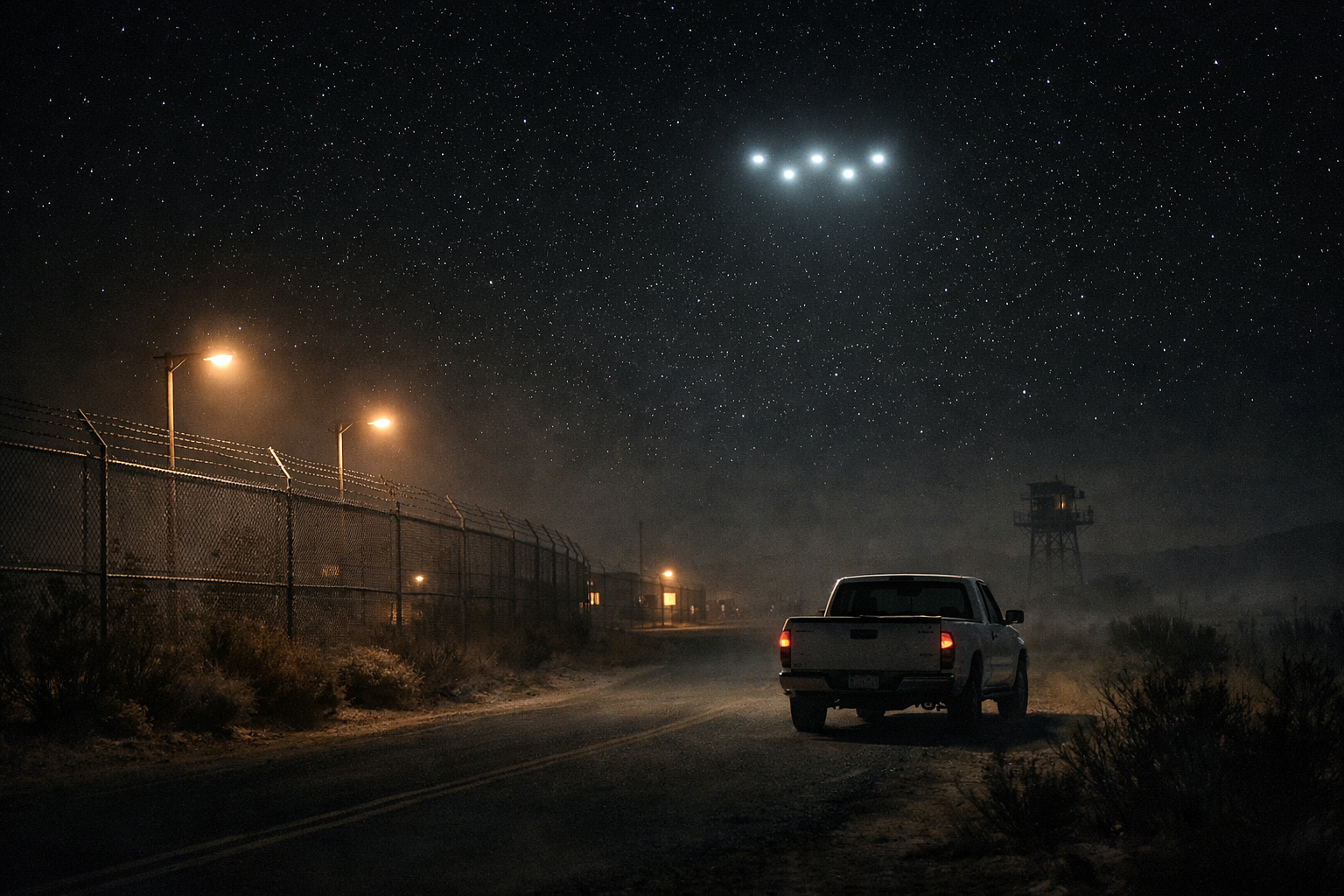
We clocked out at 22:37 because the shop clock was always seven minutes fast. The building was low and square, the kind of government beige that disappears into dust storms, with a badge reader that buzzed against your palm like it resented being touched. The air outside was sharp with creosote and cold wiring, the wind licking the chain-link as if tasting it. Out past the lot, the fence ran in an unbroken grid, topped with razor ribbon that whispered when the gusts leaned hard. Beyond that was only flat, purposeful darkness—the instrument fields, the berms, the plated hulks they dragged around for blast tests—and the hard edge of the range lights pooled under sodium bulbs that never seemed to burn all the way through.
Ray slung his lunch pail into the bed of my truck and rubbed his hands together like the night could be cleaned off if you worked at it. We’d both been installing shock sensors on dummy pylons near Bay 4, with the same checklist you can run even half asleep: torque wrench, cable tie, verify, sign. The white board by the foreman’s office had been marked RANGE COLD in green dry erase, a little loop drawn under it like a smile. “You good?” Ray asked as he climbed in. I nodded, and for a minute we just listened to the heater fan spin up, dust motes riding in it like it was a carnival ride for grit. The guard at the far gate had two hands around a Styrofoam cup and a look that said his night had been as long as ours.
We were pulling out of our row when I saw the first wrong thing. Three points of light hung in a tight line just past the inner fence, low—too low for stars, too ordered for the static glow from the distant substation. I thought it was a refraction from the lot lamps until the line bent in the middle, like someone flexing a ruler, and drifted sideways. Quiet. No rotor buzz, no wheeze of a genny cart. The points separated and settled into an equilateral triangle, then stacked—a movement that was so tidy it had to be a pattern, and the fence, with all its warning signs, was just behind it like a suggestion to behave. I killed our headlights for a count of one-and-two, not sure why, and the triangle brightened a touch, as if answering.
“They running night formation?” Ray asked, but the way he asked made it a question he didn’t want answered. We’d both seen the drone trials, listened to them wine-saw through the air, felt the double clack of test mortars and the freight hum of low helicopters. There is a sound to work that big, a weight. This was light without heat, white without spill. One point drifted behind the husk of a scaffold and didn’t throw a shadow on it. We rolled toward the guard station and I watched them out the corner of my eye. The guard looked past us when we stopped, like he expected something bigger to come through; his cup flattened a bit in his hand. He checked our badges longer than usual and then waved us through with that palm-down motion they use in briefings, the one that says keep it even, keep it slow.
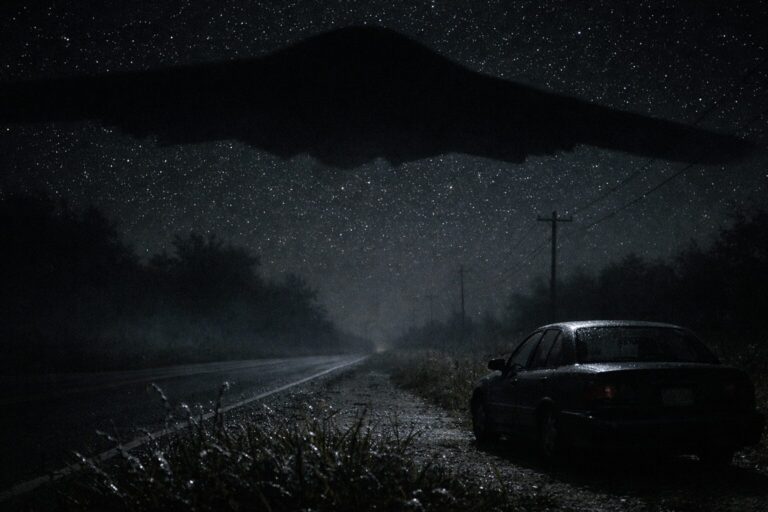
After the cattle guard, the road let go like a zipper, just a dead-straight stripe running west between brittle scrub and ancient tire tracks turned to fossils. The sky was ironed flat. I popped the truck into fourth and let the speed crawl to sixty, the cab filled with the bleached-out whine of old belts and heater air that never gets warm in the desert until March. In the rearview the world was a cone of black. Then, like dots stitching themselves from nothing, the same white points appeared behind us, not on the road but above it, centered over the faded double yellow. Three again at first. Then a fourth slid into place with the bored exactness of someone lining up change on a counter. I told Ray not to turn around too fast. He did anyway and went rigid in the seat, knees braced like the truck had started downhill.
We tried to make it about math. I eased off the gas until the needle kissed forty. The lights eased too, keeping a stretch of night between us the way a good tail keeps a few cars worth on city streets. I pressed up to seventy and heard the old wiper motors on the cowl start to vibrate. The lights grew smaller but never lost their formation, never bobbed with the washboard sections like a vehicle’s would. No dust tail. No splash of headlamps. When the road kinked just once around a shallow ruin of a homestead—a stone rectangle and a chimney still standing—the lights carved that same lazy bend in the air, smooth as a pinwheel turned with fingertips. The feeling wasn’t that something was chasing us. It was that something had taken its seat, patient, and settled in to watch us do our small things.
At Mile 14 a rusted-out mile marker leans into a tiny side spur that exists mostly as a rumor on county maps. I signaled out of reflex and clicked into it, crunching gravel until we were facing back toward the main road, just to see what would happen. It was an empty trick, but the only one I had. The lights stopped where the asphalt met dirt and held, a polite distance, the way you hang back when dogs you don’t know are sniffing the fence. Ray’s face was the color of unpolished steel, and I could hear him count under his breath—one, two, three—like he was making seconds do something for him. When I cut the engine, the heater died with a ghost of ozone and the just-barely sound of something with weight putting itself down out in the scrub. Nothing moved. The cab felt too small. I took us back onto the road like a man stepping back from the edge of a stage in the dark.
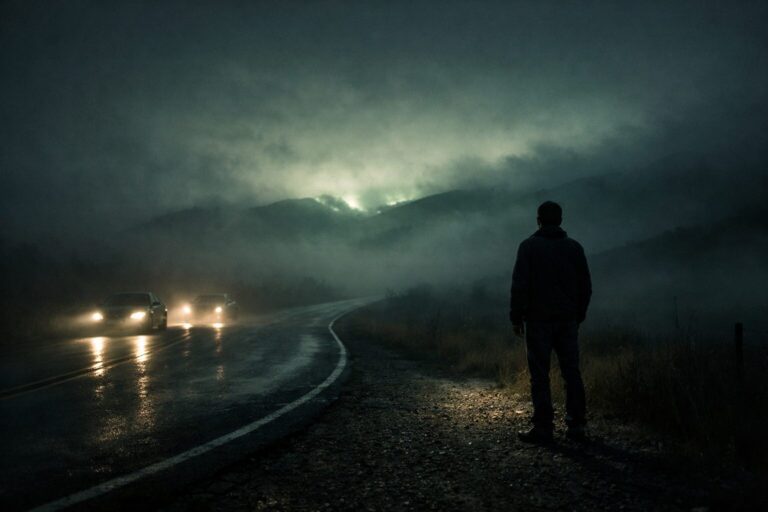
At the T where County 17 met State 95, the reflector posts flashed pale and empty in our beams. I put the truck on the stripe and turned left, into that feeling you get when there are twenty miles and two decisions between you and a hot shower. The lights came with us, ninety degrees without a hiccup. The old radio in the dash decided to come alive just then with a skin of static, cycling up and down like it was trying to find the spine of a song it used to know. One of the lights slid a hair’s breadth closer, enough that I felt it in my teeth. Ray thumbed his phone screen and showed me the signal bars. One. Then none. Then that blank where even the clock freezes up like it needs to think. The triangle widened and narrowed like breathing. I got the thought, stupid and bright, that if I put my hand out the window I could feel something from them—not wind, not heat, but attention.
The shoulder rose into a little pass that locals call a pass because it’s the only lift for thirty miles. In the dark the creases in the rock look wet and the road line goes gummy where tar snakes have bubbled and flattened. I know this stretch better than my own kitchen. Every time I flicked the blinker, the points made a small, waiting adjustment in the mirror, like their heads tilted to keep us in frame. Left at the Sinclair with one broken tube flickering in the s, past the paint-flayed dinosaur that someone welded junkyard metal into, right where the long field fence runs silver under the highlines. No other taillights. No other beams. Coyotes sometimes explode across that road and are gone in a heartbeat. That night there weren’t even shapes at the ditches, just crushed beer cans that flashed when the headlights touched them and were devoured a moment later. A security camera on a pole at the substation panned on its own and then stayed looking at nothing.
Town starts out there not with houses but with dull warehouse boxes, an RV park that is half laundry lines and Christmas lights all year, and the first left turn lane in forty miles. The speed drops to forty-five, then thirty-five, and your shoulders come down without your permission because of what pavement and curbs do to a brain raised on desert. The lights behind us shrank with the same gentled proportion, holding at the same spooky length, like a polite car in a funeral procession that doesn’t honk. When the first string of street lamps began, the points shifted up just a little, so they ran just under where the new light cut off and the old dark began. I glanced up through the windshield and they flicked over the edge of a billboard for a water softener outfit, and for half a second their glow stenciled the grin on the cartoon droplet. The sign didn’t throw a shadow, either.
A few blocks in, I pulled to the curb beneath an ironwood tree that keeps a corner quiet even on trash day. Ray lives in one of those low stucco apartments with a courtyard you can sweep in seven lazy strokes. He had the door open before I’d stopped rolling and then didn’t get out, just stayed with one boot on the floor mat as if he needed the truck to be there for the world to continue to make its particular kind of sense. We both looked up. The lights didn’t crowd in. They just came to the lip of his street and hung, arranged like a thought that hadn’t made it to words. Porch bulbs burned in that tired yellow that makes moths look like they’re thinking their way into the glass. Somewhere a TV let loose a burst of laughter that only exists canned.
“You seeing this?” A woman across the way had opened her second-story slider and stepped out with a basket against her hip. She was speaking to no one I could see. Maybe to a cat, maybe to the air. She tipped her head like something had taken notice of her, and then went back inside. We waited. A dog did three unsure barks and was silent. The lights didn’t land, didn’t scan, didn’t do any of the things a sensible mind wants to hang on to. They held the place a person would stand if they were deciding whether to knock. I thought of the guard’s hand flattening his cup. I thought of how many times the fence at the range had sung at night and meant nothing at all.
Ray slid out of the cab and kept a hand on the window frame, his keys deep in his fist. “Text me when you’re in,” he said quietly, which is what we say when what we mean is tell me I’m not the only one. He eased backward toward his stoop, never showing his back to the street, and I watched the points of light soften as if I’d blinked twice but I hadn’t. I rolled away with the truck as gentle as if a full cup of coffee sat on the hood. The lights came too, at that same exact it’s-okay distance, over the gas station lot and past the mural somebody’s kids painted in chalk along the block wall. I could feel them trawling the edges of my neighborhood without touching anything, the way you skim a hand over the top of water to feel the cold without committing to the plunge.
At my place the carport throws a ragged shadow you step into like a separate room. I backed in slow. I sat with the engine quiet and my hands on the wheel. Above the cul-de-sac, where the sycamores make a shape like a flattened crown, the lights came and steadied and were simply there. The living rooms around me breathed in and out—thirty-year-old central air units huffing their same complaint, a refrigerator cycling on, a late pot rattling on a stove—and for a moment it felt like those were the things being watched, not me. The porch light over my door clicked on though I hadn’t moved yet, the sensor catching what, I don’t know. The white points brightened like inhaling and then slid lighter in color until they were the shade of winter stars.
I opened the door for the weight of it and set one foot to the concrete. The closest light hung a touch lower, almost within the map of the nearest streetlamp’s spill, and then something in it paused the way a person’s eyes pause when they go from a face to the thing behind the face. Across the street, a mechanic’s clock in a garage that’s never closed ticked once, clearly. The three points slid together and made a line; the line shortened until it was a single bright coin floating above the dead center of the road. For two seconds—no more than that—it held there as though listening. Then it dimmed by degrees, patient, not withdrawing or blinking so much as letting the night back in, until the black between the houses was ordinary again and the high lines made their familiar small humming noise alone.