The Town That Was Told to Forget What It Saw
Where I grew up, you don’t have to explain which night you mean if you say “the night we all went outside.” You could be at the co-op or the laundromat or leaning against the ice chest outside the corner store, and people will give the smallest nod, the kind that sits halfway between agreement and warning. It’s not a story folks tell outright anymore, but I still have my own piece of it, because I was standing on the shoulder of County Road 7 that night, in my socks on the cold grit, watching the sky pretend it was the ground.
It drew us out like a change in pressure. We stepped onto porches and down driveways as if a bell had sounded that only our bones could hear. The glow was beyond the west hills—Lowell Ridge, where the scrub pines come right down to the road cut—and it didn’t sit still the way a barn fire or the refinery flares do. It breathed. It reached under the cloud deck as if gently cupping the town from the other side. Neighbors I’d only ever seen through windshields appeared like they’d been planted in their yards. Someone knocked a shovel over in a carport and said, “Lord,” and that was about the extent of talk for a while.
I remember the smell of creosote from the poles and the taste of cold metal on the back of my tongue. The power lines above us made no more than their usual mumble, and the tree frogs stayed on with the steady insistence they bring to all of summer. We kept waiting for a helicopter throb or a siren or one of those metallic bangs from the quarry. Nothing. The glow climbed along the underside of the clouds and moved laterally, slow and purposeful, as if a hidden town were driving riverboats on vapor, all lanterns shaded. It threw no beam, cast no clear source. It simply unrolled across the cotton batting of the sky for minutes that felt longer than minutes should.
That was the first wrong thing about it—the way it moved without owning its movement. We’ve all seen lightning walk along cloud bellies; we’ve all stood with our mouths open at a night launch on TV and watched how light peels backward through atmosphere. This wasn’t like those. It didn’t flare and recede. It pressed a handkerchief of pale against the undercloud and took it with it, soundless as breath. Nobody talked about color, but I remember a white with something living in it, like the behind-the-knuckles hue when you hold a flashlight under your palm.
We stood until the moths gave up banging at porch bulbs and the last of the glow went somewhere we couldn’t see. People drifted back inside with that careful way you do after a funeral, as if the stairs had changed in the dark. The phone rang a few times at our house—my aunt, the feed store manager, someone from school asking if we’d lost power. We had not. We slept badly. The next morning, County Road 7 woke to tires on gravel that did not sound like the cars we were used to.
I watched from the kitchen window over the sink because I didn’t want whoever it was to see me staring. Two sedans eased past the mailbox, dark and dusty, with the kind of antennae that ran like cat whiskers up out of the trunk lid. A boxy truck came after, newer than anything we drove then, its paint a humdrum beige that would have made it vanish if it weren’t so clean. Men got out at different houses. They wore no uniforms, not exactly, but there was something uniform about them anyway—the same square-shouldered windbreakers, the same haircuts that looked like they came with free shoe polish. At Marta’s place, one of them knocked and waited politely with his hands behind his back. Down at the school, another spoke to the principal on the front steps. At the filling station, I saw a man sit with Earl, the owner, at one of the sticky tables by the window while Earl flipped his wedding ring around and around his finger.
It never turned violent. It never had to. The men were friendly in that practiced way that wears friendliness like a suit. They told us it had been a weather inversion, a test from the substation, an atmospheric reflection of an event over the state line; the story had a different coat in every yard. Mostly, they told us it was nothing worth discussing. The sheriff, who’s buried on the hill now, stood with one of them at the four-way and nodded a lot and kept saying, “Well, all right then.” The first-grade teacher said she was told to keep the kids from drawing about it. My father came home, set his lunch pail down as if it were full of eggs, and sat with his hands on his knees. “We’re leaving it alone,” he said finally, as if reading from some script arranged behind his eyes.
It felt like the whole town learned the same trick at once: how to tuck a thing so neatly out of sight that even the thoughts of it walked quieter. Neighbors who liked gossip as a sport shook their heads as if they’d found a lost hairpin and couldn’t quite place where it belonged. When I biked out along 7 that afternoon, the road that usually answered with pickups and grain trucks felt like a stage where someone had forgotten to raise the curtain. At the Lowell Ridge turnoff, a pair of cars I didn’t recognize sat opposite one another hood-to-hood, both men inside reading papers the way people do when they’re waiting for someone else to finish something.
We didn’t tell the kids in school what we saw. We didn’t tell the new preacher, although his first sermon, if I remember right, was about not borrowing trouble, and every old man in the back row stopped tapping his hymnbook for a second. Even the people who didn’t believe in anything bigger than an insurance premium seemed to share an edge-of-the-eye feeling for a while, like an undertaking had been shuffled out of sight before it could be finished. The sky did what skies do. We went back to work and basement canning and Saturday games. We went to bed earlier.
Years passed, and I left. Whenever I came back to help with a roof or visit a hospital bed, someone’s porch would cough up a foggy retelling. No one added to it; they just kept the parts they had. The glow under the clouds. The quiet. The men who suggested, kindly, that we were making something much larger than it needed to be. The way the town, without deciding to, decided.
When my father died, I took a week off and came back to sort his papers, because that was how he kept the world tidy. He had a stack of The Gazette from the year of the glow—he kept them bound by baling twine, yellowed and soft at the folds. I sat at the card table with a cup of coffee gone cool, thinking I might finally read what had been said. The headline from that week was about a ribbon-cutting at the feed silo. I turned the page and hit air. Page three was missing. The tear was neat. It had been cut close to the spine with a blade dull enough to pull little feathers of paper loose along the edge.
That is the fear I remember without help. Not the glow. Not the quiet. The sudden sense, with my thumb on that soft paper ruffle, that someone’s hands had been where mine were, in a hundred houses, years ago. I thought maybe my father had cut something out—an ad or a wedding—and kept digging, thinking I’d find clippings, but there were none. I opened the copy from my aunt’s coat closet: page three missing. I asked Earl’s widow if she had the bound volumes from the station: page three missing there too, across the entire week, every single day. At the library, the bound volume for that month gaped like a pulled tooth where page three ought to be, a librarian’s pencil note taped inside the gap with the words Already Lost in a careful hand. I looked up at the ceiling without knowing I was going to. The fluorescent hum made the same tired saw-noise it had made my whole life. I understood, as if standing on a porch in my socks again, that I was not alone in that moment—that the missing was not an accident but an action, and the action had eyes in it.
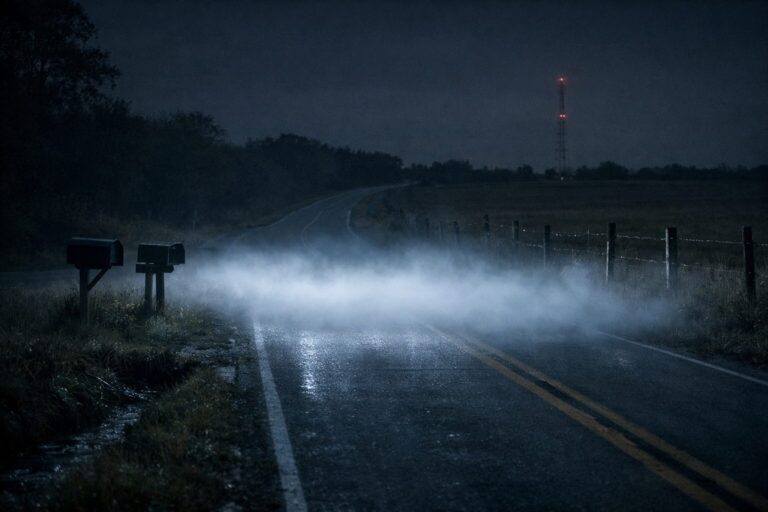
I left late, because it is easier to drive and not think than to sit quiet and let the thought fill you. County Road 7 after midnight is tunnel-dark even when the moon is up, the pines reaching their dark fingers in, the centerline worn pale by the only light it knows. I rolled my window down to keep the night air moving so I wouldn’t nod off at the wheel, and I kept the radio low at that volume where static and song swap dominance like polite friends. When I hit the bend where the shoulder cuts wide for the school bus turn, my high beams picked out a shape.
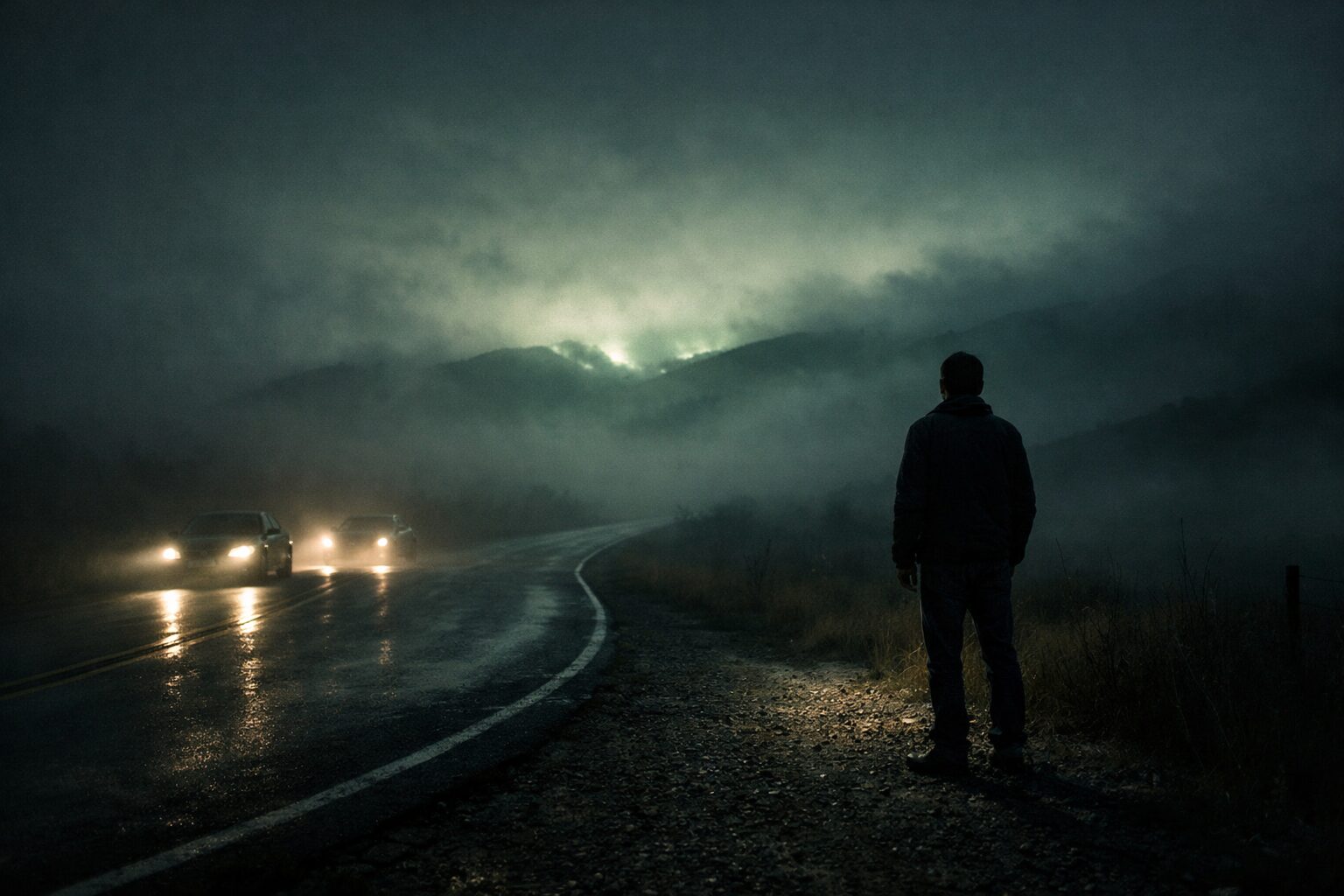
He stood on the gravel margin like a fencepost left by mistake, a man in a windbreaker with his hands in his pockets, not thumbing a ride, not stretching for a jog, not pretending to tie a shoe. Just present. Watching the west road, the way a farmer watches rain on the far field. I took my foot off the gas without meaning to. As I slid past, he turned his head the way you turn your head when you’re checking whether a burner has truly gone out. Under my headlights his face was the kind you couldn’t pick out of a crowd if you tried later—a little pale, a little unshaven, younger or older depending on how you blink. In the mirror, his outline softened as the light fell away, and then he was only the suggestion of a man on the crowned dark of a road I had always considered mine.
Driving on, I held the wheel too tight and told myself things I didn’t believe, the way people do when they’re alone. When I reached the turn to my father’s place, I found myself checking the rearview again and again at the empty gravel that had no one in it. I slept in my coat on the couch with the TV throwing quiet pictures on the walls without sound.
I don’t think the town agreed, out loud or otherwise, to keep it that way. It just happened, the same way dust turns into a film on the mantel when you leave a window open a small slit all summer. When I asked after that week, people laughed a little too easily, or asked what I meant exactly, or told me I must be thinking of another place. A woman at the store remembered the ribbon-cutting and described the cake with the kind of detail that suggested she had chosen that memory carefully. Men asked me about ball scores and diesel prices and let their eyes go soft and far away when I mentioned clouds. We were survivors of something that, on paper, had not occurred.
Decades went by. The road got more patchwork and less shoulder. A new subdivision huddled against the old pasture by the mill pond and then stalled and then sat with its cul-de-sacs like the rings left by a coffee cup on an unfinished table. Some folks died. Babies I knew went off and came back or didn’t. I did what people do to stay busy. Then one night, when the weather had gone glass-flat and the flies on the screen door had quit trying, I found myself once again on County Road 7 after midnight, driving the long curve beyond the school, and the west hills were not dark the way hills are meant to be.
It came on without warning, as before, folded into the low clouds and then blooming out under them the way a bruise spreads. My headlights seemed useless suddenly, my dashboard numbers pale cousins to what the sky was doing. Every dog in town, it seemed to me, put its bark away in a drawer. The glow drew itself into a smooth arc and glided east above Lowell Ridge, walking the under-clouds not fast, not slow, simply going where it meant to go. I could feel the pressure of it in my jaw, in the old fillings there; I could sense its attention the way you sense when someone at a party across the room has decided you are the thing to look at next.
I eased the car to the edge and cut the engine and sat with the key in my hand because it did not seem right to be making noise. The road lay in front of me like a strip of something delicate that might tear if I tread wrong. And there, in the gentle sump of the bus turn, stood the man again—or a shape the size and quiet of a man, in a jacket that did not try to fight the wind. He was turned toward the hills, the way all of us were turned the first time, as if he too had stepped out of his door to see. He did not put up a hand or lift a light or show a badge. He was there the way a thought is there just before you decide whether you’ll keep it.
I watched him as long as I could and then, without thinking, watched the clouds because you cannot look two ways at once. When I glanced back, he had shifted somehow, not forward or back but into a stance that said he had always been where he was, would always be where he would be. The glow tugged east and made the low pine tops look like a black felt cutout held up to a milk-glass lamp. Every hair on my arms rose as if the air had a hand in it.
By morning the shelves at the store would be neat with new papers and new headlines and the coffee would be poured and kids would ask if school was closed for fog. By then I would have only the seams of what I’d seen and the tired heaviness of a night where nothing exploded and no one shouted and still something important had stood and watched and been watched. Our town, if you ask it, will say it is a place where people mind their business. It has learned to be. Most don’t talk about the night we all went outside, not now, not even the ones who remember the quiet between the frogs. But every so often, the clouds make their shallow bowl over Lowell Ridge, and light fills that bowl from underneath, and on County Road 7, where the paint thins and the gravel shoulders fall away to ditch, a figure takes up the same piece of earth as before and looks at the hills as if listening for instructions the rest of us were told not to hear.