
Bennewitz Case Revisited: How Surveillance and Disinformation Shaped UFO Disclosure
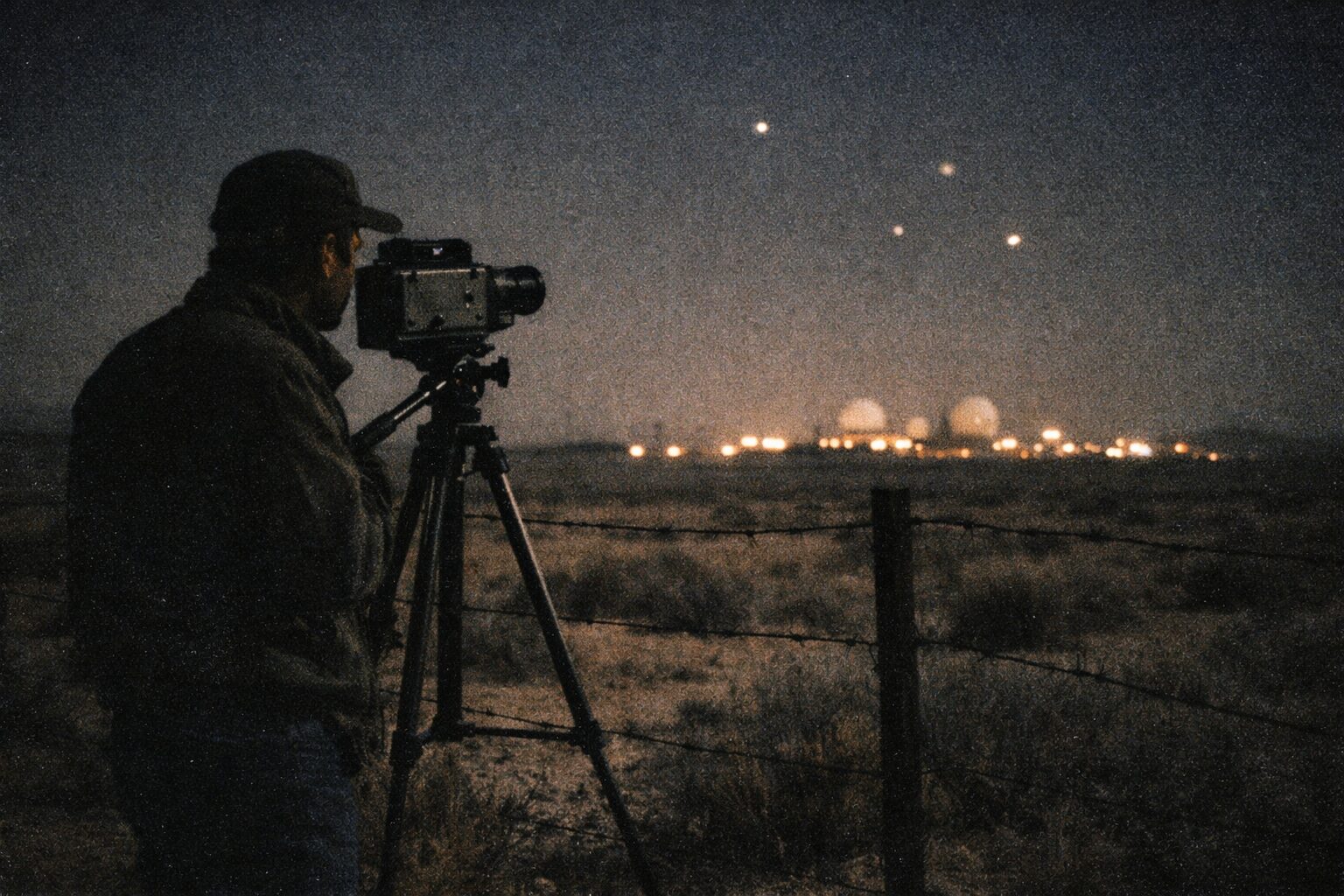
On clear desert nights outside Albuquerque, a household physicist trained his camera on strange lights and set in motion one of UFO lore’s most consequential threads. The Bennewitz case still circulates among researchers because it sits at the intersection of observable phenomena, private obsession, and official secrecy — a perfect storm for misdirection and myth.
That tension was the focus of a recent radio conversation with researcher Greg Bishop, who framed the Bennewitz case as less a tidy alien encounter and more a study in how institutions respond to anomalous reporting. Bishop’s account reframes the narrative: the story’s enduring power derives as much from what governments did — or didn’t do — as from what Paul Bennewitz himself recorded on film.
What happened in the Bennewitz case
In the late 1970s and early 1980s Paul Bennewitz, an electrical physicist living near Kirtland Air Force Base, began photographing and documenting lights and odd activity over restricted airspace. He reported his findings to military officials and circulated materials that alarmed Pentagon contacts about possible extraterrestrial technology and foreign surveillance.
Bishop emphasizes a key operational detail: the military and intelligence community did not immediately debunk Bennewitz’s claims nor feed him a steady stream of fabricated details. Instead, their response was largely investigative and observational. Officials “stood aside” as Bennewitz’s concern deepened; in short order he became the subject of monitoring. Bishop says the motive was practical espionage interest — to determine what Bennewitz had observed, who he was communicating with, and whether those observations intersected with foreign intelligence activity inside the U.S.
Why the Bennewitz case matters
The Bennewitz case matters because it illustrates how UFO narratives can be co-opted by non-extraterrestrial agendas. If a civilian with technical expertise reports anomalous phenomena near a military installation, agencies must assess both homeland security risks and counterintelligence vectors. Bishop argues this dual interest complicates the popular binary — either cover-up or confirmation — that drives disclosure debates.
That complication has political consequences. For decades, many in the UFO community have equated any official secrecy with a deliberate hoarding of alien truth. The Bennewitz case suggests secrecy can also be tactical silence: surveillance intended to elicit information or to contain perceived risks rather than to conceal an extraterrestrial fact.
The Bennewitz case: the paranormal angle
Bishop does not dismiss anomalous experience outright. He allows for the possibility of “a consciousness that’s not ours” intermittently interacting with humans, a concept that returns the focus to the phenomena themselves. But he cautions that the overlay of intelligence operations, weapons development, and misinterpreted sightings makes it difficult to separate a genuine physical event from misapprehension or manipulation.
His broader warning addresses belief dynamics: once an observer becomes committed to a fixed interpretation, they become vulnerable to exploitation — whether intentional disinformation or benign institutional indifference. Bishop also noted cultural vectors, pointing to recent films and art that respond to the emotional and spiritual dimensions of the UFO mystery more directly than political institutions do.
Source context
The observations summarized here come from a recent interview on a long-form investigative radio program where Bishop discussed historical cases and current disclosure dynamics. He referenced archival material, declassified investigative threads, and interviews that trace how the Bennewitz case moved from private study to an object of official scrutiny. Bishop is also promoting a UFO art show in Burbank that aims to examine the cultural side of the phenomenon.
Daily Paranormal Analysis
The Bennewitz case became prominent because it combines credible technical testimony with cinematic details: film footage, a scientist protagonist, and proximate military installations. Believers find it compelling because it appears to show a civilian who was both competent and sincere, then targeted by authorities — a narrative that validates long-standing suspicions of cover-up. Skeptics point to operational motives, counterintelligence activity, and psychological escalation as more mundane explanations, noting that official silence can serve non-extraterrestrial ends.
Connections to other Cold War-era cases are clear: intelligence services routinely monitored civilians whose observations might intersect with foreign surveillance or classified test programs. The Bennewitz case sits alongside those episodes as a reminder that not every unexplained sighting is evidence of alien hardware; sometimes it is evidence of human systems responding imperfectly to uncertainty.
Unresolved questions remain. Was any part of Bennewitz’s material demonstrably linked to foreign technology or classified testing? Did institutional handling amplify his fears beyond what the original data justified? Bishop’s framing doesn’t close the book — it reframes it, suggesting that the story’s endurance owes as much to human reactions and institutional behavior as to the lights themselves. For researchers and the public, the Bennewitz case remains a cautionary study of how disclosure debates can be derailed by the mechanisms meant to manage them.


