
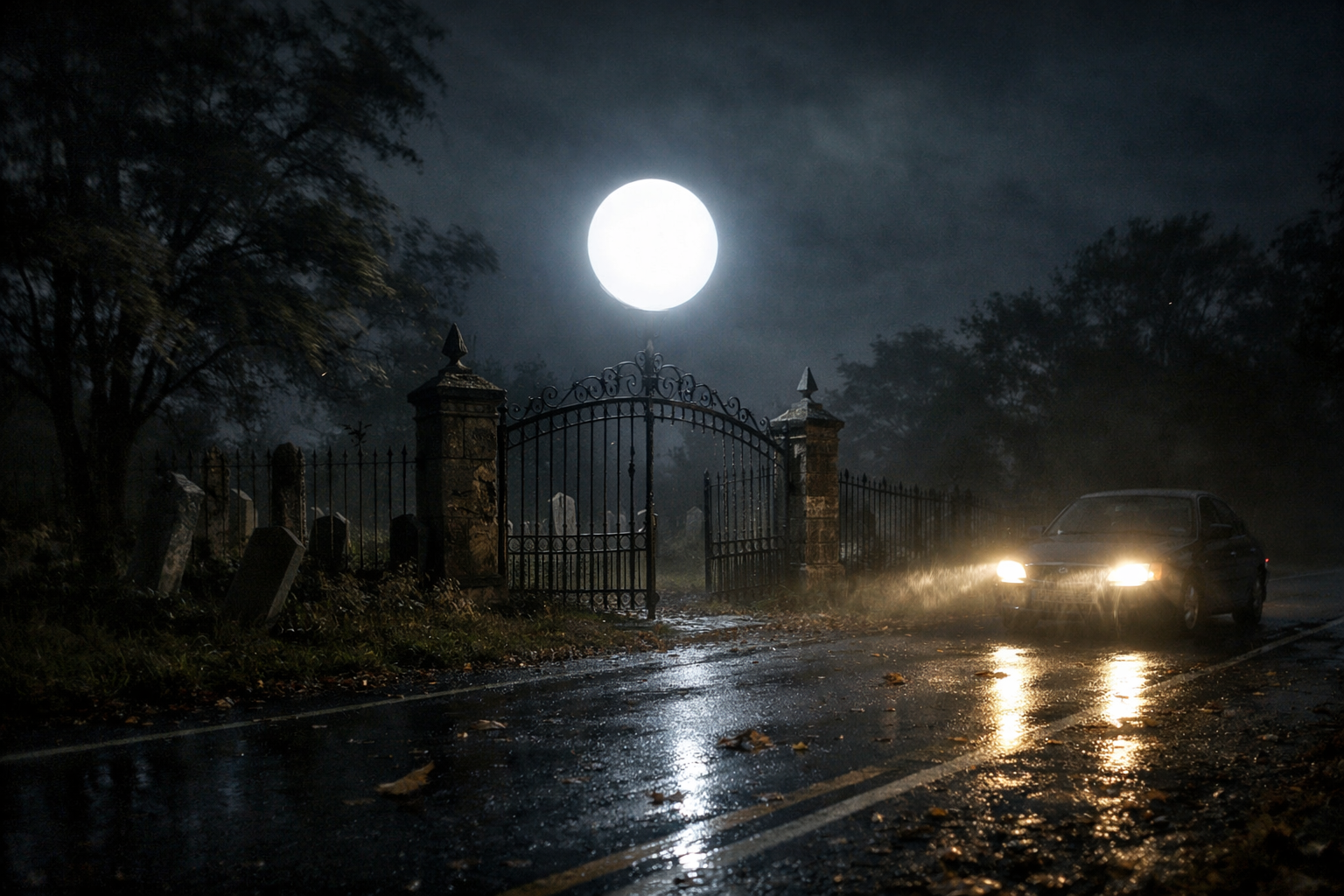
The White Orb Waited Above the Cemetery Gate
It was late enough on a Tuesday that the dashboard clock felt louder than the radio. 11:43, then a quiet click as the minute turned. The county road out by Hollow Ridge is really two narrow lanes packed down between ditches, and the old cemetery sits right off the shoulder where the gravel turn-in widens a little. I take that road when I want to be alone in the drive. In summer the tires chatter over tar snakes; in fall they just whisper, and that night it was only me, the heater ticking, and the soft scrape of leaves tumbling across the asphalt like tiny, dry fish trying to swim upstream.
I always notice Hollow Ridge, even if I try not to. The iron gate is arched with letters someone once gilded, now the color of old teeth. There’s a low stone wall that flares to columns on either side of the drive, and someone hung plastic flowers along the fence last Memorial Day; the wind has been working on them ever since. It was one of those gusty nights where the trees on the hill move like one dark animal. My headlights swept dead grass and the bony shapes of markers just inside, and there was that little noise the heater makes when I move the vent lever—like it’s clearing its throat.
What made me look a second time—hard enough that I loosened my grip on the wheel without meaning to—was that something sat right above the arch of the gate, too clean and too still to belong to the rest. It was a white orb, perfectly round and no bigger than a dinner plate at the distance I was from it, though that’s guessing. It hung where the center of the arch would be if you drew a line, just a few feet above the iron curls, not attached to anything. The wind played with the plastic roses and rattled the dry oak leaves, and that little globe didn’t so much as hesitate. It had a glow to it, not harsh, not bright like a headlight glare or a farm light. It was the same kind of white I think of on the inside of a seashell, soft around the edges like it carried its own piece of dusk with it.
I took my foot off the accelerator without thinking and let the car slow as I came up on the entrance. The orb was exactly there, almost centered between the gateposts. No wires, no pole, no branch hooked in some strange way. The sky behind it was a wash of cloud, and the wind bent the weeds, but the orb had no sway. I remember rolling my window down a crack, and cold air pushing in, smelling like last week’s rain that never fully dried in the ditches. The heater gave up a puff of dust. The sound outside made the stillness of that thing louder somehow. I had the oddest sensation that if I called out, something would answer—not because it had a mouth, but because it felt like an ear.
By then my car had drifted forward enough that the gate was at my passenger window, and I had to look sideways to keep it in view. That’s when it moved. It didn’t drift or sway away from the cemetery; it simply wasn’t above the gate anymore and was instead out past the fence line, keeping pace with me just above the ditch. I felt the soft punch in the chest you get when a deer steps out of shadow into your headlights, a clean, clacking shot of alertness. I remember glancing at the speedometer: 37, then 35, and the orb’s distance to my window did not change. It hung at my passenger side about where you’d expect someone to walk if they were keeping up with the car on foot, only it was two or three feet off the ground and had no feet at all.
I tapped the brake. It eased with me. I gave it a little gas, more than I should have on that stretch, and it gathered with the same quiet insistence, neither leading nor lagging. It wasn’t a reflection; I knew that in the way my stomach knows when a bridge has dropped out a fraction under the tires. There was no shimmering or doubling where my headlights caught it—no shadow thrown onto the brush, either. It was a thing in the air. The radio faded into static and back as I drove through a low hollow where it always does that, and the heater clicked another tired click. The white orb just kept to its line, as if the car and it were roped invisibly together, each the same weight on opposite ends.
I realized then that the feeling of being watched wasn’t just the kind that comes from your own head making faces in corners. It was tight and precise, like stepping under a motion sensor light, only there was no flood of yellow, just that mild white held up next to me the way a slow eye holds a fish in water. I passed the place where the barbed wire fence gives out to an open pasture, and I could see far along the ditch to where the road bends at the cottonwoods. The orb kept its place against the darkness. I tried turning the radio off; it obediently went quiet, which made my pulse louder in my own ears. The wind made a hollow spool of noise through the slight gap in the passenger window, a thin whistle. I closed it and the sound snapped off, and still the thing moved when I moved.
At the four-way by the county maintenance shed, there’s a stop sign someone shot clean through years ago, the hole scalloped with rust. I came to that crossroads slower than I meant to. The windows on the shed were just rectangles of darker night. I braked until my bumper lined up with the white bar of paint they laid down two summers back, and my car made that soft forward-bound tug in the seatbelt as all the weight settled. The orb, still at my side, slowed with the same easy exactness and hung about level with the stop sign’s height. We both stopped at once. It felt the way it feels when someone across a room stands up at the same time you do and you have to decide who nods first. The wind pressed at the bare branches overhead and the sign creaked; the white orb did not move and did not flicker.
I admit I did something foolish then. I lifted the brake, let the car roll a foot. The orb slid forward the same foot, keeping to my passenger side. I pressed the brake again. It was there, absolutely as-if-nailed in space relative to me, held and holding. In the mirror the red wash from my tail lights curved across the empty road like a bent ribbon. I shifted into reverse out of some private experiment and eased back that one foot; the orb eased back. The silence inside the car pushed on my eardrums. I put it in park just to feel the notch, and every muscle from my shoulders to my jaw went as tight as if they’d been poured full of plaster. I knew—more than knew, I recognized—that there was intention across from me, and it had the patience to wait for mine.
I sat like that long enough to feel stupid for sitting like that. There were no other headlights coming from any direction. Nothing on the night but wind and the rustle of old grass and the hum of my own fan trying to keep the windshield clear. I touched the wheel as if it were a living thing that might spook. I turned on my right-hand blinker because I’d always meant to go right, even though left would get me home a minute faster. The clicker ticked, loud. I eased the wheel. The orb did not slide ahead of the car or lag behind; it crossed with me, stepping that empty space across the intersection as if there were marks on the air showing it where to be.
Halfway through the turn, it rose. Not a wobble, not a slant. It went straight up, as though pulled by a string into the dark above my windshield, smooth and sure. I craned my neck like I was looking for a low star. There was the seam of cloud and the faintest smear of the moon behind it, and then there was only sky the color of wet slate. The road ahead ran empty to the line of cottonwoods. I rolled forward, too fast, then slowed again, and the white above me, if it had ever been there, had melted into the high nothing. The intersection was just an intersection again, the stop sign making its tired creak, the world in all the places it had always been.
I told myself to drive to the next mailbox because I needed the shape of something lived-in. When I reached the pull-off by the old cattle chute I stopped again and, to keep my hands from shaking, I did the ordinary thing of reaching for my phone. I don’t know why I did it then and not before, but I held it up over the steering wheel and took two quick shots through the windshield at the empty road, one right after the other, and put the phone face-down on the seat. The act felt silly and also somehow like putting a lid on a pot. I sat there until the heater’s breath evened me out, and then I drove home by the long way, keeping my eyes strictly between the white lines, not looking right into the fields where shadows might decide to make themselves.
It wasn’t until I was in my kitchen with the overhead light a hard yellow and my coat unbuttoned by degrees that I remembered the pictures. The first photo was nothing: my high beams painting the gray of the road, the right-leaning shoulders of grass, a faint blur where the windshield had smears I keep meaning to clean. In the second, everything was the same except for one dot, small as the period at the end of a sentence, settled high above the center line of blacktop where the sky begins. It wasn’t a glare; there was no streak to it, no ray, just the same white I’d seen held softly at my side, now tiny and separate and complete. When I pinched the screen to zoom, it stayed a dot, round as a thumbtack head. There was no noise in the picture around it, as if the phone’s sensor knew to make that exact place more simple than the rest.
I didn’t send it to anyone. I didn’t even save it to my cloud. It’s still there, tucked between a photo of a smudged grocery list and a picture I took of the broken latch on my mailbox to show the landlord. Every so often, if I can’t sleep, I open it and look, and the dot looks back from the high place above a county road most people have no reason to take. I tell myself the road was empty after that. I tell myself the wind took everything that could move and shook it, and the thing that wouldn’t move left. But when I hold that second picture and let the kitchen’s light bleed across the glass, some part of me leans a little to the side, making a space as if something has chosen it again.


