The Triangle Hovered Over the Frozen Lake
It was a little after ten when I took the county road that runs the long way around the lake. I go that way most winter nights because it’s empty and straight, and because the snowplows hit it early and often. The cab of the truck held the thin, metallic smell of heater air, and the vents were loud enough that I kept the radio low—a talk show somewhere between two stations, the voices a soft tangle. The tires hummed on frost and sand. Out to my right the lake was a black plate, frozen hard and rimmed in brittle cattails. Every few yards a banked wall of plow snow rose against the shoulder like a low white cliff. It was one of those clear, bitter nights when the cold is a thing you can feel through the glass, pressing its face to you.
The wind came down off the fields to the west and shoved at the truck in steady pulses. On the high spots where the drifts narrowed the lane, the snow ran in restless ribbons across the asphalt, streaming in the headlights like smoke. I passed the little boat launch—it’s just a DNR gravel pad with a chained gate in winter—and then the shoulder opened up to a view across the middle of the lake, smooth and dark and wide. Above it the stars were as sharp as I’ve ever seen them, the whole bowl of sky pricked and glittering.
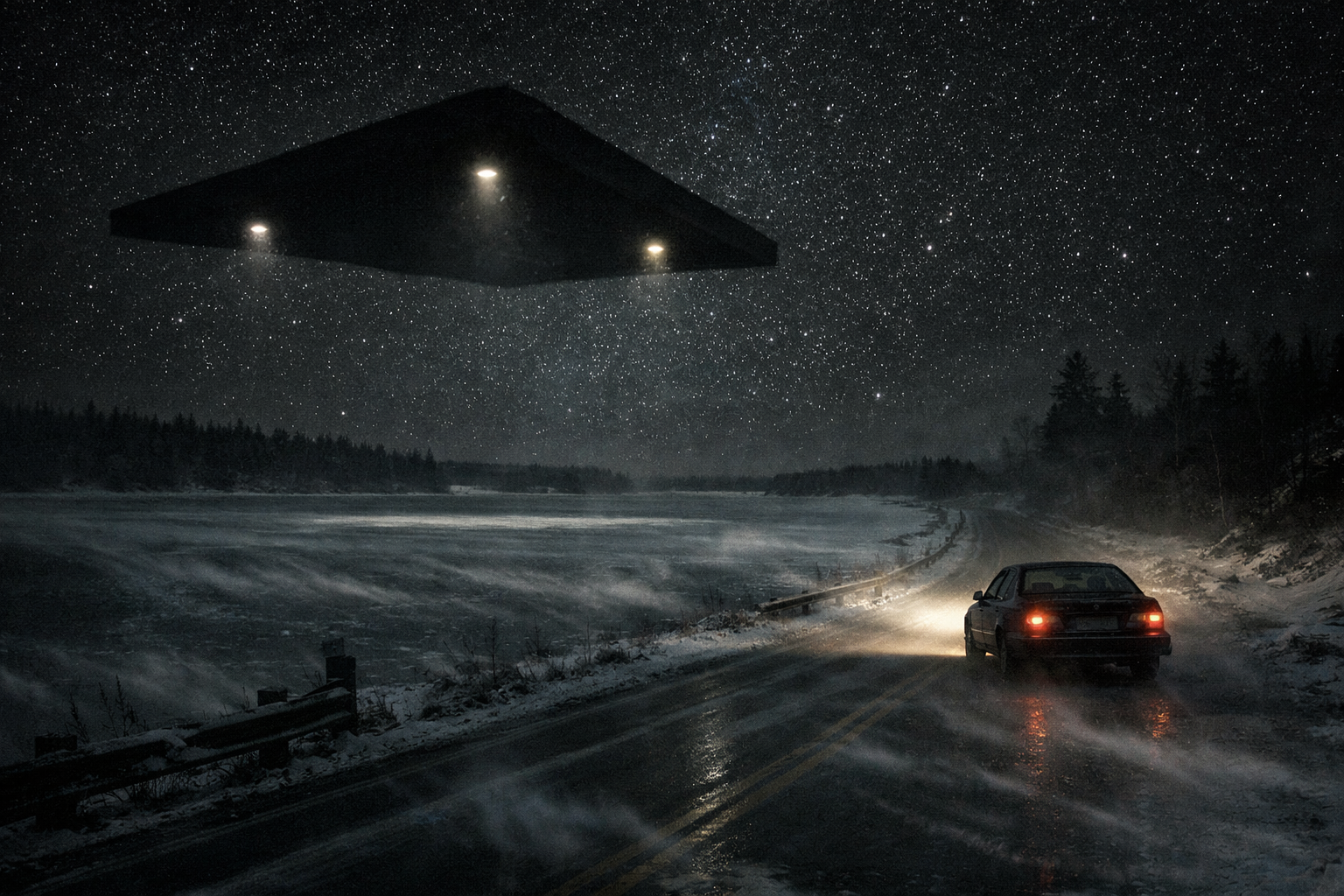
I saw the triangle because it took something away. There was a place above the ice where the stars ended abruptly, not in a cloud bank or a treeline, but in a clean-edged shape that didn’t make sense. It wasn’t a shadow from anything I could name, and it wasn’t the absence you get when your windshield fogs in a patch. It was a wedge of night darker than the night around it, an isosceles layover on the sky, hanging still somewhere just above the lake surface. I remember thinking it looked like someone had cut a piece of sky with scissors and glued a deeper black over it.
I eased off the gas without meaning to. The truck’s nose dipped, the fan belt squealed very faintly against the cold, and the hazard of it—me loose on a glassy road in a crosswind while other people slept in warm houses—made my palms slick. But I kept rolling, slower, eyes moving between the dashed center line jittering by, the cattails flashing pale in the headlamps, and that shape. I waited for the triangle to resolve into something familiar: a ridge shadow, a billboard down the road, a quirk of my windshield. It stayed a triangle.
When I came even with the broadest view of the lake, I put the blinker on and nosed over into the wider gravel apron the plows leave by the access. The truck rocked once in the wind as I put it in park, and the hazard lights started their patient ticking, orange reflections pulsing on the crust of snow along the guardrail. I cut the radio down to nothing and the heater fan sounded suddenly too big. With the engine idling, I leaned forward and peered low over the wheel at the space above the lake.
There it was, exactly where my mind had decided it would be and exactly where it should not. A black triangle, its edges so straight they felt drawn, fixed against the stars that crowded the sky around it. I traced the corner nearest the far shore with my eyes, then the base that seemed parallel to the lake’s surface. If there had been any ordinary explanation my brain could accept, it would have taken it—I wanted it gone. But the triangle wasn’t a thing out in the distance that my headlights could catch or that my windshield glare could smear. It was held aloft over that empty reach of ice as if hung on a nail driven into nothing. The wind lifted long veils of snow across the lake, little ghosts skimming, tearing, vanishing at the reeds. The triangle didn’t budge.
I cracked my window to listen. The cold came in like a mean thought. The lake made its winter sounds—pops deep in the ice, a distant, whale-like moan traveling the glass. From the line of cottonwoods along the far bank came a metallic clatter where a stop sign vibrated on its post. The wind hissed steadily, pulling at my jacket sleeve in the open gap. From the triangle there was no sound at all. No engine, no rotor chop, no fan whine, nothing to give me a scale or a distance. If I’d been told it was the size of my hand and hung two feet from my face, part of me would have considered it. If I’d been told it was the length of a barn and floating the height of a grain silo above the ice, part of me would have believed it. It simply refused to be where it seemed, and yet there it was.
As my eyes adjusted, other wrongnesses stacked. With the stars crushed that bright, anything above the lake that had substance should have sketched itself in faint reflections on the glassy surface. Even a low plane throws glints. There were none. The triangle cast no sheen, no faint echo, no suggestion on the ice. It was a cutout with nothing below to receive it. The snow ribbons ran beneath it and caught no change in light, no difference where the darkness should have deepened.
A gust shoved the truck so hard the seatbelt tugged across my shoulder. The hazard ticked. I closed the window, the rubber seal whispering against the glass, and for no reason other than habit I touched the key in the ignition, feeling its cold serration. When I looked up again, the triangle had changed. Three dim bulbs had come alive on its underside, soft and sallow, one near each corner. They weren’t bright—more like the lit ends of cigarettes seen through fogged glass—and yet the instant they appeared I had the sensation of being singled out, of a hand at the back of my head turning my face. The lights were angled, maybe, or perhaps the body itself had tipped, but their small cones found the truck.
The interior went the color of tarnish. The dash lights and the hazard indicators kept their rhythm, but the wash from those three points messed with the rest of the illumination, tensing the shadows, flattening depth. It didn’t feel like being spotlighted so much as being noticed. The radio, low as it was, surrendered to a whispering hiss that skipped and caught like breath against a telephone. The heater fan kept up, but there was a softness to the air now, a muffled quality as if the cab had been wrapped in wool.
I didn’t honk. I didn’t flash my lights or try the horn or any of that brave nonsense you tell yourself you’d do. I set my left hand on the top of the wheel and the right on the shifter and didn’t move. The truck idled a touch unevenly, a fraction of a shudder through the chassis like a heartbeat catching. Outside, across the lanes, the little weeds still poking from the shoulder were bent over flat, pressed by the wind. And in that wind, the triangle held exactly true as if pinned to a point in the night with a string, its three low lights each working their own small geography over the glass of my windshield and the hood and the snow beyond. One settled at the truck’s grille, one at the driver’s door, one a bit forward of the bumper, and I could not have told you whether they brightened and dimmed in any sequence or whether my own breath made the world pulse in and out of itself.
I remember the texture of the steering wheel under my gloves—not the big fear, not the primal, but the petty facts: the tacky rubber flaking where my thumb rested; the small draft at the corner of the window cutting past my ear; the way the hazard relay clicked a beat and then a beat, even and separate from whatever I was looking at. Every so often the ice let go another groan, echoing under the triangle like a boat dragging an anchor chain somewhere deep.
The lights did not grow. They did not sweep. They simply held, and though it could have been thirty seconds or it could have been five minutes, suddenly I could feel the unsustainability of it, the way you can feel a storm moving off before you hear the thunder diminish. Somewhere down the road to the south, a far set of headlights lifted for a second over a rise and fell again, so faint I might have imagined them. In the same heartbeat, the three lights on the triangle blinked out with the kind of obedience you only see when something obeys itself.
I lifted my foot from the brake. I don’t remember placing it there. The hazard kept up their patient orange beat on the plow bank, and without the sallow wash, the inside of the cab looked very small and very familiar—old coffee lid in the cup well, crushed pack of mints by the four-wheel-drive lever, the ghostly smear of my own breath on the windshield glass. I found myself leaning forward like a child at a window.
Where the triangle had been was only stars. Not the slow tilt of a machine banking away, not a shrinking absence, nothing I could watch to the horizon. It was as if someone had lifted a thing from the air and immediately the hole it had made in the night closed without a seam. I rolled the window down again without remembering the cold until it hurt my teeth, and I killed the hazard and the engine both so that only the wind had me.
Silence is not really silence in winter. It’s the scandal of small noises roaming around on their own. The far cottonwoods popped. Somewhere a loose length of fence wire sang a pure, sad note and then stopped. On the lake a scurry of blown grit ticked along the crust. In the patch of darkness where those three bulbs had worked the air, I could see something on the ice, spaced like the points of a broad triangle. Three circles, darker than the ice around them but not wet-looking and not deep—just there, three neat marks a distance apart, laid down with consideration. The wind ran a skein of snow across them and the powder tore and scattered on their edges, never cutting neatly across, as if the air there was fussy and wouldn’t take the drift.
I told myself I was done looking. I told myself the road needed me more than the lake did. I started the truck and the engine caught with its same tired sigh and I put it in drive. As I pulled out and let the gravel pop under my tires, my headlights swung once more across the ice. In that swing, the three dark circles didn’t shine or reflect or announce. They simply were, calm against the rest of it, a mark left in the part of the world that makes its own marks. The triangle was nowhere to be seen. The wind went on pushing the road around, same as before, and the circles held.