Five Strangers Remembered the Same House
The community room over the library had a humming soda machine and a single rectangular table with a permanent rattle in one leg. Flyers for food drives and a lost parakeet were thumbtacked to a corkboard by the door. On a Tuesday in early spring, with dirty snow mushing in the parking lot and a mop-bucket smell still hanging in the vents, five people who didn’t know each other took off coats and sat in molded chairs for a discussion group that met twice a month. The volunteer running it—a woman with short hair and a clipboard—asked if anyone had been having recurring places in their dreams. She said it gently, the way people talk when they don’t want to make a big thing of something private.
The man in the denim jacket, who’d been quiet through introductions, spoke like he was making himself do it. He said he kept ending up in the same house. Not his, not one he could name. Just a place his head knew. He was smiling a little, apologetic, when he said it. Something about the way the staircase turned. He lifted his hand and drew an invisible angle in the air. A long hall and then a landing, he said, and more steps, narrower, and a bannister that was cold through his sleeve. He said he didn’t know why he knew the weight of that wood.
The woman with a school district lanyard around her neck looked up so quickly her ponytail swished. She had the word “Attendance” printed on the plastic tag. She said, almost talking over him, does the landing open onto a hallway with a window at the end? The kind with the little shapes in the glass, like diamonds? She’d dreamed it too, she said, like an embarrassing confession. The volunteer smiled, said that was interesting, and the five of them laughed a little to let the air out of the room.
The older man in the tan work shirt had the kind of hands that still remembered tools even if he didn’t use them anymore. He said the stair runner was dark red, worn thin on the middle of each step, and there was a metal strip under the lip that caught your sock if you weren’t careful. He didn’t say this like he was telling a spooky story. He was just sure. The student with the purple backpack, whose nails were painted chipped yellow, nodded without looking up. She said there was a smell when you first walked in. Dry air, maybe dust. Not bad, just older. And you could tell the second floor better than the first, because the light there was colder. She squinted as if that detail annoyed her. The man in the denim jacket blinked—he’d never said anything about light—and he agreed. He said the front hall had a narrow table under a mirror, but the mirror had a hairline crack running down it, barely noticeable unless you leaned close.
It should have felt like coincidence, the way people’s dreams sometimes overlap with kitchens and dogs that don’t bark, but the details stacked instead of drifting apart. The volunteer kept her hands folded on the clipboard and listened. The woman with the lanyard talked about the banister, how the cap on the newel post had a shallow crescent chipped out of it, a shape she ran her thumb over in dreams without thinking. The older man said he knew that chip. The student said she always put her hand on it too, like it was a checkpoint. They went quiet at that, as if someone else in the room might be listening for the same thing.
To keep it from tipping into a whisper, the volunteer said, why don’t you each sketch what you remember. Just to see how different they are. She sounded apologetic even as she said it, knowing how naive that sounded. She tore printer paper in half and set out a bowl of pencils. They spread to different ends of the single table so they wouldn’t copy, the man with the denim jacket turning his chair so his back was to the others. The soda machine hummed and released a little click like a hiccup. Outside the frosted window, a plow scraped, then idled.
They drew the staircase without needing to think, like writing your own address. They drew the long hallway and the way it narrowed near the end, not narrower in measurement but in feeling, like the walls knew you were coming. The student sketched the window at the far end and shaded the little diamond panes like she’d done it before and got it wrong and had to get it right. The older man drew the floor vent near the baseboard with a hashmark grid. The woman with the lanyard drew the runner: a band of worn burgundy with two borders, the thinner one frayed. The fifth person, a man in a gray sweater who’d said almost nothing yet, put in a little notch near the fourth stair, a gap in the wood that nagged him any time he dreamed the place and made him take a longer step past it.
When they set the papers in a row on the table, nobody spoke at first. It was easy to tell yourself you were seeing it because you wanted to. They were different hands, different lines. But the angles were the same. The hall widened in the same place and in the same way. The window at the end wore the same geometry of panes. Each drawing had included a thin radiator down the left side with an elbow of pipe that threw a faint shine on the wall. Each had a narrow closet door off the hall with louvered slats, nearer to the stairs than felt right. In two, that closet doorknob was shown with a flat head screw missing, a small ring of bare wood where people’s fingers had worried at it.
The volunteer leaned over them with her hands still on her clipboard, not touching anything. It was strange in a way that people could talk themselves into, she told herself, yet the hair on her arms lifted a little for reasons that weren’t rational. Something in the room thinned. The soda machine took a long breath. The overhead light flickered once, the way fluorescent tubes do when the ballast is old, and went steady again.
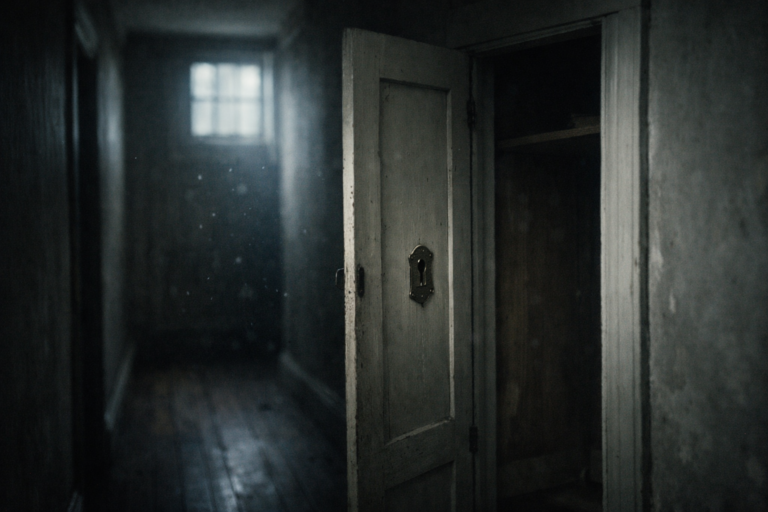
The man in the gray sweater cleared his throat. He looked at the papers but not at the others. He said there was a door at the very end of the hallway where the light from that window didn’t quite reach. He lifted a pencil and pointed at the empty space because none of the drawings had filled that end. He said he had never opened it. It was blue. Not sky blue, he said—bluer than that. Whatever that meant. Old paint with a little shine left in it. A kind of smudge around the knob where hands had rubbed it but the knob itself never turned. The student pressed her lips together and said that in her dreams, she always took a left before it, into the room with the flowered wallpaper, as if she’d always meant to go there. She said that like she was surprised to be admitting it. The older man nodded slowly. He said he never walked to the end either. He always found a reason to stop near the radiator, to look out the window instead, to run his thumb over the chip in the newel post one more time and then wake up.
The woman with the lanyard kept her eyes on the pencil point. She said she could hear something behind the blue door like a page turning. Not every time. Just sometimes, right before the heater clanked. She said it as if she were ashamed of her own specificity. The man in the denim jacket swallowed and said he had once leaned closer, as if he were going to put his ear to the wood, and the air by the keyhole felt colder than the outside winter had felt when he walked to his mailbox that same morning. He hadn’t put his ear there. He had woken. They all had a version of that. Standing at a line they didn’t cross.
The volunteer said, soft enough it almost wasn’t an idea, maybe it’s based on someplace real. She smiled to take the edge off and said sometimes your brain borrows places you’ve driven past. The man in the denim jacket said he didn’t drive through old neighborhoods much. The student said she didn’t either. The older man shrugged like it made no difference if he had or hadn’t; he would have known this place if he had. The room felt close to something it couldn’t get away from.
It was the student who took out her phone and said she was curious. She typed with her thumbs, quick, like she didn’t quite want to, phrases that came out of their mouths and into the search bar. “Diamond paned windows old house hallway,” then the name of the county because that felt like the right scale of a dream, not far, not near. The volunteer said they didn’t have to do this, but she didn’t say it in a way that could stop anything. The student scrolled, the blue light of the phone turning her face a strange color. She clicked, breathed out, clicked again. The soda machine hummed its steady refrigeration hum, like a second heartbeat you only noticed when you went quiet.
She found it on the third page—an agency with a green logo, a listing that had been live for a while and was stale enough to have a price reduction banner. The photograph was taken from the sidewalk, with a front lawn still yellow from last year’s drought. The house was two stories with weathered clapboard and a central gable overhanging a porch, and in the gable was a three-pane window set in a little triangle. In each of those panes the leadwork cut the glass into diamonds. Even in the washed-out light of the listing, the pattern was exact. The older man exhaled through his nose and said, yes. That. He didn’t say anything else. The woman with the lanyard took the phone and held it too close to her face, then farther away, then closer again, an unconscious rhythm. The man in the denim jacket didn’t lean in. He actually sat back, as if the phone had inches he could drown in.
They passed it around. The sidewalk curve matched the imagined one the denim-jacketed man swore he’d walked up a hundred times in sleep. The shrubs clipped into tired domes were where they had expected them to be. A faint handprint on the porch railing, maybe just weather. They studied the triangle of windows until the shapes swam. The volunteer asked the student to email the link to everyone, even though the habit of emailing strangers anything at all felt like handing over a bit of yourself. They wrote down addresses on the back of one of the flyers from the corkboard because that was what you did to make something part of your day instead of something you left in a room like a coat. The room felt smaller. The light was the same, but the glass seemed to show less of it.
They packed up when the building attendant flicked the hallway switch twice to let them know it was closing in ten. The older man pulled on his work shirt like armor. The woman with the lanyard took a second to tie her hair into a better ponytail, slow, methodical, as if keeping her hands busy might warm them. The student slid the purple backpack over one shoulder and crossed out a date on a calendar widget on her phone without seeming to register it. They said see you next time as if someone had to hear that to make it true. The volunteer stacked the chairs and watched their backs in the glass of the door. The soda machine hummed for nobody.
On the sidewalk, the man in the gray sweater paused to fix the cuff of his glove. He didn’t turn the phone back on until he was alone at the bus stop, under an ad for tax preparation peeling at the edges. The listing link opened on the first try. The house’s front windows were flat and pale against the dusk of the photograph, the little diamonds in the glass catching no sun. He zoomed, pinched, zoomed again. He told himself he was being silly. He told himself the pattern was the thing and there was nothing more to see. He could make out his own reflection in the black glass of his phone, layered faintly over the old wood and the clipped shrubs. When he breathed, the glass fogged the slightest bit. Behind the diamond panes, something darker than the interior shadow seemed to slope away, like the break of a stair. Farther back, much smaller than it should have been if it were there at all, there was a blue that wasn’t sky. Something about it was one degree away from the color he knew. He blinked, thumb hovering over the next photo thumbnail with the promise of the hallway inside. The screen dimmed for a second when a cloud crossed the streetlight. He looked up without meaning to, as if the door at the end of an ordinary room had just felt pressure on its other side. Then he lowered the phone and watched the bus headlights approach, the listing’s house still in the glass, those little panes catching a shine that made them look for a moment as if something behind them had moved.