
Project Blue Book: How the Air Force Studied UFOs
On a summer night when radar scopes painted errant lights over the capital and switchboards across the country trembled with calls, the United States quietly built a library of the strange. In that library—rows of metal cabinets, onion-skin memos, and starched incident reports—lived the story of Project Blue Book. Decades after the last case was stamped and shelved, people still reopen those drawers, looking for the line where ordinary sky meets extraordinary witness.
The appeal endures because the record is paradoxical: sober letterhead and guarded language on one hand, and on the other, entries that decline to be solved. Blue-ink checkmarks designate Venus, aircraft, weather balloons. But here and there are files marked less comfortably—unknown. Between the explanations and the remainder is a debate that has become a chapter of American folklore and a touchstone of government transparency.
This feature revisits the military study that tried to put names to nocturnal lights and disciplined analysis to rumors of impossible flight. The program left a paper trail so complete—and so incomplete—that it continues to invite both skepticism and belief. We step back into the filing room to see what a national security apparatus learned from the skies above it.
A Filing Cabinet Full of Lights: The Project Blue Book Enigma
Two things defined the era: the Cold War and the avalanche of sightings that coincided with the jet age. Pilots, radar operators, police officers, and civilians reported erratic objects that seemed to outperform familiar aircraft. Against that backdrop, the Air Force established a system to standardize the intake of reports and to evaluate whether any unknown aerial phenomena posed a threat or hinted at foreign technology. The blue-covered files that survive read like a slow, methodical conversation between the sky and the state.
Working cases from regional air bases to Wright-Patterson, investigators looked at the world as a mosaic of plausible errors: temperature inversions tricking radar, astronomical bodies low on the horizon, balloon flights, secret test aircraft, and outright hoaxes. Yet even within this framework, a proportion of incidents persisted in eluding identification, a statistical remainder that would become a magnet for later researchers.
Before Project Blue Book: Sign, Grudge, and the Cold War Brief
The investigation did not begin in a vacuum. In 1948, Project Sign marked the first systematic Air Force attempt to address reports of unusual aerial phenomena. Sign gave way to Project Grudge in 1949, a more skeptical incarnation that aimed to deflate the tension surrounding sensational accounts while still tracking potential national security issues. Both efforts reflected a nation gauging the limits of its instruments and anxieties.
By 1952, the volume of reports and the urgency of understanding them led to a formal, long-term study. The new program codified procedures, built case files, and developed a taxonomy of explanations. It also tried—sometimes awkwardly—to manage public expectations during a period when newspapers splashed sightings above the fold and radar-visual incidents near Washington, D.C. sparked front-page headlines and difficult questions for senior officers.
What Project Blue Book Said It Was—and Wasn’t
The mission statement was careful: collect, collate, and evaluate reports to discern whether any represented a threat to national security or an opportunity to learn about advanced technology, foreign or otherwise. Before it ended in 1969, the program reviewed thousands of cases. Many were resolved as misidentifications of conventional aircraft, balloons, astronomical objects, or atmospheric effects. The end-of-project conclusion was unequivocal: the study found no evidence that the phenomena constituted a national security hazard and no proof of extraterrestrial technology.
That official posture did not erase the atmosphere of ambiguity. Even the final tabulations acknowledged a small percentage of incidents that resisted explanation, either for lack of data or because the available data defied the catalog of known causes. This remainder would become the seedbed for later debates about method, bias, and the meaning of “unexplained.”
The People and Papers of Project Blue Book
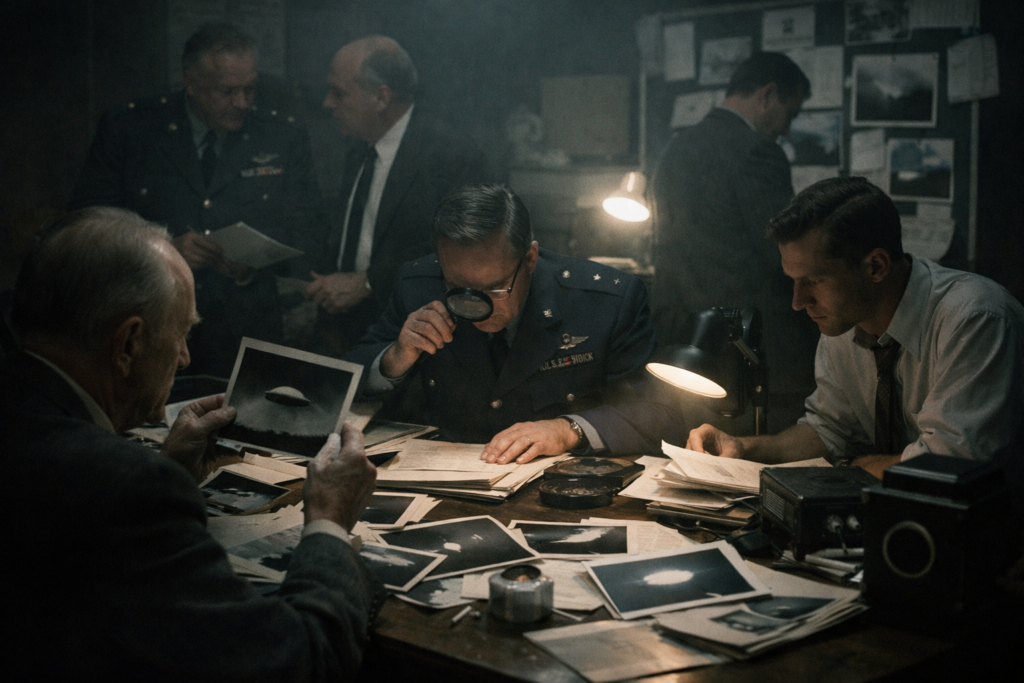
No figure looms larger in the scientific memory of the effort than astronomer J. Allen Hynek, who served as an external consultant. Initially recruited to help parse astronomical misidentifications, he later grew publicly critical of some investigative practices and public-relations choices. His career after the program—during which he advocated for more open and rigorous inquiry—shaped how a generation of researchers thought about unexplained aerial reports.
Inside the file drawers, certain documents stand out: technical memos on radar filters and propagation, field interviews with pilots and controllers, and photo analyses that tried to squeeze meaning from poor exposures. Earlier heads of the effort, including officers who emphasized standardizing fieldwork, set the tone, while external panels—most notably the 1953 scientific advisory meeting convened to recommend public handling—left their mark on policy. By the late 1960s, the University of Colorado study led by physicist Edward Condon advised that further study was unlikely to yield breakthroughs. That recommendation dovetailed with the Air Force’s decision to close the project.
Evidence in the Project Blue Book Files
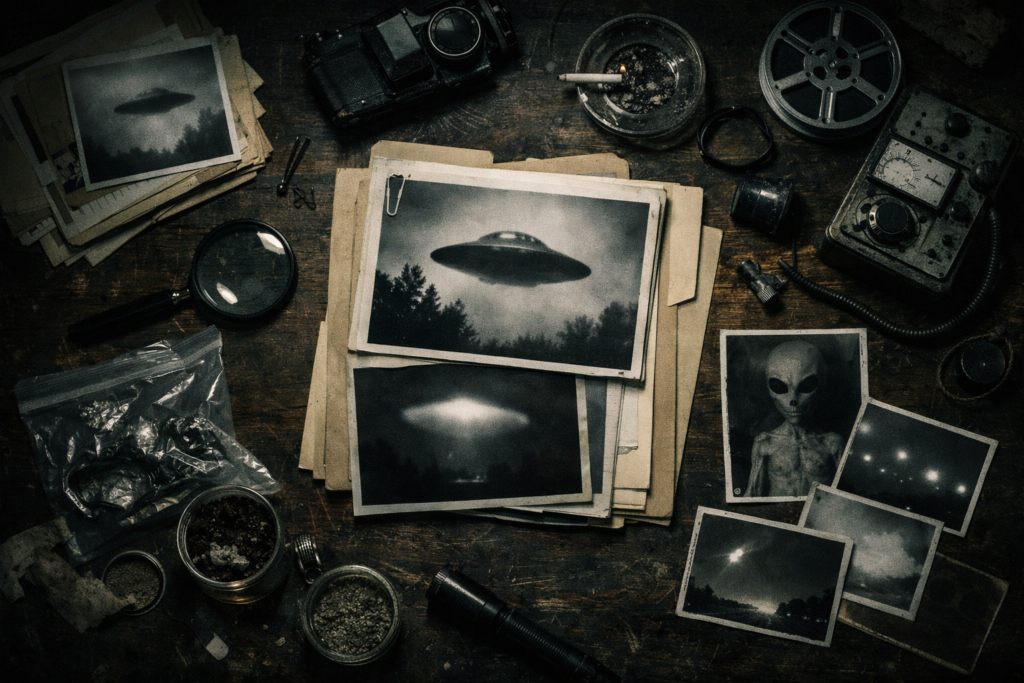
What does the record actually contain? In broad strokes: witness testimony, radar logs, photographs, and trace analyses. The quality varies wildly. Some files are little more than a postcard and a distant light; others knit together radar returns, cockpit narratives, and ground confirmations into coherent timelines. A few Cold War cases—radar-visual series over the nation’s capital in 1952, puzzling returns and intercept attempts in the mid-1950s, and multiple-witness military encounters—became touchstones for both investigators and critics.
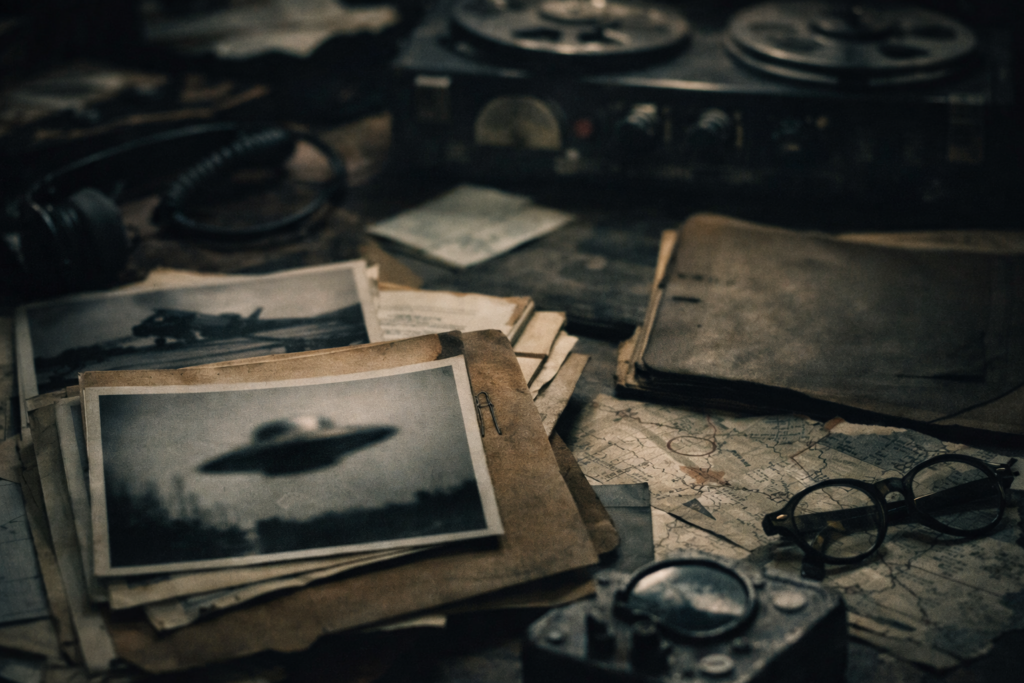
Photographic evidence proved especially fragile. Many frames succumbed to long exposures, lens artifacts, or miscalibrated shutters. Radar, too, demanded caution; atmospheric ducting and anomalous propagation could plant ghosts on green screens. Yet one of the most arresting features of the record is that, after eliminating the ordinary and the mistaken, a fractional set of incidents remained categorized as unknown. In the program’s own accounting, these were not claims of vehicles from elsewhere—they were cases the available data could not reduce.
Reading Against the Grain: Skeptics on Project Blue Book
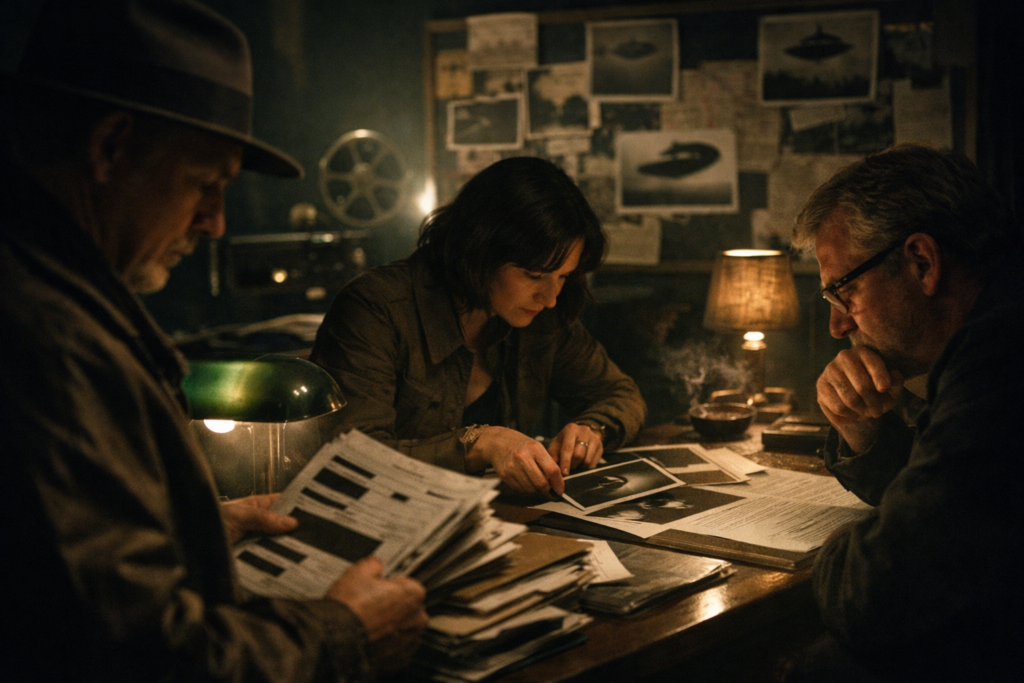
Skeptically minded researchers have long argued that the “unknowns” largely reflect the uneven quality of the data: incomplete observer notes, lack of instrument correlation, or complications from classified technologies that could not be openly discussed at the time. They point out that even seasoned pilots can misjudge celestial objects if fatigue, weather, and expectations collude. They also note that the statistical remainder shrinks when only the best-documented cases are considered.
A related critique addresses public communication. At times the project seemed to lurch between overconfidence and diffidence, offering swift conventional explanations for media-saturated cases that later bred mistrust. The infamous “swamp gas” episode in Michigan became a case study in how a rushed explanation can overshadow method. For skeptics, the proper lesson is not that the extraordinary was ignored, but that the ordinary was sometimes communicated clumsily.
Why Project Blue Book Still Echoes
Despite its closure, the study refuses to stay confined to history. Declassified case files—now available for researchers, journalists, and the merely curious—have become foundational texts for the modern conversation on unidentified aerial phenomena. Advocates for greater transparency argue that the archive is a starting line, not a finish, and that it demonstrates both the feasibility and the necessity of sober, open inquiry.
The persistence of the story also owes much to what the files cannot settle. When an official record admits to a residual category of unknowns, it invites subsequent generations to revisit those margins with better tools. In recent years, new government initiatives have renewed public interest in how officialdom handles anomalies in the sky. Every fresh announcement about contemporary UAP studies refracts backward through the Cold War archive, reviving questions about how much was known, misunderstood, or left on the cutting-room floor.
Daily Paranormal Analysis
Why this story became popular: It marries sober bureaucracy to the edges of experience. The existence of a vast, methodical archive offers the credibility of paperwork, while the subject matter—nameless objects in the national airspace—touches national security nerves and human curiosity. The contrast between formality and strangeness gives it cultural voltage.
Why believers find it compelling: The paper trail confirms that trained observers saw and tracked anomalies serious enough to merit high-level attention. The survival of a residual category of “unknowns” suggests that, even after misidentifications and mundane causes are subtracted, something challenging remained. The involvement of scientists like J. Allen Hynek, who evolved toward advocating more rigorous, open inquiry, reassures readers that the topic need not be relegated to fringe speculation.
Why skeptics doubt it: Much of the evidentiary base is weak by modern standards—poor photographs, inconsistent witness statements, and sparse instrument data. Skeptics also foreground the Cold War context: secret aircraft and sensors, radar propagation quirks, and public-relations pressures that distorted how some cases were handled. The concluding assessments—that no national security threat or extraterrestrial technology was detected—align with a view that the phenomenon was never more than a stew of error, expectation, and secrecy about unrelated programs.
Connections to similar cases and inquiries: Earlier efforts like Project Sign and Project Grudge, and the later University of Colorado study, framed official thinking. Historic radar-visual episodes and mid-1950s military encounters serve as comparative anchors. In the present day, periodic government statements about UAP echo the same tensions between caution, classification, and public curiosity that defined the Cold War files.
Does the mystery remain unresolved? Yes, but in a bounded way. The archive resolves a great many sightings and demonstrates the limits of mid-century tools and methods. It also leaves behind a disciplined set of unknowns—the kind that do not assert an exotic answer so much as they mark the perimeter of knowledge at the time. Whether those perimeters close with new data remains an open question.
After the Dust Settled: Project Blue Book’s Legacy
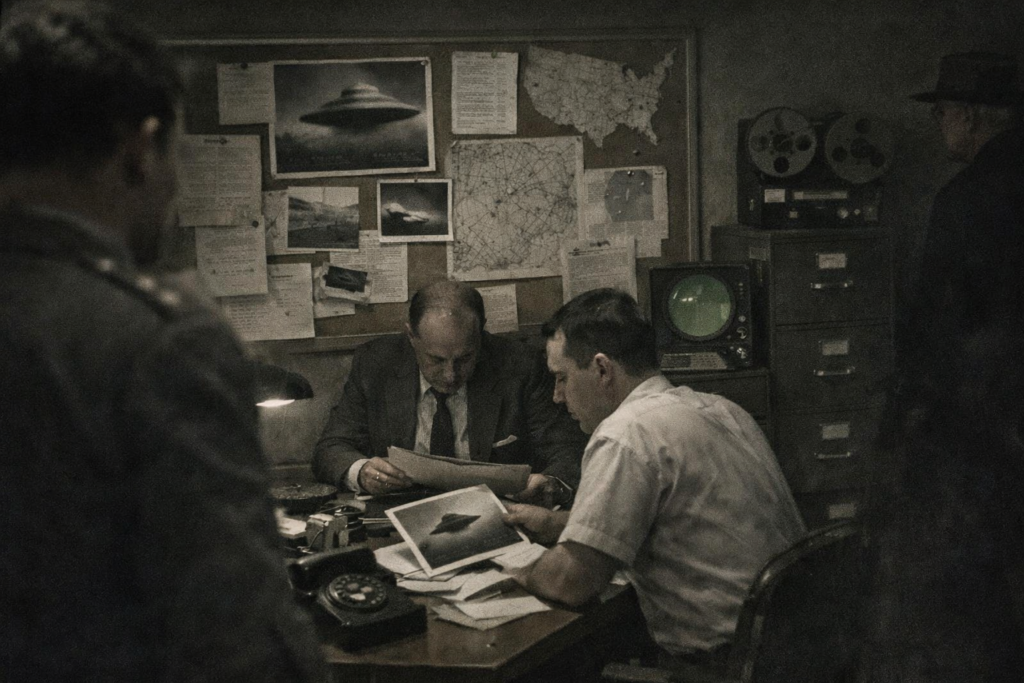
When the program ended in 1969, its official message was designed to close the book: the skies contained no verified technological surprises from elsewhere and no clear threats that could be traced to unidentified phenomena. Yet history has a way of reopening files. Today the declassified record is cited in debates over how to organize contemporary investigations, how to speak about uncertainty without sensationalism, and how to marry national security concerns to scientific curiosity.
Perhaps the most lasting effect is procedural. The program taught that standardized collection, cross-checking between witnesses and instruments, and archival stewardship matter. It also taught a softer lesson: public trust is fragile, and answering a mysterious report too quickly can be as corrosive as answering it too late. In the shadow between the ordinary and the not-yet-explained, method and humility must walk together.
The cabinets are quieter now, but their contents still breathe when read. Between the familiar categories and the unsettled few lies the story of how a nation tried to think clearly about a noisy sky. The testimony gathered may not prove what the most ardent believers hope, nor vindicate every skeptical dismissal. It does something humbler and more enduring: it shows, on the record, how mystery was met with procedure—and how much work remains when procedure reaches its edge.


