The Experiment They Said Never Happened
He used to do the late shifts because the building moved better when no one could see it. Fewer swipes at the turnstiles, fewer eyes over his shoulder. Just the steady hum of conditioned air and the blue tick of monitors that watched each hallway like a held breath. He had a clipboard then, a headlamp, the clipped swagger of someone with keys to rooms other people only pictured. It was years ago, a maintenance contract in a research complex past the highway, tucked low and unremarkable in the rise of scrub pines and substation fences. He remembers it as a held shape—fluorescent corridors and sealed windows, sanitary trim, the sense of being inside a machine that politely refused to acknowledge him.
They called him in on an ordinary work order: evaluate panel loads after an expansion. No alarms, no emergency, just columns to be checked and stamped. He signed at the front desk, exchanged his driver’s license for a salmon-colored visitor badge that would only open the doors he already had keys for. A guard escorted him through the first two checkpoints and then left him to his rounds with a shrug that said the building would take it from there. His first stop was the Facilities office on Level B—a low room tucked behind a locked glass door, each hinge wrapped in neatly labeled wire bundles. It was a small office, four desks, a bank of file drawers, a corkboard with work orders curling under pushpins. Someone had left a coffee ring on the load logs. The place had the smell he associates with every sealed building: paper, dust, human breath packaged safely away.
It was after hours, the office lights minimal, a pool of brightness over the desk where he’d sign off on circuits. The building’s day staff had gone, their chairs turned in under their desks, their monitors black, mugs yawning their brown mouths to the evening. He keyed into the office, relishing the quiet. He shut the door behind him and felt the latch thunk with a delicate finality. The office felt separated from the rest of the building by that shut door; here was his little center, a lamp, a binder of one-line diagrams, the floor plan sets, the laminated emergency egress map mounted at eye level, all the permission he needed to go find the breakers and put them into numbers.
He went about it with the relief of routine. He laid the binder open and dragged a finger down the breaker schedule for Panel L3B, his pencil tapping the margins where previous techs had initialed their checks. Everything was numbered and named: Office 212, Clean Utility, Hall 2B. He worked his way down until he paused at a line: E-6 – DO NOT ISOLATE. The space for “room name” was blank. The rest of the line was ordinary enough—voltage, expected draw. But E-6 didn’t appear in the list of offices. He checked the laminated map on the wall to his right, the one with the neat green arrows showing exits and the tidy blocks of rooms. The corridor numbered 2B ran straight and short; there was no E-6 on it. Storage 2B21 ate the space where an E-6 might have been. He frowned and looked back to the breaker schedule. There was a stamp over the line, something in small red letters smudged down to a pink haze by the years of fingers. He thought, not for the last time, that the building had its own handwriting.
He did what any good tech does: he traced the physical. He went out into the corridor, his shoes whispering on that easy-clean modular carpet, and found the panel. The air was colder out there, the sound different—a fuller hush, the distant rap of something metal settling, the building breathing through its ducts. He set his clamp meter over the feeder labeled E-6 and watched the readout find itself. A flat, steady number. Not a blip. Plenty of rooms do that—freezers, servers, anything that doesn’t sleep—but the ones that do are always proudly labeled so that no one like him ever throws them dark. He traced the conduit with his eyes to where it slipped into the wall, heading toward the south arm of the corridor.
Along that arm, the egress map said there were three office doors. He could see two. The stretch of wall between them was suspiciously new, the paint more recent in a way only a night worker notices, a sheen that hadn’t been sanded down by hands and rolling carts. There was a slim rectangle on the wall at waist height, a card reader without any numbers; its LED was unlit. No door around it. Just wall. He stood in front of that blank place and let the thought form: maybe there had been a door, once. Maybe renovations had simplified the geometry and the electricians never caught up to the idea. He put his ear to the paint, less as a serious test and more for the private joke of saying he’d done it. What came back was not a knock or a hollow. It was a sound like a low machine cycling, air passing across a grate, the repetitive start of a motor and its slow come-down, a breath with a metronome. Underneath that, if a person wanted to be fanciful—and he was not—there were vowels. Not words; a cadence without consonants, a murmur caught and smudged by who knows what meat of wall between him and it.
He stepped back, shaking his head at his own imagination, and checked his watch. Another round, another office. Still, he wrote it in his book in small careful letters: E-6, south wall, card reader, draw steady at night. The page looked more serious with the note on it. Back in the locked office, the feeling followed him like a smell. He closed the door behind him, set the deadbolt because he always did, and the office felt instantly quieter—eyes closed, ears turned inward. He took the binder off the desk and propped it on the little metal stand. Pencil to paper. Notes. Check, check. And then—because the job had trained him to be considerate of the nontechnical—he looked again at the laminated escape map. No E-6. The small crisp drawing that the fire inspector made the building pin up everywhere lied without effort or malice by omission.
When he came back the next night, because for these sorts of jobs you always come back, he listened again as much as he looked. The machine-breath through the wall of the un-room was still there, not loud but insistently even, like a metronome set behind another, larger clock. He thought of basements, of coils, of sterile water moving through clear tubing. In the locked office, after the thump of the door and the roll of the bolt into place, he realized the same sound carried through the thin partition that separated that office from whatever was beyond. He turned off the desk lamp just to see if he would hear it better in the dark. The room held the absence like a theater between scenes. The HVAC was the same as always, an agreed-upon sigh. Underneath it, that other whirr rose and dropped, rose and dropped, and there was the soft click of something valved opening, closing, as regular and unremarkable as a blood pressure cuff.
He could have let it be a quirk in the plans, but jobs like this build a callus of curiosity that you can’t help scratching. He brought it up in the morning with the day shift supervisor in the light-struck glare of the loading dock. What’s E-6 feed? he said, careful and casual, chin up toward the building as if they were just two men passing opinions about cinder block. The supervisor stared just too long. The pause looked like a thin sheet of glass, blank and rigid. Then the man smiled and reached for the plan set he kept rolled in a rubber band. He unfurled the polished paper, tapped the corridor, tapped the doors. That is a wall, he said, and then, because the script probably told him to soften it, added, They remodeled last year. The designation must be out of date. These things happen. He folded the paper back with gratitude, as if the conversation had been about how easily paper learned to obey.
He went back for the after-hours round with a stubbornness he would not have wasted on anything in his personal life. At the south wall, the blank card reader was gone. In its place was a vending machine squatting on a rolling base, its lit front hawking chips and sweet drinks to no one. He stood there and stared at the bright bags, their colors wrong in the hallway’s cooled light. The machine made a winding sound as its condenser kicked. When it settled, the other sound announced itself again behind it, softer but present, the low tide intake and release. He crouched, because crouching sometimes shows you what standing up lies about, and saw the baseboard there was a separate piece, not quite flush. The gap ran thin and honest along the seam. Cool air whispered out and across his knuckles.
The second wrong detail was a small one, absurd in its audacity. On the conduit where it dove into the south wall, a wraparound label hung by one hardened edge, a plastic flag whose adhesive had failed at the corner. In black industrial font the building used for everything, it read: E-6 – DO NOT ISOLATE – PANEL L3B. He didn’t touch it. He didn’t need to. He backed away and wrote it in his book with ‘flag label visible’ because for all the misshapen mysteries in the world, the smallness of a plastic label carries more weight with supervisors than anyone’s ear to a painted wall.
He tried again, because facts help men like him sleep. Another day, another round at Headquarters. He mentioned it to the chief electrician, a careful man who rubbed his thumb along the groove worn into the handle of his mug. The chief’s eyes slid up, past him, to the camera in the corner, then back to level. There’s no E-6 on B, the chief said, his voice a half step too even. Where you’re pointing is a mechanical wall. The guardroom and the riser. It’s all shafts. If you’re seeing a mislabel, note it and we’ll fix the schedule. He left the room with a short nod that was not permission so much as dismissal.
On his next shift, the breaker schedule in the binder had a new page. E-6 was now M-Clos. There was no stamp where the red blur had been; there was instead a penciled arrow to a note that said ‘old print.’ He flipped to the index for corrections and couldn’t find a trace of the old line anywhere. His copy of his own notebook, where he had written E-6—flag label visible—had a tear where that line had been. He stared at the ragged edge, the margin ink that now stopped unceremoniously mid-stroke, as if his pencil had found a seam in the page nobody else ever had. He told himself he’d been clumsier than he knew. He told himself that in rooms like these, built by people more practiced at doors than the rest of the world, papers sometimes caught where they shouldn’t and facts got filed in a place with no label.
The last talk he had about it was in that locked office after hours, the walls quiet, the lamp making a small star of his desk. He raised it on the radio, unsure why. Maybe for the bark of a voice, an answer that wasn’t paper. Security, this is Maintenance on B, can you confirm access to E-6? He knew as he said it that it wasn’t even the right question. The radio clicked and opened and held an empty space for just a second too long before the reply landed: Maintenance, there is no E-6. Do you require assistance? He could have asked what the breathing was, behind the vending machine that hadn’t been there the first night. He could have said he was listening to a building that didn’t sleep reliably. But the words dried. He said No, and the radio clicked back, and the office breathed around him, and in that breath there was the low mechanical murmur the way there had always been, and maybe he would have forgotten it if there hadn’t come a day when he left the job and the place and those corridors stayed where he couldn’t see them.
Years went by. He moved across town and then again, took a different contract where offices filled with day-shift people who liked to make him a second coffee, all politeness and windows. He told no stories about that old research complex because in the retelling the ordinary strangeness sounded silly: a wall where a door had been, a label out of place, a sound that could have been ductwork. His own memory felt like a room he had stepped out of and locked behind him. He married. He reset his badge lanyards in a kitchen junk drawer. He forgot the words E-6 until sometimes the hum of an appliance in the night would seem to be speaking in its own vowels, and he would think of a breath guided by a cycle timer, and then he would sleep anyway.
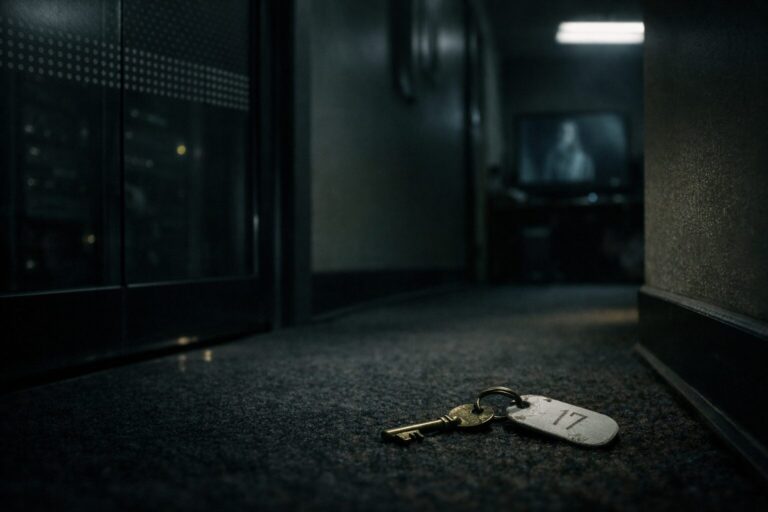
It was a winter night when he found the thing he had not taken. He was alone in his home office, a room he locked out of habit when he was sorting through anything he meant to finish, because doors felt better closed. The house held itself around him the way good houses do—the heating clicking in, the hum sneaking down the registers, the dark slumped like a cat against the window. He had a cardboard banker’s box open on the rug. It was a mixed lot of his history, the kind of box you promise yourself you’ll sort one day and only reach for when you’re looking for a tax receipt. Old manuals slid in among a wrench roll, a stapled packet of safety briefings, a dead flashlight with a duct-taped grip. He settled cross-legged and lifted a stack of eight-by-ten as-built prints he’d rescued from a different job. Under that, on the brown corrugation, lay a small white flag of plastic with hardened glue fingerprinted along one edge.
He didn’t know what it was for half a second. He lifted it by the corner, light as a fortune from a cookie. The black print was unambiguous even worn so thin the edges fuzzed: E-6 – DO NOT ISOLATE – PANEL L3B. The hyphen was in the wrong place the way that building’s stencils always put it. He felt something like a muscle in the back of his neck prepare itself for a shrug it would not be able to finish. He turned it over in his fingers, expecting some rationalizing scuff: a cracked back, a thumbed-on smear that would say it was from some other job, some other panel, some other life. The plastic was clean. The adhesive had a grit line where it had been peeled from metal. There was a faint chemical smell of label stock, the particular ghost of a print shop that reappears when plastic opens itself after a long time pressed between papers.
He laid it on his desk blotter without deciding to. He looked down into the open box as if maybe the rest of the wall would be in there too, folded small and tucked between a binder clip and a bent Allen key. There was only his life. Pencils. A coil of copper that had greened at the cut. A safety sticker for a ladder brand he had never owned. He held the label up to the lamp and watched the light draw its pale shadow like a line measured and found correct. He hadn’t pried that label off anything. He hadn’t taken anything from that building that he hadn’t brought in. He had signed too many papers to have let his pockets wander.
His office door was shut, the little bolt slipped, the way he liked it when the work was small and finicky. The heat murmured in the vent. Somewhere in the house, a refrigerator woke up and cleared its throat. He could feel the building that wasn’t his anymore somewhere back behind those noises, behind the clear domestic hum—the other rhythm, regular and low, wrapped up in walls drawn not to be believed. He told himself how it could have gotten there: a box mixed by mistake, a page it had clung to until the adhesive gave up and the plastic slid loose. He told himself someone, some supervisor, had dropped one into his paperwork to have a laugh that he had never been present to receive. He stood, turned the plastic in his hand to read it one more time, and thought about the way the guard on the radio had said there is no E-6 with the flat weight of a brick set down on a table.
He placed the label back in the box, on top of the printouts, and closed the lid. When he bent the cardboard ears into their slots, the home office made the small sound rooms make when you take one last look at them before shutting off the light. He paused with his hand on the lamp’s pull chain because habit told him to check the lock one more time. He looked back at the box because habit told him he would forget if he didn’t. The box was the same. Nothing moved, no grandness to announce itself. The only new thing in his life was that small white label that shouldn’t have been there at all. He turned the light off and heard, through the thin rational walls of his house and through the thicker ones memory builds, a faint mechanical breath counting its way toward morning.