The Soldiers Who Heard Voices in the Desert
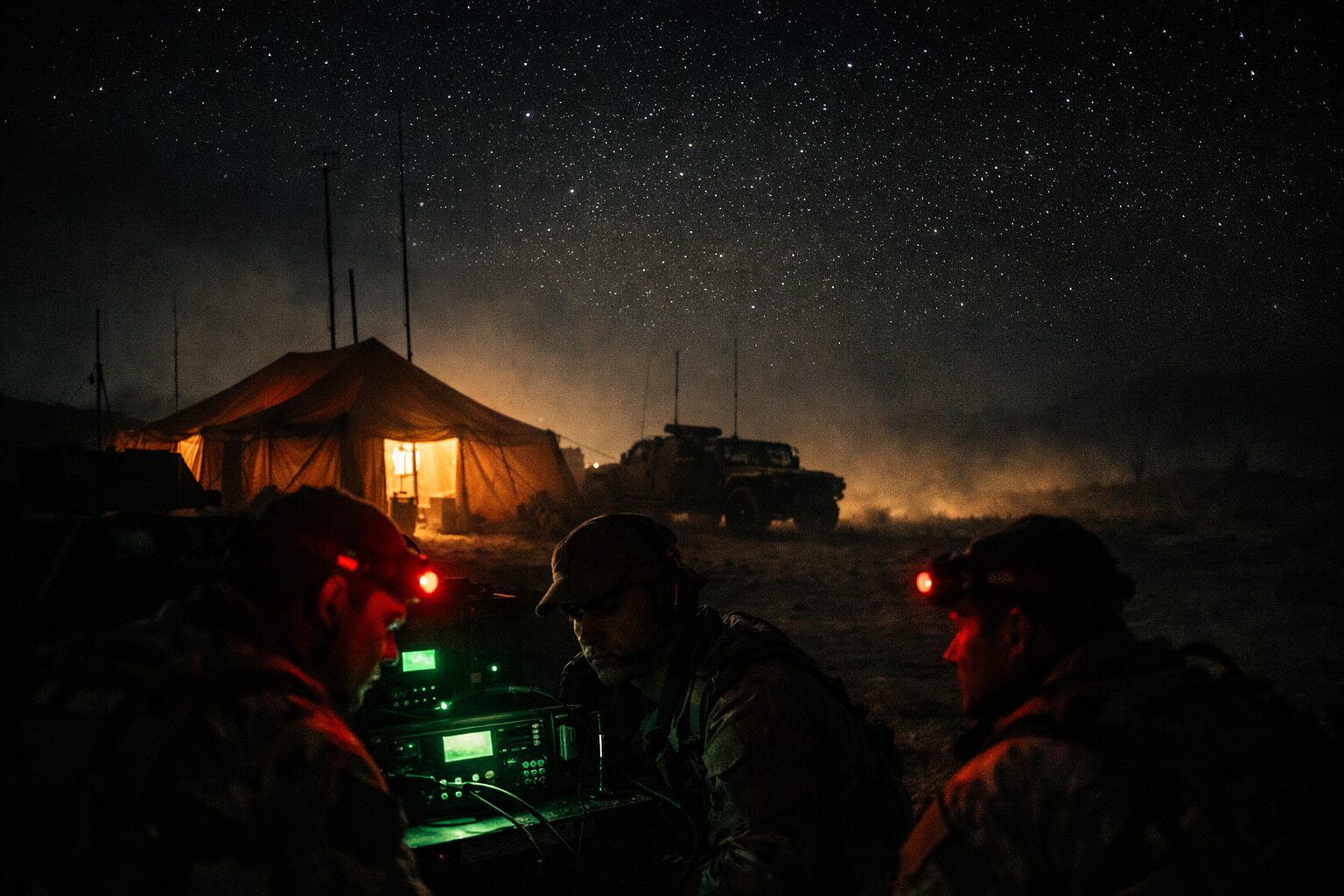
They were a line of dim red dots scattered across a basin of emptied light, the unit stitched into the map by coordinates and routine. Headlamps stayed on red. Breath went white in the cold that came after midnight, thin as paper. Engines were off. The last convoy had rolled past hours ago, the hum of tires on distant hardpack now a memory the desert took back. In the operations tent, a green light from the radio rack turned the aluminum table a softer color. Paper checklists were clipped beneath a stone to keep them from lifting in the barely-there breeze. Outside, vehicles hunched like animals asleep under tarps, windshields hooded, antennas ticking softly as they cooled.
They’d set their perimeter at last light and gone quiet. SINCGARS in frequency-hopping, COMSEC load good, time-of-day synced, primary net on five, backup on seven, admin on three. Channel eight had a line through it on the commo card, unassigned. Sergeant Hale made the rounds with a roll of tape and a Sharpie, boxing dates and initials on battery packs. Specialist King checked the PLGR twice and thumbed coordinates into the log with bare fingers despite the cold. Ortega taped the map down to four corners. Their voices inside the tent were low and without ornament. The night out there was too large to answer back if you raised yours.
It was calm enough that they could hear nails pinging as the heater metal contracted. When the wrong sound came, it was first just the shape of speech, a human rhythm slid under the radio’s steady hiss. “Check, check.” Corporal Liu looked up, a pencil paused above his grid book. Channel five’s squelch light stayed dark. Hale leaned in and watched the LEDs. The sound came again, mid-volume, clean, not like a far-away unit bleeding into them. “Copy traffic,” the voice said. It was on eight. On the blank channel.
“Range, confirm you’re on eight,” Hale said, out of habit more than hope. He changed the selector, the small detent stepping over plastic, and pressed to transmit. The voice did not wait. “Viper actual,” it said, pronouncing the callsign with the slight lift an instructor might use to make you feel they knew you by name. “Viper one-six, Viper three-one. Acknowledge.” There wasn’t any engine noise under it, no wind. It sounded close, as if the speaker had taken two strides nearer the wall of the tent and put a hand flat on the canvas to steady himself.
“Identify,” Hale said. “Who is this?”
“You’re at one-one Sierra November Tango two-seven eight-four zero five-three three two-one,” the voice replied without breath. The room of faces tightened as all of them looked down at the map without wanting to. Ortega tilted the PLGR so only he could see it and didn’t say anything. The numbers were theirs. A half-beat later, it added: “Sergeant Hale, Specialist King, Corporal Liu, Private Ortega.” Silence settled in again as if waiting to be accommodated.
They pulled the fill and pushed it back. They stepped nets. They changed hopsets. The voice did not seem to move with them so much as live wherever they went. “Authenticate Echo—Zulu,” it said, like a person who had been given enough of a procedure to be convincing and no more. Their sheet did not have those letters. In their headsets, in the quiet hum of batteries thinking, the calm talkers of range control stayed absent. The O/Cs didn’t break in to tease them or correct them. It was just this voice on the blank box, asking for attention, making the right shapes with its mouth, saying names it should not know.
“We’re going dark,” Hale said finally, after twenty minutes of trying not to look like he was rattled, after the second time the voice read their grid just slightly differently and somehow closer to the way Ortega pronounced numbers in Spanish when he was tired. “No transmissions. Keep listening. No one answers unless it’s the DO.” They killed the admin net first. Then backups. Even the rack radio went to a flat black panel, its little light mad and throbbing before the switch took it down. They were left with fabric moving at their shoulders when they shifted their weight, the click of someone’s nail on plastic, the spotlit triangle of a headlamp on red pointed at a fold in the map.
Outside, the cold made sound carry strangely. Sand was granular cement under boots. Far off, a coyote unsheathed three remarks and stopped. Beyond the line of HESCO and the low berm they’d built by habit, the land kept going, a lattice of creosote and yucca blush barely visible. No one was supposed to be near them. The training area had a border and a gate, a sign with dimensions and rules. The highway—a ribbon everyone said you could hear late at night if you held your breath—was too distant to account for any human words that were now coming very close.
“Viper actual,” the same voice said, not on a speaker, not through their headsets. It came from just beside the tent, at about the height a man would stand if he had walked in from the dark and stopped by the door and said it as a test. Hale turned his head slowly and watched the shape of stone and sand through the fabric. Ortega’s throat forced down something dry. King looked at his radio, dark and dumb as a toy that had been left to sleep. “Copy, Viper,” the air said. The fact of the tent’s wall touching no one made it worse.
They went outside together, red cones of light stitching wavering funnels through dust. The engine cowls of the trucks were all gleaming black ridges, soundless. Their breath made a thin fog that blew sideways a little and then did not. “Who’s there?” Hale asked, and he hated himself for using the line that, wherever you heard it—movies, bad training videos—meant nothing good. The dark offered nothing in reply, just the feeling of a person nearby choosing to keep his back to you. Then from up, or everywhere, or in the more honest part of the silence: “One-one Sierra November Tango two-seven eight three five… zero five three three four. Adjusted.” The sky showed them a handful more stars, nothing else.
They checked each truck, each cot. They found nothing human outside of themselves. King, done with his walkaround, took off his helmet in the tent and set it on his cot, his hair now a rough cap pressed flat by hours. He reached for his canteen and missed, the thing rolling under his boot with a light click. “Don’t,” he said aloud, to no one specified, and the other men in the tent kept looking at their hands. He closed his eyes for a breath and felt the old pulse of how a phone used to ring in the kitchen when you had not expected to be in trouble. No one in the unit called him anything but King. He had never told them the other name, not because it was a secret but because it was just his and he left it at home like his bills and the notes on the fridge.
“Is your mother there, Caleb?” the voice asked from the center of the tent, in the tone trained operators use when they’re taught not to escalate someone who might be small and alone and lying through their teeth. It didn’t ask it through a radio. It didn’t ride a wire. It was just in the fabric of the air they were already breathing. King dropped the canteen then, the hollow clank ringing too long. He had been nine the day the dispatcher said that to him after he accidentally dialed, and the line had a slight delay on it because their house sat out past the last good pole. He had never mentioned it out here. Hale stared at him and did not say anything because there was no instruction for this in any binder.
The voice didn’t remark on the way King held very still, or on Ortega swearing softly in Spanish with his hands closed so the sound would not get out, or on how Liu was folding and unfolding his map like he used to fold the picture of his kid until it had a white scar through the face where the paper had broken. It moved. It was at the cot. Then at the corner. Then standing in the zipper’s teeth of the open door the way wind sometimes finds a sound there. It asked for their grids again. It said, “Break, break,” to a night that had not offered any traffic in the first place. It said Hale’s first name, the one not on his blouse. It spelled it. It made of their security something with teeth marks in it.
Just before three, the O/C truck came up the wash with amber beacons strobing glass and metal. Men in orange vests got out but did not come in. They called Hale outside, and he stood with his hands out of his pockets because there is a way to be when you might be looked at for a decision. He came back holding a paper. “Weather coming. Early ENDEX,” he said, as if someone might argue the weather. The sky looked exactly the same as before. The paper had the words electromagnetic interference typed on it as if that were a thing that moved like a cloud and could be shooed.
“Turn it all in,” the O/C with the clipboard said when they stacked their radios on the table and began to strip batteries. His voice was bright with a supervisory warmth that had never been inside their tent. “You’ll redact any unverified transmissions. We’re not interested in dead air chatter for the AAR. Keep it clean. Training value, gentlemen.” He said training value in the way people say it when they have said it too many times and it has become a password.
Hale signed, hand stiff with cold. King unscrewed a battery and set it aside, and for a second the plastic casing warmed under his palm as if someone were breathing on it. Ortega taped the last coil of cable and pressed his thumb to the seam in the tape, smoothing it down longer than necessary. Outside, a gust of desert the temperature of a closed garage went through camp and came out the other side unchanged. The men did not look at each other much because they did not want to see their own faces repeated back.
By first light, the trucks were warmed. The glass on the forward rigs went from wet to a chaotic frost to clear. The desert changed color from ink to something like metal ground under a boot. A line of vehicles made a way across terrain they had conquered by permission only. They staged down from the berm, brake lights sending up small emergencies and then recanting them. The voice had not come since the men with the clipboard, and it was almost worse like that, the absence too clean.
“Last radio check,” Hale said, defaulting to a ritual that could wrap up a night loose at the edges. “Viper one-six up.”
“Three-one up,” King answered because every other day he always had and because a person who did something every day at the same hour could trick his own hands into not shaking. The net stayed ordinary and silent.
They rolled. The berm tricked the suspension into a little hop, a yaw, the kind of movement you feel in your stomach days later. Dust jumped and then decided to settle. Sun made a blade out of a far ridge. They turned their wheels toward the road out and toward measure and repetition and food that came on trays. The gate would be a rectangle in a fence they’d stop thinking about as soon as they were through it.
When it came back it came without fanfare. It came from the dash speaker, dead and untethered, and from the space behind King’s seat where there was nothing but air and stowed straps. The words were the same, in the same cadence, the same small, patient pause before his name. “Is your mother there, Caleb?” The convoy did not change speed. No one said anything. The tires found the road surface and liked it.
“Is your mother there, Caleb?”