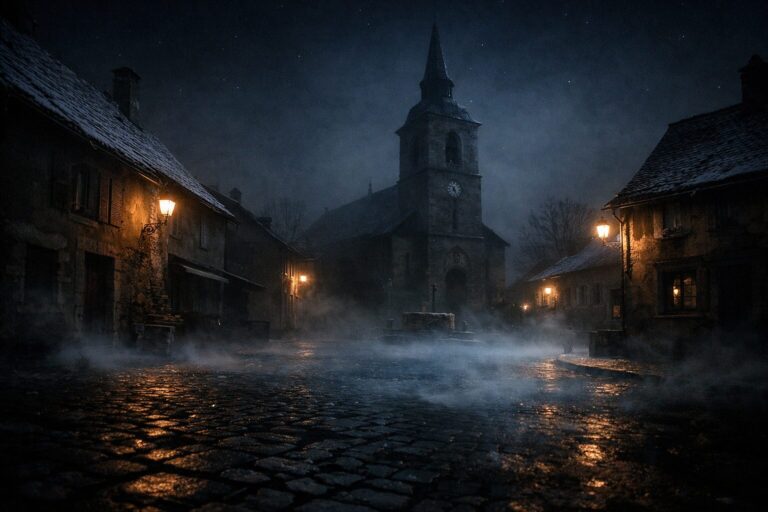
Someone Left a Fresh Coat Beside the Old Grave
I didn’t go to the cemetery looking for anything. It’s small and mostly forgotten, tucked behind a narrow strip of pines where the town’s oldest road bows and turns toward pasture. The iron gate has a way of complaining softly when you lift the latch, and I take some comfort in its voice, like a hinge clearing its throat. Some evenings, after work, I walk there to cut through the noise in my head. The newer plots sit closest to the gravel drive, decorated for holidays and milestones; the farther you go, the more the names yield to lichen and the dates unspool into another century. Dusk arrived in long bars of cloudy light, and the air held that wet, early-spring smell—cold earth and the faint metallic breath of the nearby creek.
I keep to the path out of habit, nudging aside fallen pine twigs with the toe of my boot. I know where the ground sinks a little and where the names prick my attention—long-ago farmers and infants, wives with the same middle names as their daughters. The place feels like a room the town forgot to shut the door on. If you leave it alone, it greets you anyway.
There’s an older corner past the hawthorn where the stones tip their shoulders toward each other, as if conspiring under moss. A low, veined headstone there has always looked neglected to me—Merrit Dole, 1896–1931. No flowers, no little stones, no evidence of family. The dirt dips around it the way it does over time when the coffin settles and the winter heaves relent. I pause there often, as if I owe him a moment the rest of the town has forgotten.
That evening, something new interrupted the familiar arrangement. Beside Merrit’s stone, on the grass that thinned down to clay, lay a coat, neatly folded. Not shrugged off or slumped—folded, sleeves crossed and lapels lying straight, the way you might place a sweater on a guest bed. Even in the gray light I could tell it was good wool, a dark, salt-and-pepper herringbone with horn buttons, the kind my grandfather would have kept for church and cold funerals. It struck me first as a kindness. Then it struck me as wrong.
People don’t come to that grave. Not in the years I’d been walking there. No tinny balloons, no plastic flowers, not even a soda can to betray a teenager’s mischief. The idea of someone standing alone in that corner and making the gesture of folding a coat—it came with an intimacy the place didn’t usually muster. My first thought was to look for the person it belonged to.
I scanned the path and the grass where it would have kept a record. The ground held an even sheen from the day’s thaw and a fine crust of grit, the kind that records everything that presses into it. My own footprint was dark and plain to see: heel, tread, the half-moon scuff at the toe. But leading up to the coat, there was nothing recent. Near the hawthorn, the leaves lay as they had fallen, their edges crumbling with a softened brittleness that would have given under any step. The gravel near the bend of the path was smoothed over by last week’s raking; no new grooves or breaks in it. If anyone had come in ahead of me, they’d moved without touching the ground.
I crouched and put my fingers on the coat. The wool felt thick and solid, and I expected it to wear the evening’s chill the way everything else did. It was warm. Not sun-warm from some earlier hour and saved in its fibers—a different warmth, like when you pick up a sweater someone just took off. I turned a cuff between my fingers, and warmth came off it like a quiet breath. My own hands were cold and greedy for it. The lining was soft and dark, half-satin, half-cotton, with a faint, sharp, clean smell—something that lived between aftershave and laundry soap, nothing fancy, the scent of a careful person.
Under the collar, a tiny rectangle of worn cloth clung by two stitches—W. & Sons Worsted, in faded blue ink, and a little mill emblem the size of my thumbnail. I don’t know why that detail lodged itself so hard in me, except that it placed the coat on a map of the town that doesn’t exist anymore. The mill closed before I was born. I slid my hand into the inside pocket and found nothing: no wallet, no scraps, no ticket stubs. I pressed both palms flat, as if I might find body heat the way you find a pulse.
Somewhere beyond the pines, a soft humming started. I’ve heard power lines sing on very cold mornings, and this was almost that sound, only it moved slowly across the graves like a person thinking of a tune they can’t quite land on. It carried from no direction I could assign, closer than far and farther than close, if that makes sense. I was alone, and I had been sure of it—until I wasn’t. The twilight had shifted to the part where colors drain and leave the shapes in a slower language. The feeling slid up between my shoulder blades that someone had stepped in behind me and was waiting, not unkindly, to be noticed.
I called out something useless—“Hello?”—and heard how the trees ate it. The hum kept on, steady, unhurried. I didn’t stand right away. I didn’t want to give the coat back its place on the ground, not with that little rise of warmth in it, not with the feeling the air had of holding someone else’s breath as a possibility. Then a push of wind fussed at the edges of everything. It wasn’t a proper gust; it came in a single, sleepy hand that slipped under the dry oak leaves and lifted them just enough to make them tumble. A scatter of them moved along the gravel and then stopped short, like a startle froze them at my feet. The hum softened until it seemed like it was coming from my own mistakes in listening.
I folded the coat as I’d found it and hesitated for a count I felt in my neck. It took me a moment to choose. I carried it with me, hugging the folded weight against my ribs. It felt heavier than it looked, as if it remembered who it belonged to and expected to be returned. The gate’s latch clicked when I set it down to lift it, and the coat kept its warmth like a small confidence I hadn’t earned.
The caretaker’s office is a squat building by the gate with two windows that glow when he’s in. Nolan was there, bent over a desk with a pencil, turning pages in a ledger the way a person does when they’ve learned to respect tidy columns. He’s a wiry man in a cap who keeps the place from surrendering to bramble. His face changed when he saw what I had—first to concern, then to the sort of assessment someone gives a tool they recognize the worth of.
“Nice cloth,” he said, and he took it from me like it might bruise. He thumbed the lapel and then the cuff. “That’s not new. Not new at all.” He turned the collar back until the faded label showed, and he breathed out through his nose. “Weller & Sons. Up on Mill Street. Closed, what, ’79?” He held it up and looked for a maker’s stitch that only tailors and old men know to look for. “See the pick-stitch here? That was Mrs. Ellery’s hand. She did buttonholes like this. There weren’t many of us could afford cloth like this, even then. It’s not—” He stopped and looked past me, as if the name had almost climbed the wall and failed. “I don’t know whose this was.”
I told him where I’d found it. He nodded in a slow, measured way and rubbed his jaw. “Merrit Dole,” he said, and the name sounded like a small obligation suddenly remembered. “Nobody much bothers with Merrit. No people left to. I put a flag there once on Veterans, then I took it off when I realized I had him mixed up with another Dole. He’s just… he’s there.”
“There were no footprints,” I said. “And it was warm. Still is.”
He let me touch the lapel again while he held it out. The warmth hadn’t gone. If anything, it had settled in, like something had chosen a room in a house and lit a lamp. Nolan didn’t make any face at that. “Sometimes things don’t like the cold,” he said after a moment, and it wasn’t an answer so much as him putting words in the space where an answer might fit. He wrote a note on a scrap of paper—found coat; no name; Dole plot—and pinned it under the calendar with a pushpin shaped like a maple leaf. He hung the coat on a brass hook by the door as if it deserved that place.
After that, the story of Merrit’s grave changed in small ways, the way creek banks change when a branch floats down and catches. Nolan asked around, quietly, about anyone missing a good coat. Nothing fit, nothing of that quality gone missing. One woman said her grandfather had one like it long ago, lined just so, and he wore it to the cannery and to church, as if the same cloth could attend both work and God. The mill’s name brought out talk that didn’t lead anywhere—who worked there, who’d lost fingers, who liked to sit on the curb at lunch with their bread and cheese. A week went by and no one claimed it. Nolan kept it on the hook a while and then put it, carefully folded, into the cabinet where he keeps the good flags and the spare guest book.
I kept to my walks, not looking for anything, and found that I looked anyway. I checked the path for prints I hadn’t left. I checked Merrit’s corner before the shadows pooled. Some afternoons, someone would tell me that they’d been told about the coat someone left by the old grave—the way a story wears a new pocket with each person’s telling. People added things I couldn’t swear to and didn’t correct: that the coat had been laid there three times now, always folded the same way; that a low humming had been heard in that far corner for years; that the man it fit wasted away a winter and was buried in shirtsleeves because the good coat had been lent out and never returned. Nobody could say from whom they’d heard it. The grave began attracting two stones placed neatly on its top, and once, a thin sprig of rosemary laid like a bookmark, its scent sharp even in the cold.
Late one evening, returning the long way from the store, I cut by the fence just to look in. The office light was off; the window kept only the reflection of the road’s last traffic. In the blue hour, the white stones go quieter, and the trees ink themselves darker, and everything pretends to hold still. From the hawthorn’s direction, there came again that steady, ordinary humming, not spooky at all if you didn’t decide to make it so. I stood with my hands on the gate and listened until it became part of the air. Nothing moved except a single leaf eddying against a low stone. I didn’t go in. The latch, under my palm, was cold.
I can’t tell you what belongs to Merrit and what belongs to other people’s need for a story. The coat in the cabinet still carries its warmth longer than it ought to when you take it out, Nolan says, but he’ll say that only if you ask him in a way that lets him shrug after. Every now and then there’s talk—someone saw a man near the old corner in a dark coat without a hat; someone found the grass pressed as if a folded thing had rested there awhile. When I pass that spot and the light goes thin, I have to resist the small, precise urge to gather a thing I haven’t been asked to carry. The humming reaches me some days like a thread and not at all on others. No one has claimed the coat. No one has stepped forward to say it was theirs to begin with. It feels like the kind of waiting that has chosen a place and settled in.