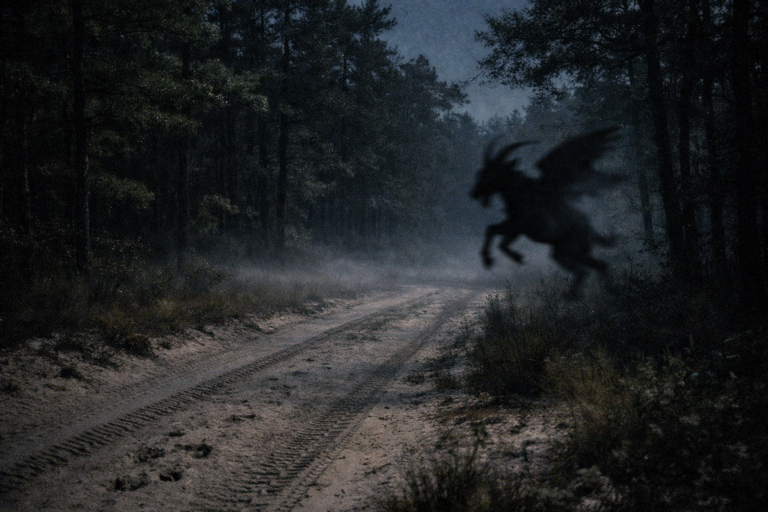
Something Was Digging Circles Around the Campsite
We were farther out than either of us had planned to be. The forest road had turned from gravel to ruts and then to something that looked less like a road and more like a dry creek bed. We finally gave up on the last washout and shouldered our packs the rest of the way to a clearing I knew from an old topo map. It wasn’t a marked site. Just a flat spot under lodgepoles with a wedge of sky and a sliver of creek noise somewhere out of sight.
It was the kind of quiet that soaks into things. Our footfalls sank into the tan mat of needles. There were no bird calls for a long time, just the tin rattle of our cookware in my pack and Dani swearing at a strap that wouldn’t cinch. We set the tent where the ground leveled under the trees, door toward what we guessed was the creek. I collected deadfall while she arranged the food box, tucked bear canisters in the shade, shook out the sleeping bags to let them fatten in the cool air.
We ate simple and hot. Noodles, a little oil, a packet of tuna, the kind of meal you shovel in because it’s getting cold fast and your legs are remembering every step. The sun found the notch between two ridges and dropped with very little ceremony, the sky pushing from gold to slate in the space of a breath. Our headlamps picked out the chalk-white of aspen bark along the edge of the trees. It smelled like dust and smoke and resin.
When the fire settled into a low oval of coals we talked less. The sounds came back then—tree frogs starting and stopping, something moving up the creek and setting a tempo that wasn’t our own. The air pushed colder. We zipped the tent up tight and wriggled into sleeping bags. The nylon gave its small talk in the dark: zippers rasping, fabric sighing where it brushed our jackets. Dani said something—I’m warm now, this is good—and I listened to our breath even out until the noise of the creek was the only thing steady left.
The first scrape didn’t sound like an animal. That’s what kept me awake. If you camp enough, you get a drawer of sounds in your head: chipmunks rummaging sound like a pin spilled onto ceramic; raccoons are busy little hands; deer are a slow deliberate step with a wet snort every so often. This was none of those. It was a drag. A measured, even drag like someone drawing a line with a stick not far from the tent. Then a pause. Then the sound again, moved several inches along, as if whatever it was was being careful, keeping it uniform.
“Do you hear that?” I whispered, because in a tent voices do something weird—they get absorbed and come back wrong—and whispering seemed fair to the dark. Dani was awake already. She didn’t answer for a second, then said, “The scraping?” as if she had hoped we would be talking about anything else in the world.
We lay there counting the gaps between passes. It went on for… I don’t know. It’s hard to judge time in the dark when you’re not looking at your watch on purpose. The thing—tool, claw, whatever—moved slowly enough that I understood it wasn’t random. The line advanced until, at one point, the drag came as close as my side of the tent wall. The fabric whispered as the noise slid along just inches away. I could picture it in my head as a line. I couldn’t stop picturing it as a line.
It stopped for a long time. The kind of long where your body decides nothing is happening and starts to let the muscles unclench one by one. When I finally heard Dani’s breath even into sleep again, I let myself unzip my bag and feel around for my headlamp and the little folding knife I never actually use. I hated that I had the knife. I hated the theater of it and I hated how my hand trembled around it as if I were auditioning for a fear I was not supposed to have.
The night didn’t end. It just thinned a little when the moon climbed into the firs and put some shine into the needles. When I couldn’t stand it anymore I said, “I’m going out,” and felt Dani’s fingers close over my wrist in the dark before she could stop herself. “It’s fine,” I lied. The zipper pulled and every tooth sounded like a spoon on china. Cold fell in as a living thing.
I stepped out with the lamp turned low. The first thing that felt wrong was not seeing eyes. Out here at night, you catch enough deer-glow or raccoon-flare to know you’re a guest. My beam slid over trunks and low huckleberry and found nothing alive. Then it found the line.
It was a groove carved into the forest floor around us. At first I thought it was a snake track, then a bike tire, then I dropped to my knees and traced it with my fingers and knew better. Someone had pushed something hard into the soil and dragged it. The trench was like a shallow cut, two fingers wide, uniform depth, clean edges. It curved tight and then tighter again and when I stood and followed it with the lamp, it kept curving until I was back at the door of the tent. It circled the entire campsite—tent, little fire pit, hanging food bag—everything we had claimed as ours. A perfect, continuous ring as if we’d been surveyed and staked overnight by a patient hand.
There were no prints. Not ours, which had churned places around the fire to fluff and then mat the needles, not anyone else’s. The mat of duff was even except where the cut passed, neat as sewing. I tried to step back over our own tracks to the tent and couldn’t help scuffing a heel, and that smear of my own presence was suddenly obscene in how loud it was.
Behind me, the zipper buzzed and Dani stepped out fast, then froze as her light found what mine had already learned. She didn’t say anything. She walked the ring once, then halfway again, then knelt and dug at the groove with her fingers as if, if she could feel the bottom of it, that would tell her what had made it. The soil was compact and cool and gave that wet-earth smell only in clumps, not dust. She said, finally, the way you can say a thing without making it into a question, “How?”
We widened our lamps and put them low to cast side-shadow. All we got were our own gear shadows and the line. I tried to imagine a person creeping around our camp with a stick and laughed once at the sheer cartoon of it. Dani flinched at my laugh as if I had thrown it at her. We went back to the tent and, because we had no better idea, we zipped it up again. The night closed around the ring. Our little orange house breathed with our movement.
I tucked the knife under my palm and lay like that until my arm ached. I told myself not to fall asleep and then woke up so hard a minute later that I had to orient to my own breath. The scrape came again. It announced itself the way a chair leg announces itself on a kitchen floor. Measured pressure and lift, pressure and lift. It was not a finishing of the circle, because the circle was already finished. It was a retracing, a deepening maybe, but the part that set my teeth on edge was the way it paused when it reached the tent door. As if something waited there on the other side of the zipper, deciding.
The fabric bowed in. Not a lot. Just that silver-dollar place where the mesh and the heavier nylon meet, where your hand goes a hundred times a night, pressing to find the zipper pull. The tent wall pushed toward my knees and then released as if someone had leaned a palm and taken it away. The little plastic toggle at the corner clicked gently against the pole. I felt, stupidly, like the zipper teeth were being counted. The sound of the scraping held right there a breath longer.
“It’s right at the door,” Dani said, very quietly. Her hand was on my forearm and she wasn’t squeezing exactly; she was steadying herself through me. Outside, the drag moved on. It traced the curve behind us, then along the side where our boots sat under the fly, then forward again, slower at the door as if learning it. We spoke no more after that. We didn’t shake the tent or shout. Fear does not always make you big. Sometimes it makes you a listening device.
The scrape completed another pass. The night had thinned into its gray part. The creek returned to being water instead of only a sound. We lay there and waited for a voice that didn’t come. Something stepped on fallen twigs, but you couldn’t call it a step. More like a careful settling of weight, then lift. Twice more the door bulged that bare amount, then stilled. Sometime between then and daylight, my mind frayed at the edges enough that I must have drifted. When birds finally began their small arguments around us and the sky learned a little blue again, I had the unreasoning sunlight thought that we had made everything up out of the flaws in the dark.
We didn’t drink coffee. We didn’t say we were packing. We packed. The circle confronted everything we did. You couldn’t unsee it. We lifted the tent and shook it and in that empty ring our footprints were at last obvious because they were the wrong thing: mutinous little scuffs that crossed the neat line where it shouldn’t be crossed. When I walked the ring one last time, I thought just once about stepping across and then walking out beyond into the trees, as if I’d find another ring around the whole forest, and then I stopped myself with the kind of small, animal caution you don’t admit in daylight.
We shouldered our packs and headed for the car. The road in was worse going out because we weren’t eager. Sun hit the crowns of the pines and turned the dust into something like smoke. I kept hearing it even after we’d left the site—the slow drag, the careful arc. We turned the last dogleg and the pullout came into view where the brush gave way to the little apron of dirt and gravel where we’d left the Subaru crooked under a snag.
At first I thought it was our own tracks around the car that looked so precise. But we hadn’t walked circles there. We had hauled packs and made two stupid trips because I’d forgotten the fuel canister. We hadn’t measured anything with our feet. This ring had been measured. It ran around the car, front to back, bumper to bumper and back again, so tight the tire sidewalls were almost brushing it. The gravel had been pushed aside into even ridges on either side of the line, like a child had dragged a finger through cake frosting.
We stood a long while and let the birds talk over us. There were no shoe prints. There was no trace you could point to and call human other than our own tire tracks from the day before, and even those looked less sure now, as if they’d been a suggestion we had made to the ground. Dani touched the hood and left her warm handprint there, and something about that little fogging on the paint felt so loud I could have sworn it echoed. I bent down to look at the ring where it curled behind the rear tire. It passed under the bumper so cleanly it might have been drawn with a compass. If I reached out, I could almost have fit my two fingers into it and run them along, do it myself, finish it in some way I couldn’t name.
We didn’t talk on the drive out. The car rattled the same over the same ruts. The light was clear and honest. The only theft on our cooler was a condensation ring from last night’s bowl. Somewhere back behind us, under lodgepoles and sky and someone else’s sense of straightness, there was a circle around a patch of dirt where we had slept and learned we were measured. The second circle stayed in the rearview, then in the side mirror, then in nothing at all, but I could feel the way the steering wheel vibrated when I crossed the edge of the pullout—just a small bump, the kind you might ignore any other morning—and I knew exactly where its line had run on the ground.