The Facility Was Removed From Every Map Overnight
On that route, the best thing was the quiet. I ran it on Mondays and Thursdays, first light, a looping spool of county roads that swung past a feed store, two churches that never seemed open, and a string of fields that changed color with the season. The last stop was always the same: a short spur off County 64, fenced, with a sliding gate and a keypad on a post. I never had to look at the map. You turned after the leaning cedar and the pump shed with a blue door, rolled over the cattle guard that clanged under the weight, and waited for the light to go from red to green. The guard—always the same man in an orange vest—or sometimes no guard at all, just the camera on the pole and the reader beeping when I keyed in the code. They kept it efficient. I’d back to Dock 3 or Dock 1 depending on a paper note taped to the post, they’d come with a pallet jack and count off quietly, log sheets clipped to a green board. No logos on their jackets, just dark-blue coveralls and the rubber-capped pens. The sign out front changed names twice in the six months I went there—first it was something like “Rowan Storage B,” then “Clymer Test Annex”—but the road, the fence, the humming light over the gate were the same every time.
It had a smell to it at dawn, the place. Not factory exactly. Cold concrete, fresh-cut grass when they mowed the strip outside the fence, a damp chemical sweetness like the inside of a new garden hose. The buildings were low and unpainted block with flat roofs. Once I had to wait an extra ten minutes while a long white truck with no plates nosed out ahead of me; the guard raised the barrier and watched the road behind it until the dust settled. Nobody hurried. Everybody looked down when they spoke. It was routine. I drank the last of my gas-station coffee, signed, slid the carbon pages apart, and pulled back onto the county road with the field wind nudging the trailer.
Monday night before what turned out to be my last run there, I was checking routes on my couch like always, thumbing the tablet to see if any road closures were posted. I keep all my stops starred in the map app, a little belt of yellow pins across the back roads I drive. The spur with the fence was one of them, named “Plant 14” from the first time dispatch wrote it that way. Only the star wasn’t there. There was just a square of pale green on the map, like an empty lot. I zoomed in, thinking I’d somehow scrolled wrong. The thin spur road was still drawn, a hairline off the county track, but when I tapped where the pin had been it told me “Can’t find place.” My saved route opened with a warning banner: “Location not found.”
I tried the other app I keep as backup. Same thing. The name wouldn’t come up, even when I typed it exact from memory. I dug into an old email thread where dispatch had sent me the coordinates months ago, copied them, pasted them in, and the satellite view swung to a bland square of field with the road curling in and then stopping short at a blank patch. No buildings. No little gray outlines. The imagery date it gave me was last week. The street-view car has never gone down there—pretty normal for a private spur—but before, you at least got the little blur that meant there were structures. Now it was scrub and two power poles. I watched it for a long minute, the way you look at your own driveway on a screen and feel like you’re trespassing. The longer I stared the more I told myself it was a data mistake. Someone renamed something. Some layer was turned off. My wife called from the bedroom to ask if I was coming to bed and I shut the tablet and told myself I’d sort it in the morning.
At five, the warehouse humid and lit, dispatch handed me the stack of papers for the day. The customer name was a number now, not a word—just a seven-digit code and a line under it. The address field was strange: a blink of cursor in a blank white box. The page still had “Dock 3” typed where notes go, and the pallet count and the product codes. Filters, absorbent pads, cases of nitrile gloves. Nothing that would melt or explode. The phone number printed under “Contact” was just dashes, five of them. I asked the morning dispatcher if they’d changed something and she shrugged and said, “That one? They don’t want to be found.” She tried to pull it up in her own system and showed me the little spinning hourglass where an address should be, then the whole line flicked gray and came back with “Inactive” in a lighter font. She told me to go anyway, to drop if anyone was there and call if they weren’t. There were two other stops before it, so I told myself there was time for it to fix itself. I kept a photocopy of last week’s invoice because it still showed “County Road 64 Spur” and a barcode, and out of habit I scribbled down the landmarks: the black-stripe silo, the old hay rake rusted into the ditch past the turn.
I texted another driver who had run the place when I was on vacation to see if his pins had vanished too. He sent back a thumbs-up, then: “Mine are gone. Spooky.” Then a second later: “Maybe they moved.” I didn’t like the word, even though it was the normal explanation. Places move. Leases end. Still, you don’t often see the ground keep the road and lose everything at the end of it in the maps.
By the time I was on County 64 the sun was just a pale strip you could almost miss. It had rained two nights earlier, and the ditches were still holding water, mirror-still. The wind off the fields was light and a hawk hung over the powerlines. The onboard GPS—a tight-lipped little box wired to my dash—had been stubborn all morning, taking a long time to lock, then suddenly flipping my truck icon sideways for half a mile before catching up. Six miles out, the tablet chimed and put up a banner I’ve come to hear in my sleep: “Arriving: Gate 1.” I wasn’t there. I was passing the storage units with the peeling green doors. The banner vanished on its own. A minute later it lit again, then with a short buzz switched to “Unknown Location.” I looked down long enough to frown and when I looked up the leaning cedar was sliding past my windshield and the notch in the bar ditch that was my turn opened to the right like a mouth.
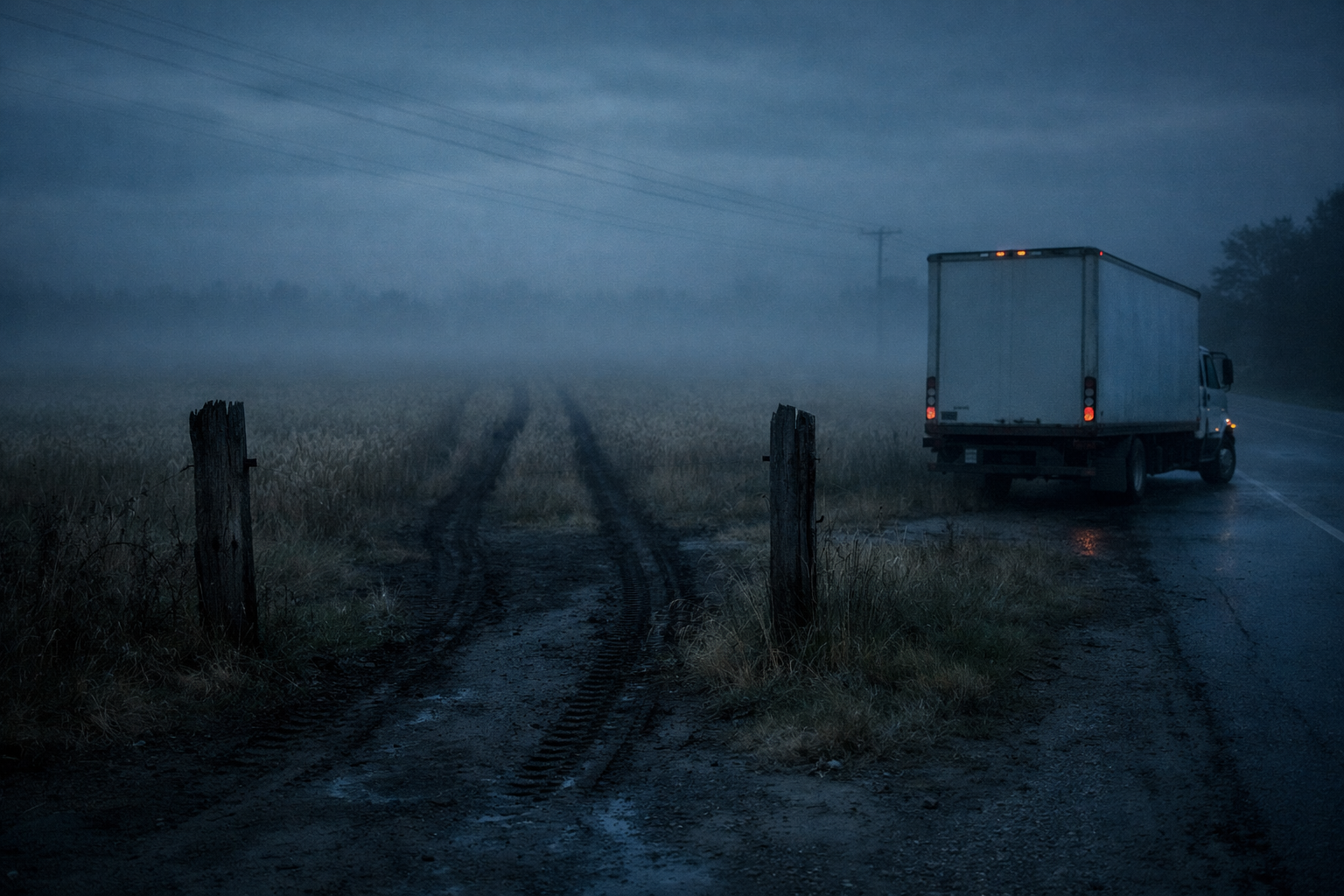
Where the gate had always been—a chain-link slider with two heavy posts and a No Trespassing sign patched three times—there was grass. Two new-looking treated posts cut off almost even with the ground, pale in the morning light, as if someone had sliced the gate away just above the sod and hauled it flat, then seeded around it. The keypad post was gone. In the shallow dip where the cattle guard clang used to be, the grating was filled flush with soil and gravel like it had never been there. The camera pole was not there. The asphalt spur itself continued, though, and it was not old asphalt: the same mix as the county road, a neat seam, dark edges. It ran twenty yards and then it simply became dirt, as if it shrugged and gave up and passed the baton to the field. All that should have been ordinary, a lease-ending kind of scene—except for the tire tracks.
They were fresh. Two lanes of them, wide and paired, the darker earth pressed smooth and glistening where the dew had been ironed away. The tread was deep, interlocked chevrons, larger than half-ton pickups. More than one vehicle had gone in. Overlapping, crossing. In a few spots, you could pick out the neat little rectangles of a pallet jack or some smaller wheeled thing that shouldn’t have been out on dirt. They went straight into what from the road read as winter wheat but up close had the stubbled look of a field cut short and left to rest, the kind of surface that will keep a tire mark for days if the ground holds water. I rolled my truck as far as the shoulder would take me, careful not to put a wheel onto their ground, and I just sat and listened. There was a hum that I realized was my own radiator. When I cut the engine, another sound kept on, a far, even thrum that could have been a highway miles off or an air handler buried behind the hedge that used to hide the guard shack. It didn’t change when a breeze came. The air smelled clean and a little like hot rubber. No birds right then. The wheat stubble moved without a sound.
I got out, boots on gravel, the door hinge creak somehow too loud. My phone came out of my pocket because that’s what we all do now when we see a thing we think we may not be able to describe later. I pointed it at the tracks where the dirt went down into the old cattle guard dip and the screen peeled into sharp green and then blurred on its own like a finger smear. I wiped the lens and it sharpened onto my own sleeve, wouldn’t hold the ground. Twice the camera app froze and bounced me to my home screen. When I tried to drop a pin, the little blue locator spun in place and the compass card on the status bar turned slowly like a lazy top and then snapped back north. The delivery app popped a gray box across the bottom: “Arrived—Gate 1.” The same font I see a dozen times a day. Only there was no gate. The timer under it began at 00:00:01 and then jumped backward to 00:00:00 and the gray box dissolved. When I look at my logs now, there is no event there.
Where the guard shack had been was a rectangle of pale gravel in the green, and in the gravel, four round darker spots spaced like legs, bolt holes filled or cut flush. If I’d never been there, it would have looked like someone once set a picnic table out and took it away. I stood over the darker spots just to see if I could feel something and I didn’t, just the colder stone under my boot. My breath was syrup in my mask. I stepped close to where the keypad post used to stand and saw the square of darker soil where they’d scraped it flush. In the mud there a print that stopped me: a boot heel. Big, the little crosshatch pattern good leather leaves. It pointed in, then it was like the next step didn’t land. Between that heel and where another pair of heavy tire marks crossed, there was nothing. That’s dumb to say of dirt. Something always leaves something. But the print just… failed to continue. I looked for the next one until my eyes watered and the wind huffed my hair into my face and I felt, ridiculous as it sounds, like I was being rude by looking too closely.
I called dispatch. The call went through and then sound cut in and out like water. I could hear my own name in their voice and the words “account” and “inactive” and then “if anyone… drop” and then nothing for three seconds and then their voice at full color like someone lifted a blanket: “…get a signature if you can.” I told them there was no building. I read the code that used to open the gate, out of habit. I told them about the tracks and the gravel rectangle and the blank. I gave them the landmarks: “leaning cedar, black-striped silo, the pump shed.” I watched a white county pickup roll past on 64 without so much as a slow-down. Dispatch said, “We can’t even pull up the address anymore. It was closed out at two-seventeen this morning.” In the background on their end I heard someone say, “Delete that one,” and the clacking plastic sound of a keyboard. The line popped and then there was nobody there. When my phone found them again, they asked me for a proof-of-attempt and I said I would take pictures and I held the phone up just to be perverse and took a five-second video of the empty field.
Back at the truck, the radio wouldn’t grab a station. The scan ran all the way up and wrapped down and found only hiss where the farm report usually is. In the passenger mirror for one second I saw two points of light like headlights in the distance coming down the spur behind me, in the perfect place in the glass they’d fill when someone turned right off County 64, and heat hit the back of my neck the way it does when a vehicle’s nose points at your bumper. I turned around because you do, and there were no headlights there. The mirror held them like an afterimage. I waited until a breath fogged the glass and again I told myself I was being dramatic. A meadowlark zipped and landed in the ditch with a sound like paper tearing and I jumped. You don’t realize how often a place is full of little noises until every one of them registers as if it means something. A cloud moved off the sun and the shadows on the stubble all leaned a hair to the east.
I left a copy of the bill of lading under a flat rock where the keypad had been, a childish thing to do and exactly the sort of thing I would roll my eyes at if someone else told me they’d done it. I took a second to run a finger along the scuff lines in the dirt where the heavy tires had cut, the dampness still trapped there, and my finger came away clean. I wrote “Attempted; no contact; no structure present” in the note field with the pencil tied to my clipboard string. I strapped the pallet tight in the nose of my trailer and drove slow back to the warehouse feeling all the long bars of the cattle guard under my tires even though there was nothing there now but packed earth.
In the office, Accounts glanced at the paper and slid it under a file with the flat hand motion that means it won’t go anywhere fast. Someone higher up told someone lower to close the account altogether. The customer disappeared from the route screen while I was still standing there. When I checked that photocopy of last week’s invoice later, the address line had bled into one thick gray band like someone had run a wet thumb across it before the ink set. I know that is just cheap paper and cheap toner. I know that. Back at home that night I pulled up the county parcel viewer and clicked the square of land I thought must be theirs, and the box that popped up said “Unassigned prairie.” The little photos I fired off at the tracks, when I looked at them on a bigger screen, were of the sky, washed thin white, my dashboard, half my own knuckles. The five-second video was a smear of green and a clipping of the radio weather band voice from a day earlier somehow riding in the audio. I sent the coordinates to myself by email and it came back, not failed because of my inbox being full or the server being down, but with a clean banner: “Undeliverable. Address not found.” I’ve never gotten one like that sending something to my own inbox from itself.
We wrote it off. The pallet went back to Returns. Thursday came and that stop was gone as if I’d never had it. The week after that, a Tuesday, I was fueling under a gray lid of sky that felt low and close, nozzle humming in my palm, mind already on the interstate work ahead. The little label printer on my dash made a noise it only makes when I hit “Print POD,” a tiny pre-feeding whine, and without me touching the tablet it spat a two-inch strip. I reached without thinking. The paper was warm and it had the seven-digit customer code on it and below it in the same block font the software uses the single word: Dock 3. The time stamp under it was nine-oh-seven, which was fifteen minutes from then. The tablet chimed too and, when I tapped it, a stop blinked onto my list with the old plant name for a heartbeat before the letters scrolled into x’s. The map drew a pale-blue route line that left the highway I was on and arrowed straight over fields, not bothering with roads at all. I called dispatch and while the phone was still ringing the printer gave another half-burp and a second strip slid onto my knee. It was only three words, my last name and the note: Use the gravel, not the slab. We don’t ever use that phrase in the system. Nobody at the office saw a new job when I got them on the phone. I sat there with the smell of diesel and a light rain starting, paper curling in my fingers, and I stared through the windshield at the thin pale run of the highway and the way the power poles marched east in a straight line toward the place where the spur had been, and I haven’t found a radio station out there since that will hold, no matter how slow I turn the dial.