
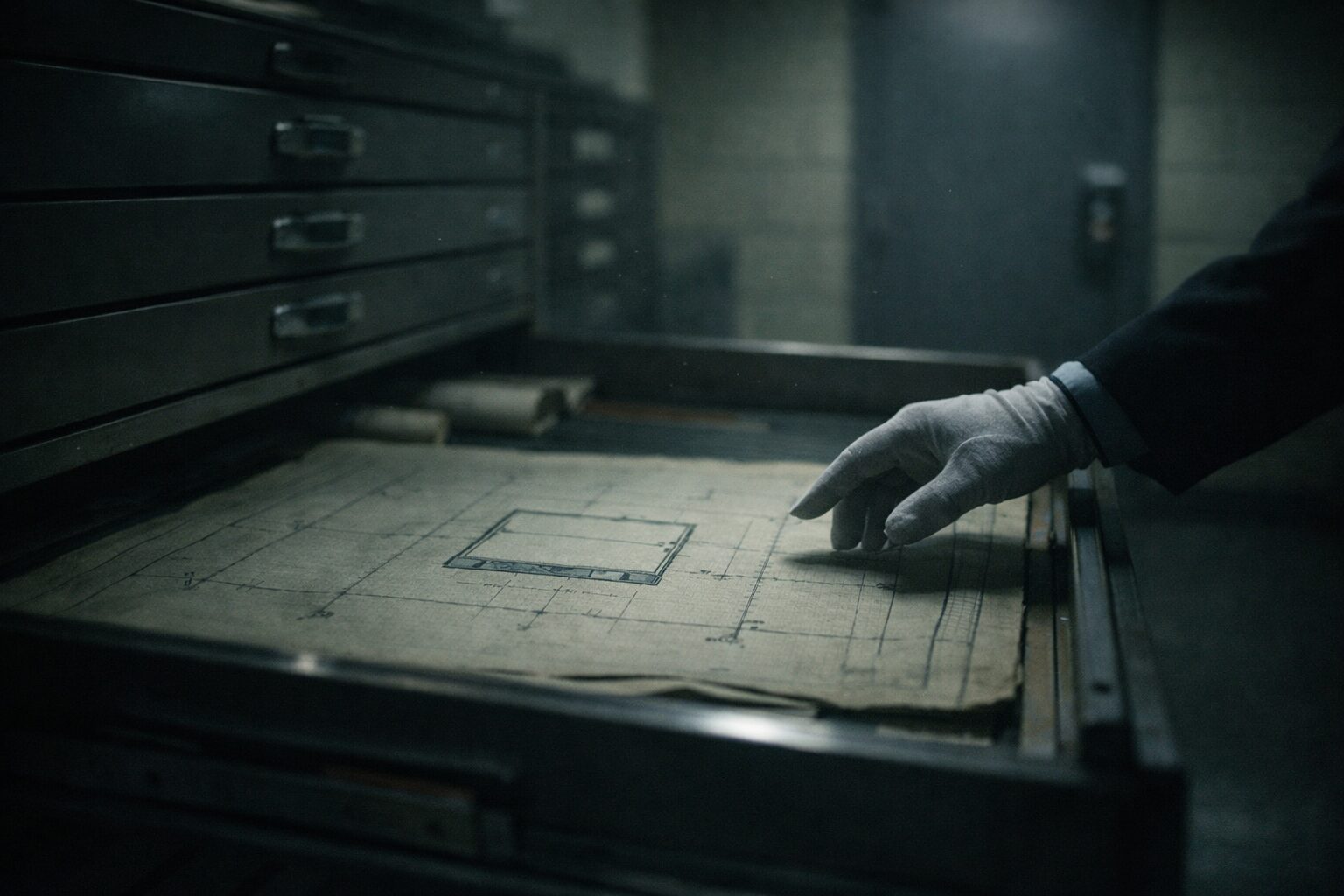
The Blueprint Labeled Building Zero
Most of my days pass in quiet, the kind of quiet that belongs to sealed stacks and gray cinderblock rooms where paper is kept at a temperature that keeps it from dying. I work where old plans go to be cataloged, their paper brittle and edges feathered, the ink crisp even when every memory tied to them has gone soft. The building is anonymous by design—no signage, only a beige badge reader and a federal seal that watches you come and go. I learned to read the air currents in the map room, how they slide over drawers tall enough to bury a person standing up, how the ammonia hangs stubbornly in the throat when you open something from a certain decade.
The day I found it, I was processing a transfer from what used to be an Army installation not far from here. The accession list promised installation master plans, as-builts, and utility overlays—familiar, rectangular ghosts. I slid open a flat file that had a rubber band on its handle, a small code scrawled on masking tape that meant unindexed. Inside, under two copies of the same fire-suppression plan, there was a rolled sheet wrapped in browning kraft paper. The knot had been tied with the humorless intent of a person who learned to keep their hands busy in windowless rooms. I cut it carefully, expecting another pump house elevation. Instead I saw a title block that should not have existed.
It was a diazo print, linen-backed, dimensions a government standard. The smell caught me in the face the way only those old prints can. The blue was that stubborn navy that never seems to fade. In the title block: Installation: Test Annex (East). Discipline: Architectural. Sheet: 1 of 1. The project name was hand-lettered and somehow surer than the machine type around it: “Building 0 – Plan and Sections.” There were standard stamps: a mid-70s “CONFIDENTIAL” ghosted by time, crossed through with a later “DECLASSIFIED” stamp on the diagonal, a tiny rubber mark giving an authority number I wrote down without thinking. In the corner, coordinates that matched the style used in that era’s site plans: degrees, minutes, seconds, with a faint penciled MGRS conversion above it. I checked the lines, the hatching, the callouts, the font of the numbers—everything about it felt correct in the way an unpracticed forgery never does. Whoever drew it knew the discipline’s habits by muscle memory or because they lived it.
Building numbers on most federal installations are stubbornly logical. They begin at one, and even when they cycle into the hundreds there’s a pattern to where they cluster. Zero is not a number we use, not in any roster I’ve handled. The installation maps in the same drawer showed a grid of neat small rectangles, each with a number set in it. I pulled the real property inventory ledger, ran a finger down decade after decade: warehouses, labs, admin buildings, ranges. There was nothing between the admin HQ and Building 1. No Zero. The plan itself showed a simple rectangle, no ornament, labeled only with door swings and a few utilitarian notes—one word, “STAIR,” placed twice, a line marking a service road. The coordinates were half an inch of ink that felt like a door a person could step through.
I hadn’t intended to leave the building that afternoon. It was drifting weather outside, the kind that makes the lot sound hollow. But the coordinates were too close not to check; a fifteen-minute drive along a state road that skirts the edge of the decommissioned fence line and the still-active annex. I told the front desk I was going to pick up envelopes and drove with the windows cracked to get the paper smell off me. The fence rose out of the scrub before the road turned—chain-link doubled, topped with wire that has its own logic, with signs every twenty yards. US GOVERNMENT PROPERTY. NO TRESPASSING. A smaller sign, faded, warned about the use of force. The coordinates led me to a short pull-off by a drainage ditch where people throw fast-food bags. Beyond, past the outer fence and a corridor of mown grass, was an inner fence that made a box by itself, not quite square, gravel pale against it. There was nothing inside it.
From the road I could see the gravel lay newer than the roadbed. It still had that bluish cast new stone holds until it darkens with dust. A concrete pad sat a touch off-center, four anchor bolts capped against weather, each one stubbly with rust where the caps had split. At one corner of the inner fence, a post bore a small black cylinder with a dark lens—motion maybe. A service road—that was how it was labeled on my drawing, SERVICE RD. E—ran parallel to the outer fence and dead-ended by the fenced square. The brush on either side was pressed down, the springy way it looks when heavy tires have come through more than once but not often enough to make a rut. I felt watched in the unpersonal way one feels watched by infrastructure. I put my hands in my pockets so I wouldn’t look like someone using them for distance, breathed, and memorized the color of the gravel, the stain on the concrete, the exact shape of the nowhere that was inside the fence.
Back at my desk the room felt a hair too warm though the thermostat insisted it wasn’t. I laid the Building 0 sheet over a photocopy of the base map I’d made years ago for a different project. The lines matched without effort: the turn of the service road, the angle of the drainage. My plan had a faint rectangle screened in at that spot, the sort of thing a drafter leaves in as a reference to future development or a buried utility. The sheet I’d found didn’t bother with exterior utility detail. Its two sections cut clean through a rectangle that had no furniture, no mechanical notes, nothing but two flights of stairs labeled and an unlabeled hatch at center. I circled the coordinates on a yellow sticky and put it at the bottom edge of my screen so it would stare at me until it became ordinary.
At home I opened the satellite viewer I use when we need to confirm road alignments for accessions. It’s a comfort to be able to watch places change in tidy time-lapse, to see roofs blanch and darken, trees collapse and grow back into themselves. I found the box of fence and gravel in bright summer and slid backward a year at a time. The pad on which nothing sat was older than it looked in person; the stain around where something had once lain on it was visible in winter, like an inverted shadow. A decade back, a rectangle the color of roof coatings existed, not large, with no visible HVAC units—just a squat body making a right angle under the sun. Two years later, in a spring shot you could count by the green, it was gone, gravel softened to dirt in places, a path faint as a breath leading to the ditch. In the late 90s the outline changed entirely—taller shadow, a different pitch to the roofline, a darker line across one end that could have been a vent cap or could have been a trick of stitching.
Seams in satellite imagery are a fact; I don’t elevate them. But there was a winter shot when the surrounding roofs held snow and that boxed square did not, like whatever had been there radiated itself free. In an image from the early 80s that should not have been so granular and yet was, a shape sat there with a small structure stitched to its side, a geometry that never shows up in the official plan series. Then, abruptly, a year was blurred out for half the installation, the square crossing the seam of edit like a coincidence. By the time I slid to the present again I had printed three frames and built a flipbook that showed a building un-building itself and rebuilding until it decided to be nothing. The blueprint’s stairs twinged in my head like I’d strained them.
There were names in the title block. DRAFTER: ATCHISON, M. CHECKED: LUMLEY, P. APPROVED: OIC DPW. There were also tiny stamps you learn to use even when you never meet the people. I called the number we keep for the retirees’ association, asked the coordinator if a Mae Atchison or a P. Lumley were still around. It turned out they were, or at least their addresses were. I wrote letters first, as we’re trained to do, stick inside them self-addressed envelopes like a polite ghost. Then I called.
The man who picked up for Lumley told me I had the wrong number and hung up decisively, the kind of hang-up that comes from practice. A day later my phone rang from a different number I didn’t recognize. A voice that could have been his or a man just like him said, We don’t use that designation, then was quiet like giving me space to apologize. I asked if he’d ever seen a plan with that title. The pause was longer, then: I signed too many things. Some you sign and you don’t remember the shape of the pen after. He asked me where I worked. I told him and he said, Then you’ll understand that I’m not saying I know what you mean. He hung up, gentler this time, as if hanging up were the last courtesy he had left.
Mae Atchison didn’t answer my letters. When I tried the number the retirees’ coordinator had for her, a woman who might have been a daughter told me Mae had stopped taking calls that weren’t names she recognized. Two days later I found an envelope in my incoming mail slot with no return address and my own name written on it like it had been done on a hard surface with a pen that was running out. Inside there was a three-by-five card. In a tidy, training-camp hand: ZEROS GET FILED WHERE THEY CAME FROM. The back held a scrawled line: Courier took the set. He wasn’t in our system. I carried the card back to my chair and let it sit on my blotter while I stared at the ceiling’s spray-on texture and listened to the vent work above me click and settle like it was thinking too.
We scan what we can, when we can. The flatbed in the back room hates diazo—the rollers slip on that old linen and the ammonia wakes up like a cat. Still, I powered it up and let the light bar warm with its small fluorescent whine. I filled out a temporary catalog sheet for the plan: series number blank, building number as per title block, date estimated from stamps, declass authority written in my neatest numbers. The software named the file with the accession number and my initials; the file path slotted it into the right folder. When I laid the plan down it crackled in a way that felt like a warning not to press too hard. The scan moved in a slow, even bar of light like daylight melting across a floor. The output preview stuttered, recovered, then froze to a strange pixelation over the title block. I took a photo with my phone as a sanity check. The next pass went smoother. I saved, watched the progress bar inch, then die. In the destination folder sat a zero kilobyte file, named correctly. I told myself it was a permissions issue. I rebooted. The room was empty but for the sound of the HVAC and the machine insisting it was busy when it wasn’t.
I left the sheet in its melinex sleeve inside the drawer it had come from, on top, a piece of acid-free around it to keep it from grabbing. I made a note on my clipboard to revisit it after lunch. I ate in my car, then went to the stationery store because I had promised the front desk envelopes. When I came back, the open-drawer light on the map cabinet glowed red. The drawer was shut. Inside, my plan was not there. In its place was a red out-card like we use when something is in the reading room. The line for Requester had a set of initials done in a tight print that looked almost like someone’s effort to mimic handwriting. The timestamp was in the system’s font, which the machine only prints in the reading room, and it said the plan had gone out ten minutes after I left the building. The reading room schedule board upstream of us had nothing on it for that time slot. The staffer on the door assured me no one had come in but a researcher for a census schedule.
In the log there was a withdrawal notation: Returned to Origin Per Request. It had a transfer number I recognized from an entirely unrelated box of service manuals I’d accessioned two years earlier. The initials on the red card matched no one in our staff directory. The camera in the hallway that watches the map room had its feed checked weekly; this was the day it had dropped into a blue screen that asked for service. I asked the service tech later and he explained there had been a firmware push. He said the cameras kept running even if the screens went blue. The footage I requested a day later showed my back going out the door and then a jump to my back coming in with a brown paper sack of envelopes. There was nothing in between but a glossy flicker that might have been a fluorescent tube on the edge of its lifespan.
I opened the folder on the server where the scans should have lived. The zero kilobyte file sat there like a fact. I checked the temp folder, the scanner cache, the auto-save directory—nothing. The photo on my phone was a blur where my phone had tried to guess the depth of a flat thing and failed, the title block edge warped into unreadability. The sticky with the coordinates had fallen and adhered to the sole of my shoe. When I peeled it off, the graphite left enough to read them. I wrote them again in my notebook, pressed hard to leave a ghost on the pages underneath in case the first one went.
For two more days I carried the empty melinex sleeve in my bag like a charm you keep because you have to prove something to yourself about how the world works. Every now and then I reached down and touched the slickness through canvas to be sure it was still empty. A supervisor told me not to worry; misfiles happen, especially in large accessions, especially when they come from places that used to work off different numbering systems. She is not wrong. She also told me it would help if I stopped asking around—that retired employees have a tendency to hear a question one way and answer it in another. She smiled like she had rehearsed it, and for all I know she had.
On my way home I drove the perimeter again. The late light made the fence bright. The small square inside the larger fence looked the way empty rooms can look when you stand in them—the shape of a thing is there even when the thing has been taken away, a cleaner patch of floor, a mark on a wall where something had leaned too long. A white pickup idled on the service road, angled so it could see down both lines of fence. The same cylinder on the corner post tracked nothing. The gravel showed a set of straight lines pressed into it in a grid like the feet of something had stood briefly and left. Night came with a quickness that made my car feel like a lit box. On the drive back the coordinates sat on my passenger seat, a graphite duplicate of themselves etched on the page beneath as if they might be more true the second time.
At my desk that night, with only the cleaning staff going past the door like clock hands, I looked through every transfer box from that accession just in case the plan had slipped its place and decided to be somewhere else. It was not anywhere. The kraft paper it had been wrapped in was gone, replaced with a fresh sheet as if the plan had never taught the old paper to curl around it. In the morning, the accession list updated in the system and the line where I had keyed in the Building 0 entry had collapsed into an error that said, simply, Duplicate ID. There was no duplicate I could find. There was only the smell of old ammonia stubborn in the map room, a note in my hand in someone else’s even hand that said zeros get filed where they came from, and a fence around a piece of ground that, on paper, had never needed a number.


