The Grey Figure on the Moor Road
People in our town don’t take the Hollin Moor road after midnight when the fog presses down. It isn’t just superstition; it’s the way the moor sits, all peat and heather and old water held in the black earth, with the wind waiting just beyond the hedges. Taxi drivers will add an extra mile to swing the long way along the river, and farmers in battered pickups would rather stick to the ridge road with its potholes than risk the blind dips past the old quarry. On the nights when cloud sags low and the lane is a narrow wet ribbon under a woolen sky, the road across Hollin Moor becomes the world’s back room—somewhere you step into out of necessity, not choice. Everyone knows that. I knew it too.
It was late in summer but there was still a chill to the nights. I closed up at the pub a little after midnight—counted the till twice because the numbers never like to behave when you’re tired—then locked the old blue door and stepped out into puddled lamplight. My car sat under the lime tree where the leaves keep falling, even in months they shouldn’t. The air had that taste the moor sends down when it’s about to swallow itself: metallic and damp, with a hint of peat smoke that never seems to have a source. It wasn’t thick fog in town yet, only threads under the street lamps, but you could see it climbing the hill as a pale weight, and I wanted to be home before it made a full meal of the lanes.
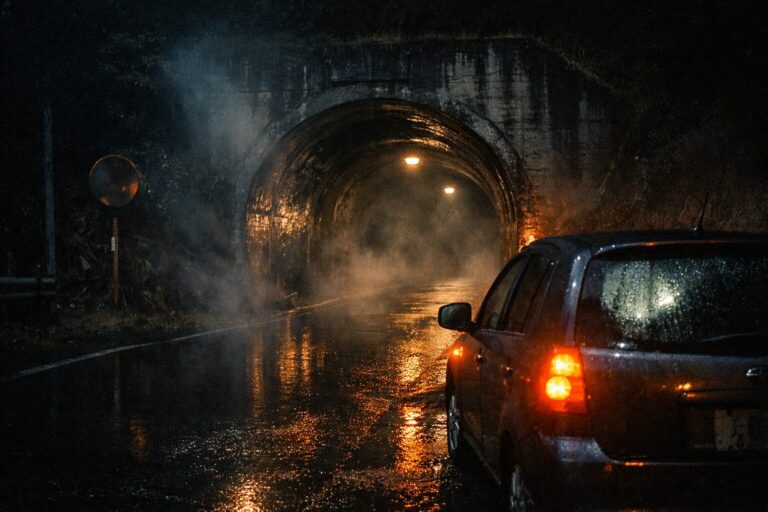
It was one of those nights where the dashboard light feels like a small, tame thing. The radio tried to offer company but only gave a wash of hiss and the odd scrap of a shipping forecast, then nothing at all. Past the last terraced houses and their stoop lights, I turned left at the war memorial and took the climb toward the moor. The hedges fell back to drystone wall and gorse. The cat’s eyes lit up like little coins. Ahead, the lane narrowed to a thought, and the fog began to move in sheets, slow and deliberate, the kind you only get on high ground. I kept the beams dipped because main beam makes a white wall out of weather like that. The wipers clicked like a metronome as the glass gathered a skin of cold.
There’s no footpath along that stretch—just stone and heather and the sort of ditch that’s really a wet throat. The only places you can pull off are the memory of lay-bys from decades ago and the cattle grids, two of them between our town and the mast on the other side. I reached the first grid with its iron clatter and felt my tyres hum on the bars. The moor opened then, the low ground to my left and the faint outline of the quarry spoil on the right. It’s where you start to feel alone, even before the fog says so. That was where I saw the figure the first time.
It was there beside the wall on the left, just beyond the chevrons that warn of the bend. A person-sized shape, grey against grey, no reflective strip on a jacket, no dog, no bike. No light in hand. It wasn’t in the lane, not blocking my way, only placed where no one ever stands because there’s no path and nowhere to go but the ditch and the heather. It was turned a little away, head tipped as if watching something further out across the bog. I felt that small, automatic lift in my foot, easing the accelerator, the instinct to offer a lift to someone daft enough to be out there without a torch. I expected motion—an arm up, the shuffle that means someone will risk the road and your bumper to reach safety. But the figure didn’t move. It didn’t seem to notice me. As I rolled closer, the fog slid across the wall like a curtain, and in the next second there was only stone and the dark ribs of winter-browned bracken clumped where I’d thought the legs had been. I drove past nothing, only a place under weather, and had to make myself breathe again.
I told myself the distance plays with you out there. Fog gives you shadows for company. I watched the centre line and the cats’ eyes and let the engine pull me up the slight rise where the road flattens out. I didn’t pass a soul. There wasn’t another pair of headlights anywhere, not even back on the ridge. You can sometimes see a tractor lamp moving like a star on the other side toward Scarth Bank if the night is otherwise clear, but there was no such comfort. I came out of the bend, and a hundred yards ahead, by the white-painted marker post near Old Moss Gate, the grey figure stood again.
It was the same height, the same lift to the head, the same quietness about it. There is no way to be there without walking all the way along the edge of the road or clambering the wall and crossing the bog. Between where I’d seen it first and where it now stood are trenches of black water you don’t cross without knowing your footholds. And if it had been on the tarmac, if I had passed it without seeing, I would have felt that tug that comes when you skim too close to flesh. I hadn’t. I would have seen the shape step into my dipped beams, would have braked. I had not. Yet it was ahead of me, as if I’d circled and it had been waiting inside the circle, already there.
I slowed to twenty and inched forward, a tyre’s width off the painted centre, the way you do when you’re not sure if there’s a sheep in the fog. The figure stayed by the marker, facing the fields beyond, neither claiming the road nor retreating from it. My hands were cold on the wheel, the cheap leather wrapping creaking when I moved my grip. Between swipe and swipe of the wiper, the world outside flickered like an old film: grey, blank, switching. I thought of shouting through the crack of my window—Do you need help?—but the moor has a talent for giving voice back to you in the wrong tone. I didn’t open my mouth. The radio coughed once with a burst of static and then went dead again, and in that little nothing I rolled abreast of the marker and saw only fog coalescing into itself and no person at all.
I kept going because there’s nothing else to do there. The second cattle grid was ahead, then the long straight where the phone mast is a suggestion even on clear nights. My head did the arithmetic: time from here to the first house on the far slope if I don’t meet a tractor; petrol enough; brakes sound. Ahead, a break in the fog came as a thinner veil, the road suddenly longer under me, and in the thinning I saw it again, nearer the straight, by the tumble of stones where the wall has fallen to a V. I wasn’t yet halfway down the straight. I hadn’t seen a figure cross or keep pace in the verge, which is ankle-breaking country in daylight. It was simply placed there again, correct as a road sign. I could have turned around at the grid, but I didn’t like the idea of reversing near something I had already failed to overtake.
I brought the car to a crawl. The fog was densest at about shoulder height, a band you could almost touch, pearly and damp and muffling the world. The figure was in that band, the grey of its outline the same as the grey of soaked cloth left to rot on a gatepost. As my dipped beams reached it, it turned, slow as if water moved it. The light should have made sense of it; headlights are good at learning edges. What they found instead was a kind of smear where a face belongs. Not a mask, not a skull, not anything your mind can use. The light slid off it the way light slides on wet stone, refusing detail. There was a hint of where a nose should break the plane, a darker patch where an eye might make an entrance, but nothing enough to put together into a person I could speak to. The mouth, if there was one, wasn’t where I expected. It was like the fog had made a person-sized pocket around emptiness and turned it to look at me. My foot knew what to do then and pressed down again. The engine obeyed, the bonnet nosed forward, and whatever attention I had gathered on me went back to the side of the road, to the unseen thing in the fields it had been regarding when I first saw it.
At some point in those next minutes, I forgot to blink properly. My eyes burned in that pricked way they do when you’ve stared too hard into nothing and tried to make a shape into a fact. I didn’t shift my gaze from the centre line and the poles of the fence that flicked in and out. The scent coming through the tiny gap at the top of the passenger window was peat-cold and a little sweet, like pond water. The heater couldn’t keep up. A film of condensation lipped along the inside glass, and the wipers sketched their arcs and set the rhythm my breath wanted to follow. Once, from the passenger side, there came a small sound, not a knock exactly but the sound of wet skin losing a tiny purchase. I told myself it was just a runnel of water changing its course across the door.
Downhill the fog thinned in degrees. The television mast on the far knoll became a suggestion and then a black geometry, then the orange wash of town began to seep under the lid of cloud like fire under a door. By the time I clanged over the last cattle grid, my shoulders had loosened enough to ache. The road broadened to two full lanes and hedges started again, and the moor released me like a held breath. In the rear-view there was only a milk-white world under its own rules. Ahead, our town sat ordinary and foolish beneath the sodium lights, litter twirling in the breeze along the pavement by the bus stop, the kebab van closed and quiet, the chemist’s shutter half scrolled.
I turned the last left past the playing field and pulled up outside my place, second in a row of four stone cottages with shallow steps and knee-high iron rails. The orange streetlight above my bay made a wide puddle of light on the bonnet. I sat with the engine ticking down, listening to the quiet drum of cooling metal, to my own breath enough above it, and let the world here be the world again. I thumbed off the lights and for a second stared into the dark glass where my own face should have been, pleased that it was there and charted correctly. I reached across to grab my bag from the passenger seat and froze.
On the outside of the passenger window, in the streetlight shine, were two handprints. Damp, spread wide, one higher than the other as if someone had leaned there from the darkness a moment to look in. The marks weren’t clean negatives like you get on a misted interior; they were the opposite: grey upon grey, slick with something that caught the light with too smooth a sheen, and at the edges a fine grit had caught, like the silt that sits at the lip of ditches on Hollin Moor. The streaks ran a little where the water had made its own path down the glass, a finger-length slide in one place as if the grip had shifted and then been taken away. I hadn’t stopped. I hadn’t wound the window down. I had not passed anyone who could stand in that middle space where passenger meets outside and place both hands quiet on the glass. My house key sat cool in my palm, untroubled by the story my skin insisted the night had told. Around me, the town hummed its sleepy summer noise, a television laugh line escaping from somewhere, a fox’s tread invisible along the kerb. The handprints held their shape a while in the orange light and then began to soften, returning to the damp that could have been any night’s work, had I not known the road I’d taken to get them.