The Woman in White Beside the Mango Tree
They told me the rule as if it were a kind of prayer, each of them repeating a piece of it while we ate. No one should linger near the mango tree after midnight, not to smoke, not to check the chickens, not even to hang laundry if the moon was good for drying. When the talk turned to it, my aunt tightened the scarf on her head and glanced toward the window, where the branches pressed against the sky like a black net. My cousin said, softly, that sometimes a woman in white stood there—always by the trunk—facing the house. Don’t call to her and don’t answer if she calls to you. Don’t give her your name.
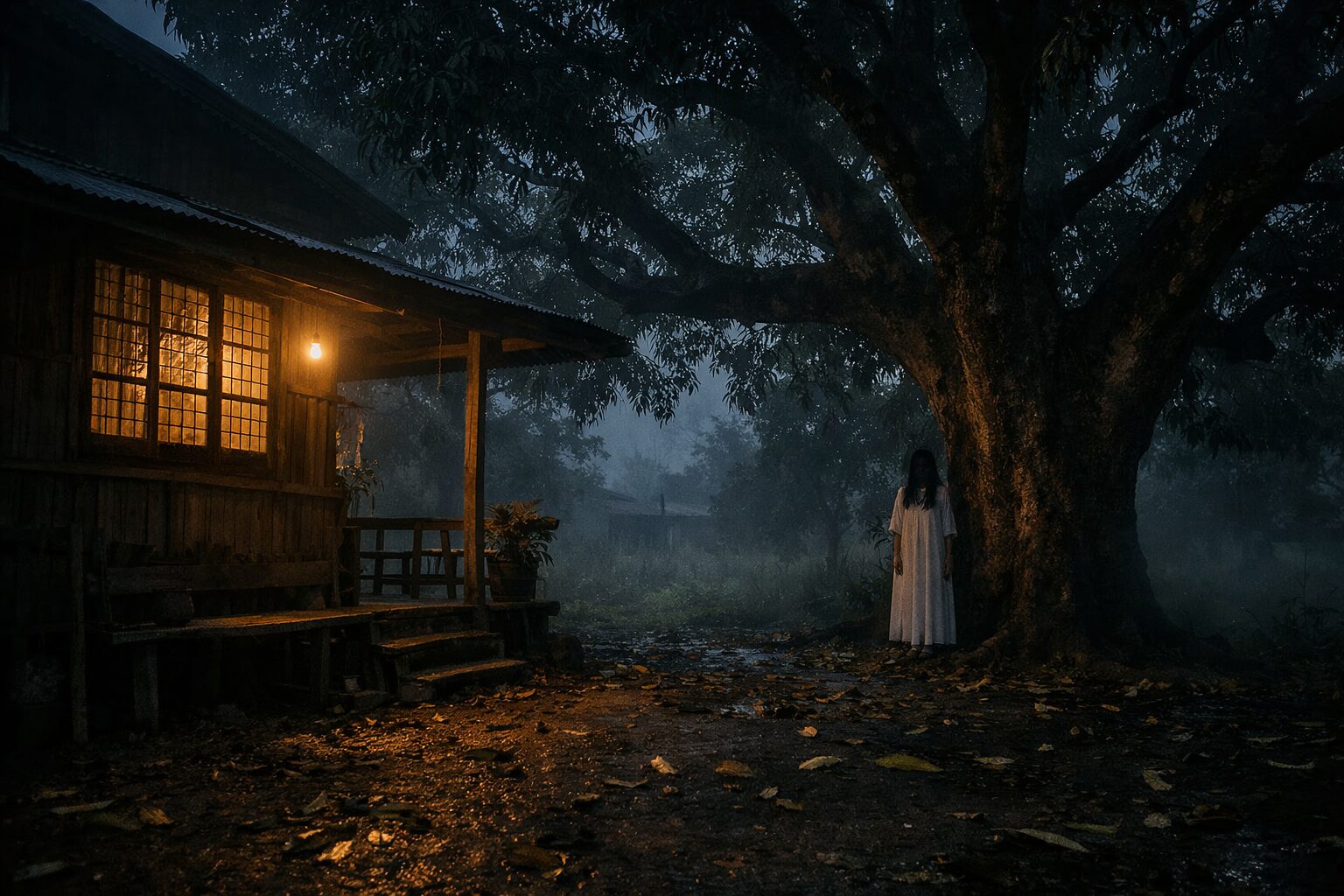
I told them I wouldn’t be foolish. I wouldn’t test anything. It was early summer in Batangas and the house sat a little higher than the fields, a simple square of wood with capiz windows and a low front porch, the roof patched with sheets of tin that rattled in the wind. The mango tree had been there before any of us, the trunk as wide as a barrel, bark folded and dark, thick roots muscling the ground so the stepping stones tilted out of true. In the afternoon the sweet, fermenting smell of fallen fruit drifted up like a heavy blanket. After dusk, frogs took up their positions around the well and the air trembled with the cicadas’ last effort. There were always small sounds—the skitter of a gecko behind the calendar, a spoon tapping enamel. The house held its noises the way the tree held its shade.
I don’t know when I stopped thinking their warnings were only superstition and started taking them on like a shirt I didn’t realize I was wearing. The first night I stayed up later than the others. The fan clicked and sighed. I stepped out to the porch because the heat inside made the banig sticky under my legs. The yard was a plate of gray, the grass dull with dew, and the tree climbed out of it like a tower. I sat in a woven chair with a mug of salabat, the steam pushing a damp curl into my face, and I watched the pattern of light and dark where the leaves broke the moon. I remember telling myself I would only sit a minute, breathe, and let the heat fall away.
It was there already when I noticed it. At first I thought my aunt had ignored her own rule and left a sheet from the day’s wash over a low branch. It had that white, careless hanging look. But the wind was running in the leaves and nothing shifted in that white. It wasn’t draped over anything. It was next to the trunk, a person’s height, not touching the bark but near enough that, if she were truly there, she could have rested her palm against it. I stood before I had decided to, the chair scraping a little, and the figure did not tilt its head or break apart into laundry or straw. I could not make out a face. There was a kind of patience about it, a vertical patience, and I had the stupid thought that I could talk to her if I wanted, that if I said something ordinary—Hello, do you need anything?—the situation would become an errand and not a question.
I whispered for my aunt instead and then felt foolish immediately, like a child waking someone over a dream. The door sighed under my hand when I opened it. The inside had its own night sounds—the quiet tap of water into the basin from the roof’s last rain and the distant report of someone’s radio across the fields, clipped voices exchanging a late story. My aunt didn’t answer and I didn’t call again. When I went back to the porch, the figure was still there. I forced myself to sit. From the threshold, our dog—brown, scar-wormed, aging—had lifted its head and was staring too, ears parted, breath faintly whistling. Only when an insect bumped the screen did he adjust, as if disturbed by us rather than by it.
In the morning, no one asked why I looked tired. It rained before noon. My uncle came with sacks of feed. We shelled malunggay pods and laughed at the way the kernels shot sideways when you pressed them wrong. There is a way a day can be so normal you carry it like proof against anything foolish you thought before the sun went down. And yet that night the same patience waited under the tree. I opened the porch light and then turned it off. The glow barely reached halfway across the yard either way; it made a yellow pool at my feet and browned the moths into little marks against the glass. She—if I’m allowed to call it that—was as far as the trunk again, the white there and then there again when I blinked, and always oriented toward us. Toward the line of the house. I could not see her face but I knew I would never catch her from the side. I tried to slide left on the chair, but from any angle, the impression was the same: we were the thing she was looking at.
On the third night, leaves wagged like hands in a theater, the tin roof popping in the heat that stayed even in darkness, but the white did not sway. The dog, who would scratch at the door every night to be let out to examine his little kingdom, lay with his muzzle pressed to the wood and vibrated in a small growl that never fully formed. I could hear the tuko’s rubbery call from near the ceiling and, farther off, a tricycle chugging down the barangay road, the red tail light smearing once across the window’s capiz shells to make a brief false sunrise in the room. The woman—was that what she was?—kept her station. In our family there had been a great-grandmother who wouldn’t let anyone sleep with their hair wet; another who burned banana leaves and marched the smoke around crib corners to keep away the wrong kind of visitor. Superstitions and their particular weights. I began to get the feeling of someone being at a bus stop in the hour no buses came.
“Stop looking,” my aunt said from her mat on the floor, surprising me. Her voice threaded through the screen door without her getting up. “If you give it attention, it will take more.” She used the word it without malice, the way you’d talk about a rat at the rice bin. I nodded though she couldn’t see me and turned my eyes to the boards at my feet. When I tested myself and glanced back, the figure had not moved.
On the fourth night I was alone with the porch and the dog and the hum of far, low things that seem to live under the fields. My aunt had gone to a wake; my cousin had a fever and slept with a damp cloth folded over his face; my uncle had taken his beer to the neighbor’s sari-sari store. The clock over the calendar had stopped an hour before, the second hand kissing the twelve and staying there. The smell of resin from a broken mango twig threaded the air, a clean bitterness. I told myself I would not look for her. I counted the squeaks of the fan blades and the clicks between the fan’s clicks. When I failed my own dare and looked, she was there—a human length and white where it should be darkness, facing me, facing us. The porch bulb made a weak ring at my feet and left the yard a theater stage waiting for its actors to come in from the wings.
I bent to put a match to the mosquito coil. The matchbook was down by my ankle, on the plank where I’d dropped it. I struck once, bending the little red head into smoke, and cupped the blade of my hand around the curl of green until it took. It was not a full second, that glance away. When I lifted my head again, the white had stepped closer—not stepped, because I hadn’t seen movement. It had adjusted the distance between us. Where before there was ten long paces from the trunk to the first stone, now she was at that first stone, the one that wobbled because the roots had shouldered up under it. I could make out the shape of the lower hem now, the way it hung heavy, and something else—the way the grass seemed to pale around it, as if a cool moonlight gathered there that didn’t touch the rest of the yard.
My mouth opened and no sound came. The dog stood and took two steps back until his ribs touched the door, nails clicking once as his paws looked for an edge that would let him go inside without me opening anything. I had the childish urge to fold the air like a blanket, to draw it over my head and hide from being visible. I told myself, I will not blink. As if blinking was a bargain. The coil breathed its sharp curl of smell into my face; a moth battered itself against the bulb. The woman in white did not sway, did not alter the tilt of her head. And then some unfaithful muscle made my eye close. The softest shutter.
The sound I heard was the low step of my own heel as I retreated. I hadn’t decided to move. I only wanted to draw my breath easier and found myself on the threshold with my hand on the door, the wood hot under my palm from holding in the day’s heat. She was four or five paces nearer now, at the flat stone where we set the basin to rinse rice, close enough that, if I’d spoken my name, she could have heard it without me raising my voice. There was a shine across her that wasn’t from our bulb or from the moon. It had no source I understood. The porch boards under my feet gave a little tick and I thought, absurdly, that they would remember my weight and tell it later.
I went inside. I didn’t slam. I closed the door and slid the bolt into place and hooked the chain, and I pulled the curtain across the window though there was no one to see my caution but me. The house had the stunned quiet of a place that believes itself safe because of a single iron latch. I stood behind the door and listened to the hinge settle. If she had been a person, there would have been the drag of a hem on the stairs, the faint dull of a foot on soft dirt. There was nothing except the old, low noise of the house breathing, tin dilating, water tapping into the basin. Somewhere, somewhere very near though not outside, the tuko started and stopped again.
I told myself to sit. I sat on the floor with my back against the door, the wood warming the bones of my spine through my shirt. The dog made a question-sound and then folded down beside me so his hip pressed my leg, his head on my ankle. In the other room, my cousin shifted, and a spoon knocked itself off a plate. I waited. There is a kind of waiting, in the middle of the night, that is just a list of small promises you make to yourself: I will not look. I will not say anything out loud. I will not fall asleep. If I keep to my promises, the night will pass me like water finds a way around a stone. The gray behind the curtain deepened and then lightened again. Once I thought I heard the almost-sound of a step on the wooden stair and then it was gone, or it had only been the fan correcting itself and the dream of a step had been inside me.
Dawn has a smell here before it has a shape. The odor of cooking rice by someone who wakes before you. Pig feed beginning to sour in the heat that returns like a tide. A bird claiming a fence and then forgetting it. When the first rooster down the lane tried his voice and then decided to keep it, I stood. I checked the chain and the bolt because habit demands its proof. Both were in place, the bolt’s paint chipped where our fingers had always touched it, the chain’s cheap brass worn smooth. The dog’s ears turned toward me like little dishes when I lifted the hook. I could hear my aunt stirring her mat, the delicate knock of her bracelets against the floor.
I opened the door. The yard was unmade bed—dew and long shadow, the tree a dark bulk with its high leaves already taking light. The stones sat where they had always sat. No mark on the soil said anyone had stood there. A neighbor’s radio was already talking about the mayor. From the steps the world took a breath and pretended it had been like this all along.
It was my aunt who sucked her teeth softly, not a sound of anger but of recognition, a little sound you make when a puzzle tells you its last corner is lost for good. At our feet, on the inside of the threshold, were mango leaves. Fresh, heavy with that unripe green smell that leaves on a table have for a few minutes before they turn ordinary. Three of them lay across the woven doormat and two more had lodged under the edge of the plank, as if they had been set down with care so the door would still open. They were new enough that when I pinched the stem of one, it bled milk and stung my fingers. One pressed mark of sap shone on the board like a small fingerprint that wasn’t mine.
The chain had been across the door all night. The windows, with their crisscross of bamboo slats, were latched. No one had come in to leave them. My aunt crouched and slid the leaves into her palm the way you gather coins you find on the floor. Her eyes flicked once toward the tree and then away, not because there was anything to see there but because there was what we already knew. She set the leaves on the kitchen table, and for a little while we went around them as if they were a guest waiting to be offered water, careful not to brush them with our elbows or set anything on top.
After breakfast, I reached to pick them up and throw them back into the yard. The resin had dried in a thin shine. A hair—long and fine and not from anyone in the house—clung to the tip of one. I blew it away and it didn’t move. The dog nosed the air by the threshold, attentive to something that wasn’t smell.
By then the sun had burned the shadows under the mango tree into simple, harmless shade. I stood on the porch and counted the stones again the way a child gets the same answer to a question over and over, hoping it might come out different. The trunk held itself together, the bark did its holding, the branches went on with their rustle. Every time someone opened the door, a slip of that green smell, sweet as a warning, creased the air behind us from those leaves, though they sat quiet and exact where we had put them—inside the door where they had no right to be.