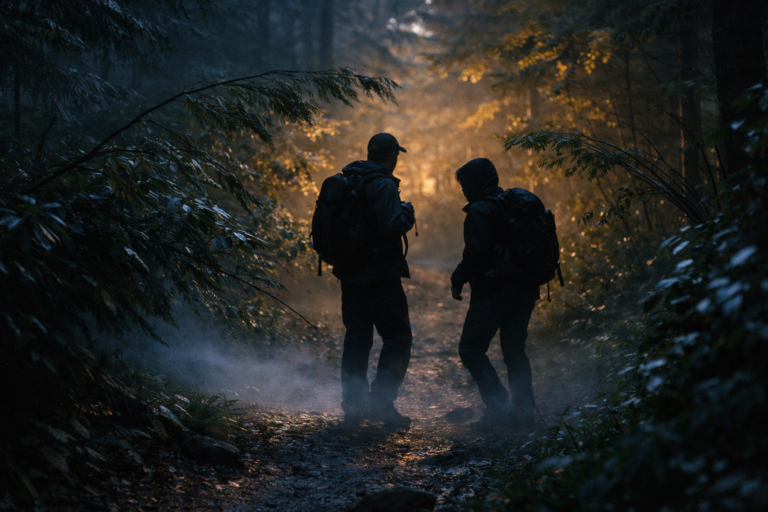
The Horned Shape Near the Old Railroad Tracks
People in our town say not to walk the old railroad tracks after midnight. It’s one of those rules that doesn’t come with a written sign or a law, just a way people talk after dark on porches, the same joke with the same careful edge every time. They say if you step on the ties when the day turns, something steps on with you. They say it stands between the rails and watches. The old men at the grain co-op will nod along, spitting shells, giving the exact mile marker where it likes to show. But every time you laugh and ask what happened next, they shrug and say that’s as far as anyone got. The ones who kept going, you don’t get to hear their jokes.
It sounds like a bedtime rule for teenagers. It sounds like a dryness in the throat of an older town, something rattling in the cupboards that doesn’t want to be chased all the way out. We’d all heard it, and we’d all said the same thing, that people make a shape out of their own shadows when they’re looking for it. The tracks are disused, rust snapping along the top of the rails, and weeds shouldering up through the ballast. No trains but the occasional maintenance truck. No reason to stay off except the trespassing signs that no one’s enforced in my lifetime. It was August, heat half-burned off by midnight, and the four of us had been at a bonfire along the river until the smoke thinned to blue and the younger cousins packed up.
When it was just us—me, Travis, Beth, and Miguel—we idled the truck on County Road 14 and joked about going to see the place where night supposedly stacked itself. We weren’t drunk; we were bored. Off the county road, the gravel ribboned to the right and ran parallel to the tracks for a while, and the ditch was full of cattails and frogs you could hear but not see. The stars were messy, pale as breath, and a bank of summer clouds had slumped to the west, backlighting the cottonwoods in a sleepier version of daylight. The crossing where we parked had a flaking white X with no lights, just a passive sign that didn’t bother to warn anybody because nothing came. You could smell creosote and dust and something green from the ditch, a pressed smell like old hay.
We stepped over the first rail together, one palm on the cool, scabbed metal. The stones shifted and popped under our shoes. Beth lifted her flashlight and decided to walk the line like a gymnast, arms out. Travis said we had to listen for the thing everybody blamed on the night: phantom footsteps, a cough, a whistle. We made jokes on purpose so we wouldn’t have to admit we felt different out there, even with the corn cut low and the horizon honest. The sound of the bugs, that steady wet treble, made the silence under it sound like a dropped coin.
Past the overgrown siding, the track opened into a mild straightaway nobody had reason to notice in daylight. The rails narrowed in the distance to a wire pulled tight. We’d gone maybe a quarter mile when Beth pointed. Her light slipped along the silver like a spilled drink and gathered itself in the dark long enough to touch a shape. Far down, between the rails, there was something that interrupted the line of the ties. It could’ve been a sign someone dragged out there, or a post torn loose and wedged upright.
“There’s our midnight man,” Travis said, but even he kept his voice low.
From that distance, what I saw was a vertical smear, ribbed by the shadows of the ties. It could have been a person if you were the type to see a person in a bush. It could have been a bush if you were the type to feel safe. But there were two points at the top—two pale arcs that the beam of her flashlight seemed to miss, so they stayed dark and felt like they might be shapes in my eye, not in the world. I told myself it was a bent crossing arm someone had dumped. The curves looked like the ends of handlebars tipped toward each other.
We walked on, stupid the way you get when you’ve convinced yourself nothing is going to happen. The smell of creosote was stronger, the ties spongier underfoot where rain had softened the dirt. Miguel kept his light down tight on his boots and the little galaxy of white stones shivering with it. When I looked up again, those two points at the top hadn’t moved, but they were wronger. Closer, maybe. The distance on tracks is a liar; the way they pinch the world to a vanishing point makes everything else bend to the same lie. I told myself that’s all this was, a trick of parallel lines making something normal look set on the line like a target.
“You hear it?” Beth whispered, out of jokes now. And I did hear something, but the problem was, it was the absence of something. The ditch frogs were going, the brush’s dry jawbone of a sound was going, the soft express of air across the corn stubble was going. But there was no human sound. No cough or shuffle from ahead. More important, there was no slight scatter that goes with someone shifting their weight on gravel. We were making all the noise there was to make, and the figure—sign, post, shape, whatever—made none.
We stopped walking without deciding to stop. The four of us stood in a little clump, our arms not quite touching, with three beams of light jittering and one, mine, resting at my side. The thing ahead of us had become a silhouette you could select and move with a mouse: a central body, narrower than a man’s, rising from the exact middle between the rails. Those two arcs at the top had resolved around the light in a way I didn’t like. They weren’t catching it. They were refusing it.
Then, without being able to explain how I knew it, I knew that it had closed some of the distance. It was the same kind of realization you have when a storm is nearer than you thought—you can tell by what your skin does. Only my skin was listening to the stones, hearing nothing, and telling me something had slid instead of stepped.
“It’s moving,” Travis said, careful not to name it. We weren’t making jokes now. He put his light dead center on the ties and held it there. I put mine up, finally, my hand shaking harder than I wanted it to, and swept the beam along the railheads like measuring with a tape. The light snagged on the shape. The world came together with an ugly little click.
It stood between the rails as if that strip of earth belonged to it. It wasn’t as high as I had somehow feared and not as low as would have let me relax. The body was long and too narrow at the shoulders, and where a head should have sat, there was something tipped slightly forward in attention. From that, two horns rose, not straight but curled back a little, each one thin at the ends like the last loop of a question. The light didn’t knock a shine out of them the way it should have. It feathered off, making them look matte, like the black of a new bruise. The face, if there was one, ate the light and didn’t offer a detail in trade. It didn’t flinch at the brightness. It didn’t put a hand up in that automatic way people do. It simply stopped the way a picture stops: chest quartered toward us, the horn nearest to us throwing a curved edge into the beam, like it was presenting itself.
I had the sick feeling you get when someone holds too still for too long, a stage stillness, strong-armed into place. It wasn’t a surprise I could laugh off anymore; it was a posture that had chosen us. Nobody said anything, because the only thing we could think to say would have been the thing we were refusing to put into the open air: that we were looking at it and it was looking back. The lack of sound hissed in my ears. I couldn’t hear my own breath for a second and then I could, the sound of it an indecent thing in the neat field of quiet.
“What do you want?” Beth said finally, because she is the kind of person who would rather cut a line than be tangled in it. Her voice didn’t carry. It stepped off her mouth and lay down.
The figure didn’t answer. It didn’t even sway. It did one small thing I wish it hadn’t. It repositioned its stance by the smallest adjustment, something like a dancer’s margin of correction, so sure and so exact that the ties under it didn’t dare complain. It was the first positive proof that it wasn’t a sign or a fencepost. A post doesn’t amend itself for the camera.
“Nope,” Miguel said, and turned, and I felt the animal part of the night move in me and take my legs. We broke and ran, all four of us, the light jumping us into and out of our own shadows. The ballast slid under my shoes and filled my socks with dust and little razors of stone, but I don’t remember hearing even that for the first few steps. Behind us, ahead of us—no sound from the shape. I took one hard look over my shoulder even though everything in me wanted not to, and the distance I had been carefully counting, like a string between my hands, had shortened again. It wasn’t the way a runner shortens a distance; it was the way a shadow does when your own light betrays you and brings everything too close.
We pitched off the rail bed toward the gravel road, a tumble of cursing and apologies and the slick slap of hands on hood metal when we got to the truck. Miguel didn’t fumble the keys. He didn’t even look; he knew where every key was, and the engine caught on the second try. Headlights threw a pale length of the tracks into relief from the crossing. There was nothing there to see where we’d been looking before, just the long unspooling lines and the black seam between them. When we pulled away, the reflection on the rails chased the truck briefly and then let it go.
We didn’t tell the story well that night. It came out in clanks and false starts, and then we let the talking slide away and just kept each other in the reach of our porch lights. I tried to sleep and watched shadows turn into other shadows instead.
In the late morning, when the fields smelled sun-struck and the cicadas were all teeth, we went back. Nobody said we were going for proof. We said we had left a flashlight and wanted to find it. The crossing lay open as ever. Birds hopped along the rails, pecking rust. We walked out to where we thought we’d stopped and then kept walking because in daylight that line gets longer and longer, as if the night had taken some of its slack back. The place we settled on was marked not by memory but by a small, very particular wrongness laid out on the ground.
Between the rails, on the padded bed of stones, two hollows showed like cupped hands pressed too hard into sand. They sat a little wider than a person’s shoulders apart, but too narrow to be a person standing like we do. Each hollow had a clean edge as if whatever made it had weight and time and wanted to be precise. The stones around them were shoved up in ridges—like frost pushes soil into little walls—only there had been no frost. When I crouched and touched the gouged spots, I expected them to be wet or oily or heave back at my fingers, ridiculous as that sounds. They were just warm from the sun, the edges of the indentations faintly brighter where the stones had been freshly turned.
“Hoof marks,” Travis said under his breath without meaning to make it a word in the world. Beth glared at him and then didn’t say anything to deny it. There were no prints leading away from those two places, no scattered trail showing a run or even a shift of weight. Just the two deep marks, as if something had risen straight up out of the stones and settled back into its own silence when we were gone.
The wind came up once across the field and pushed a hiss through the weeds along the ditch, and for a second I thought it was the sound we hadn’t heard the night before. It wasn’t. It passed. Far down the track, heat shimmer made the rails float, and I could’ve sworn the space between them pinched a little tighter, the way it does when something is waiting that hasn’t decided on you yet. We stood there longer than was smart, looking at those two indentations like they might relax and tell us what had happened. They didn’t. The ties were ordinary boards again and again. The town was right over there, with its tidy square and its diner open for lunch, and yet the piece of world under my shoes felt fractionally tilted.
On the way back, as I stepped over the crossing rail, I realized I’d put my feet exactly where it had stood, and the idea sat in me like a stone in the shoe—irritant, weight, direction all at once. That night, when the bugs started their thin fiddle again, I lay with my window open and thought about the way it had paused for us to look, how it had held itself in a neat frame between the rails like something that knows a pose is half the story. In the dark, the memory kept its shape better than it should have, and when I finally slept, I woke unsure whether the little, regular ping that comes from old metal cooling was in my head or out by the tracks, somewhere past the crossing where we’d all promised each other not to go.