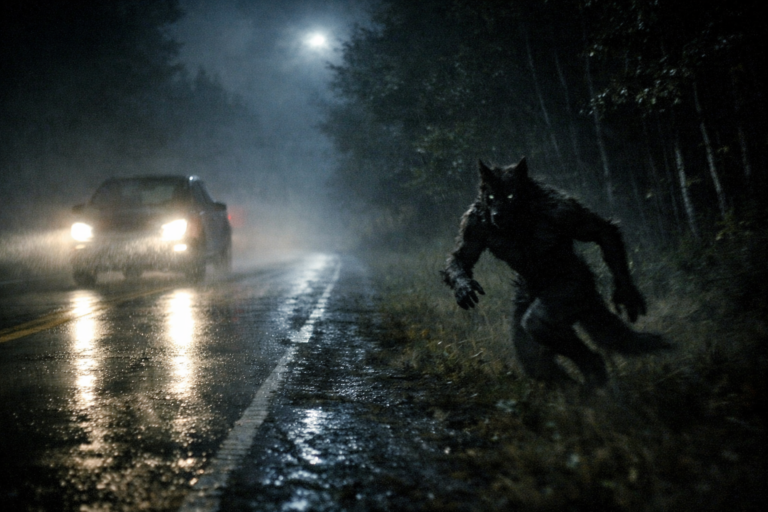
The Whistling Came From Above the Tree Line
By the time I turned back toward the trailhead, evening had already thinned the colors into grays and soot-blue. The last of the day sat in the treetops like a hush. The trail, a familiar six-mile loop I’d walked enough times to know the rocks without looking, had gone empty in the way woods do when they decide you’re done. One more hour, I told myself. I could be down by full dark if I didn’t stop. The creek off to my left kept its steady talk, but the birds had traded their busy sounds for the more careful notes they use before night.
The path slid through fir and hemlock, needles soft over the dirt like a rug. Sometimes the trunks widened into cathedral rows where you could see straight ahead for fifty yards, then it would pinch back to a narrow cut between slick boulders with just enough room for my boots. I could smell damp bark and the faint, mineral cold that only shows up once the heat has bled out of the day. I kept my headlamp less as a light than as something to look forward to—one small circle I could make in the dark when it finally took the rest.
There’s a sign near the last mile marker where the forest service reminds you to be off the ridge by dusk. It’s an old sign, the reflective paint rubbed down to a thin, dull mouth. I passed it with the small, automatic guilt of ignoring advice meant for someone less prepared, and realized the wind had died without me noticing. The hemlock tips had been twitching earlier and now held perfectly still, needles like wet hair.
That was when the whistle came. Two notes, not even a second apart—clear as if someone had puckered their lips right next to my ear and thrown the sound high, so it landed above me. I stopped. It wasn’t on the trail. It wasn’t at ground level at all. It came from somewhere over the treetops, well above the highest limb, up where the last pale strip of sky pooled between the black edges of the canopy. I held for a breath, waiting for the ordinary logic of things to catch up, and there was only the thick silence the forest keeps like a chamber.
I moved my head slowly as if sight would undo what I’d heard. The ridge to my right rose steep enough that nobody could be standing above me on the slope without sliding. The opposite side fell away toward the creek. There were no outcrops, no towers, no people at all. The whistle had the shape of a person’s attempt—no trilled bird throat, no complicated notes—just the sure two-note rise you’d use to call a friend without yelling. Only there had been nobody to throw it, and no place for them to be if there were.
I shifted my pack higher on my shoulders and kept walking. There are a thousand good sounds you forget until they happen: a branch settling under its own weight, a squirrel’s clatter snapping you back to size. I let one of those reasons be true in my head until the whistle came again from ahead of me. Same two notes. Same human aim. This time it was farther down the trail, around the next bend, like it had leaped beyond what my steps could account for.
I paused again and let quiet find its level. I didn’t want to answer it, and I didn’t want to pretend I hadn’t heard it. My second step set a small stone skittering. The sound felt obscene. Dusk had lengthened into that hour where distance makes a different kind of sense, where across and above aren’t as firm as they are at noon. I walked faster.
Every few minutes, when the path straightened enough that I could see twenty paces of myself moving through the trunks, the whistle would alight ahead as if it had ridden the understory down and landed in front to wait. Never from behind. Never from the trail edges. Only out ahead, placed where I was about to be, above the run of the canopy, dropped in the air and let go. I tried to hear any echo that would tell me it had bounced from rock and fooled me, but the trees ate the edges of the sound. It hung there and didn’t spread.
Maybe the third or fourth time it happened—time loses its muscle in, and I can’t tell you how many minutes had gone by—something else joined. The first bit was small: a zip of needles above me like rain thinking about it. Then a dry tick of twig against twig. I looked up and saw a single low hemlock bough give way and rise back up, not a wind-move, no ripple traveling the other branches, just that one glossy spray lowering as if it had been brushed by a hand and then lifting back on its own. I stopped. The branch settled and so did the sound.
I took a step. Overhead, a light scuffle answered, timed exactly to the movement of my boot. I took two more. The sound moved with me—a faint, irregular slide, as if weight scraped carefully from one perch to another, and then stilled when I did. I stood and let my breath get quiet against the pack straps creaking in the way they creak when you hold perfectly still and the little hardware shifts on its own. Nothing above me moved. I waited long enough to recognize the shape of my own fear without having to dress it up as anything else.
“Hello,” I said finally, because I felt rude not to. My voice didn’t go anywhere. It was like speaking inside a coat: all sound returned at once, unsure it had been used for anything. Somewhere out ahead, the two-note whistle sounded again, brighter now that the dark had come more completely down. It landed above the place the trail would take me in about a minute. As it faded, something above and to my left made the same quiet slide along bark I’d been hearing, a weight not big enough to crash, not small enough to be animated by breeze, keeping my pace with a patience I didn’t want to test.
I kept to the center of the path where the pine needles made their own kind of matting. The angles of the trees feel more intimate at night, like you’re walking through the ribs of a house you don’t own. The creek had fallen away enough to become an idea. There was only the small, varnished sound of my shoes. When I sped up, the presence above me sped with me—not loudly, not with any show of breaking through anything—just that controlled shift, tiny scrapes and the whisper of needles parting in measured, unhurried lines. If I stopped, it stopped. I tested it. Four steps. Stop. Four more. Stop. The reply above me came with a precision that made my tongue dry.
At one curve the canopy thinned and a wedge of sky showed through, the last color pulled tight like a bruise. Something crossed that gap. I won’t swear it was form. It was absence, a stroke cut out of the dimness, too steady to be a bird’s flutter, too wide to be a single branch. I moved under that opening quickly, and the sound above came with me, unspooling to follow the simple arithmetic of my steps.
There’s an old service road that runs below the trail near the trailhead, a straight scar with an old cable gate and weeds shouldered up to it. When I reached the cut-through that drops to that road, the air changed in a way you can only call relief—open ground somewhere ahead, the weight of the trees less total. I could smell the dust of cars before I could see the gravel. I could even imagine the faint tick of some metal cooling from the workday. I stepped off the root tangle onto the hardpack of that short connector and waited. Above me, everything waited with me. Not a needle moved.
The whistle came from the left then, above the old sign about not camping past the lot, near where the cedars make a wall. Two notes. The same precise interval. If it had been a person, they would have been standing thirty feet up a vertical trunk with nothing to hold onto, and the sound would have had some grit of a chest in it. This had no grit. It was clean the way something deliberate is clean. I realized my mouth had been open this whole time, my breath going in through my teeth as if I could get more air that way.
The service road lay ahead like a line drawn to salvation, the trailhead only a short walk beyond it. I went down it quickly, more a controlled fall than a jog. Gravel pulled under my heels. The sky above the break was darker than it should have been, the kind of navy that eats detail. As the trees thinned, the sound that had been moving with me grew less precise, as if the choreography of branches had found fewer grips. There was a single knock—just one—like a pinecone meeting a fender, only there were no cars yet, and then nothing except my boots and my heart and an animal’s quiet somewhere choosing to be else.
I came into the lot with my pack asking to be taken off. The striping on the asphalt held a low glow to it, fed by whatever day still clung to the clouds. There were three cars besides mine, but they might as well have been ghosts themselves, so silent, so complete in their stillness. My own car sat beneath a tangle of overhead lines and a pair of lights that had not yet turned on. The open space felt like stepping from a crowded room into an empty stage. For a moment the relief was almost love. The trees ended; my world had walls again. In the not-quite darkness, my windshield was a shape that belonged to me.
I stopped with my hand on the driver’s side door handle and listened as hard as I could listen. It wasn’t a bet or a dare. It was an acknowledgment. The alarm chirped when the key fob brushed the button in my fist—a sound too perky, too definite. In its wake fell a hush that made my scalp tighten, as if my hair had thought of being touched. I could hear something ticking far away—the lazy thermal clicks of some other car or maybe nothing at all. I told myself I’d open the door, throw my pack in, and let the inside of the car be its own season.
From up and to the right, from a height with no branch to hang it on, the whistle came again, the same two notes, bright as a coin dropped onto glass. It fell directly over my car, as if there were a place there for feet to stand where there was only sky, and then the pavement, and then the sound inside my chest going very, very quiet, leaving only that clean, deliberate whistle.