The Local Channel Cut to a Room No One Recognized
In that town, night settled in layers. The noise of the day was gone, the storefronts along Main dark, the bar two blocks over thinning to murmurs. You could stand in the middle of the block and hear a dog’s chain rattle from a yard and the soft clatter of someone rinsing plates. In the apartments that stacked above the hairdresser and the locksmith and the bakery, television screens put a dull blue drift against the ceilings. The local channel, the one with an idiosyncratic jingle and an anchor who still wore a lapel pin for the high school team, ran through its late slot. There was the city council committee replay, a pre-taped interview about a fall festival, then credits washed over with one of those mall-carpet instrumentals. People left it on out of habit more than attention. It made a kind of company at the hour when refrigerator motors and streetlights seemed too loud on their own.
She was in a second-floor apartment at the back of a narrow brick building, a window that looked toward the alley and the wall of the next place, an air conditioner grumbling less out of duty than memory. She kept the television on a rolling cart near the wall, angled just so to avoid the lamp’s reflection. She lived alone there, her coffee mug set down on a coaster she’d crocheted herself, the remote a little bowed from heat and years. She worked afternoons at the pharmacy and watched the local channel at night not because it was riveting but because it remembered the town the way the town liked to be remembered. She had a dish on the sill where she kept her keys. She listened to the hum, the newsman’s easy voice, the ballooning silence before commercial breaks. There was a gust of rain somewhere out on the boulevard, the smell of damp masonry sneaking up through the sash.
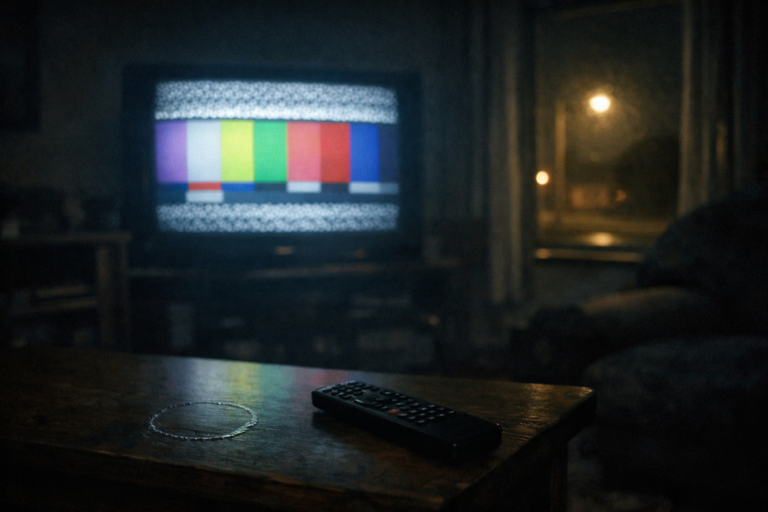
At 11:23 by her stove clock, the picture did a small sick thing. A slip, like a breath sucked in and not released. The white balance shifted, the colors went a degree wrong; then the whole thing cut without fade or graphics. No ad, no bumper, no emergency crawl—just a fixed, dimly lit room, as still and wrong as if the television had been rolled into someone’s quiet, and told to hold its own breath. The audio went dead. If there was tone, it was the faint coil whine of the set itself. The familiar logo dropped away; the bug in the top corner was gone. There was nothing in the bottom third, no names, no ticker. Only a room that didn’t belong to anybody she could name, thrown up like a window had opened in the middle of her wall.
Others saw it too. A night cashier locking out his register, the bartender wiping a glass while the TV above the bottles stopped showing the high school coach’s pale hands and instead offered a shot that didn’t have any people in it. A nurse in the break room at St. Catherine’s blinked at the mounted set while spooning pudding out of a cup, eyes adjusting to the fact that the anchor had been halfway into a sentence and was suddenly replaced by a rug. A retired teacher in a house near the river had her hearing aid in and thought at first she’d sat on the sound button. Houses and apartments and little back rooms across town, all the same silent frame; a dim room that might have been a living room if living ever happened in it.
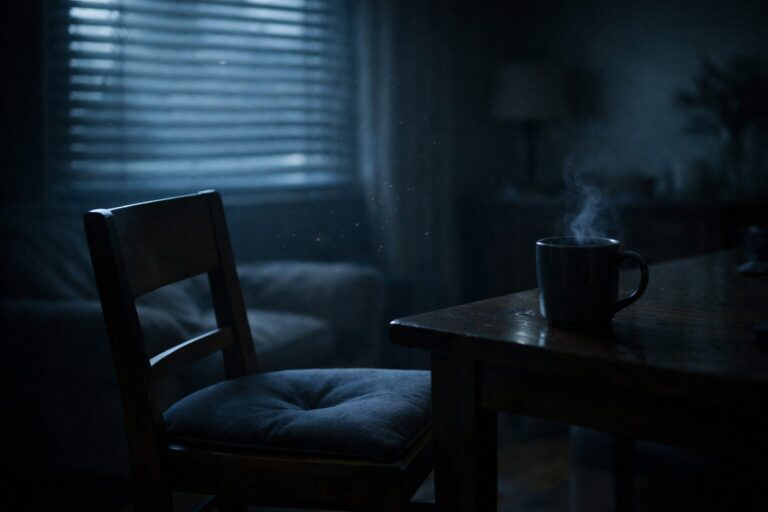
It was ordinary, in its way. A wall painted an old beige that had been repainted in slightly different beiges for years, the way landlords do. A low bookshelf along the left side with three or four hardcovers and a magazines stack that had slumped. A ceramic lamp on a table that wasn’t lit but threw a little reflection off its glazed belly from somewhere off screen. Blinds at the back window that didn’t sit perfectly straight; one slat warped into a grin. Picture frames on the shelf…but facing in, their backs out. A braided oval rug on the worn floor, a section of baseboard showing a little dark swelling where once a leak had swelled it, paint puckered. And there, too prominent without trying to be, an upholstered chair—angled not straight to the camera but off toward the unseen space on the right, its shadow patchwork on the rug. Nothing moved. Not a dust mote, not a shift in the lamplight. The television’s own little mute icon did not appear; it was as if the world behind the glass had paused and invited the town to feel its pause.
It held long enough for people to find themselves leaning in, for the first thin joke—commercial for a haunted furniture store?—to detonate and evaporate without a laugh. The clock on the stove ticked with its own wet sound, the streetlight outside her window snapped a flying insect against its lens, and she looked harder at the circle marks on the end table in that other room. One light ring, one darker. A book cover she thought she knew, spine cracked the way only time can do it, a title that refused to come into focus. The sound didn’t come back. The channel marker didn’t reappear. She adjusted the volume anyway and watched the number climb and fall under a silence that felt like a hand pressed lightly over the mouth of the town.
Her breath shortened because of the chair. It should have been a dozen other things that snagged—the turned frames, the way the window refused itself—but it was the chair, and more specifically the place on the right arm where the fabric had been stitched over after the seam had let go. The upholstery was a nubby oatmeal tweed. A years-old crescent of heat darkened the wood cap on the left where she had once, stupidly, set down a candle stub and had slapped it away a second too late, blowing and saying, no, no, what am I doing. The scratch along the back leg where, moving it out of a tiny city place, she had caught it against a chipped doorframe. Her chair had sat in the corner of her first apartment like a breathing thing. When she’d moved to this one, it had simply not come along. She and a friend had hoisted boxes and folded rugs and breathed sweat, and afterward when she had gone back for the chair, the door she was sure she had locked was latched again and the small main room was empty without it. She had argued with the landlord. She had searched classifieds. She had scouted thrift stores. It was gone in a way so absolute it felt like a dare. And now it was on her wall, on that feed, angled toward the right as if listening for something beyond the edge of what the camera allowed.
She found her thumb on the remote’s back-skip button, a habit muscle. The set had a buffer; the picture hopped back twenty seconds, then forward again, but whatever mechanism usually remembered what it had shown remembered only the anchor’s careful hands and the low compression sheen on his tie. In the place where the room should have been, there was a jump cut to his lips halfway through a phrase about river levels. She let the button go. The light on the cable box flickered as if thinking. She pressed the information key and the strip came up: Community Roundtable. Original Air Date: 11:00 PM. There was no log for anything else.
On screens across town, the cut ended. Forty-six seconds, fifty-three by one person’s microwave, a hair under a minute if you took the clip someone had recorded on a phone and counted frames between the first wrong color and the anchor’s return. He came back mid-blink and his voice was still there, and he did not notice that he had been missing. He smiled, turned to the other guest in the studio, and kept on in that way of people who have not been told that silence got into their mouth and made a home there. Commercials came. The car dealership that used the owner’s children in its jingle yelled. The town breathed again, unflatteringly loud.
Her hands had already gone damp. The chat in the neighborhood group that idled open on her phone was as steady as rain: Did anyone else’s TV—; Did Channel 6 just—; What was that room; Is this an ad; Is anyone else having sound—. Descriptions piled in and matched without having to work hard to match. The backs of the picture frames were the cheap, furred kind that leave black under a fingernail; the lamp had a chip near the base the shape of a snowman’s head; the rug wasn’t new enough to lie flat, one edge rolled on itself like a tongue. A man two streets over swore the magazine was the one with that football player on the cover, not so much because of the legible letters as the blocky color fields. A woman in the condos past the library said she saw a little brass duck on the shelf and had one just like it until her sister took it when they cleared their mother’s place. Someone else said no, there was no duck, there was a key jar with a big red motel fob in it, and in that nobody-gets-to-be-right way of the night, both convictions felt certain and not useful.
She did not comment about the chair at first. It felt like a confession, like raising her hand and telling the room your silly private symmetry. She typed, erased, typed. Finally she said only: did anyone notice the chair arm had been stitched. Two responded within a minute, both with the kind of immediate yes that doesn’t read like courtesy. One woman described a crescent heat mark on the opposite arm and said she had always intended to sand it down and never had. Another sent a private message and asked, tentatively, whether the left back leg had a lighter, husband-fixed look to it, a replacement turned a shade wrong, which had driven her, over years, a little crazy. She read her own memory back to herself in their words and felt a sense she did not have a container for. The phone video posted by the bartender—tilted, wobbling as his wrist had done two jobs at once—caught twenty seconds of the room before he’d panned to say something to a patron and panned back to the anchor resuming with no gap. If you paused it on the ninth second, a place in the crooked weave on the chair arm looked exactly like the frayed knot she had picked with her thumbnail during winters watching television in another life.
In the morning, the station’s Facebook page parked a simple note between a school supply drive and a recipe share: We did not experience or transmit any interruption of service during last night’s programming. They added a phone number and a smiley face. When she called, the first person she reached said he had been in master control and had seen nothing funnier than the espresso sputtering onto its warming tray. Someone higher up called back after lunch and used calmer words: no known outage, no observed signal degradation, no third-party content intrusions. He told her, twice, that all monitors in the building reflected continuous feed. If something had been seen, it had not been seen from their side. “It’s possible,” he said, “there was an equipment-related issue in your building. Glitches happen.” He wished her a good afternoon and reminded her to try reseting her set-top box by unplugging it for thirty seconds.
Online, the thread elongated into the afternoon and then the evening again, even as, in the way of all digital heat, it cooled and slid and was replaced by a parking complaint and a cat someone had found under a porch. But there was also a map someone made, pinning the rough times people said they had looked up and seen the same quiet. A drawing, even, done on a legal pad and posted as a photo, of the room’s layout: the angle of the chair to the rug, the distance from the bookshelf to the blind, the way the frames—no one could agree if there had been three or four—had leaned as if waiting for a thumb. A handful of calls to the state cable office went unreturned. Not a single still surfaced that showed more than the suggestion of a corner or a smear of a lampshade, and in the dark library of their heads, the lonely room became, not grander exactly, but more factual. She dreamed of it but omitted telling anyone that.
Her own apartment felt thinner at night after that, not colder but occupied by something aligned and misaligned at once. She ate on the couch. She watched without watching, turning the volume down to cut the mouths in half. When she powered the television off the first night after, she could see herself in the black of the screen smudged with the reflection of her own lamp. As the panel’s light bled down there was, for a hiccup’s width, the suggestion of a rectangle within the rectangle, a darker place in the dark like a bruise. She told herself it was an artifact, the panel doing panel things as it wound itself to sleep. Then, scrolling one evening through the channel guide on the cable box, pausing long enough on the local channel to make the tiny live preview spring to life in its little window, she watched the inset square fail to catch up to whatever was airing. For a full second—maybe two—the thumbnail held the soundless dim of that other room. Blind, chair, rug. Then the script caught back up and the studio returned to the corner of her wall as if it had always held court there.
Others had their own afters. A man posted that when he turned to the station the next night the audio was there a half breath ahead of the picture, as if the two had been separated and were finding each other by smell. Someone said the closed captions blurted a subtitle [no audio] at a time stamp the broadcaster politely explained was a general tag and meaningless. The station went on insisting that there had never been any interruption, and they were so cleanly confident about it that it felt less like gaslighting and more like the top of the water telling the lake there was no bottom. Yet if you stopped people on the street, if you got them at the right hour with the right tone, they could describe that room for you in the sort of detail that makes a courtroom sit forward. They could tell you the blind’s grin and the exactly wrong color of the wall and how the frames’ tiny hardware points would have scratched if they were turned back around again. She could tell you about the stitch on the arm of the chair without looking at a photograph, the way it had puckered and then smoothed as if taught to behave. The next week, when she flipped the guide too quickly and the tiny inset confused itself, it showed her that room again, and not even for a second this time, only the time it takes for a thought to flare and know it is not welcome. It was enough, in the middle of her own room, to leave the sense of a shape angled just right toward something she still could not see.