The Room Felt Wrong Before Anyone Spoke
The hallway outside my cousins apartment smelled like old wood and lemon cleaner, the way it always did. You could hear the elevator cables thrum through the wall and the sharp little ticks of the radiator working too hard in October. I balanced a store-bought pie against my hip and nudged the door with my knuckles. It was one of those Sunday evenings that bloom more out of habit than planning: a few of us bringing food, a small celebration for a new job, a reason to see faces that only existed for me in profile pictures and birthdays.
Shed left the door on the latch. It gave the breathy sigh of the weatherstrip as I slipped inside. The apartment felt mostly empty; I could hear water running somewhere and the soft whir of the refrigerator. The living room opened into the dining area, and the whole place was lit the way a memory gets lit: thin orange from the setting sun cut into neat stripes by the blinds. I took a few steps and let the door roll closed behind me, careful not to let it catch and slam.
I stopped there, at the threshold to the room, before my foot found the rug. I didnt think then; I just froze. The air on the other side of that small strip of hardwood felt denser, cooler, as if the temperature dropped three degrees right where the carpet began. It wasnt dramatic. It was as ordinary as a mid-breath pause, as automatic as the way you adjust your grip on something that suddenly seems heavier. The room felt wrong before anyone spoke. It was the kind of wrong that makes you shut your mouth around your name and swallow it back down.
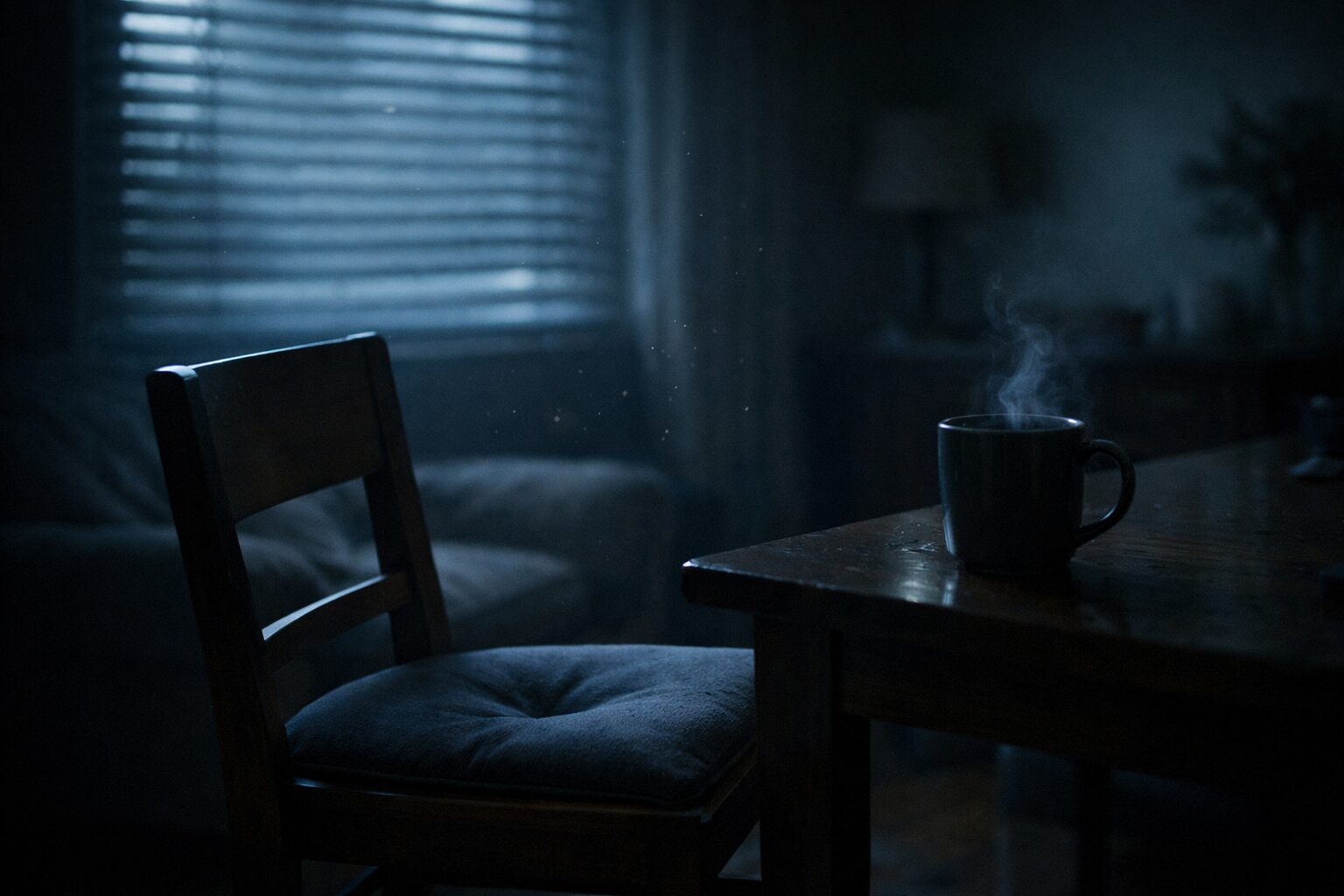
I placed the pie on the narrow console table and rubbed my palms together without knowing why. It had nothing to do with the weather. The windows were shut but not overly; the smell of coffee sat warm on the air, and a thin line of steam curled out from a mug near the sink. Still, a weight pressed behind my breastbone. The silence wasnt empty so much as intact, like a pane of glass youre afraid to knock against.
There was an empty chair at the head of the little table, the simple wooden one with the straight back and the seat cushion that never quite fit its corners. It was pulled out a hands width, the way people leave a space when they know someone is coming right back. I caught myself staring and then looking away, my eyes snapping to the clock on the wall. It ticked with a sound too large for its size.
Its a thing I dont talk about much because it lives behind so many smaller excuses—the tiredness, the sore throat, the way noise sometimes runs itself together until its only hum. I dont see things and I dont hear voices. Its just that sometimes a place feels like its already decided something before the people inside have. And standing there in my cousins apartment with the blinds striping the far wall, I knew the chair wasnt simply empty. It held a shape I couldnt see, as if heat had left it a moment ago and the cushion had been slow to rise. The impulse came sudden and small—to put my fingers to the fabric and find it warm.
I didnt touch it. My hand hovered and fell back to my side. The chair tugged at my attention every few seconds, a magnet buried under a tablecloth. I felt something attached to it, or maybe I attached something to it just to make sense: the grit of grief caught at the edges of my tongue, the cold urgency of a phone buzzing again and again, the flicker of someone moving through a kitchen in the dark only by memory. The room didnt just have weight; it had direction, and all of it pointed at that exact place at the table.
I heard the bathroom fan give its thin whine and then cut off. Water rattled in the pipes and stopped. My cousin stepped out from the hallway, wiping her hands on a dish towel. She saw me and smiled with only half her face, the other part still somewhere else. We hugged without words. The towel left a faint damp rectangle against my shoulder. Youre early, she said, barely above ordinary.
Traffic was good, I said, though there hadnt been any to speak of at all. I gestured to the pie, shrugged. She nodded as if wed both agreed to something more binding, then went to the sink and turned the mug so its handle faced the other way. We didnt say anything about the chair. Neither of us sat down. It would have been the most natural thing in the world to take our places, but the room didnt allow it. We loitered at the edges, as if our weight might crack the surface of it.
Others arrived in drifts. Shoes stacked like bricks near the door. Coats took up the rack one by one. People kissed cheeks and pressed palms silently. I saw my aunt smooth the front of her sweater three times in a row and then decide to sit halfway on the arm of the sofa like a child sneaking cake. Eyes twitched toward the table, ricocheted off the empty space at its end, came back to rest on nothing in particular. Someone set a bowl of salad down too softly. The serving spoon clinked once and then stayed still. I realized I was holding my breath and let it go through my nose instead, careful not to disturb anything I didnt understand.
The chair waited. Thats the only way to say it. It waited and the room waited with it. I could almost feel the angle of it, slightly turned from the table, the front leg catching in the low nap of the rug. In my mouth the word formed and unformed: dont. Dont move it. Dont fill that space. Dont name it yet.
When someone finally spoke, it was with the same careful softness you use to light a candle in a draft. My cousin stood with both hands flat on the back of a dining chair that was not the one at the head of the table. Her knuckles pressed white. Her voice found the room and set itself down in it. Moms gone, she said.
The words didnt break anything so much as answer it. A murmur rose without language inside my chest, the way a hallway grows louder a second before a door opens. My aunts hand went to her mouth and stayed there. Someone made a sound like a shoe pulled out of mud and sat. The light through the blinds went from orange to the low gray of a room that stops pretending its day. No one moved toward the head of the table.
I didnt ask when or how. The sensation that had been sitting on my ribs lifted a little, only to settle more evenly across the rest of me, like a blanket tugged flat. The empty place held its shape with a confidence I found indecent. I could picture my aunt in that chair so clearly that it crowded the edges of the vision—the way she always smoothed the same crease on the same napkin; how she picked, without fail, the heel of the bread; how she draped her cardigan over the back of the chair even if she was cold. I had the ridiculous urge to cover the seat with a dish towel as a kind of promise, or a compromise.
We did the small things that people do because there arent any large things left to do. We poured coffee no one finished. We cut a pie no one asked for. We cleared plates that had never been used and washed them anyway because it felt good to have a task with edges. Someone reached for the empty chair at one point, two fingers under its top rail, and then let go without remarking why. The legs had caught a little on the rug, just enough resistance to be noticed, not enough to insist on anything.
At some point, the room found its voice again in low threads: stories braided quietly, orders made for food no one wanted, the practiced math of who would stay the night and who would come back in the morning. My cousin sat, finally, at the side of the table, and I slid into the chair across from her as if wed been there the whole time. Between us, the head of the table remained unoccupied. The clock ticked past the hour and forgot to ring. The mug by the sink, the one Id noticed when I came in, had cooled to a color that looked like it knew something it couldnt say.
When the apartment started to empty itself in reverse—coats taken down, shoes pushed into heels with a small hop, the hush of people doing their best not to let the door click too hard—I stood with the pie tin wrapped in foil Id wrinkled without meaning to. I stepped back into the hallway. The lemon cleaner still lingered along with the faint wet-coat smell of other tenants. The elevator down the corridor blinked its floor number like a little pulse. I pressed the button and waited in a square of carpet where someones groceries had once leaked a small permanent circle.
The elevator arrived and I stepped in. The doors closed. It wasnt until the car began to move that I noticed the way the air changed, just slightly, as it had when I first paused at the rugs edge. It was a gentle settling, like a hand placed on top of a book to mark a page. The tin in my hands grew heavier by nothing you could measure. There was a corner of the elevator where a tiny bow in the wood paneling caught the light, and I had the brief, stupid thought that if I looked away and looked back, Id see the impression of someones shoulder leaning there. I kept my eyes on the descending numbers. The car hummed through seven, six, five.
I stepped out into the lobby. The chair by the front window, the one meant for waiting on rideshares or for catching your breath when youre carrying too many bags, was pulled slightly out of line with its twin. It wasnt much, the kind of thing any breeze could have done if the building had any to spare. The cushion was flattened, slow to rise. I passed it and didnt touch it. The soft heaviness stayed beside me in a way that didnt quite feel like following and didnt quite feel like coincidence; it felt, more than anything, like arrival, like something that had gone down in one room was waiting, patient and unchanged, in another.
By the time I unlocked my own door and set the tin on the counter, the apartment had its usual smells and its usual sounds. A neighbors television burbled behind the wall like water. The radiator let out a single patient sigh. But the dining chair near the window—not pulled out, not touched since that morning—had shifted somehow into the smallest angle off square, a sliver of space facing into the room as if to make room for a body that hadnt come in yet. The air above it felt pressed in, the cushions fabric faintly creased where no one had sat. I stood and watched it a long time, held precisely where the heaviness wanted me, until the refrigerator motor clicked on and the hum made everything sound the way it had before.