The Locked Trunk Contained a Map of Tomorrow’s Fire
The attic of the county museum has its own weather. Even on clear days a dust of light hangs from the rafters like fog, sifting through wheel spokes and the shoulders of headless mannequins. We were up there on a Wednesday because the new donations wouldn’t stop coming: grocery boxes of family Bibles, a crate of bent church fans, a stack of framed portraits with clouded glass. The space smelled like old paper and winter apples, the curled paint on the dormer window throwing off a faint chemical sweetness in the sun. Eleanor claimed the light was best at that hour, the undersides of things lit without glare, and she worked by that belief as if it were a rule. We called down measurements and accession numbers to Marta, who typed them into a database with haloed patience. We told stories like we always did—whose aunt kept her gas money in a mayonnaise jar, which farmhouse had a cherry wood banister people used to slide down in Sunday clothes. We were ordinary and slow and exact the way museums require.
I had my arms full of spool drawers when I found the trunk. It had been pushed against the eave behind a rack of school band jackets, a low sailor’s thing reinforced at the corners with greened brass. A name was tied to the handle on a faded paper tag: A. Merriweather, Stationer. The leather strap had dried to a hard ripple; the lock’s tongue looked like something pried from a lobster. I pointed it out to Cal, who came up from the workroom with his ring of old keys. “That one’s been up here since before my time,” he said, which, for Cal, was saying decades. The tag on the rafter joist behind it read 1989 in blue grease pencil. Someone had looped twine through the hinge as if just to be sure.
It took three tries to find a key that slipped home and turned. When the hasp lifted, it made a small satisfied breath like a bellows brought to life. I half expected to see bolts of ribbon or guest book blanks, some pale stationary logic that explained the name on the tag. Instead, there was only a single object, carefully wrapped in tissue as clear and crisp as if it had been ironed that morning. I remember we laughed—not cruelly, not even oddly—just that little private laugh you make when old things present themselves without dust. It felt like a mistake had been preserved and we were the mistake it meant to correct.
I slid the packet out. The paper below wasn’t the yellowed bond of clerk’s letters. It was heavy and white with a faint tooth, the kind of cotton rag Marta likes to hold up to the light to divine watermarks. It had been folded so exactly that the edges felt like they were machined. On the outer fold, in a hand without tremor, someone had written: Municipal—Saturday, November 5, 2:20–2:45 a.m. We all stared at the date because it was still three days away. The black of the ink wasn’t browned or feathered. It sat on the paper like small, patient shadows.
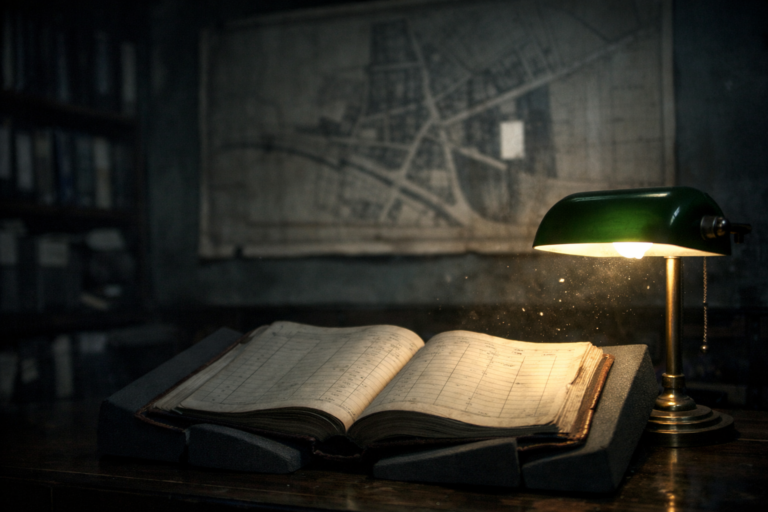
Inside was the town as I know it when I walk it before the hardware opens: the grid of Linden, Court, and Third, the less certain drift of Mill behind the rail spur. Buildings labeled in neat caps. The courthouse was a square block with shaded steps, the library a long bar with an ornamented cornice. The museum—a simple rectangle on Elm—wore a dot that I assume someone meant as pride. On the corner of Linden and Court there was a tiny flame drawn, no more than three crescents meeting at a wick, colored in with a wash of ochre. To its side, a small notation had been made as if someone had not wanted to write it but felt compelled: service alley behind Pruett’s Hardware.
We sat on crate lids like schoolchildren and tried to locate our breath. Eleanor touched the corner of the drawing with her gloved finger, very gentle, as though even heat might hurt it. “That line weight,” she said, not meaning anything except that it was beautiful and harsh. Jules, the college intern, took a photo of the corner with his phone and bit the inside of his cheek the way he does when he’s thinking. Marta said it straight: “Who made this and when.” She tried to find a watermark in the window but the afternoon had turned. Light was a slender thing in the attic, and it refused to help. Someone—I can’t remember who because we all felt the impulse at once—checked the ledger to see when the trunk had been brought in. In 1989 a B. Denman had recorded it, under Donations of Uncatalogued Stationery, contents unspecified, provenance: Judge Haskell’s clerk, after the flood of 1966. The key had been kept with Cal for safekeeping because the hasp was considered delicate. There was a tidy circle of bureaucracy around a secret no one had been in a hurry to open.
That it could be a prank was everyone’s first mercy. We stepped into it with relief. But the drawing resisted us where pranks often welcome finding. It was not photocopied. It was not printed on office stock. It did not mimic our letterhead or use the types of pen lines people prefer when they want to be caught. The corners had that blunt softness papers get after time under something warm. Even its folds held a memory. And there were the odd details that refused to be old. The angled parking lines on Court had only been re-striped this July after a council meeting that took three hours and changed no one’s mind. They were drawn here, angled just so. The new railing along the post office ramp, with its awkward meets because the fabricated section had been measured an inch too short, had been put in place last spring; here it was, kinked in the drawing like a small apology. I found the little rectangles of planters the Garden Club set out last week, tulip bulbs still in sacks under someone’s kitchen sink. The mural of the fox on the back wall of Husk & Grain was represented by a cleverly shaded field of crosshatching that suggested only its look if you already knew it. Jules, who bikes everywhere, pointed out the symbol for the charging station in front of the bank, a thing our great-greats could not have imagined. There was even a dotted line, faint as breath, that seemed to mark the temporary crowd barrier for the Harvest Walk scheduled for Saturday afternoon.
We brought the map downstairs because the attic had begun to feel as if it were breathing with us. We spread it on an acid-free board beneath mylar. People drifted in on rumor—Chet, the retired fire chief who volunteers when we do school groups; Ruth, who answers the phones when Marta has to do grant paperwork; even a council member who said she was at lunch nearby and had “popped in” which no one believed. Chet stood over the little painted flame. “That alley,” he said, tapping the crease beside it through his glove. “We had an issue back there years ago with a lint trap vent. The laundromat backed up to Pruett’s gets sloppy.” He named it without drama. “If it’s a joke it’s not a funny one. You should call the current chief and let him laugh at you from a safer place.” We did. He sent a crew by to look around the alley. They tested outlets and peered at conduit boxes and found nothing but a smell of detergent and the oil-darkened ovals people leave when they lean with the same hand on the same brick. They thanked us, told us to get some sleep, and said a man with his hair on fire had come through town once every time the railroad changed schedules, so maybe this was just the new timetable.
I told myself I would leave it at that. The map went into a flat file in the workroom with a pencil note on the sleeve—Do Not Exhibit—Because of Content—Pending Board Review, which made us sound like we were important enough to be sued. I locked the file and slid the key into the top drawer where we keep microspatulas and cotton gloves. The afternoon drained itself into early evening as if there were a leak we could not find. I went home. I made myself a sandwich. I watched the baseball highlights and pretended I was a person other than the one who had unfolded a Saturday that wasn’t here yet.
By one, I was awake again. You live in a town long enough the hours become theirs; one a.m. belongs to the trains, the slack-bell ring through the cut and the headlights on the siding. Two belongs to the machines that clean restaurants and to the men who deliver bread. I had left the dehumidifiers running up at the museum because the weather was damp, and I told myself I was just going to check on them and come right back. The square was the kind of quiet one earns. Oak leaves skittered upriver though there is no river closer than three miles. If I had known what else I was going to look at I might have gone another way, but we take the streets we know. I came into view of Linden and Court and felt the old unease in the new shape of it.
I smelled it before I saw it, the sweetness of warm insulation on a cold night, like a toaster taken to a field. The laundromat’s neon clock in the window glowed 2:28 in a red more persuasive than the moon. There was a sound like someone had dropped a bar of copper in a dry sink. Then, behind Pruett’s where the alley narrows, a small orange thing lifted itself up on the lip of brick, the way a lighter’s first try catches and considers. It was not dramatic and it did not try to be. It was exactly the size the map had suggested, though I cannot tell you how big that was. I said the address out loud as I dialed, then I said it again. I watched one filament thin as hair leap from the transformer box like a gymnast dismounting badly and touch a cardboard sleeve left near the dumpster. It was 2:30 when the first siren bounced off the storefront windows and turned the alley’s wet air into the kind of show a whole town used to wake up for when we were smaller and less certain of the difference between alarm and entertainment.
The engines came patient and quick both, an art I have never understood. Steam rose from the hose line as it filled; somebody in turnout gear swung it into a small arc that sketched, with awful, neat humor, the curve on the map where the hydrant’s reach had been worked in as a strap of blue pencil. The emergency light mounted high on the post office porch stuttered and threw a triangular shadow exactly where the shaded wedge had been drawn on the map’s corner. The flame was hardly anything by then. You could have sent a child out with a flour sifter and he would have put the thing down without speaking. Still, the scorched shape left on the red brick when it was over reminded me of someone’s fingertip pressed too long to paper, darkened to the exact measure named by a neat mind. A man with a clipboard asked me why I had been here, and I told him about a bad dream and a damp museum and a sense of duty I was ashamed to admit. He wrote what he needed and let the rest be air between people.
Back in the workroom, the map lay where I had left it. The mylar was cool as if it had spent the day by open water. The drawn flame did not seem bigger or smaller. The pencil trace of the hydrant’s circle, the crosshatch of the alley’s shade, were as they had been. I rubbed my thumbnail absentmindedly on a fleck of adhesive on the tabletop and realized I was waiting for the paper to warm in my hands or for the ink to run a little in sympathy with the steam outside. It did nothing. Objects are good at the dignity we cannot always find.
By morning everyone knew. The newspaper ran it under a headline that said only Small Fire Contained Downtown, though the second paragraph mentioned that the museum had alerted the department after receiving an “unusual map” that seemed to note the location before the event. People came in after lunch and before school let out. They said things like I never go that way and I always park there and Do you think that trunk wanted to be helpful or did it want to be opened so it could finally be what it was. We don’t exhibit things like that often because our insurance company does not have a box for Premonitory Paper. Still, we laid the map out for a few hours each afternoon that week so the town could look at it and try its voice out against it. Ruth set a little rope barrier like at a bank between the map and the floor, which felt expensive and wrong all at once. People leaned on it anyway. A boy traced the little painted flame in the air and then pressed his palm against his own sternum as if checking whether something matched.
Arguments happened the way arguments do when there isn’t a place to put them. The council member said the trunk had warned us and we had done the right thing. Chet said the trunk had nothing to do with it and we had been saved by routine inspection and luck. A woman in a green cardigan whispered that the thing in the trunk had caused what it pictured the way an address on an envelope summons a person to the door, and she asked if I still had the key. Jules asked if he could check the watermark again, and when the light was better we saw a small oval impressed into the page near the fold that looked like a shield or a pear, but it was too small and too shy to name. Cal returned the trunk to the eave even though it was empty and then brought it down again an hour later because he said it made the rafters feel crowded. He put the lock back on with the trembling gentleness of a man who knows when an object wants the form of itself more than the ease of being used.
There is no moral that fits. The insurance adjuster will write it up as an electrical short at a sign transformer. The newscaster will marvel, in the way they practice, at the alignment of things that otherwise do not speak to each other. We live with our quiet and we don’t mind. The map still sits in a flat drawer in the workroom, third down, under the place we keep the photo corners and a broken set of glass negatives of a family whose eyes are so tender you want to apologize to the dead. We have written a soft instruction on the sleeve—Consult With Staff Before Viewing—not because the paper is fragile (though it is) but because what it holds burns a little even when it does not. The trunk remains unburned, if that is what you want to know, and it is a kind of gallantry that it does.
Sometimes, when the museum is closed and the attic’s fan ticks with the slow decisiveness of a grandfather clock, I think I hear a fainter sound beneath it, the lift and set of a page crease remembering how to lie down. It is probably the pipes or a bird still awake. The drawers in the workroom hum the way metal hums when it learns a temperature and keeps to it. People ask if we’re going to open the other old things now, if the town holds any more of its tomorrows wrapped in tissue. I tell them we are careful with locked things because locks are not always about keeping people out. If you come to see the map, you should bring the person you are when you walk home in the dark. And when you are tempted to lift a hasp in a place that has lasted longer than you, ask yourself whether you want what waits quietly inside to remember you next time the town draws itself again.