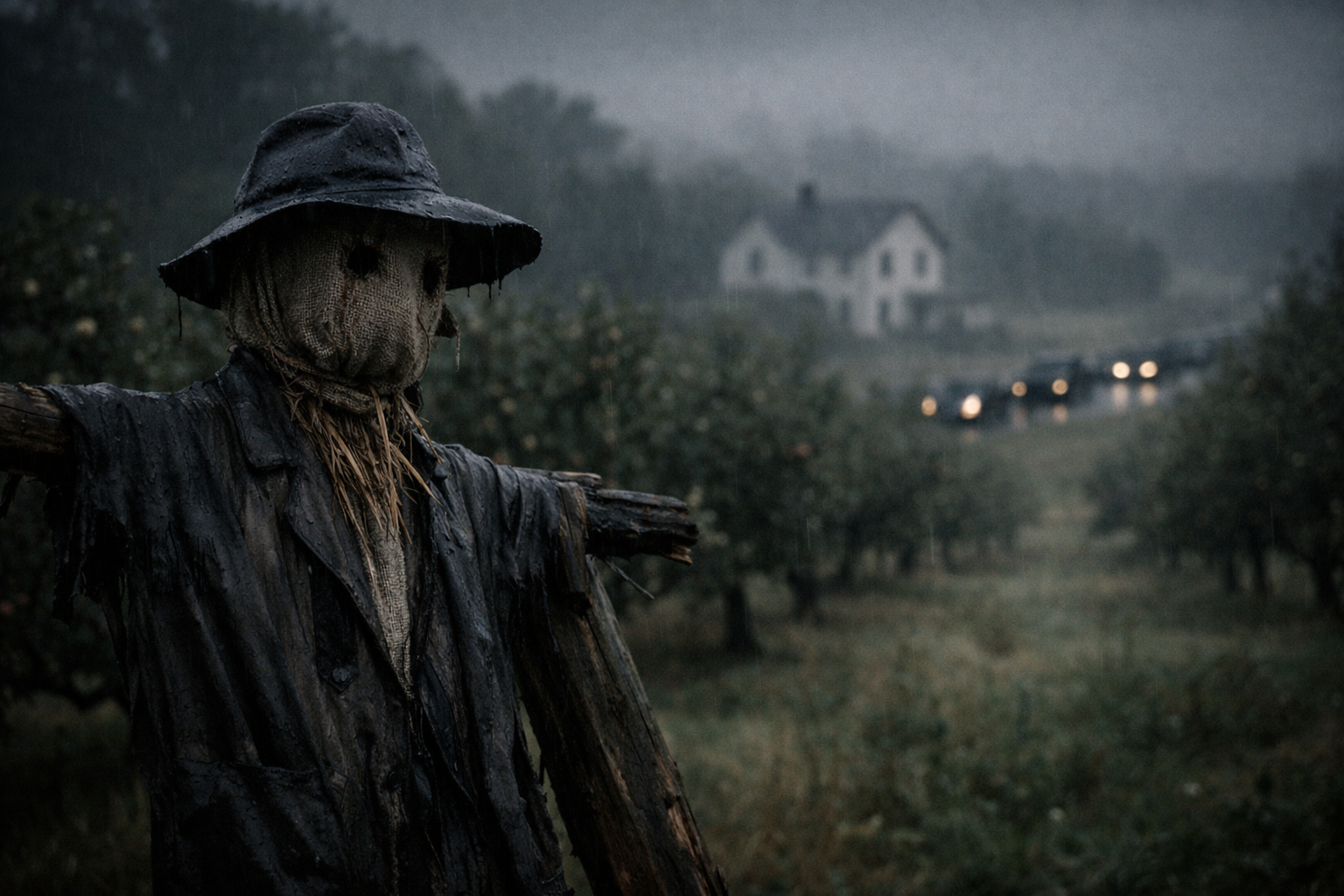
The Orchard Scarecrow Moved Only During Funerals
I grew up in a small white house with a porch that leaned toward the orchard like it was listening. The orchard sat low in the bowl of the valley, rows of apple trees pitched on a slow slope that led toward the river and the county road. In winter, the trees threw bony shadows on the snow and the wind blew straight through the hedgerow into our chimney. Spring fattened the branches with tight green fists and white foam of blossoms, bees lifting in a sound like far electricity. Summer was heavy, humid, with fruit under leaves like polished lanterns. Autumn came in with ladders and rakes, and the cider press sang its sweet, wet saw of work.
At the far edge, where the trees ended and the field fell into ditchweed and cattails, the scarecrow had stood inside of my memory the way telephone poles and mailboxes do—more a fact than an object. It wore an old chore coat gone the color of wheat dust, a folded hat with a dark ring of sweat like an eclipse, and a scarf someone had tied once and forgotten. Sometimes the coat sagged with rain. Sometimes, in frost, it shone. Crows would sit a few trees in and talk about it. People would drive by without seeing it. It stood on its post with the same good posture as our minister, arms out like a crossed gate.
On fair afternoons, I could soap plates in the enamel sink and look through the window over the orchard without thinking, the scarecrow at the corner of my eye like a comma in a sentence I’d already read. It faced mostly toward the southeast, toward the low knoll and the creek beyond. There was a steadiness to it. If you went away for a week and came back, the same tilt, the same hatslope, the same splay of sleeves—like a photograph hung on the wall.
People in town are good at noticing the slight difference in a thing they think of as steady. Maybe that is what you learn from looking at clouds to figure your hay or from reading weather off leaves. I cannot tell you who said it first, or whether I started watching for it because I’d heard it said, but at some point someone noticed the scarecrow’s posture wasn’t as fixed as we’d believed. Not every day. Just on some days. The days the church bell did not stop after one ring but kept tolling, low and slow, at intervals that made your jaw tense. The days the flag went to half and the mirror in the parlor got covered.
That was the wrong thing, the detail that tilted everyone’s heads the way a sound out of place does: on a funeral day, the orchard scarecrow would be standing a little different than it had the night before. If it had looked to the creek, it would be squared to the road. If its hat brim had shaded the shoulder of the next tree, now it would seem to stare down the ditch at the bridge. There was no one to be seen in the field. On such days the pickers stayed home, the tractors sat with their exhaust caps neat and closed, and the gate by the loading dock had a chain around it so folks wouldn’t be tempted to cut through. The wakes were held with the casket closed more often than not, people telling themselves it was a matter of decency or hospital rules; what I remember is how quiet those rooms were, how little anyone wanted to speak. Out among the apple rows, even the sparrows seemed to mind themselves.
It was talked about more at the hardware store than at the diner. At the dinner table, maybe once, if at all. You might hear, in a low way, “Did you notice,” and the person you asked would either nod, or say no and make that be the end of it. No one said it too plain, the way folks avoid naming something you could end up tethered to. And because on a funeral day there is a good deal to be done—food to be carried, cars to be organized, black cloth to be found—it could be put off as coincidence. Wind. Settling. A loose nail at the base of the post.
Except we didn’t have wind on those days, except sometimes a thin fall of rain or a heat so close even the dogs lay still. I know, because I started watching. From my kitchen window in the morning before the bell, the scarecrow would be itself, pitched a little lopsided toward the southeast. By late afternoon, while people stood outside the church and looked at one another’s black shoes, I would pass the window on my way to the back room for more coffee and the figure would be plain on the diagonal, squared toward the county road as if it had turned its face to catch the procession out of the corner of its stitched grin.
Over the years, I learned that I was not the only one keeping a private ledger. A boy who mowed grass by the cemetery said he had seen it lined up with the gate when he looked from the rise; the woman at the post office said the scarf once hung forward as if in a wind that was not in town. A retired man across from the grange told me he’d driven by after a burial and found the scarecrow looking up his lane, and had to pull over and sit until his hands were good again on the wheel. Stories came slow, with that same matter-of-factness old farmers have when they tell you about a blight or a good bloom—no flourish, just the detail. The pattern was not every single time. It was often enough that, when the bell began, I would feel the sense of someone clearing their throat in the other room.
What troubled people most was when it seemed like the figure didn’t just turn in general but took aim. The road into town curves across the flats, then hooks up past the old school and goes left along the orchard before climbing toward the cemetery hill. If the procession went that way, folks told me, the scarecrow would be faced not to the road but to where the road would be in a hundred yards, as if looking ahead. If the preacher decided instead to lead cars along the river road because the mud was bad on the hill, the coat would be bellied out toward the river bank. It was as though it attended without moving, without having to move. That was the word someone used once in my hearing—attended—and I did not like it.
On rainy days, the phenomenon felt closer. Rain here is not dramatic. It is a hush. It pushes sound down into the ground. One funeral day like that, a gray sheet pulled over the valley and tightened, and we did as we always do: left crockpots and cakes and jars of pickles at the bereaved house, found our umbrellas, lined our cars. I remember the church crowded, umbrellas collecting on the porch like dark mushrooms. The casket was closed. The minister’s voice seemed to come from under the floorboards, and when it ended, no one moved right away. Then we rose and filed out to follow the hearse.
As the procession rounded the orchard bend, wipers ticking, we all turned our faces in the same direction. It is a reflex. And there it was, the scarecrow’s hat brim slick as a duck’s back with the rain. But it wasn’t faced to the road. It was set hard toward the white house up the lane to the north, away from the line of cars, away from the church hill. If you grew up here, you knew that house by the pattern of ivy on its porch posts, by the way the upstairs curtains were always drawn. Some of us looked. Some of us did not.
I had dropped food at that house two hours before, not knowing why the casseroles were piling on that stoop. We were burying a man who had been ill a long while, and the house up the lane was not his. Word had traveled poorly. The rain, the quiet, the closeness of people—all that swallows talk. It was only when the hearse’s lights vanished into the trees that someone said, in the hum of engines and rain, that the woman from the white house had died in her sleep that very morning. Her daughter had come to find her before the bell ever started, and there had been a quiet at that house since then that felt like wool pulled over furniture. The casket for her, if there was to be one, would be closed too; that is what the woman at the post office said later, though she did not say why.
It is something to stand in a parlor with damp sleeves, to smell wool and rain and the faint sweetness of lilacs from a vase, and to feel every voice damped down to the pitch of a library, and to glance past the rim of a curtain and see a figure in the gray distance glaring, or seeming to glare, right at your windows. I say it now and it sounds like I am dressing it up. It was plainer than that. The hat was a tilt, the coat was a sway, the whole pose a sliver different than yesterday. A floorboard complained in that parlor though no one had stepped on it. The clock on the shelf had stopped at eleven-thirteen and remained so, a small hand pointing at the fact for the rest of the afternoon. No one mentioned the orchard. Everyone could feel it on their faces, wet with rain.
That day turned the talk from coincidence to something softer and less easy to say. The scarecrow was not ours to scold. It was not ours to fix. In town the next week, someone pulled the scarf off and someone else tied it differently and the coat was put to rights, and after that another set of hands came along and replaced the rotting post, and then once more in June the whole thing was taken down and fresh straw stuffed into the sleeves and the hat knocked free of mildew and set straight once again. The farmers said it was for the birds. The children said it was to make it uglier. I watched from my porch, hands in my pockets, not wanting to be the one to ask what they had seen when they were up close to its face.
It did not matter. On the next burial day—quiet, hot enough that the asphalt let off a smell—I passed the kitchen and saw the new scarecrow had found the same habit. It had the cleanest lines of a new-stitched doll and yet there it was, by four in the afternoon, looking not to the creek but straight to where the road makes its elbow to the cemetery, as if to catch the first car past the orchard corner. Another year, they put a store-bought head on it with a painted smile, and that one turned as well, smile aimed at a farmhouse where a widower sat alone on his porch for the last time. The pattern held as true and as loose as rain—sometimes missing, often present, never enough to be called a rule, always enough to be called known.
I live still at the edge of those rows. On days when there is a funeral, I do not hang wash on the line. Out of respect, yes, but also because it feels like being too visible. We kept away from the field’s margin on those days, even the teenagers who thought nothing of jumping the ditch at night. If a ball rolled from a child’s hand and went down among the trees, it stayed there until the next. The good paths into the orchard—the ones people cut and the ones the deer cut—lost their track for a day. Cars went around longer than usual to avoid the curve by the scarecrow. No one made a rule to do that. Habit is enough. Habit and the fact that no explanation has ever been any use.
Folklore is a word people use when they want to put a skin of harmlessness over a thing. In the coffee line at the church, someone will say, “Old stories,” and shrug. With this, people do not shrug. They lower their voice and lean in and tell you their piece of it and then lean back as if to separate. We do not say haunting. We say the orchard has a way. We say the field minds the rituals we keep, and maybe keeps its own. A thing like that rides along in a place for a long time and does not need you to make sense of it to keep itself going.
Some evenings when the light is slant and patient and I have a hand in the dishwater and a hand on the sill, I look out and think that the scarecrow’s head is a trifle to the left or a shade more bowed and then tell myself I am borrowing trouble. There are summer nights the house inhales so deeply you swear it rearranges its bones, and in the quiet after the last train goes through, there is a faint weight on the stair that could be heat, could be an old board thinking about giving up. On mornings the bell tolls, I set an extra place on the counter for a while and lay it aside again, and if I must go past the orchard, I keep my eyes on the puddles in the ruts and not on the far corner where a coat, old or new, may have found its fresh angle.
I do not say this is anything more than what we have made of it when we try to live with it: the habit of walking a little wider around the ditch on a day such as that, of talking softer in rooms with covered mirrors, of not peering too long through the curtains when tires slow out on the county road and the line of black cars bends like a snake along the orchard’s edge. If the scarecrow attends, it has never been nearer than the field. If there is something else in it, it has kept to its corner. Still, on days when the church bell starts up and you can taste metal in the back of your mouth, I find myself washing the same plate twice, listening for footsteps that would never be made by anyone I can name, and choosing not to look at the far post at all.