The Numbers Station Began Counting Backward From My Age
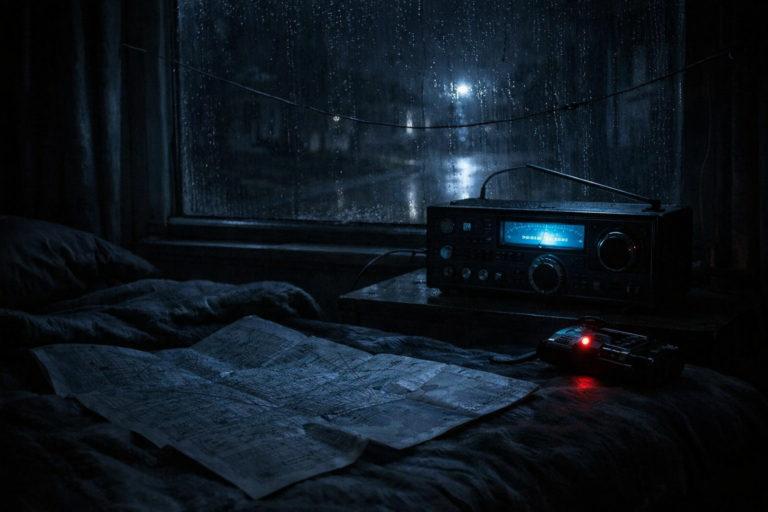
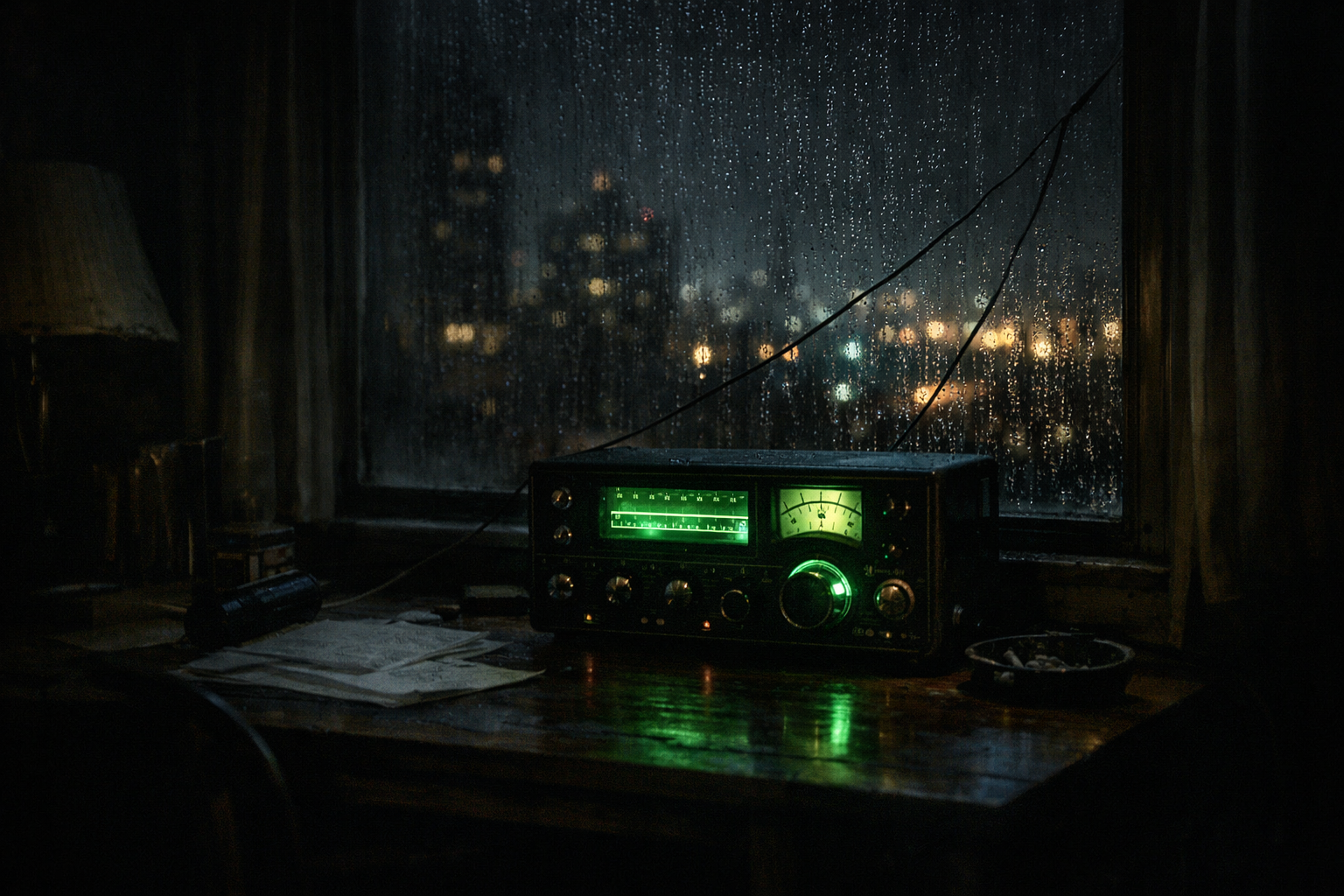
Nights go quiet at a certain depth, even this high up over the street. The radiator goes from clatter to a slow breathing, the hallway outside my door quits its echo, and the buses sigh at the corner like animals sleeping in a pen. That’s when I set the receiver on, just a small slab of black and amber light on the desk by the window, and let the whip antenna lean toward the glass. I keep a notebook and a pencil there. I write times. I write things that are mostly static and guesses. Tuning shortwave is the only thing I’ve found that doesn’t ask anything of me. You listen, and you accept what comes.
I know where the nets gather and where the weather rolls and where the lonely old men confirm one another in measured phonetics. I know the atonal hum of beacons and the gummy whine of a failing power supply somewhere two continents away. There are stations I tune the way other people might check locks before bed. It’s not that I expect to hear something different; the sameness is the part that settles me. The city turns to hiss and my head smooths out.
Numbers stations, if they arrive, are like someone calling your name in a crowded place. Not because they mean anything but because they feel as if they should. I’ve logged a handful that show up like commuters, on the dot, with the same clipped voice and the same introduction tones. I know one that lopes through five-number groups in a woman’s schoolteacher cadence, zeroes shaped solid and rounded like pebbles in the mouth. It’s always impersonal, and that, too, is a comfort. A machine of a voice arranging the abstract into order and then leaving you alone.
It was after two on a weeknight when the air had that muffled quality you get after rain. My notebook says 02:11. I was sliding past a murky racket of heterodynes when a clean carrier rose out of it, as sudden and smooth as sheet glass. I knew the timbre. There was a long beat of nothing, then the tone they always use, that flat pip like an elevator arriving, and then her. The same woman, only this time she didn’t open on five-digit blocks. She said a number and then paused: eighty. A breath. Seventy-nine. Another breath. It took a moment to register that she was going backward.
I’d heard tests ascend now and then. You catch all kinds of odd rehearsals if you sit up with this stuff long enough. But the cadence of this was different, deliberate, slowed by a patient drag. Numbers fell in reverse like guests leaving a party one by one. When she reached thirty-seven she stopped. That was my age, and there was no reason for the pause to press perfectly against me the way it did, but the room pulled tight around it anyway. I remember holding the pencil above the paper as if the air would tell me what to do with my hand. The pause went on a fraction longer than any of the others. Then: thirty-six. Thirty-five. It was as small a thing as a beat of silence, and somehow it found me exactly.
My log page shows a scuff at that line where the pencil dragged. I wrote “backward count—pause @ 37,” as if naming it would diminish the way it felt in the chest. The microwave clock on the counter was stuck at its permanent faint emerald: 2:12. The voice had returned to its even metronome, numbers dropping with a bias toward certainty, as if the rightness of each had to be weighed before it could fall.
Somewhere after thirty the delivery changed. It might have been propagation, the way signals get scalloped and stretched by the sky; it might have been me leaning too close. But between numerals, she started supplying times, almost incidentally. Zero two thirteen, she said, right as the digital minute flipped over on the oven. Thirty-one, she said, and then a word that got tangled in hiss and came free as something that could have been “station” or “stairwell” or “west.” I knew better than to trust my ear, and yet the apartment seemed to rearrange itself around each little possible word.
By the window, the alley breathed. A late train fluted far off, and a siren rolled its edges around the block. The voice went on, and in its weave came things that felt too small to belong to an anonymous transmitter laboring over a far horizon: a street name I swear I only ever see painted on the side of the bus shelter down the block; a cardinal direction said so idly that I turned toward the wall it described. Between twenty-nine and twenty-eight: zero two fourteen. Between twenty-seven and twenty-six: “platform,” sliced clean out of a brassy squeal that could have been any two stations grinding against each other. She sounded like a person who’d never had to shout in her life.
I took the antenna away from the glass and then pushed it back and then brought the radio nearer the drainpipe. I was making offerings to nothing. The room had that sense you get when you’ve said something aloud and the air has yet to decide what to do with it. The count did not falter. Twenty-two. Twenty-one. The radiator put its soft ping exactly in the blank space before twenty. The brake-breath of a bus stopped at the corner during nineteen in a way that felt arranged and then ashamed of feeling arranged.
At fifteen, I stopped trying to change anything. At ten, the pauses stretched and cooled. Each numeral arrived alone, balanced on the lip of the speaker. Nine. The hallway bulb outside my door flickered once, a brief amp-dip you could explain to yourself if you needed to. Eight. In the long wait before seven my own pulse made a woolen sound in my ears. The woman upstairs crossed her floor, and each footfall installed itself between syllables like a metronome for a different song.
Seven. I said it with her in a whisper, ashamed of myself even alone. Six. I turned the volume down until the voice barely skimmed along the bottom of everything else. Through the wall, a neighbor dropped a pan. Five. The numeral hung there so long it went from sound to object. My microwave clock said 02:18 and suddenly seemed very far away.
Four. There was a burr in the word now, as if the recording had acquired lungs. Three. I leaned forward until my forehead touched the cool of the desk and the radio’s warmth ran like a ribbon under my skin. Two. The pause after two was as long as any corridor I’ve ever walked in a dream. In the breath after it, before any syllable a person should be expecting from a count, she said a single word in a way that took language out of it and left only address. You.
I didn’t breathe. The carrier was there, untroubled, its thin electric seam running under the apartment’s old bones. There should have been one. There should have been zero. Instead there was a clipped sound like someone lifting a mic from their mouth, then the flatness of a transmitter before it decides whether to die. I reached for the dial as if I could bring it back by touching it, and my palm left a print of heat on the plastic and nothing else.
I ran the band. I caught echoes and ghosts; I pulled the antenna in and out like a fisherman who no longer believes the river contains fish. Two frequencies up, the same voice was there again, smaller, like a version of her one room over, already in the teens as if nothing had interrupted. The signal dropped away when I breathed on it. I tried one of those online streams of someone else’s radio in a country whose night had already ended. Their waterfall showed a dim comb of transmissions and a whole clean place where mine was. It was as if the station were leaning in at my window only.
I stood by the glass. The city did what it always does: it sent a bus past and let a couple pass under a streetlamp halfway through an argument and bent a flyer into the gutter before thinking better of it. My reflection was pale and long and someone else’s. Behind me, that tidy voice found the edge of the room again and said zero two twenty and then thirty-four and moved back down as if nothing strange had occurred. I returned to the chair because there was nowhere else to return to.
After that, I started to write things I had never written in the log. I wrote which way the bedroom door stuck. I wrote whether the hallway light had been on when I came back from the bathroom. I wrote if the radiator had exhaled during twelve. It felt superstitious and childish and honest. The station would walk itself lower, skip to a new frequency the way a person might step to the other side of a squeaky floorboard, and go on. At eleven, the cadence hardened; each number had a question mark you couldn’t hear and could feel. At eight, my neighbor slammed a cupboard and apologized through the wall to no one. At five, the light outside buzzed awake and died again, a fly in winter. At three, the carrier pressed itself flat and thin as frost on the speaker. My hands shook as if I had run somewhere.
Zero never arrived. That became a kind of rule I couldn’t unlearn. The first night it left me at you like a fingertip against my ear. Other nights, there was something like a syllable at the end of one that I couldn’t keep hold of the second after I heard it: a click, a breath, a room swallowing. I kept listening because my body had remembered how; because the count would sometimes begin at an entirely different height—seventy-two on a Tuesday, twenty-nine on a Sunday afternoon—and always slow again at thirty-seven with a little hitch the way a person does when they don’t mean to say anything at all.
I tried to be reasonable about it. I hung a wire out the alley window to a stubborn nail. I wrote cloud cover and wind direction and which airshaft made what hum. None of it mattered. On some weeks the bands ran clean and dull and the apartment lay down into ordinary noise again. On others I would be sunk in a marine forecast and hear, off to the side, the tidy schoolteacher voice easing from fourteen to thirteen, as if she were pacing under the floorboards of someone else’s program, as patient as a drip.
There were words between numbers that made me ridiculous. Most could have been anything: overlapping dispatch, an airline call sign flattened by distance, my own brain obligingly filling in. Once, though, from by the sink, I heard “west window” in the same bland tone she used for nineteen, and for a while I stood there holding a damp towel and looking at the window everyone would call west though no one ever had reason to. Another time “zero two seventeen” met my oven timer’s chirp with such indifference it felt like mockery. It’s very strange to feel a faceless signal brush the wrong side of your life.
The last time I heard it with everything in me, I had decided not to listen at all. The radio was unplugged. The cord lay curled like a sleeping animal. Rain ticked the glass. Someone below practiced scales on a trumpet, neat and slow, the way a person teaches themselves to breathe better. I lay on the couch and let the building speak itself into whatever it needed to be. I rolled my head and looked toward the dark profile of the set on the desk because the habit of it lives in my neck now.
Something that knew the route back to me as well as I know where the volume knob is began where it must have last stopped. Four. It was more absence than present, like a picture coming up in a tray. Three. Each numeral had furniture in it, space for a person to stand. Two. The pause was so long I could have stood up and walked around it. I held my breath the way you do when you hear your name in a crowd. And then, soft as a thing that might never have left my throat, the same small word, exactly placed: you.
I sat up and it was only my room again, with rain on the glass and the after-image of the radio in my eyes and the absence of trumpets. By the time the windows went from black to a tired gray, I had my palm on the set’s cold flank. When I did plug it in, the band gave me drizzle and ham chatter and a tugboat whistle slipping from somewhere I would never see. The neat, clipped voice had gone to whatever field it walks when it isn’t here.
It returns when it likes. Sometimes it opens in the forties; sometimes it finds me already at nine and limps to four. It will sidestep up the dial in coy little kilohertz as if catching its own breath. I can’t trace it upstream to any mouth. Whoever keys it—if anyone does—knows nothing about a person in a city sitting by a west window with a pencil and a habit. Or else they know everything and it makes no difference. On nights when the building stills and lays its old bones down and the buses hold their breath at the light, the count noses back out of a place that shouldn’t be able to reach me and lingers, just long enough to be recognized, at thirty-seven before stepping neatly away. Last week I woke at 2:19 with that feeling of having been spoken to. The room held its air like a held thought. I said the next number into that held air, low, embarrassed. Outside, a woman laughed at something on her phone. I didn’t turn the radio on. I don’t always need the speaker to know where the pause is.