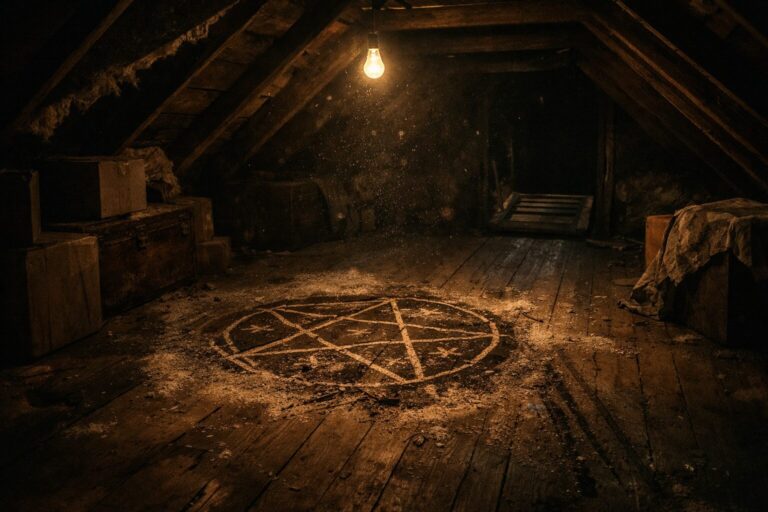
The Recorder Whispered Directions to the Attic
I set the little silver recorder on the hall table the way you might set down a glass of water, without thinking much about it. The table has been there since I was a kid, wedged against the wall under the framed seascape and directly beneath the square of the attic hatch. The house was settling into its evening noises: the baseboard heat making those small ticking pops, the refrigerator doing a tired hum in the kitchen, a faint rush of cars two streets over. It was early spring and rainy. The air carried that damp wood smell, a little sharp where the front door swelled against its frame and scraped the jamb.
It wasn’t my idea to make an EVP recording so much as a way to fill the slow, odd time that happens when you’re helping your mother sort a house you know by heart. I’d found the recorder in a drawer with dead batteries and old shopping lists, the same one I used to use for band practices. I put in a fresh pair and scrolled the menu like you do with something you found in a time capsule. I told my mother I was going to “see if Dad left any messages” and she rolled her eyes but smiled and went back to her crossword at the kitchen table.
I tried to do it right, as far as those things go. I turned off the TV and the radio. I stood in the living room doorway and said the date and time into the recorder, the name of the street, like it mattered to an empty room. I asked that if anyone could hear me, they could use my voice to answer or speak into the red dot of the machine on the hall table. I left ten seconds between questions, counting in my head. The hallway light was off; the only brightness was the slice from the kitchen and the orange rim of the stove clock. From where I stood, I could see the loop of the attic cord swaying slightly because the vent in the bathroom was on. The air smelled like lemon cleaner and old rugs.
My questions were nothing, really. “Is anyone here?” “Do you have a name?” “Are you connected to this house?” I asked if there was anything they wanted us to know, and I tried not to feel stupid. The house answered with itself: the threads of the carpet shifting under my feet, the flex of wood, the quiet of rooms that have held so many quiets they seem to store them in the corners.
I only recorded for maybe six minutes. When I stopped, the kitchen felt warmer. I sat on the bench by the hall table, pushed in my earbuds, and scrolled back to the start. It always sounds worse than you imagine, your own voice on a small device—thin and unsure. I listened through the first two questions and there was just my breath and the low hiss of the walls being walls. The third question—”Are you connected to this house?”—ended and I heard my own silence stretch out.
Then a voice I did not recognize came into that space, soft and close enough that I thought for a second someone had come up behind me. It was not my mother. It was not the high shush of the vent or tires on wet pavement. It was under my breath, not above it. “Up the hall,” it said, like you say something to someone you’ve lived with a long time. There was a tiny delay that I can’t explain—a pocket of blank—then, even quieter: “Pull the cord.”
I took one bud out and looked back toward the kitchen as if the sound had come from the doorway. “What?” my mother called. The house had that stopped feeling it gets in the instant a thunderstorm changes its mind. I didn’t answer her right away. I rewound a few seconds and listened again, this time holding my breath like you do when you’re trying to hear a word underwater. It said the same thing, with the same precision of where we were, as if it could see the cord and the hall and me. “Up the hall. Pull the cord.” The s was soft at the end of “cord,” as if the speaker was careful with breath, or used to being careful.
“Mom?” I called. She came to the doorway wiping her hands on a dish towel. I handed her one earbud, and we leaned shoulder to shoulder in the dim. I played the section and watched her face the way you do when you’re not sure what you want to see. She flinched, just slightly, then kept very still the second time it played. “That isn’t you,” she said into the quiet when it ended. I shook my head. “I didn’t say that.”
We listened again and I pressed the volume up one notch at a time until the little device ticked at the top. It wasn’t just the two lines. Under the hiss, if I let my mind step into it, were more scraps that seemed to come before and after, like a person giving directions in pieces. “Two steps…” was one. Then something that might have been “mind the nail.” I knew that phrase because my father always said it about the attic, a particular nail that punched through a rafter along the left side where the boards didn’t quite meet. He’d warn us even when we weren’t going up there. “Bring a light,” the recorder gave us, like a breath on the glass of a window. The sound of my own exhalation overlapped and made it hard to be certain.
“Your uncle used to call that ‘the crawlspace that eats men,’” my mother said finally with an odd attempt at a laugh. “He wouldn’t go up after that summer the fan fell.” She told me this the way she tells things she hasn’t brought up in years, as if we were simply sorting the house out loud. She said there had been bats once, and a dead one stuck like a leaf along the tar paper by the far gable. She said some nights, after my sister and I had gone to sleep, she’d hear a dragging sound above the hallway and prod your father until he sighed and said it was the squirrels until he got the soffits patched. “Remember when Christmas lights went missing for a whole year, and then turned up in that old hatbox?” she said. “That was up there. Everything just… scooted the wrong way in that place.”
We kept replaying that thirty-second strip until the edges of my own sentences frayed. The house felt different listening to it in front of itself. It felt watched, the way we were listening inside it. I texted my sister a short clip and she called me right away, her voice coming in quick. “Do you remember when I had that dumb nightmare about someone at the top of the attic saying ‘hurry up’ to me?” she asked. “I swear, I was like nine. I dreamed the attic hatch was just slightly open and the string was swinging. I didn’t go in the hall for like a month.” She asked me to play the part again where it sounded like “mind the nail,” and when I did, she said, very soft, “Dad said that all the time.”
There was something else in the recording I hadn’t noticed until the fourth or fifth listen, not the voice but the world of the house around it. Right after the whisper—after “Pull the cord”—something feathered across the thin ceiling above us. It wasn’t in the room at the time. I would have heard it; my mother would have asked me what I’d dropped. On the recording it is faint, a textured scrape, like the heel of a shoe sliding a few inches over dry wood, or a cardboard box being pulled because someone has one hand free but not the other. It trailed off toward the linen closet end of the hall and stopped. The timing was tight enough to feel like a reply to itself, like the whisper had spoken and then something above it had tried to make itself known by moving the smallest amount you can move without making noise for living people.
We both looked up at the attic hatch then, not on the recording but in the present, as if we could catch something in the act of being still. The ceiling was a little bowed, the paint hairline-cracked the way it always had been. The pull cord hung from its nail in a loop the color of old cotton. A moth ticked against the kitchen light and dropped into the sink. The rain pushed against the porch roof. It was not a dramatic moment. It was the skin prickle of realizing a voice had given instructions into a device on your own table that had not been spoken by anyone you could point to.
“Don’t,” my mother said when I put my hand on the cord. “At least not tonight.” She said it softly, without making a big deal, but we both heard the way her voice thinned. I let the loop swing and stop.
I saved the file and gave it a name like you might label something ordinary: HALL_EVP_03_21_6MIN.wav. I sent it to my sister and a thread of cousins who always react to family oddities. One cousin wrote back, “Play it backwards, lol,” and then wrote five minutes later, “Okay no actually don’t, that was weird.” My aunt didn’t comment for two days and then said she’d listened in the car with the volume all the way up and had to pull over near the bowling alley because she thought she’d heard something in her own backseat at the same time the voice said, “Bring a light.” Another cousin said he remembered when Grandpa still owned the house, he’d keep a padlock on the hatch—not to keep anyone out so much as to keep something from dropping down and giving your grandmother a fright. I couldn’t tell if he was kidding. I don’t think he was.
For a while, we let it live as a link in the family messages. Nobody wanted to talk about what it meant beyond the small talk kind of meaning—”Old houses make noises,” “Mics pick up things,” that kind of thing we say to keep a room the size it needs to be. Each time I listened, I’d notice a new contour in the whisper the way you notice a path through the backyard grass that you never cut but always appears where people actually walk. Sometimes it sounded like the voice started to say my name and veered into “Up the hall” instead, as if pulling back from being too known.
I didn’t go up into the attic that night. We found other things to do—wash a few more glasses, stack a few more books into giveaway boxes, wipe down the inside of a cabinet no one looks in. When I walked past the hall table, I put the recorder into the drawer with the flashlight and the rubber bands and the tiny brass keys that don’t open anything now. The house sighed in the way houses do when you tell them you’re not going to test whatever they seem to be asking for.
We still have the files. They’re on my phone and my sister’s and my aunt’s tablet she keeps by her bed. Every now and then somebody asks me to send the clip again, even if they already have it, like it might be different this time, like a picture of something alive that never sits exactly the same way twice. The voice is always there: polite and definite and shaped just for the hall in that house. We never learned where it came from. We never learned why it wanted us to go up. When I’m alone and I listen late, I hear the scrape afterward, that small drawn sound traveling along the ceiling, and I can feel, without looking, the weight of the loop of cord just above my head, waiting to be pulled by someone who already knows the route.