The Trail Camera Showed Snow Falling in July
I check the cameras the same way every Sunday after church. The cards come in from the edge of the property, still warm from the sun in my pocket, and I slide them into a little USB reader at the desk by the mudroom window. Coffee goes on the coaster, a fan ticks in the corner, and I scroll through deer nosing the salt lick, raccoons investigating everything with agile hands, a fox slinking by with its belly low. It’s rote, but there’s a kind of comfort in routines, in seeing that things out there continue in their patterns whether you’re watching or not.
I set the cameras mostly to watch for coyotes and the neighbor’s stray dogs, and sometimes to see what’s been tapping into my tomatoes. In July, everything moves slower. Heat makes the leaf edges shine. The creek runs low enough to show the red stone in the shallows. On the trails, dust rises with your boots and the grasshoppers pop sideways through broom sedge. I’ve learned the times each path comes alive. The creek bank at dawn for turkeys. The far fence after midnight for the raccoons walking it like a balance beam. In the hollow where the two deer paths cross, late afternoon brings the most traffic, a kind of parade line. That camera’s on a sweet spot where a tulip poplar leans just so, offering a little shaded throat of trail, a green tunnel with shoulder-high ferns.
That Sunday, everything looked ordinary. July had baked the house boards until they made those little ticks at night. I had been out the day before pounding a new steel post into ground that clanged instead of yielded. The weather station in the yard had recorded triple digits on the shed wall. I knew for a fact it had been bright, hot, the sort of air that holds onto your shirt. And then I reached a twelve-second clip at 3:12 p.m., that green tunnel of the poplar framed perfectly on the screen, and the view was full of movement that made my brain say snow before any other word could form.
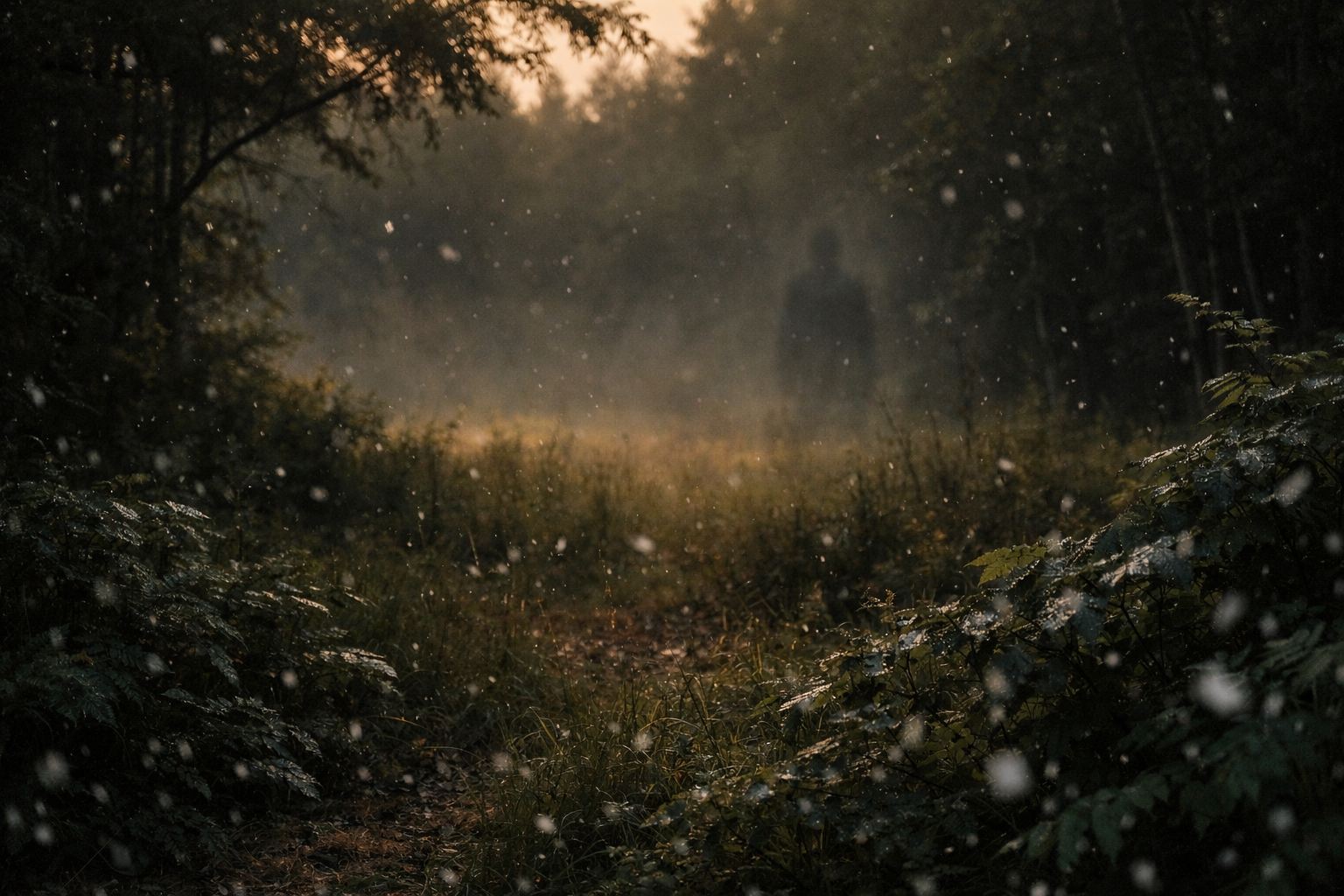
There were white flakes. Fine, like sifted flour caught in a downward draft, not chaff drifting up from the ground, not dander, not gnats. They moved with that unpredictable softness I only associate with a real snowfall: little paths inside the air, curved and loopy, sometimes lazy, sometimes quick as they found eddies and shallow currents. They made no sound; the camera doesn’t record audio in daylight mode anyway. I stared, my mind lugging behind what my eyes were insisting on. Because I could see heat shimmering off bare dirt at the base of the poplar, the little oily mirage that happens when summer cooks the air right above the ground, and through that shimmer, clearly, were white flakes falling from somewhere past the thick green shade.
The camera takes short bursts when motion trips the sensor. The first second was clear footage of nothing but the trail, no animals, the same scuffs from deer hooves, the same tatted leaves of jewelweed. Then the second second, the white started. By third and fourth seconds, a drift of it. It wasn’t like cottonwood fluff; it didn’t rise again once it touched. It didn’t stick to spider webs with telltale stringers. It was falling, and as it fell it landed, and where it landed the green dulled under it.
I backed the clip and forwarded it half a dozen times, feeling a rip of memory that wasn’t from July at all, but from November or December, the first flurries coating the bark ridges with that quiet algebra of white, straightening other shapes down to line and contrast. Here it was in July, and I couldn’t make it be anything else. I watched one flake hit the curled lip of a dead leaf that had hung on through spring, and the leaf moved in the exact way dead leaves do when a snowflake gives them weight for a heartbeat. A dusting collected in the V of two thin branches. Another pile built where fern fronds met their brown stems, a faint ghost of whiteness resting there. It was as if the camera had changed seasons for a handful of seconds, as if it had blinked and found itself alone in winter and then blinked back.
When the twelve seconds ended, I expected the next clip to be the animal that set it off. Sometimes a breeze in the ferns will trip the sensor, sometimes a bird winging low. The next file was five seconds long, almost immediate by timestamp, and it showed the same place. No flakes. Green and brown and hot sunlight. The powdered look where whiteness had been—gone. The branch angles the same, the bare dirt the same, as if someone had lifted off a thin fitted sheet. The fern that had held a little of it looked dry, its tiny pinnae fluttering with a bright gnat flying close by. It might as well have never fallen.
I sat with my finger pressed into the desk edge until it went numb. After a few minutes I thought I should go look, even if I knew it would be no use. I put the card back in my pocket, grabbed a bottle of water, walked the trail down through that stand of pine that smells like heated sap and sunbaked hay. The poplar tunnel was three minutes from the house if I kept a steady pace. My dog followed for the first thirty yards and then decided it was too hot for foolishness, turned back and lay under the mulberry tree by the shed.
At the camera, I checked the housing, feeling the hot plastic under my thumb. There was dust inside the gasket line where I once dropped the unit and gave it a nick. The lens was clean. The trail under the poplar was the same as every day that week: dry duff, a line of deer prints from the morning. I squatted and touched the ground. Between my fingers it felt rough and warm. I pressed a fern down with the back of my hand and watched it spring up, releasing a little powder of pollen into the light. There was no white on anything. No water on the leaves. No damp in the soil. The air had a taste of iron like the well water when we haven’t run it in a while. A cicada whirred high in the canopy and cut off sudden as if it remembered itself. Above me the poplar leaves were the rich, almost waxy green of their best month. The blue through them was as hard and endless as it gets here in July.
Back at the desk I went through the rest of the day, my finger pulling the slider like I was skimming a home video of a familiar room hoping for a mistake to show itself. At 5:19 p.m., the same trail flashed up again. The timestamp sat at the bottom right in the same pale block font. The camera must have caught something; the clip was one second long. The first half of that second was the empty trail, same shadows slanted a little longer now, the kind of warm color that comes when evening collects itself. In the last frames, just before the motion capture ended, there was a change in the air that read as more than the breeze. At first I thought shadow. Then I thought glare. Then I leaned so close my breath fogged the glass, because the change was the outline of a person standing precisely where that earlier blank snowfall had seemed to gather the most—at that V of thin branches where the dusting had held for an instant. It wasn’t a crisp figure. It wasn’t a man in a coat or a child or a hunter passing through with a rifle on his shoulder. It was the suggestion of human shape, a bleaching of the air into a head and shoulders, torso, the slope where arms should be. It didn’t block the leaves. It made them look briefly thinner, as if an eraser had moved over their green. The camera didn’t hold it. The frame cut. The next automatic recording two seconds later was only the tunnel again, hot and ordinary and the same as any other Sunday.
I pushed my chair back far enough that the leg hit the baseboard. In the quiet of the house I could hear the refrigerator compressor come on and hum through the floorboards. I watched that one second a dozen times, and it stayed the same every time: half a breath of nothing, then the soft absence of a human outline that wasn’t quite anything at all, and then it was gone.
I didn’t tell anyone right away. I copied the two clips into a folder with the date in the title. I dragged that folder onto a thumb drive and then dragged it onto a portable hard drive because sometimes I worry about lightning taking the computer. After supper I walked back to the camera and changed the batteries, even though the reader said I had half power left. I angled it a little to the left, then back, then left again until the frame was nearly identical to the original. I stood in front of it and held still until the red light flashed, then moved back out of view.
On Monday I called the weather service office two counties over, the one that posts the close readouts for our area. A man with a loamy voice told me there was nothing in the data. No cloud cover. No pop-up cells. No smoke reports. A dry day. He said it twice: a dry day. I sent him the clip even though it embarrassed me to call a stranger and talk about snow in July. He wrote back and said, if it were up to him, he’d call it ash, but there were no fires reported, and he couldn’t explain why it would seem to settle like that if the air was as dead-still as the logs suggested.
I showed it to my neighbor over the hood of my truck, the two of us leaning in toward my phone with the sun making the screen hard to see. He said cottonwood in a knowing way and then squinted and said maybe not. We don’t have cottonwood down in the hollow. And I watched his eyes do that small widening when the figure came in on the later clip. He didn’t say words right then. He just drew a slow breath that made the dust on the truck’s hood stir.
A week later, a friend at the community college put me in touch with a professor in atmospheric sciences. I didn’t want that to happen, but it did, and I found myself in a small office with a mounted radar image on the wall and a bowl of peppermints by the door, handing a USB stick to a person who might have something educated to say. They watched it and then asked me if there were any mills around. I told them about the old feed store that closed in 2003 and the way dust lifts from gravel when a convoy goes by on the county road. They smiled with professional politeness and said, I don’t know. They asked me for permission to examine the footage, which sounded formal, and then they said I might not want to ask too hard what I wanted from an answer.
The weather service never posted anything. The professor never wrote back with anything more than it’s interesting and we can’t reconcile it with our instrumentation for that hour. I didn’t push. It had already lodged itself under my skin in the way that certain sounds at night do—the late train that rolls through town and makes you picture its impossible length; the hollow tap of a branch on the porch that you swear comes between your heartbeats.
I still check the camera on Sundays. I still get deer, raccoons, a bobcat now and then like a ghost in cream and gray. Sometimes the dog will go around the long way to avoid the poplar tunnel. Sometimes she won’t, and she’ll barrel through it and come back with burrs in a dignified row down her leg. On a couple of nights when the air was too close for sleep, I played the clip again on my phone. I watched one flake fall with what looked like intention, its little slide angling to a resting place I already knew it would choose, and then a second flake that seemed to hop upward against what I know gravity is supposed to be. I watched the soft outline appear and stand for less than half a blink and go, and I waited for my brain to give it a word. It didn’t.
Last week, I stood under that poplar in the last light and waited—no camera, no card reader, just the air and me and the smell of crushed fern and warm bark. A breeze moved and the leaves showed their pale undersides like fish. For a moment, not long at all, the day cooled against my cheeks the way it does in November when the sky holds snow you can’t yet see. Nothing fell. Nothing stood in the V of the branches. I left the path feeling I’d been looked at, which is a foolish sentence to write down, but I don’t have a better one. The clip is on three devices now. It will live there until something wears out. The camera blinks its red light in the dark when an owl’s shadow passes, and I can’t help but think I will one day scroll through and find that same tunnel again, frosted in the wrong month, the air changed by something standing where it wasn’t before.