The Video Showed the Basement Light Turning Off Twice
Most mornings I skim through the overnight clips from the little camera that watches the bottom of our basement stairs. It started as a practical thing after we moved in—checking for the cat, the sump pump, the kids leaving laundry in a wet pile again. Click, scrub, delete. The camera makes a bloop when it tags a sound or movement, so it organizes the night into blips I can digest while my coffee cools.
The night that matters, I had woken at 2:13 a.m. to a thick, dull thump from under the kitchen, the kind of sound you feel in the wood under your feet more than you hear in your ears. I opened my eyes in the dark and listened. The furnace was idle. The refrigerator motor was steady. No voices, no footsteps on the stairs. I told myself the detergent jug had settled on the shelf or the dehumidifier hose had popped and slapped, rolled onto my other side, and counted the humming seconds of the house until sleep came back.
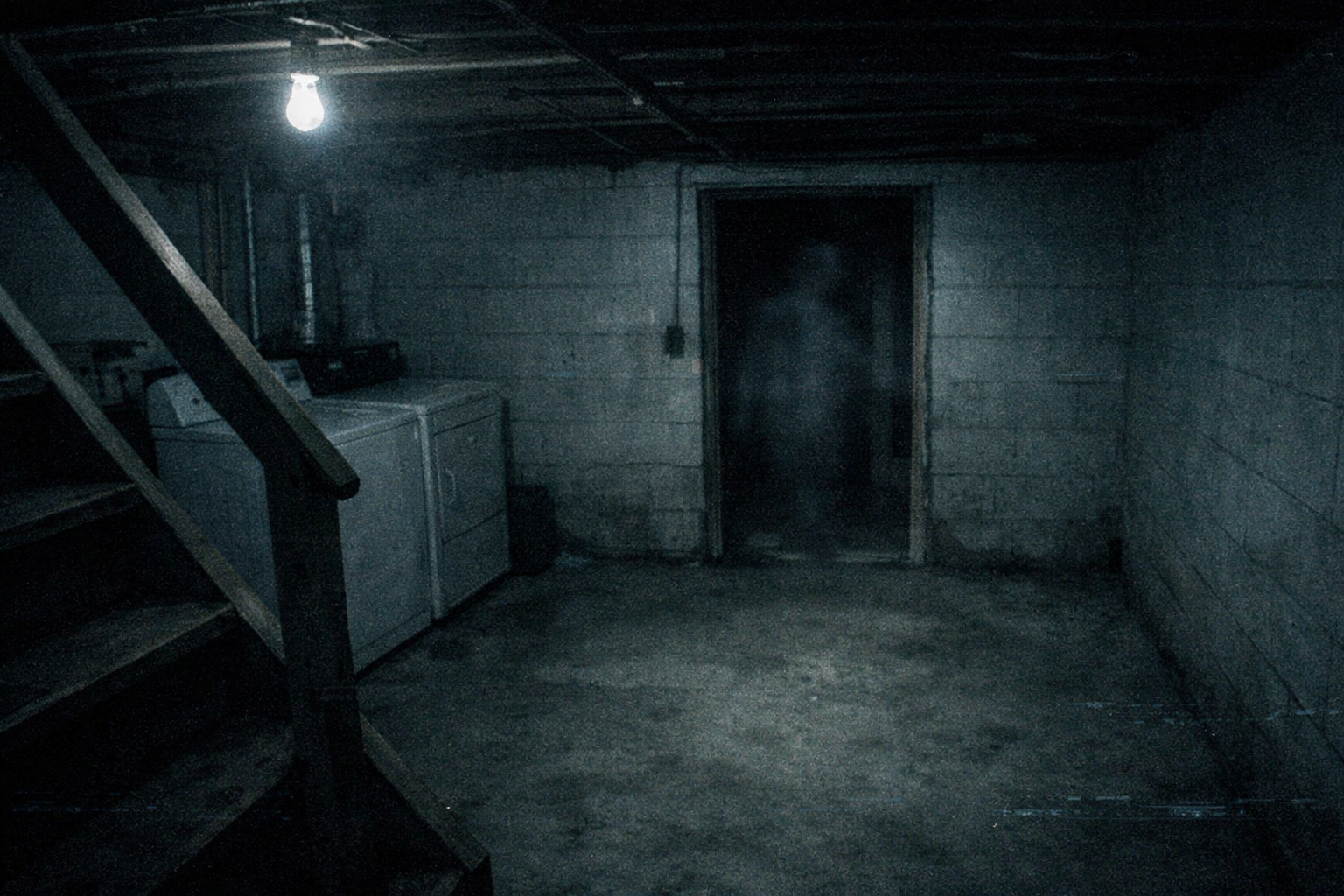
In the morning, the camera app had four flagged events clustered around 2:14. I set my mug down and tapped the first one. The view is nothing fancy: the concrete floor, a rectangle of a cheap rug under the laundry sorter, the cinderblock wall painted that landlord shade of gray, the ductwork ribbed like a sleeping animal. On the left, the wooden steps come down from the kitchen, open-backed, with scuff marks where the cat had learned to launch. Straight ahead is the short hall to the old storm door that was walled up long ago, and just to the right of that is the pull-chain light we converted to a regular switch when we moved in. A single LED bulb in a porcelain socket. It was on. Everything under it had that flat, exposed look you only get under one bare bulb—the string shadow of the chain, the chalky glare on the side of the washing machine.
The time stamp in the corner read 02:13:47. The audio was the usual basement track: the soft hiss of the dehumidifier, a distant drip tick ticking into the sump, duct metal ticking as it gave up heat. I watched myself, or rather the house, do nothing for three seconds. Then the light went out.
It didn’t dim or flicker. There was no slow fade like a bulb dying. It was on, and then the frame blinked to a darker level as though someone had clapped their hands over the ceiling. For half a beat, the outline of the laundry cart and the bottom third of the stairs floated in a blue-gray wash from the camera’s sensor adjusting. The time stamp rolled to 02:13:48, then 49. Upstairs, when it happened—I remember this clearly—nothing else changed. The oven clock never blinked 12:00. The corridor nightlight up here stayed on, a steady ember under the trim. The Wi-Fi box on the shelf in the pantry didn’t chirp the way it does after a power hiccup. The furnace didn’t cycle. The refrigerator’s low growl was exactly the same from the moment I woke until I fell back asleep. None of that is in the video, of course, but the steadiness of everything else is the reason the next part stuck in me like a sliver.
At 02:13:54, the light was back. No switch sound on the audio, no pause or shuffle. The cart snapped back into glare, the washing machine face went white again, and the halo on a lone spiderweb in the far corner reappeared like a drawn breath. I scrubbed back and forth between 53 and 55 and rewatched it a few times, listening for the click we had trained ourselves to hear when we left the switch wrong. Nothing. Just the electronic shush from the dehumidifier.
Then at 02:13:58, the bulb went black again. Same decisive cut to dark, no wobble. And in the bottom-left corner of the frame, the green status light of the camera keystoned against the wall, unwavering. The app didn’t toss up any warning about power loss. The overlay didn’t disappear. The time marched on as if the house, the camera, the app, and my phone were in silent agreement that everything was normal, except for the one thing that wasn’t.
I sat there for a long moment with my thumb on the glass, then I did the boring things you do. I went to the utility’s outage map—nothing. I opened the energy app tied to the little clamp-on sensor in our panel. The minute-by-minute line through 2:10 to 2:20 was smooth, the small sawtooth of the dehumidifier cycling right where it always was. The freezer in the corner had a smart plug that tattled if it ever lost power because of a thaw scare last year; no alert, no dropout in its log. The router’s UPS—a small brick that screeches at the slightest flicker—hadn’t beeped. The thermostat held its little leaf icon through that whole block of time. I went downstairs and stood under the light and flipped it. On. Off. On. Off. No delay, no crunch in the switch, no scent of hot dust from a loose connection. The GFCI by the sink hadn’t tripped.
Back at the table, I expanded the video to full screen and rode the slider into the seconds between the first blackout and the second. There was a very brief hiccup of static at 02:13:57, less than a frame—white freckles like sleet in the bottom third of the picture, a horizontal scar of compression tearing across the laundry cart—and then it cleared, and then the light died again.
I let it run into the darkness. If you’ve used one of these little cameras, you know how they handle true black: they go soft, and the sensor lifts to find something to chew on. The image that took over wasn’t infrared; the camera hadn’t clicked its filter. It was just the faintest suggestion of space, like a memory of the room rather than the room itself. The verticals where the shelves stood. The rectangle that had been the rug. The sheen off the washing machine glass turned from white to a flat, tired gray. I put my ear to the phone speaker and heard only the house: the hiss, the ticks, the faraway water noise of the sump swallowing.
At 02:13:59, something passed the doorway. I nearly missed it. If I hadn’t been pressing pause and start with my nail because my thumb had gotten sweaty, I think I would have. It wasn’t a person, not in any way that made sense. It was thinner than that—narrow, as if the darkness was folding on itself and sliding forward. The line it left on the floor was not a shadow so much as a change in the feel of the black, a seam from right to left across the faint rectangle that was the rug. In the stainless ring of the washer’s door, whatever faint ambient traced in there rolled and warped the way a car passes by a garage in daylight and changes the room without touching anything inside it.
I went back and frame-stepped. The app doesn’t actually do frames—it pretends to when you tap—but I could see the time stamp hesitate on 02:13:59 twice, like a hiccup, then commit to 02:14:00. The second time that 59 was onscreen, the seam was halfway across. The audio didn’t change. There were no footsteps on the wood stairs, no scrape of the laundry basket, no pull-chain clink. I remember thinking, absurdly, that maybe a moth had flown right into the lens, except there wasn’t the telltale flit, no bright wing in the light, and also the light was gone.
On a new clip, apparently separated by the camera to save space, the light remained off and the room stayed. The next flagged event was a minute later, tagged for motion, but it was just the dehumidifier cycling. At 02:16, the light was still off. Sometime after that, before dawn, I must have gone back to sleep, because when I came down for coffee this morning I flicked the basement switch and the bare bulb answered on cue, easy, like it had no idea it had been the center of anything. The cat came down with me and ducked through the railings and paused three steps from the bottom, tail puffed for no good reason, and stared at the laundry cart like someone she didn’t like was standing behind it. She did that once when a neighborhood tom had found his way in through an open window at our old place, but there was no one here to make sense of it.
I spent an hour trying to get the clip off my phone so I could see it on a bigger screen. The export worked, but on the laptop the last six seconds of the second outage do something the phone did not. The time stamp keeps counting, 02:14:03 to :04 to :05, but the picture holds like a breath on the silhouette of the hall, the gray wash that has replaced the room, and whatever seam of not-quite-black had been crossing is frozen just beside the bottom step. The audio keeps going: the sump tick, the air through the duct. At :06 the video resumes with a tiny smear of white across the middle of the frame as if it has been dragged, and then it ends. When I scrub backwards, the time does a small, mean trick: it returns to :04, then vaults to :07, never allowing me to stop squarely on :05 ever again. On the phone it still shows; on the laptop it won’t.
I swapped the bulb that afternoon anyway. I opened the breaker panel and ran my knuckle down each switch. I pressed my ear to the cinderblock next to the conduit and listened for the whisper of a short as if I would know it if I heard it. Nothing. The switch plate screws were cool to the touch. No burnt smell in the porcelain. The freezer never blipped; its graph was a comb. Everything that should have noticed didn’t. The one thing that did—a camera the size of a teacup I bought more to monitor teenage mess than metaphysics—captured the light going out, coming back, and going out again as if someone had thought it through and wanted me to see it exactly twice.
I told myself I would leave the light off that night. I told myself I would stop watching, that the noise had been the house, that bulbs die in strange ways, that compression makes ghosts from air. But after dinner I went downstairs and left the switch up, a little act of stubbornness. The room took on that single-bulb clarity I know too well now, the hard-edged circles and long thin shadows. Before bed I sat on the edge of the stairs and watched nothing happen for five minutes. I could feel the cool of the concrete through the wood and smell the mix of detergent and faint damp cardboard. I don’t know what I expected. A hand on the chain. A soft tick before dark. Anything to tell me this was wires.
Later, upstairs, I tapped the latest clip. It buffered. The counter started 02:13:52 and rolled forward. The light was on. It was ordinary. Then the bulb flattened the colors the way it does right before it fails. I waited to see which second it would choose. The export of last night’s clip sits on my desktop now. When I press play, the same six seconds of stopped picture slide under my cursor regardless of where I enter, the time sliding but the gray not moving. If I jump past it, the basement is back, grainier, the hum still there, the light still gone. I don’t know if it will ever play cleanly, or if the part of the video where the dark is not just absence but quantity is simply not meant to move again.