The Tape Recorded a Conversation No One Had
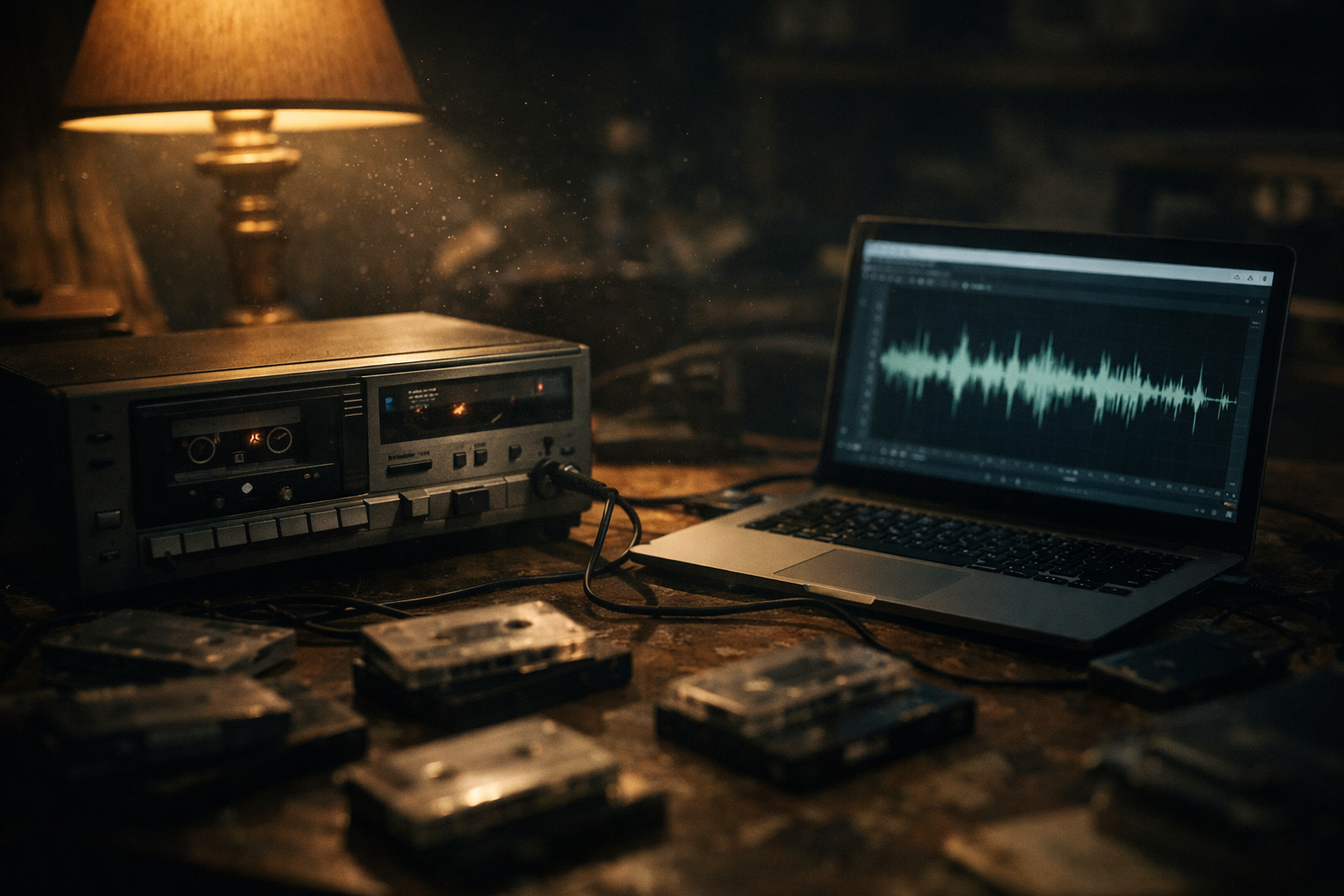
I started on the tapes because no one else wanted to. Two shoeboxes of sun-bleached plastic and loose labels had lived on the top shelf of my mother’s hall closet for as long as I could remember. Over the holidays she’d asked, not really looking at me when she did, if I had the time to put them “on the computer” so the grandkids could hear their parents high and reedy, before any of us learned to round our voices down. I brought the boxes to my apartment, set them on the desk under a lamp with a yellow shade, and cleared a space for the little USB deck I’d bought online. It made a soft motor sound, like a distant aquarium pump. In headphones, that sound became a shaded hum behind everything else. Outside the window, the street had gone quiet with cold.
The first hours were all easy sweetness: a birthday where everyone talked over the singing and my uncle brought the mic too close to his mouth and laughed about blowing out candles he wasn’t entitled to; a school play where you could hear me, small, trying to say my one line without breathing too loudly into the built-in microphone; a Thanksgiving with three generations arguing about whether the stuffing was too wet. Between pieces, hiss rose and fell, and there were gaps of room-silence with only the shift of someone’s weight or the blunted tick of the old wall clock. I labeled the files as I went, typing dates when I heard them spoken. In the spare room, with the lamp haloing everything in that syrupy light, the world narrowed to tape passing heads and the slow climb of green bars on my screen.
The unlabeled cassette wasn’t special to look at. It was a black shell with clear windows scuffed almost opaque, one corner chewed where the case must’ve cracked and been taped back together with a strip of yellowing cellophane. I slipped it in, pressed play, and let the software start a new recording, a fresh track stacked under the neat list of what I’d already captured. The leader went by clean, then a scratch of static, and then a room I knew: our old living room, late afternoon by the sound of the light. Children’s voices—mine among them—counting to ten and getting tangled on seven. Someone clapped. I paused the capture to write “Side A likely 1991,” because an aunt sang “Happy birthday, nineteen ninety-one, you’re such a big boy now,” in a key she would defend to her grave. I kept listening until the end of that side, which was a long hiss and then a thud as the button was pressed a little too hard. I flipped the cassette.
Side B woke up in the kitchen. The acoustics gave it away: closer, more tile and glass and the hollow pop of a cupboard door left open a crack. Cutlery had a brighter ring. If I closed my eyes, I could stand in that room absolutely—the scar down the center of the table where someone dragged a metal toolbox; the chain on the back door that stuck on humid days. At first it was the usual Sunday night drift, people moving around the problem of the week without naming it. My father filled a glass too far and slurped from the top before he lifted it. My mother said, with that bright tiredness that means she’s at the end of herself, “If you’re going to drop something, please pick it up, don’t kick it under the stove and think I won’t see it.”
I knew that tone. I had heard that exact sentence a thousand times, and laughingly copied it when I first moved out and started complaining about roommates who left onion skins on the counter. Everything in the kitchen sounded right, shaped like memory, until the first thing that was wrong slid in too casually to notice if you weren’t listening for it. “Since we did the blue tile,” my mother said, “it shows every crumb. I hate it. I loved it in the store, and in here, I hate it.”
The blue tile didn’t exist when Side A was recorded. We had laminate that pretended to be wood in a way no one believed until 2003, when a neighbor redid his counters and gave us his contractor’s card. I hovered over the stop button, then didn’t push it. A pot lid chimed on enamel; my father sucked his teeth the way he did when he was deferring an argument. Someone—one of my cousins, maybe—asked if they could have more milk. The tape went on like kitchen weather.
Maybe the unlabeled cassette had been reused. People taped over things all the time. I told myself that, watching the waveforms pulse on my screen, but it didn’t unhook the shiver from my spine when the conversation wandered, unforced, into a place it couldn’t have been and still be what it sounded like. “When the fence went down last spring,” my father said, “we should have done the posts right, not the patch. We’re doing it again come April.” The fence came down in the windstorm of 2008; the year before that there had been a scare that put my father in the hospital for two days, and in this tape, my mother said quietly, not needing to say the word hospital, “The nurses were kind to us. I don’t know why I was so afraid of that place.”
They talked about the porch the cousins helped build the summer after my grandfather’s funeral. They argued whether the new TV was too large for the den; my mother said it was like having the ocean in the house, and my father said, “It was a great deal because they were closing,” which was true of the Sears that went away in 2010. I stopped pretending I was catching mislabeling. The deck thrummed under my hands. In my headphones, time felt loose, as if the tape were a rope that had slipped its cleat and now lay slack in the water, slack enough for a tug from anywhere.
At twenty-nine minutes, a chair scraped. It was the exact complaint of wood on old linoleum that puts your nerves on edge even as you tell yourself you’ll put felt pads under the legs this weekend, and then you don’t. Forks chimed against plates. And then I came into the room.
It wasn’t my child voice. The voice that spoke next was mine now—my breath shape, my vowels, the way I swallow before I say something I know someone won’t want to hear. “Ma,” I said, like I do now, a syllable that wasn’t how I said it then. “Write it down. It’s going to matter later.” I stopped breathing for a second as if the past could notice. The room on the tape moved around that sound like an animal recognizing a shape in the doorway. My mother answered, a softness in her reply that belonged to the years after we both got better at apologizing. She said my name the way she says it when there’s a favor she isn’t sure how to ask. “What am I writing?”
“Label the boxes,” I said. There was a laugh in me then, flat from holding itself in. “Please just… label which room. You’re going to change the kitchen and you’ll hate the grout and in a year you won’t remember where you put the cast-iron. Put it down. Future you will thank me.”
I recognize myself as much by stupidity as anything. I have said future you too often, and people have rolled their eyes lovingly or otherwise. On the tape my father said, “Who’s got my pencil?” and there was a sound of a drawer being slid open, that wooden thrum that always stuck at the end and pinged when it was released. My mother said, “If we’re changing, we’re not telling your aunt until it’s in,” and everyone laughed because that was an old complicity. The rest was ordinary. The conversation tilted toward weather, and someone snapped the burner off with a click. Distantly, the clock in the living room marked the hour, not a time that meant anything. I sat in my chair in the quiet lamp-colored room and let the tape run out to air.
I marked the file as “Unlabeled B—kitchen—unknown,” and I saved it where everything else went, nested in folders with names you make up quick and never change. I told myself I would sleep better if I listened to something else normal for a few minutes—a recital, my grandmother swearing at a dog who had found a hole in the fence, the way the house used to breathe when the heat clicked on. But my hands didn’t feel like my hands. I pressed stop and pulled the cassette and did not like the way it was warm. In the pad of air after the motor stilled, my apartment sounded too large for one person.
I didn’t say anything that night. I don’t know what I would have said that sounded like sense. The next day, I put the tape back in the deck to show a friend, watched the spools catch, waited for the kitchen to open again. Hiss rose and stayed. It wasn’t the slight noise floor of old tape. It was hiss like a television left between channels, a neutral snow that went on and on with no rise or fall, without even the suggestion of a room.
I flipped the cassette, thinking maybe I’d wound it to blank by mistake, but Side A had gone the same way. Where the birthday had been, where my aunt had sung the year into the song, where I’d felt the stubborn knot of childhood someplace below my ribs, there was nothing but sand-colored roar. I pushed stop and start and stop again. I tried the pencil trick, the gentle twist to ease slack, then held it up to the lamp; the tape inside wore the faint bronze of something used, not new. I tested other cassettes. They played fine. The deck wasn’t at fault. This one had decided to be a winter storm and stay that way.
I told my mother that afternoon. I drove across town with my laptop and the file saved on a cheap flash drive that rattled in its case, and I played it for her at the kitchen table in the house she still lived in, all its corners changed around since those first tapes and not as much as you might think. She listened with her head tilted, her fingers pressed together, the way she does when she’s keeping herself from talking until all the information’s in front of her. Once, she put her hand out and stopped the progress bar with a fingertip to make me replay something. “That wasn’t,” she said, and didn’t finish the sentence. “We didn’t have that panel yet.” Another time she shook her head as if to fling off water, then said, “But we did say that. About the grout. I remember hating that grout.”
When we got to my voice, she looked at me the way you look at your reflection to find the years, and she smiled without much humor. “You do sound like that,” she said. “That is what you say.” Later, when I sent the file to my brother and he listened in his car in a parking lot and called, he was impatient with me in the old way. He asked if I’d found some trick, if I’d matched clips or did some machine thing I don’t understand. I told him no. He said I was being dramatic. I told him the original tape had gone to hiss. He believed that part easily; technology, in our family, fails with gusto.
The cassette still sits in its case on a shelf by my desk, the cellophane peeling, the reels waiting for a sound they’re not holding anymore. The digital copy remains exactly as I captured it, down to the click where someone set the ladle on the counter and it tapped the edge on its way down. I have it saved three places because that helps me breathe, and I don’t open it unless I can put my elbows on the table and concentrate. I’ve learned the shapes on the waveform—a laugh, a glottal stop, the lean-in to a whisper—and sometimes I notice a smear I didn’t see before and wonder if it was always there or if the file is a kind of house, and when I go into one room more than another, the dust settles differently.
After a week, when I played it again late at night with the volume turned low, right after the scrape of the chair but before my voice speaks, there’s a small sound I don’t remember from any kitchen we ever had. It’s a thin click, close to the mic, like the lamp on my desk when I touch the chain and the bead skims the metal before it swings free. If I lean in and listen hard enough, I can almost hear the air moving in my spare room where the deck hummed, steady and patient, as if the moment of listening found its way onto the tape that recorded none of this and all of it at once.