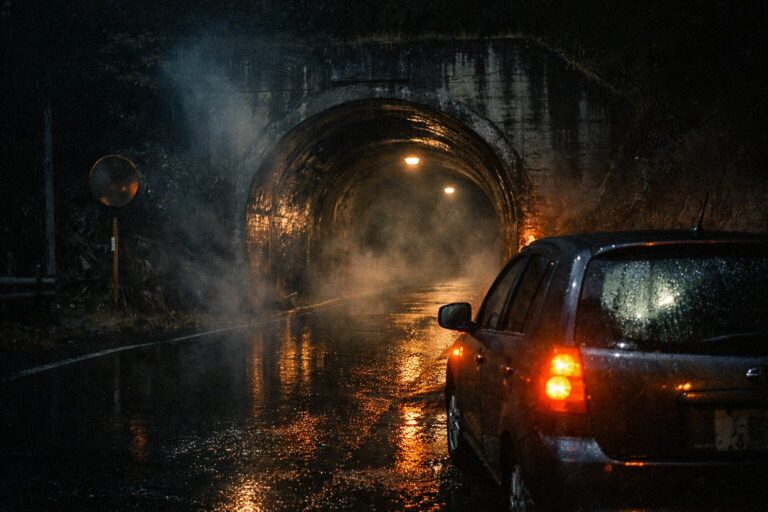
The Village That Heard Footsteps Across the Fog
When the fog comes in thick over our lane, we draw the curtains early without anyone needing to say a word. It is a custom older than my memory, something my mother did and her father before her: bring the washing in before tea, prop the door with the old stone, and keep the night where it belongs. We leave the porch lights on, not bright, just a low amber, and we mind the latch. The lane runs crooked between cottages of slate and limewash, then past the churchyard and fields down to the beck, and the fog finds it the way water finds a groove. It slips in thin at first, then sits, heavy and pearled, and if you stand too long on the threshold you feel its chill on your teeth. We say the sheep go quiet and the birds keep to their hedges, and if there’s talk in the snug at the pub, it lowers when the mist drafts in through the door and someone leans to push it shut again.
On those nights we give the lane back to itself. Children are told stories of the moor and its tricky light, and the old ones will say a cough will linger longer in fog, and regardless of what’s true the effect is the same: we don’t wander. Windows show nothing but our own rooms reflected, and the houses become islands in a grey sea. It is comfortable, mostly. You cook, you rinse the cups, you settle by the small fire and listen to the clock. You tell yourself that what’s out there is only weather. By habit, you set the draught snake along the door and remember to wedge the letterbox with a bit of folded card to keep it from knocking in the wind. Fog has a way of magnifying little sounds. The copper pipes give a tick like a footstep if you’ve a mind to be jumpy.
I had not thought of the lane as something that could sound crowded. Fog eats sound. It tucks the village into a soft box where you can’t hear the farm dog two plots over or the late car pacing the top road. But that evening last November, when the fog came stripe-thick and rolled down from the common with a steady swiftness, I heard them. The first wrong detail arrives quietly, the way a drawer that should not be open is found open, and the mind tries to make a polite reason for it. I had set down a cup, or the boiler coughed, or a bird skittered the stones beyond the hedge. Then the second set of steps came, and there was nothing to be done but stand inside the hall with my hand at the latch and feel my chest go cold.
They were footsteps, clear as any man’s, measured and not in any particular hurry. They came from the bend near the iron postbox, somewhere inside the gauze of fog where you couldn’t see as far as your own gate. Heel to toe on wet stone, but the stones were not wet. I knew this as well as I knew the profile of my own garden wall, because there had been no rain that day. The lane had been dry until the white came down. The sound was wrong twice over for that, and for how close it seemed when there was nothing to see outside the beveled glass of my door but my own hand in the hall light.
I turned off the light, thinking I might make out a shape if I gave my eyes a chance. The fog pressed the pane like a damp sleeve. I heard the steps come to the Baxter’s, two doors up, and stop. Not a knock, not scraping or shuffled indecision. Just the end of a counting-out, as if the walker knew the measure between sills, the exact number of paces from the bend. There was a hush in that stop, the sort of silence under rain when you know someone else is on the path, listening. Then the steps moved on, even and proper, and stopped again at Mrs. Gray’s. My breath clouded the glass and I realised my mouth was open.
There is a small group of us who message about potholes and whose bins have been missed, and my phone broke its politeness with a soft buzz. Are you hearing it, someone wrote, and a minute later, Next door. They’re at mine. The grey circled my porch light in damp feathers. I could hear every footfall clearly, each one laid down solitary and exact. They came to my neighbour across the way, stopped, then walked on toward my gate. There was no shape to follow with the eye, no smear of darker fog held together like a person. But the lane had gained a second life in my ears: stone, weight, then the tiny sigh of the pace settling, and then that pause as if waiting to be allowed in.
When I was a child, I had played a game in the fog where you close your eyes and point and try to guess where a sound is coming from. Grown, I have learned I am not as brave. I did not unlock the door that first night. I stood and felt the latch inside my palm, waiting for a knock that didn’t come. The steps did not scuff or linger. They marked their stops the way the postman once had in the old schedules, though this was well past midnight and the village was tucked down. You could feel every house draw its breath in as that even tread reached it and halted for two quiet seconds, then passed on as if books were being counted on a shelf.
In the morning I told myself it could have been someone’s son walking the wrong lane home, or a prank that had decided, halfway to worse, to go home to its bed. The fog lifted that time and there were no marks. I scrubbed it from my head, because you can do that with a single night if you are stubborn. And yet when the fog laid in again the next week, heavier and closer to the stones, the steps returned. They were calm, like a man on his rounds, never running, never faltering, crossing and pausing in front of cottage after cottage in a line I could follow without ever stepping out. I thought of the baker who had died the year I started school and who walked that route for decades, the slope of his shoulder, the way his shoes made a particular chip on the flags, and I hated myself for bringing his memory into it.
The third time, there were more messages. Bridget, whose door faces the little triangle of green by the cross, wrote that the steps had stopped for longer than usual at hers. We all went quiet then, because what reply do you send? The fog altered the lights so they looked like coins caught in milk. Something banged far away, a shed door or a bin toppled by its own weight. The footsteps continued. They came to me, to my own house with the foxgloves still black and stiff along the wall, and they paused on my slab of stone. In that pause, my impulse was a thing I did not respect or trust: I wanted to open the door. My hand moved before I could tell it not to, and the latch lifted with its old church-mouse squeak. The fog pressed in immediately, cold and smelling faintly of green ditch, and I held the door with my shoulder while my other hand found the torch. I kept the beam low, remembering my childhood lessons. You don’t go hunting faces in fog. You see what you need by your feet.
There was nothing there. The night outside was a blank roomsworth of grey, lidded with a faint circulation of darker shade where the hedges might be. The light showed my threshold stone, bone-dry, its chips and old mortar lines, the snail trail from some damp morning weeks back that had set and dulled to chalk. My heart had its own small hammering. Then, between one breath and the next, a sound landed on the stone so exactly beneath me that the weight of it felt like a hand on my knee through the floor, and I saw: the print formed.
It did not arrive as a smear laid by someone’s silly boot. It darkened in the stone from the heel up as if pressed from inside the rock, a bloom of wetness shaped like a left foot of a man in a narrow-soled shoe. The edges were sharp. The toe had that little splay you get from years of the same turn at the same corner. I watched the water bead where there should have been leather and tread, and I swallowed a noise and took my weight off the door to let it swing wider. There was no figure there to have made it. The fog lifted in a patient way, like someone breathing steadily close to my face. Another step sounded on the lowest of my two porch steps, and on the second flag, a second dark shape grew, too close to the first to be natural if a living person had been walking. It was as if the lane was laying down images of feet that had been there over and over again in the same place. The steps did not come inside. They did not touch the threshold proper. The sound of them, and the wet imprint they left, paused as before, then moved on.
I followed with the torch, not into the fog—only to the limit of my porch. A trail of prints walked away from me. Each one came into being between the fog and the stone like a coin wet from a spring. They were not many; the walker did not pace or fidget. There was an economy to it I found bitterly familiar, the way my father had trod to the gate at four in the morning and back in all weathers, one, two, one, two, the years teaching the ground where to expect his feet. I felt I could have reached out and touched a calf that was not there, a coat seam, a hand. When the steps reached the Baxter’s, they stopped. I saw Bridget’s porch light lick the fog and heard her breath through the crack in her door. Somewhere in the white ocean of it, a child cried a single note and was hushed.
I shut my door then. It was too much to stand outside and wait and learn that a thing could stop where it wished and listen to you listening. Back in my hall, the print was still wet. I pressed my fingers to it without thinking and they came away clean, which startled me worse. It was water, but it was not. It had no silt, no grit, only the impression of wet catching what light there was. I wiped my fingers on my jumper like a thief. The steps went on. I listened to them visit the Grays, the Dawsons, the small cottage with the geraniums in the window. At each a pause. At each, I imagined a new damp stamp planted and left, though at mine, two had appeared. That felt like a knowledge I did not want to share.
Morning came the way it often does after a night like that: hurried and embarrassed, with birdsong that seems too bright, too busy for what has just happened. The fog did not lift all at once. It folded upward in slow skeins, revealing the hedge-tops and then the window-boxes and then the brass numbers on the doors. Milk thinned; shadows returned to their posts. I took my mug to the step because I could not bear to peephole it any longer. Across the lane, Bridget was already outside in her dressing gown. She looked as if she’d slept in it, which meant she hadn’t slept at all.
We didn’t speak at first. I let my eyes travel to the stone below my door. The print was there, but not where I had seen it last. Not as wet. It had changed with the air, it seemed, the way a tide-line pulls back a little as it dries. On the lowest step, there was not a second after all; I had been too full of my own fear to count properly. There was only the one on that lowest slab, the left foot, heel crisp, toe splayed. My stomach lurched because I had been certain there had been two. But no. And when I looked up from my own and let my gaze drift along the lane, I saw that everyone’s doorstep bore the same.
It was strangest for those who had not opened doors, who had kept the snake firm and their curtains pinned. On stones kept dry by luck and fog, there lay a neat single muddy-looking print at every threshold, the same leftward tilt, the same slight flaring at the toe, as if the entire village had been visited by the same careful foot, once, and then moved on. No trails ran from one to the next. No raindrops had spattered them in the night because there had been no rain. Some had collected a thin lace of dried fog crystals catching along their edges in the morning sun, as pretty as lace, which made my neck tighten for reasons I could not have explained. We stood in our little ways at our doors, each of us measuring our own mark, measuring the others, as the cobbles came back into their colours and the day remembered us.
Bridget looked up at me finally. She touched the place on her stone where the print had laid itself and held her fingers apart to see what might cling, and then wiped them on her gown like I had on my jumper. The air smelled of damp hedges and bread from the baker’s new boy. A van went by slow on the top road and the sound of it was normal, unsinister, ours again. We did not speak about it properly then, or later, not so it would stand. Some nights the fog is thin and never fully settles and we sit up later then, light spilling easy into the lane. But there are other nights when it comes in a straight line as if choosing us, and you’ll find our doors shut earlier than seems needed, the letterboxes wedged, the low amber porch bulbs on in their patient way. And if you listen—if you can’t help yourself and stand in the dark hall with the light off—you can hear someone walk the measure from the bend to the church and stop at your door, and then at mine, and then at the next, all the way down to the beck, and once the fog has lifted, once you’re sure you see clearly again, every doorstep holds a single print, as if counted and agreed on: one.