
The Voice Said “Leave” in an Empty Church
I started going out at night with a small handheld recorder the way some people go running. It settled me, walking slow routes, catching the hush of places when they emptied of people. On a damp weeknight this spring I took it to a stone church on the edge of town, the one that sits down from the road and looks across its own dead. The yews along the wall made a dark seam against the cemetery, and the iron gate complained softly when I pushed through. The signboard out front still had last Sunday’s hymn numbers with two digits missing; someone had turned them into approximate eights.
I knew the sexton a little. He’d told me there were no evening services on weekdays and that I could sit if I wanted to soak the echo. The doors were unlocked until nine. I went in just after eight. It was one of those interiors that keeps the dusk, even when you switch a few lamps on. Old varnished pews, a sharp trace of wax, and the cool stone that came up through my soles. The chancel lamp was out. Everything was gray and brown and the dust had its own weather in the high, neglected light.
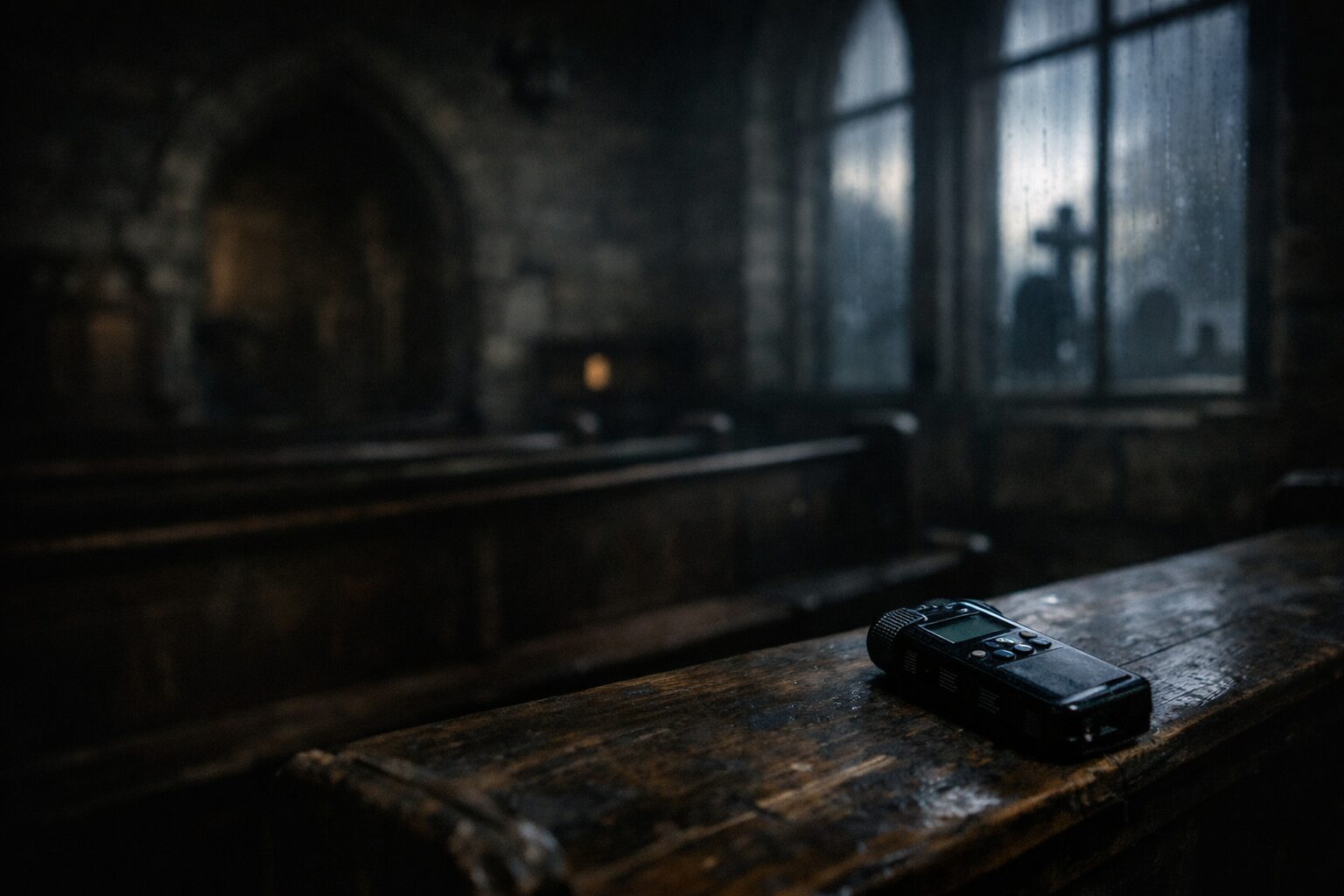
The recorder fit in my palm and showed me a soft wash of levels when I tapped it. I set it on the end of a pew down by the center aisle, where the sound would be even. The air was at rest. A little wind climbed under a door somewhere in the vestibule and made a round, patient sound like someone playing with a bottle top. Beneath it I could hear what I’d come for: that mild sea inside, the same no matter the building’s shape, the way it remembers hundreds of breaths that are already gone.
I left it to run for six minutes and then another four. I watched the door, because emptiness has a way of asking to be confirmed. Through the windows beyond the narthex I could see part of the graveyard rising and falling and, above that, the longer black of the hill. I didn’t feel watched. I felt like I had wandered into a held breath. When I stopped the take I marked it on the little keypad with the date and the place so I’d remember later. It was a good block of hush.
I listened right there, half out of habit. The headphones I use cup tight; they make the world lean away. The first part was all I expected—fabric rustling, a knee popping, the occasional groan of wood settling into wood. Then, just before the fourth minute, after a short sizzle as the input trimmed itself, there was a word spoken so close to the mic that I felt my jaw click, as if I’d been told something directly. A single breath-small warning, not quite a whisper because it carried the shape of lips on the syllable. “Leave.” The sound of it didn’t live in the big room. It was right there at my left ear, as if someone had reached the recorder without crossing floor.
I stared at the pew in front of me and then took the headphones off slowly because silence has a skin, and tearing it makes a noise you can’t take back. I said, “Hello?” into the aisle and the word went all the way to the chancel and came back thin. No movement. No cloaks, no broom, no sand in a shoe. I went to the front steps and looked down at the cemetery and the wet path; the iron gate I’d come through was still shut. Far off a car door had a small argument with its hinges. I played the clip again, and there it was, so clean that my own mouth answered with a little, involuntary exhale when it came: “Leave.”
I left a note on the table in the narthex for the sexton, out of courtesy more than anything, and went home with that voice traveling on a straight line behind my eyes. It wasn’t a voice you’d call men’s or women’s easily. It was the way you’d speak if you wished not to be overheard, but wanted to be obeyed, and had only one word with which to make your case.
Two nights later I went back. A drizzle had started and stopped, and water tracked in the dirt along the stone walk like veins. In the churchyard the names on the nearest markers had started to silver over under lichen. I didn’t touch the iron gate this time, and it still sighed. The building was the same inside, except that the hanging bulbs above the aisle were dimmer, and the damp had come into the wood so the pew ends felt almost alive under my hand.
I tried a different position, up in the choir loft where you can see everything at once: organ pipes like captured thunder, the figure of a saint in a side arch keeping an old appointment with his book. I set the recorder on the rail and let it stare at the nave, red light steady. The sound up there was wider, but it was the same quiet. Footsteps from outside made nothing inside. I did six minutes and then checked again. The voice was back—same volume, same nearness, stepping into the same distance between my left ear and my heartbeat—only this time it came earlier, almost like it had been waiting for me to do the thing with the headphones so I’d have it right up against me. “Leave.”
I said it back into the loft so I could hear how a human interruption sounded in that air. Mine lifted and climbed the nave and found the stone ribs and loved them. The one on the recording stayed small and complete and close. It had no room on it. Listening again, I noticed there wasn’t even a click of someone’s tongue breaking. It arrived the way a thought does, fully itself.
I moved down after that because I didn’t want to be in the high place. I set the recorder on the middle pew this time and kept one ear of the headphones on so I could monitor the hiss and the occasional snipe of handling noise if I brushed the cable. I wasn’t after proof or anything else at that point; I wanted to take whatever space was left to me in that building and set it down in a straight line. Five minutes metronomed out on the recorder’s counter. The rain had picked up again outside; it colored the quiet a little, like graphite rubbed over old letters. My free ear started to hear my own breath.
When the voice came it did not wait for playback. It stepped into the air right next to my mouth, right against the baffle of the headphones, as neatly as a key turned half its distance in a lock. No rise, no approach. “Leave.” It pressed against my skin. At the same instant, without me moving, I saw the LED bars on the recorder prick up as the sound came into it. It was recorded while it was happening to me. I looked at the aisle like you would look at the spot where you’d expect a cat, or the corner of the kitchen where someone might be with a glass, because the body wants there to be a body where a word is made.
Nothing else spoke. No after-sound of shoes, no swallowed breath that wasn’t mine. I sat very still and the levels on the recorder soothed themselves back into their slow tide. The headphones felt suddenly too warm, as if someone’s palm had been on them a moment before. The old varnish smell had a sweetness that made me think of sickrooms. The word carried the shape of a mouth and the quick, careful push that comes when you don’t want the larger room to know you’re talking. I stopped the take without ceremony, as though leaving a conversation politely. I did not look up toward the loft. I told the empty door “I’m going” and the way the syllables went through the nave made me feel traitorous for hearing how good it sounded.
Outside, the grass beside the path sagged under the new wet. The graveyard had a darker life to it now, each stone a shoulder under a thin shawl. The yews knitted together against the rain. I walked the length of the path with my mouth closed so as not to make any more shape out of the air. The ironwork let me through with a last old complaint. When I turned back, the church’s small windows gave nothing away. You could believe there wasn’t a room inside them at all, only more dark.
I did not play anything in the car. The recorder sat on the seat like a bird in a box. At home I left my jacket on its back on the chair and went straight for the cable to pull the files across. The folder I had made the first night, with the date in numbers and the word church after it, bloomed on the desktop when I dragged the new takes in. I made tea and waited for the copy to finish. The little progress window closed and the room got quieter again in the way it does when machines stop their murmuring.
That was when I saw the other folder. It wasn’t mine. It sat inside the same directory as though it had been there and had only now decided to show its name. Hymns. I hadn’t typed that. I hadn’t named anything that, because I wasn’t thinking of content, only of place and time. I opened it. Inside was one file. Its name matched a take from the second night, except that it had none of my dashes. I clicked it before I had time to regret it and leaned in without the headphones, because I didn’t want any plastic touching my ears.
There was exactly twenty-one seconds of room tone, from the church I had just left. It was clean and bare. You can learn a house by its empty room sound; I could tell where I had put the recorder by the weight of the quiet. Then, right at the end, there was the voice again, the same mouth-near warning with no room on it, getting as close as something can get when it never had a place to stand. “Leave.”


