The Blue Orb Followed Us Through the Trees
The fire had been dying for an hour, going from a crackle to that slow, soft breathing that wood does when it loosens its last heat. We had been telling the kind of stories you only tell when you know there’s a tent flap between you and the dark. When my friend and I finally stood, most of the group stayed by the ring, half-circles of faces orange and calm. We took the lower trail to our tents, a path that ducks into the trees where the ground goes mossy and the air changes. You could still hear the occasional laugh back there, thinned out by needles and slope.
There was moonlight, but the canopy braided it. We used my phone’s flashlight, pointed low so the beam wouldn’t punch a hole in the quiet. The trail cuts along a shallow ravine, bridges a trickle of water, then climbs back toward the loop where our site sat. I remember the grit of decomposed granite under my boots, the sour-sweet pinch of woodsmoke in my clothes, the damp root that tried to take my ankle and didn’t. Small things. That’s how normal it felt.
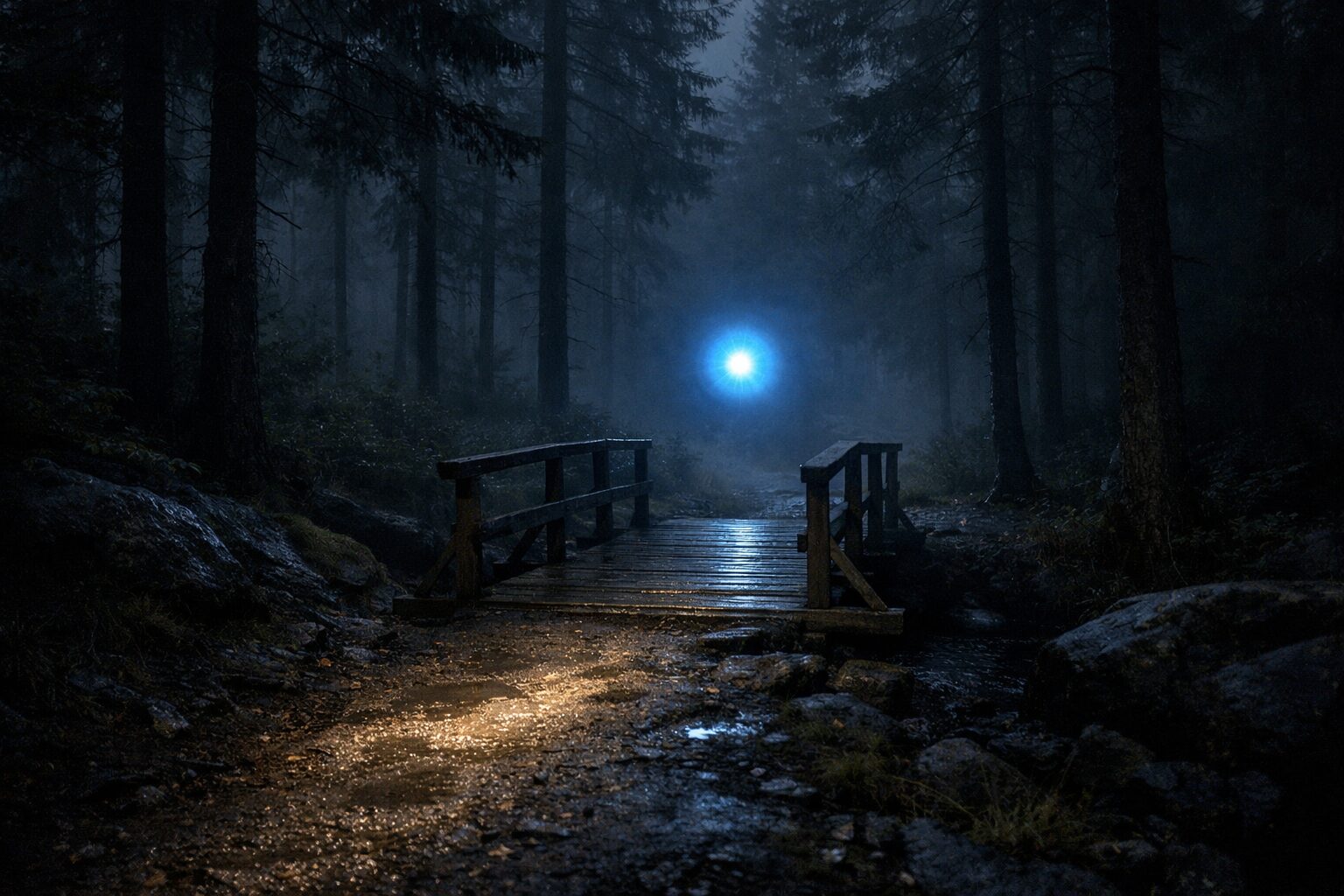
We hadn’t gone more than fifty yards when I saw it—between two trunks on the uphill side, not far above the ground. A round blue light. It didn’t strobe like a bike light, didn’t blink like a phone. It just sat there, a quiet coin of gas-flame blue, the kind of blue you see in the center of a propane flame when the rest of the world is asleep.
My friend slowed. We both did that thing where you pretend you haven’t seen something until your brain knows where to file it. You learn the shapes of the woods: the reflector on a dog collar, a marker nailed into bark, a car on the road beyond. It wasn’t any of those. It was low, as if it were resting in air, not touching branch or trunk. The light didn’t ripple on the needles or catch and scatter the way a lantern would; it held itself together, neat and clean.
“Trail marker?” my friend tried, voice pitched soft, like speaking too loud would make it take notice. I wanted that to be true so badly that for a few long breaths I let it be. We walked, angling for it, and as soon as the beam of my phone got anywhere near, the blue sank back into the line of trees and was gone. Vanished is the word, but that sounds like a trick. It was just there, and then the place where it had been was bare bark and a curve of blackness between trunks.
We went past, and the trail made one of those lazy hooks to the left, skirting a snag downed long ago. The white light from my phone slid along it, a thin river. Then, ahead—just far enough that the bend kept it coy—the blue light appeared again. Same size, same height off the ground. Waiting where the trail would carry us.
My friend stopped, and so did I. The wind moved high branches, a hush that could have been water. Somewhere below, the creek went on being itself, and crickets stitched their little hems in the dark. All the sounds you count without counting. We didn’t speak this time. We turned back the way we’d come, just a few steps, and there it was again ahead of us—another bend, another pair of pines holding that round of blue like a bead on a string we couldn’t see.
There are shapes of fear that have edges and teeth, and there are shapes that are just a gaze pressed against your skin. This felt like the second kind. The distance between the light and us did not change, but I had the sense of something leaning ever so slightly toward us from that distance, a posture you feel more than see, the way you’re aware of someone’s eyes before they speak your name.
We tried the spur that drops to the creek. It isn’t long—forty steps to a square of planks over a breath of water, then a switchback up. We made it to the planks, our steps careful to keep the wood from complaining. On the other side, the trail shivered left, and there it was yet again, at the top of the rise. It didn’t waver. It didn’t get brighter when we approached or dimmer when we stopped. It just placed itself where the next decision would be, as if it knew the rules of the trail even better than we did.
We stood on the plank bridge then, both of us. My friend squeezed my arm. There was ash on my thumb from the fire, and when I rubbed it, it left a faint gray smear on my skin that the phone’s light made look colder than it was. The orb slid—not fast, not slow—down into line with the boards. Dead center of the trail. And in that instant, the woods went quiet.
I have never known silence like that. It felt like what happens in a room when someone places a finger to their lips and everyone obeys at once. The creek didn’t speak. The trees forgot to answer one another. Even our breath lost its sound in the air, like the world had put a lid on itself. The blue held steady. The ground was damp enough that the smell of it lifted, loam and old leaves, and that scent made the stillness feel like thick glass. I realized my shoulders were up around my ears because they started to ache.
Time became whatever it is when you stare at one small thing too long. We could have been there seconds, or we could have been there long enough for dew to form. The light threw nothing to read. No halo on the moss, no shadow to count. I had the absurd thought that if I stepped toward it, I would find it painted on air. My friend said my name once, low. The orb moved then. It didn’t dart or blink; it drifted aside an inch, two, barely off the center line, the way a person might if they were giving you a path through a tight hallway without looking at you.
We didn’t thank it. We didn’t speak at all. We slipped past with the kind of steps you take leaving a room where someone is sleeping you don’t want to wake. Every part of me waited for my boot to scuff the plank, but it didn’t. The silence held a few feet more, and then, with a sound as simple as a sigh, the woods remembered themselves—the creek found its voice, the crickets finished their careful seams, and a barred owl far off tossed its question to no one. I did not turn around. I kept my gaze on the slice of trail the phone gave me and let the edges of the world be edges.
The rest of the walk was shorter than it should have been and longer than I wanted. Once, on the last bend where you can see the backs of tents like low pale hills, my friend said, “It’s gone,” and I realized I’d been walking with my mouth open, listening for a sound that wasn’t mine. We came up into the ring of campsites like sailors making shore. A kettle pinged; someone laughed; a radio too far away to hear words let out a warm, human murmur. I tucked us into that noise like a blanket.
We didn’t tell the whole of it right away. The others were folding chairs, tucking coals, arguing about whether to hang the trash or wait until morning. It felt obscene to bring down the quiet we’d just crawled out of into the yellow. I set my phone on the table between us, and it woke to a mess of thumbnails—pictures from earlier: fire, faces turned toward it, the way sparks look like stars when the exposure gets bold. There was one from when we first left the ring, standing at the trailhead sign where the map lives under cloudy acrylic. I’d taken it without thinking, a habit of mine to mark the start of a walk.
I opened that one for something to do with my hands. Two soft figures, more suggestion than portrait—me with a cap brim low, my friend with her hood up, the rectangular glare on the sign behind us catching the light. I was going to delete it. Then I saw it: not in the trees, not in the path itself, but in the flat shine of the acrylic over the printed map. A small, precise blue. Clean and round, sitting on the reflection like a coin on a glass table. Not a smudge. Not a lens thing. The rest of the glare was warm and muddied, the way firelight is, and within it sat that separate blue, like a drop of cold water in fat.
I pinched my fingers to pull it closer on the screen, and it held shape instead of falling apart, crisp even as the pixels around it gave in. My friend leaned over my shoulder and put her lip between her teeth the way she does when she’s trying to not say a thing out loud. The timestamp at the top of the photo made my chest tighten in a way fear hadn’t on the planks. We hadn’t seen it yet then. We hadn’t stepped into the black part of the path. We were still close enough to hear jokes and the hiss of a beer can opening.
Someone called my name from the other side of the fire. I clicked the screen off and felt the cheap protective film catch under my nail. The dark reflected my own face back at me and, behind it, only our makeshift table with its stains and the outline of the lantern. I set the phone down face-up anyway, and every so often, while the last log sighed into itself and the smoke thinned, I found my eyes tracking unasked to the mouth of the trail. You know that sense when you can tell someone is looking at you without looking back. It’s a childish thing to admit, but for the rest of the night, I kept half-expecting that blue to find some new surface to sit on—an enamel mug, a glossy cooler lid, the curve of a car window—and show me where it was standing, quietly, just beyond the trees.