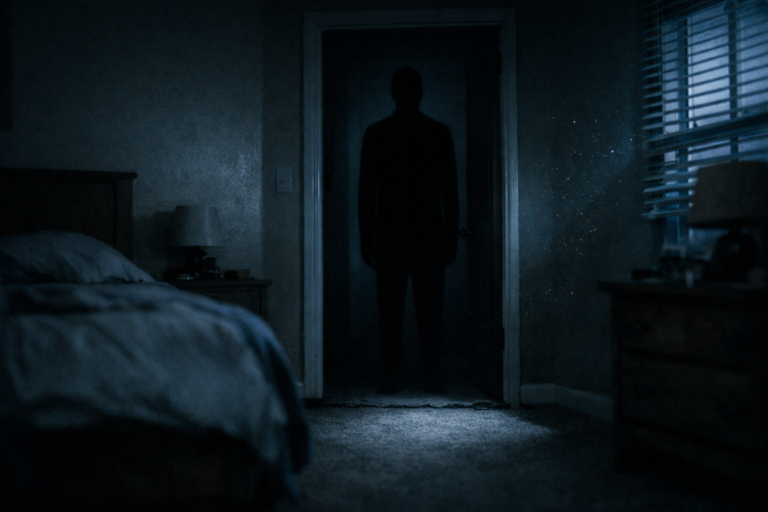
The Hat Man Watched From the Hospital Window
I left the hospital later than I meant to, carrying the paper cup I’d refilled twice with coffee that had gone from burnt to just numb. The corridors were thinning out to their after-hours hush: machines reciting their loops, a cart rattling down somewhere I couldn’t see, the faint citrus of disinfectant hanging above everything. The visiting hour announcement had played an hour ago, a gentle recorded nurse reminding us to go home when we could. My mother had finally dozed with her mouth a little open, her face slack in sleep, and I stood there a while to be sure it would hold. I tucked the blanket up under her arms, set the little bag of toiletries on the chair, and told her, out loud but softly, that I’d be back in the morning. I waved at the nurse at the end of the hall, who waved back without looking up from her chart.
Downstairs, the lobby was half-lit, muted like a movie on pause. The volunteer desk had been abandoned to a plastic vase of carnations and a stack of trifold pamphlets about physical therapy. The vending machines glowed clean and square. Through the revolving doors, a mist hung over the lot, catching the sodium lights in a dirty halo. I palmed the sticker on my shirt that said VISITOR and rolled it up and stuck it to the rim of my cup, then pushed out into the night.
The air had the crisp, hollow chill of a night that threatens to frost. Somewhere past the loading bay a truck hissed and shifted, then went quiet. I crossed the painted crosswalk, walking faster than was necessary, feeling the heat of the day lift off my back like someone uncurling their hand. To the right, the South Pavilion rose like a separate ship joined to the main building by a glass corridor. A printed sign cable-tied to a barricade read SOUTH PAVILION CLOSED FOR RENOVATION. I’d seen the taped-off doors upstairs too, a sheet of plastic hung behind them like a shower curtain, dusty footprints on the tile ending at the threshold.
I glanced up because people always do, I suppose, when leaving a place like that: you mark the room where your person is sleeping, put them in the right square. My mother’s floor was on the west side. The window I found instead was across from it, up in the closed wing: a single lit pane on a dark wall. It shone like a lit aquarium, a perfect rectangle of room light among the deadened squares around it. And there—in the center of the glass—was a man-shaped dark. A cutout. The shoulders were broader than the neck. And there was, unmistakably, a brim dipping out from the top edge, a flat shadow lip that made a shape I hadn’t seen in real life in a long time. Not a baseball cap. A hat like in old photographs.
I stopped without meaning to and set my coffee cup on the concrete wall of a planter to steady it. The figure didn’t move. Not a shift of weight or an incline of head. It was as if someone had glued a charcoal silhouette to the inside of the window, face pressed to the glass. I told myself it was a worker finishing up, or a fire safety dummy, or one of those cardboard cutouts people put in windows in old neighborhoods to deter break-ins. But the brim did not look cut from anything. It had a thickness to it, a way it intercepted light from the ceiling fixture inside that felt like something you would feel if you reached up.
I took three steps backward until the planter dug the edge of its brick into my calves. The figure, obedient to the laws I understood, grew no larger or smaller. It didn’t angle different, didn’t lean. The light behind it stayed a consistent clinical white. I knew the wing was empty. They had said so upstairs at shift change, nurses talking in the elevator: “South is sealed until they finish the asbestos thing. No one but facilities past the plastic.” Still, the rectangle shone, and the brim cut its straight line.
I went back inside. The automatic doors dragged out their breath and closed after me. The security desk man sat with his chin in his hand, a sports game flickering on the small mounted TV with the volume off. He looked up as I approached and slid my parking ticket toward him for validation as an excuse to stand there.
“Does anyone work nights in the South Pavilion?” I asked, and heard how flat my voice sounded in the lobby. The word pavilion felt overeager on my tongue, like I’d grabbed it from the sign and hadn’t earned it.
He pressed the stamp down with a thump. “Closed down. Has been for months.” He pushed the ticket back. “Why?”
“I thought I saw someone in a window. Light’s on,” I said.
He sat a little straighter, not suspicious so much as bracing for extra work. He swiveled his stool to look out the glass. From the lobby you couldn’t see the wing head-on; you saw the reflection of it doubled and warped in the sliding doors. “Yeah,” he said, as if agreeing with something else entirely. “They keep power running on the breaker. Motion sensors sometimes do what they want. Nobody up there, though. They did rounds at eight.” He adjusted the little name badge on his vest and folded his hands again. “You have a good night.”
Outside again, the damp was crawling into the seams of my clothes. I yanked my coat closer and walked parallel to the building to change the angle. The window kept watch. The man-shape—if it was a man—remained pinned to the glass with that ridiculous, unmodern hat, exactly centered as if by design. I tried walking to the edge of the lot until the rectangle of light stood behind a bare-limbed tree. The branches laid bars across it and then fell away, but the silhouette didn’t jitter or resolve. From the small rise by the bus stop, it was a neat paper square again, the brim as precise as a horizon.
At the edge of the covered drive, I stood against one of the stone columns and peered up from its far side, and then from the near side, the little movements people make when trying to prove a trick in a mirror. I thought of lifting my phone and pointed it, but the screen threw my own reflection back at me like a warning, and when I tapped to focus the pane bloomed with glare. In the few shots I took, it was all fog and grain and the violent rectangle of light, no hat, no man. Anyone would think I had made too much of it. I erased them and put the phone in my pocket, suddenly embarrassed to have tried to trap it.
Cars slid by on the road beyond with that floating sound tires make on wet asphalt. A woman in scrubs came out with a bag of trash, tied neatly in a knot, glanced up as I had and didn’t slow, disappeared around the side of the building. I waited for the figure to move even a fraction. I waited until the waiting itself felt watched. It didn’t move.
When I finally turned away, it was to realize I hadn’t gotten my ticket stamped after all, only the small validation sticker applied wrong and curling off at one corner. The machine near the gift shop was dark. I had to go back in to the desk to get it re-done or pay the nighttime rate at the exit, which I didn’t feel like doing mostly because it was one more human conversation to be had in a night of more than enough. I stepped on the rubber mat, the doors sighed, and I moved into my doubled self in the lobby’s glass.
The first thing that landed wrong was the shape of my shoulders. The second was how the black that was my coat ended too low and too wide. For an instant the sliding doors held a version of the lobby that included me and another arrangement behind me, something cut from a darker dark. It had a hat. The brim made a thin horizon across the top of my reflection’s head, a slash of absence. The rest of it was so certain in its lack of edges that my brain filled them in: the line of a sleeve, the suggestion of a lapel, the sense of a face bent toward the glass. I know how reflections work. I know I was seeing the outside folded into the inside. I still turned around. There was a spray of ferns by the volunteer desk, the stretcher waiting with its sheet folded flat, the doors that led to the lab hallway propped open. There was only me and the echo of my footfalls and the security guard asking if I’d dropped something. The room behind me was empty of people. In the glass, the brim slid for a fraction of a second across the arc of light like an eclipse and then dissolved back into the ordinary geometry of a lobby at night.
I handed my ticket over, made a joke about the sticker misbehaving. The guard peeled a new one, pressed it carefully, scratching the adhesive down with his thumbnail. “All set,” he said. I don’t think he looked in the direction of the doors again.
Driving out of the lot, waiting at the gate, I turned my head like a kid being told not to. The window stood neat and far and wrong. The figure was there as if it had been set at manufacture, broader than the frame would comfortably allow, but it did not lift a hand to the glass or tilt its head as if to check the lot for me. It watched in a way that didn’t look like watching. The light around it was steady. My ticket slid into the slot and the barrier rose with a mechanical patience, and the car behind me rolled forward with heat in its grill and I had to go.
In the morning a storm had scrubbed the sky clean. I came back with a tote bag of things my mother had asked for in a note she left on the tray: toothpaste, reading glasses with the arm tightened, the magazine she liked, and a fleece because the air conditioning on the floor had a habit of turning on like a sneeze. The hospital looked smaller in daylight, as if the mist and the quiet had added a story that wasn’t there. I cut across the same crosswalk. Up above, on the South side, the lit square was gone. The window was a deep, heavy black, eating light in a way the other panes didn’t. I found it quickly, by habit now. No glow. No halo on the glass.
I stood with my head tilted back until my neck protested. Inside, I could make out the suggestion of a curtain—the kind they hang on tracks to give the illusion of rooms where there are none—pulled open. Last night, if it had been closed, I’d not noticed. Now, in the dark, it was a clean parting. Someone, something, had pushed it aside, gathering the drape back to either end, leaving the window bare, neat as a parted comb track in hair. A bank of cloud went over the sun and the glass briefly threw me back at myself; for half a breath the brim crossed my own reflection’s forehead like a ruler laid on a map. Then the cloud moved on, and I was only a small person squinting up at a black rectangle, my breath tracking briefly in front of my mouth while inside a curtain hung open to an empty room.