The Shadow Sat Down Before I Woke Up
I started waking at 3:17. I don’t know why it was that time and not another. I wasn’t setting an alarm. My phone stayed face-down where I always left it, charging on the nightstand, and the only thing that changed was the way my eyes would open to the same quiet minute, the digits a soft electric bruise in the dark when I finally reached for it.
The rest of the building kept sleeping: the people upstairs done with their late-night pacing, the elevator across the hall stilled between floors. The radiator ticked its cooling metal clicks. Outside, the streetlight threw a diluted square through the blinds, thin lines of gray laid over the wall and the top edge of the chair beside my bed.
The chair isn’t anything special. It’s one of those old, sturdy wooden things with a tired cushion I never got around to reupholstering, a place to drop a sweater, to catch the strap of my bag when I come in late. I used to pull it close when I was sick and needed a place for a glass of water. It had become part of the bedside geography—lamp, books, glass ring on the coaster, chair. I never devoted a thought to it. Not until the second night I woke at 3:17 and something in the room shifted as if it had just remembered me.
The third night gave me the reason to start watching. I came up out of sleep with that bare-animal feeling you get before a storm, a static across the skin that doesn’t explain itself. I was listening to the kind of silence that has a shape to it when the chair made a sound it only ever makes under a person’s weight: a low, creaking dip, the wood settling a fraction of an inch with a quick intake and a soft, longer exhale. I’ve heard it hundreds of times getting dressed, tossing myself down to tie my shoes. It’s a private, upholstered sigh, the old cushion trying to remember its spring. Only now I hadn’t moved. No one had.
I told myself it was the building. Maybe the heat had kicked wrong, a pipe complaining. I lay there and tried to match the creak to a pipe, to the wind. Nothing else moved. The lines on the wall stayed thin and unbothered. I couldn’t see the chair for more than a silhouette, a blacker shape against black; I could only feel that the corner of the room where it stood was occupied in a way empty corners should not be.
By morning I dredged up a reason. Springs shift on their own. The cushion’s lopsided; I’d thrown a sweater on it last evening and maybe the weight tugged to one side in a way that let the wood slip. I left for work and told myself I was laughing, and I did laugh, thinly, to the coffee machine. But before bed I placed a paperback face down on the chair—not a test, not on purpose at first. I finished a chapter and couldn’t keep my eyes from stinging and it was the closest surface. Later, when I woke again at 3:17 and the chair breathed as if someone tired had sat, I kept my spine rigid and my breath shallow and pictured the book lifting, sliding, falling.
In the morning the paperback was on the floor. It didn’t look thrown. It lay two feet away, open to the same page it had been on, splayed with the kind of injury that ruins a spine. There was a gentle smear across the bottom edge from where it had skimmed the dusty floorboard.
It could have slipped. I’m aware of this. The next night I put more on the chair: my bag, the book closed now, a folded hoodie, a lop-sided stack. I arranged them with an attention I hated myself for. I propped a receipt impossibly on its edge between the hoodie folds so that the smallest jostle would drop it.
At 3:17 the chair let out its weary consonant. I stared at the ceiling and felt the hush of the room like a held breath. Somewhere outside a truck shifted gears. The evaporator in the fridge coughed and settled back down. There was the faintest suggestion of a second sound, a friction—fabric against fabric as if a coat sleeve were brushing the arm of the chair on the way down. I did not turn my head.
By morning the bag hung from the back of the chair, not where I had left it. The hoodie had a shallow depression over the right thigh of its folded shape, as if a knee had rested there. The receipt was on the floor, folded once cleanly in half.
It became a ritual, and because I couldn’t admit it was a ritual I thought of more and more normal reasons for it: I wanted to keep the chair clear for once. I wanted to stop draping things anywhere. I told myself I’d stop if it made me any more nervous. At work I nodded through meetings and typed with the detached speed of someone who expects to be interrupted any minute by an alarm she didn’t set. I came home to my room and put things on the chair with the neatness I only ever summon for guests I worry about. And each morning there was the same small wrongness: items shifted sideways, the folded edge dented, the strap of the bag elongated like the arm of it had been tugged and then let go.
On the night of the fourth waking I opened my eyes at 3:11. I knew it before I turned the screen of the phone over to double-check. I lay there in a hush that was not quite still. It was the kind of quiet the air has right before you sneeze—an incoming that hasn’t yet arrived. I let my lids sink again until the room returned to the thin gray of one more almost-sleep. The square of streetlight on the wall nudged a pale ladder of slats down over the chair. Between those steps was the usual dark, and beneath that an even darker seat.
I had put only a sweater there that night and balanced my house keys on its sleeve, an apology I don’t know who I meant it for. I found myself, with the strange practicality of a person who is not moving and will not move, calculating the angle at which the keys would slide if the sweater went down.
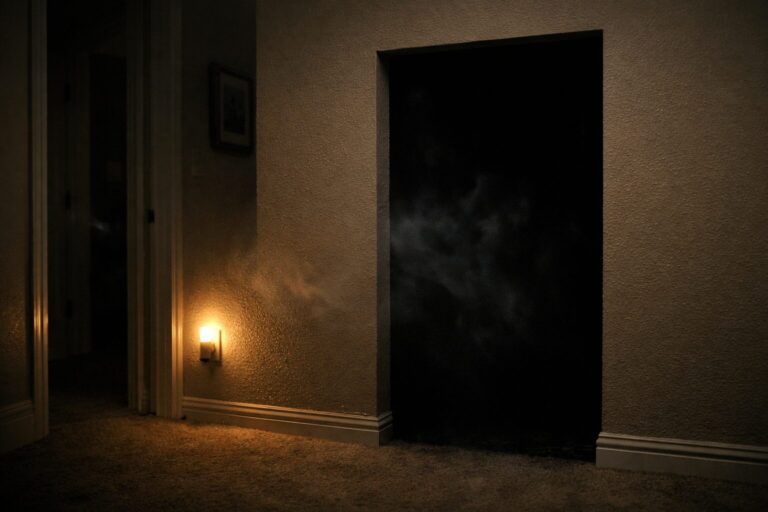
It didn’t happen all at once. The corner where the chair stood got darker the way a room gets darker when a cloud crosses the moon you can’t see. Something occluded a little light that wasn’t much to begin with. There was a moving lack, a more-coherent absence that approached from the indistinct hallway of my half-closed bedroom door and unlatched nothing as it passed. The sense I had was of height first, and then of an intention that belonged to someone else entirely—something that knew where the chair was without looking. When it arrived at the chair, it bent.
The air in front of me thickened and abbreviated into the memory of a person sitting down. The darker shape hinged slowly, weight rolling down through invisible hips into the cushion that met it with a bow of sound so familiar that for a fraction of a beat I failed to be afraid. The chair creaked. It was louder than it had been on the other nights, not because the act was louder but because I had watched its beginning. There was an almost courtesy to the way the seat took on mass, like someone easing down so as not to wake me, except that I was looking straight at the angle of nothing becoming a lap.
The keys slipped after all. They made a small metallic whisper along the sweater’s knit and dropped into the deeper dark between the legs of the chair with a soft, apologetic chime. The shadow tightened, or gathered, or settled the way a very tired person does by rolling their shoulders forward. My own shoulders tightened without my permission. I could feel that if I lifted my head even a little something would join the movement of it. So I stayed where I was, eyes open as small as I could make them and still see.
I didn’t see a face. There wasn’t one, not the way there is light and a socket for it. There was a density where a head should be, a roundness that suggested a presence the way your hand knows the curve of a glass in the dark before it touches it. I had an unhelpful flash of my father, bent forward in the chair at my childhood desk, late at night when I’d wander to the bathroom and find him asleep in the light of the computer screen, his jaw soft, his breath steady. This silhouette had none of that gentleness. If it breathed, I couldn’t hear it. The room leaned into its listening.
Some minute passed. My phone screen stayed face-down beside my hand and I did not move it even when my thumb ached from holding still. A car went by outside and the wash of its headlights put pale water on the ceiling. The chair offered nothing but its low, well-mannered groan and then the minute changed, unseen, and I was back in the part of the night that isn’t precise about itself. I closed my eyes not because I was braver with them closed but because the watching had become its own kind of participation and I wanted to be as little involved as possible.
In the morning the chair was empty. The sweater had fallen to the floor with the body-curve of a long-occupied sleeve. My keys were under the bed. When I lifted the sweater, it was warm for a second, but that could have been my hands.
That was the day I moved the chair out of the room. I told myself it was sensible—there’s only so much furniture a small bedroom should have. I carried it to the living room and put it in the corner near the window that looks down onto the street. I vacuumed the spot where it had been and felt, absurdly, as if I’d just cleaned up after a guest. That night I made the bed with fresh sheets that still creaked with newness when you pull them tight. I drank a full glass of water and set it on the nightstand with a chemistry-lab attention to where the coaster ring met the lamp base. I told myself the joke wasn’t funny anymore.
I slept well for the first half of the night. Then the familiar upward tug woke me and I reached for the phone. 3:17. I was already farther into being awake than any of the other nights, and with that came a pettier kind of anger. The corner where the chair had been was bare, stripped to its scuffed baseboard. There was only the wall, and the shadow ladder of the blind’s light that met floor. Nothing stood there. I listened anyway, to prove the quiet to myself.
Something close to the bed flexed and let go.
There is no polite way to describe that sound. It’s the sound a chair makes, but there was no chair. It came from the space just over the carpet where my hand could have reached and not touched anything. The air seemed to lower around that invisible point as if a shape had found its height again and folded into it. Wood didn’t creak—there wasn’t wood there—but the room produced a creak anyway, a born-of-habit settling of weight like a mouth making the word it has said every night for years.
I lay very still. In the living room, a page in some old magazine rustled without being touched. The empty corner stayed empty. Closer, closer than it had ever been, the bed frame gave a tiny answering tick, an echo of a smaller adjustment—the kind that happens when a body leans forward to listen.
The last sound was a careful little sigh beside my bed, the sound of something settling into nothing at all.