Something Knocked Using My Father’s Pattern
It was the rhythm that woke me. Two quick, one long, three quick. The odd little syncopation my father had made up when I was a kid and losing keys was a regular event. It meant, I’m here, open up. He’d rap it on the glass of our old apartment door, on the side of the car, on the toy chest if I hid behind it. In this house, my house, it carried through the wood like it always had, the same way you recognize a voice before you can name it.
The clock on the stove showed 1:17. I was still at the kitchen table, a glass with a ring of water sitting off-center on a magazine, the TV in the living room paused on a frozen face. The porch light cast its hard, yellow cone through the narrow sidelight beside the front door. The air felt unreasonably cold for late spring. I heard it again: two quick, one long, three quick. I said his name out loud without meaning to, the way you do when a memory arrives as a body.
He lives across town now, past the mill, a good forty minutes if you catch the lights wrong. He doesn’t drive at night anymore, not since the cataracts. I stood up, the chair legs chattering against the tile, and the sound came a third time, exactly the same. I could picture the way he’d curl his middle and ring fingers and use the backs of them, not the knuckles, so it was more of a hollow sound than a tap. I caught myself smiling—something childlike and involuntary—and then I was already halfway down the hall, socks slipping on the polished wood.
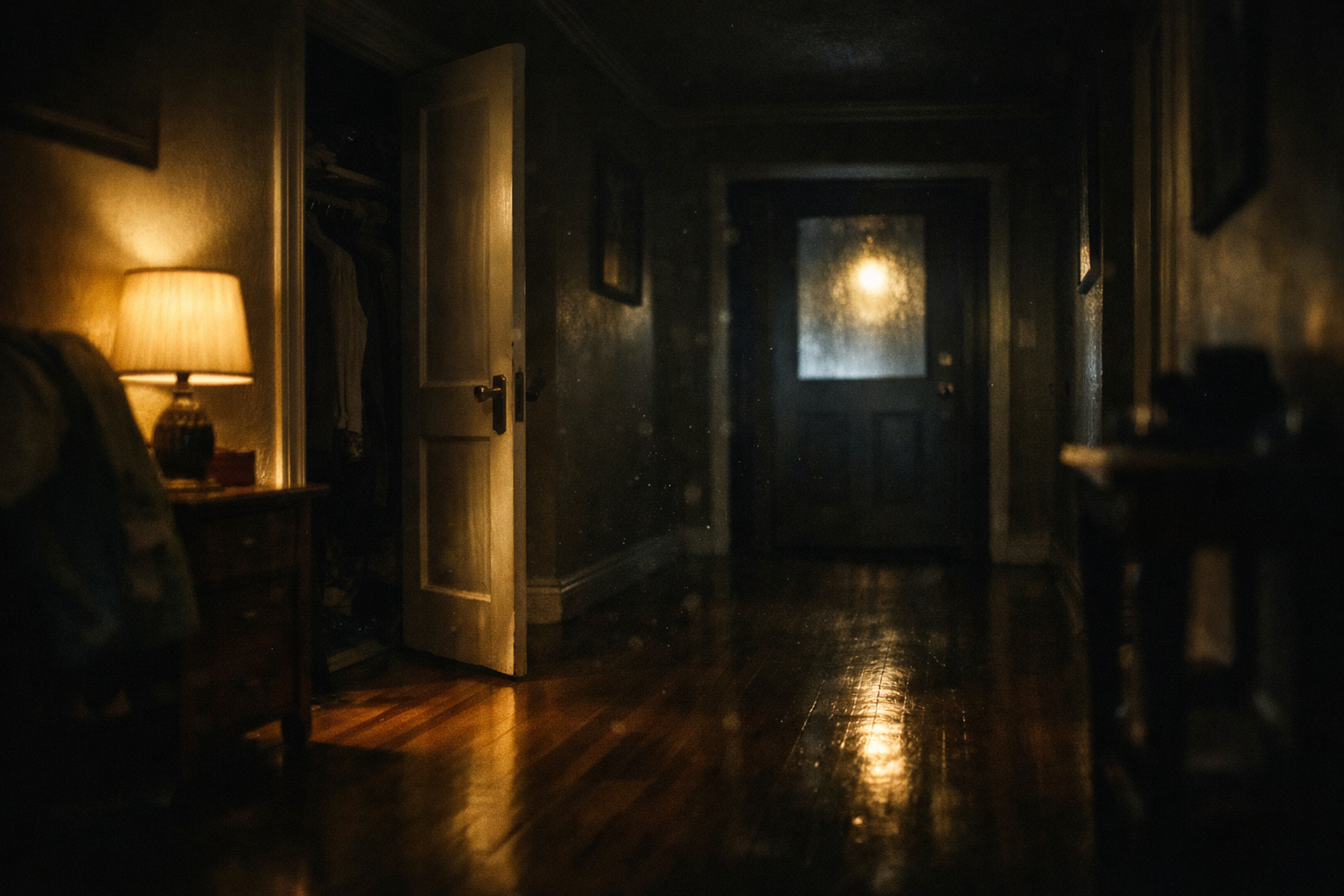
I put my eye to the peephole. The distorted oval of the porch steps. The rail. Beyond it, the empty smear of my little front yard and the darker street. The light drew moths that bumped and circled in that mindless way that looks like intention if you want it to. Nobody there. The glass of the storm door showed a dull reflection of my own face, small and pale in its curve. I waited until my eyes watered and then I lifted my head. The house breathed around me—the baseboard heat clicked, the fridge compressor groaned off—and the absence of any footsteps or weight outside the door yawned open in my chest.
That was wrong. Not the emptiness itself—I could tell myself a kid had run off or some neighbor was mixed up—but the chain. I always slid the chain at night; it was a little ritual I had, the tiny metal kiss and then the thumb pressing the deadbolt. I had done it at 10:11, I could have told you that, because the weather alert chirped from my phone right after. Now the chain hung limp, the slot bare. The tiny screws on the plate were flecked with old paint that I had picked at with my nail one evening, and I could see the place I’d lifted it away. I put my fingers to the chain as if the metal would be warm where a hand had lifted it—ridiculous—and it was cool as if it had been that way for hours.
“Dad?” I said, before I could stop myself. My voice fell flat in the hallway. I slid the deadbolt back on principle, even though it made me feel like I’d just closed the lid on a box I was convinced held nothing. I turned on the porch light anyway, then off and on again, in the childish code neighbors sometimes adopt. I put my ear to the wood, feeling stupid, palms cold, and listened so hard the blood in my head sounded like a small engine.
The knock came again, but not from the wood under my ear. It sounded thin and farther away, like someone had moved around the side of the house. I backed up, felt the low table on my thigh, and swore without sound. Then, as clear as if I were standing with my bare feet on the welcome mat, it came from the back door off the kitchen. Two quick, one long, three quick. The exact weight of it, the exact spacing—even the longer pause after the third, the one that always made me swallow because it acknowledged I was slow to answer. I felt something dark inside me widen and flatten out.
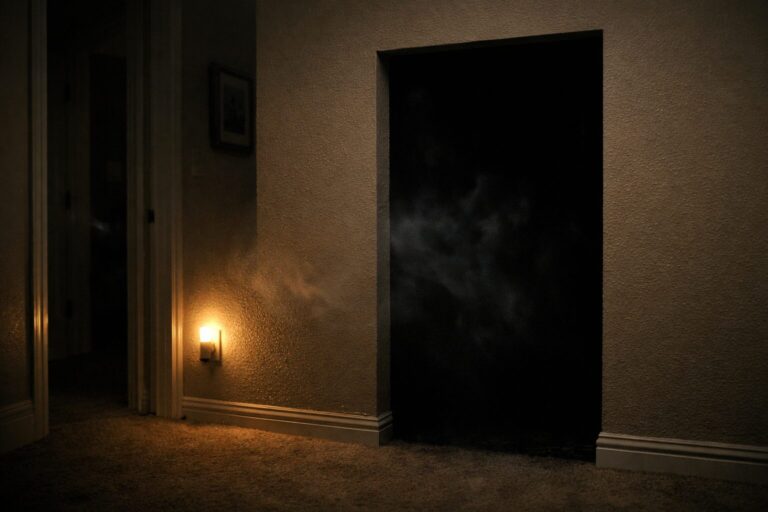
I crossed to the kitchen and the back entry. That door’s glass is ribbed, the kind that makes a lantern of the night. Sometimes, if someone’s there, you can see a hint of a shoulder shape, the break in the pattern. All I saw was light from the neighbor’s bathroom window and the skeletal shadow of the lilac branches that press the fence in summer. The door itself was still. No shudder, no lingering vibration under my palm. I called his name again, and this time, for the first time that night, I heard a voice.
“It’s me.”
It wasn’t the full thing, not the whole instrument. It was the scrap of it that arrives through a phone with bad reception, a certain worn corner of the vowel, the indifference to the S at the end. My father has said that phrase my whole life, with irritation or warmth or teasing in it. The voice on the other side of my back door said it with none of that, and also with all of it at once, as if someone had taken all the times he’d spoken and run them together too fast and then cut out a sliver. I stood there with my hand on the deadbolt and didn’t move.
“Dad?” I said, but softer than I meant. “Where are you?”
Silence. The refrigerator cycled on, a slow heartbeat in the cabinets. A pipe rolled somewhere in the wall with the sound of loose coins in a dryer. Then the knock again, but now it wasn’t on a door. It was to my left, in the wall that separates the kitchen from the laundry closet. Two quick, one long, three quick. Dull and thick, exactly at shoulder height, as if someone were standing in that impossible slice of space between the studs and rapping from within. I took a step back so quick the heel of my sock folded under.
The sound moved. Not far. I could feel the map of my house all at once, lines overlaid with the memory of laying out the moving boxes, of my father himself standing in this very doorway a month after I closed, looking pleased and tired and calling me ridiculous for the deep shelf I planned for the spices. The knock ran along that map. First in the laundry wall. Then, after a pause you could fill with my name, in the hall outside the bathroom. Two quick, one long, three quick. Then at the far end, by the little linen closet’s hollow core. Then—God—low to the baseboard as if it had crouched down. Same rhythm, gentler, coaxing. My heart tried to keep pace with it and failed.
I said his name again and this time I put the phone to my ear as if that mattered, as if it could carry the house better than I could. No missed calls. No new messages. I texted him: Are you up? Everything ok? The little undelivered gray circle. Then it sent. I swallowed, realized my mouth was dry. The taste of the tea from earlier had gone bitter and metallic. I closed each light I passed out of reflex, then turned them on again just as quickly, the rooms exposing themselves too suddenly like creatures startled out of sleep.
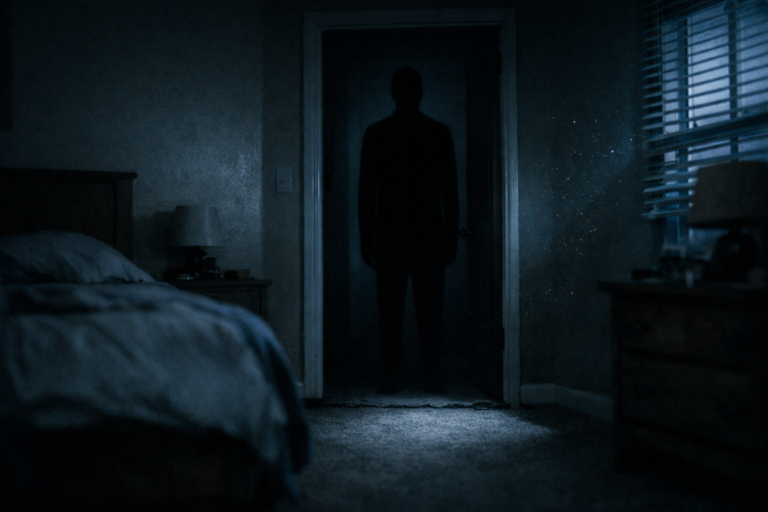
The knock shifted into the hallway leading to the bedroom. The quiet there is different at night, closer to the ear. The rug there holds the last of the day’s warmth and smells faintly like the dog I don’t have anymore. When I reached the bedroom door, my hand, sweaty now, left a faint shape on the white paint. The closet door opposite the bed was half an inch open, the darkness inside like a mouth close to breathing. I stood there and watched the edge of it as if it might widen without the hinge.
Two quick, one long, three quick. From the closet. Each rap a soft reply from wood that had never once in its useful life been asked to be a door. I felt something old and child-size knot under my breath. There is a smell inside that closet that comforted me always—cedar from a small block my mother gave me years ago, sun-stored laundry, old sweaters that had accepted my shape. The smell moved out to meet me, and underneath it, under the dry sweetness, a flat cold that belonged to basements and empty houses.
“It’s me,” the voice said, from inside that dark, at the same time the coats on the lower rod made a tired, whispering sound against one another as if they’d been disturbed and were settling again. It was so exact I could have kissed the air in gratitude and grief. And yet there was a hollowness in it, like an echo in a room that should not echo. The way a recording of a voice can be perfect and wrong at the same time, because the room it comes from is not your room.
I did not touch the closet. I do not know if there is a way to describe choosing not to, other than to say that you stand there and feel everything in you breathing yes and no in the same beat. I said, without opening my mouth fully, because I did not want to give the sound of me any more space than it already had, “Where are you right now?”
There was a pause the exact length of the one my father makes when he is about to say my name and scold me lightly for something I have forgotten. The coats stopped their tiny swaying as if they were being listened through. Then, from inside the wood in the wall adjacent to the closet door, two quick, one long, three quick.
The phone rang in my hand and I flinched so hard I almost dropped it. My father’s name on the screen. I stepped backward until the back of my legs hit the bed and sat down all at once. I said hello, or something like it. The air on the phone line sounded like the sea for a second, the way it sometimes does when a call connects badly.
“Why would you do that?” my father said, without preamble, as if we’d been already talking. The thickness of sleep in his voice made it real. The way he sits up when he’s worried, I could hear him do it, the little grunt. “Are you outside? Don’t mess around, it’s late.”
“What?” I said. My mouth had gone too dry again and the word came out like a cough. I stood up without meaning to, as if standing might push the sound back from the closet. “Where are you?”
“Home,” he said, and there was the sound of him moving the curtain in his bedroom, the faint squeal of the rod. “You just knocked your ridiculous little pattern, then nothing. What are you doing? I opened the door. There’s nobody. Why would you do that?” He said it again, softer. “Why would you do that.”
I stood with the phone pressed between my ear and shoulder and looked at the thin slice of dark at the closet’s edge. I could hear, under his voice, the sigh of his old furnace, the way it starts like someone clearing their throat. That detail—the breath our home used to have—tore something in me open. I wanted to tell him I was there, in a way, that I was a child at his door again, sweating into my mittens, wanting it to open. I wanted to tell him I had not left this house tonight and also that I was everywhere it had knocked. The words lined up and slid away uselessly.
“I’m not there,” I said at last. “I’m home. Someone just—” But I couldn’t finish the sentence. The language couldn’t decide if it should be a joke. I looked down at my hand. It was shaking with a speed that looked like I was shivering, though the heat was on.
He was quiet. In his quiet, I heard it through the phone, small with distance and unmistakable. Two quick, one long, three quick. On his side of the line. On his door, or his wall, or wherever it had chosen for him. In that exact rhythm that means I’m here, open up, always familiar and always only ours. I didn’t know he heard it too until his breathing changed, until the word he said was not my name but a shape of it that is older and gentler: “Hey.” And then, as if to answer him, as if to answer both of us, from beside my left ankle on the painted wood of my bedroom baseboard, close enough to feel the faintest tremor through the floor into my feet, the knocking starts again.