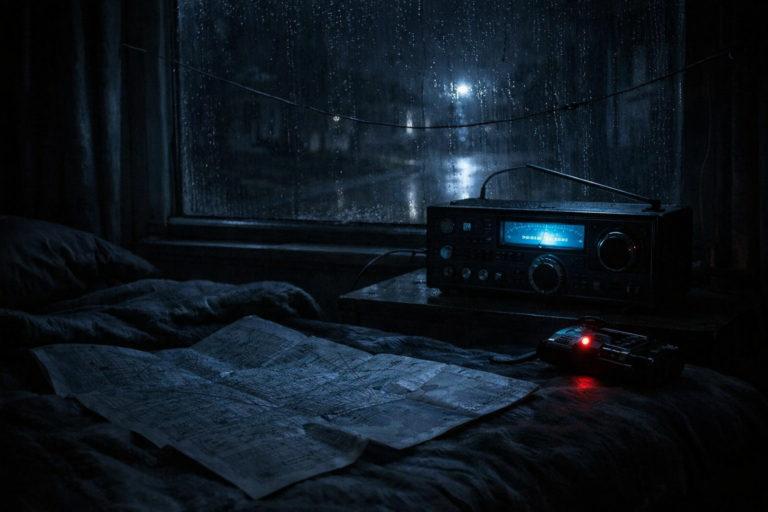
The Emergency Alert Named a Town That Doesn’t Exist
I was up later than I should’ve been, the TV whispering to itself in a dark living room. The weather had a clean, empty feel to it—no wind, no rain, just the soft rush of the fridge and the occasional click in the baseboards as the house settled. The glow from the screen made a small lake of light on the coffee table where a sweating glass left a ring. Somewhere beyond the window, a car rolled by without urgency and went on, taking the noise with it. It was the kind of night where nothing is happening and you feel fine about that, where your mind drifts with the movie and the hum and the faint buzz from the streetlight outside.
The movie broke into a block of commercials—a local car dealership, a pizza place offering a midnight deal, the tail end of a lawyer’s phone number—when the tone hit. Three steady blasts that prick at your gums, like the room got narrower all at once. The picture cut to a flat color, a sort of dark gray-blue, and the crawl began at the bottom in the usual segmented way. The text-to-speech voice came on, trained to sound stern and unnatural without quite being human. I almost reached for the remote to turn it down, assuming it was one of those tests that show up and tell you everything is okay.
“This is an Emergency Alert System bulletin for residents of…” There was a little skip as the voice smoothed over whatever it didn’t recognize. “…Graybridge.”
I sat up without knowing why. I don’t live in a big place; you hear about towns even if you never go. There’s always a diner, a team, an old factory, something to attach the name to. Graybridge didn’t bring up anything. No logo on a baseball cap. No high school your team might play on a Friday if you end up stuck behind the marching band. I waited to hear the counties, thinking I’d find my bearings that way.
“Effective immediately: residents of Graybridge should evacuate via posted routes. Use caution. Remain calm. Do not attempt to return until an All Clear is issued. This message will repeat.”
The crawl said Civil Emergency. No details. I watched it go by once, twice, the voice chipmunking slightly at the ends of words like it was having trouble keeping up. I grabbed my phone and typed Graybridge into a map app. It spun the compass and bounced the pin in place, then suggested one Gray with a ridge two states over and a hardware store named Bridge’s in a town I’ve never set foot in. Nothing here. I tried the name with the state on the end. Still nothing.
Across the street, another living room glowed the same slate blue. My upstairs neighbor thumped the floor and I heard the muffled question through the ceiling, like someone scolding a cat. Messages started in the building’s group text—the kind that’s usually for lost packages and “does anyone know who owns the red Honda”—lighting up in quick pings: “Is anyone else seeing this?” “What is Graybridge?” “Is that tornadoes?” There wasn’t a cloud to be seen outside, and even the leaves on the sycamore were flat and lazy.
I switched channels, half to escape it and half to test it. It followed me. On the game show rerun, the crawl slid over the contestants’ frozen smiles; on a nature doc, it walked past elephants bathing at a muddy river. The voice didn’t change: “Residents of Graybridge…” The guy three doors down who works nights and knows things about antennas said his satellite was carrying it too. Another message popped in from the house behind us: their ancient television with rabbit ears had switched itself to a blank screen with the tone and the banner. We weren’t all on the same provider. It wasn’t just the cable.
After a while the tone didn’t hit as hard. It was worse than that. It became a pulse, and the space between pulses started to feel like the important part. In those gaps, I could hear the apartment’s breathing—the click, the drip, the almost-silence that admits a new noise if you let it. I pulled the window up an inch. It was late enough for the roads to be mostly empty, late enough to hear the train if there was going to be one. Nothing. Just the rustle of something small in the hedges and a neighbor’s wind chime surrendering one note to a breeze that didn’t commit.
When the voice came back, it started giving instructions. For a second I was relieved, because at least there was information to hold. “All residents of Graybridge: evacuate using State Route 171 east to Exit 14B. Then follow County 12 to Ridgeway Pike and proceed to the fairgrounds at Mile Marker 42.” I said the names under my breath to see how they tasted. I knew those roads. Or I thought I did.
State Route 171 runs the other way around here. When you’re on it, you think of north-south first, not east-west, not the way the voice ordered it. Exit 14B is not where it would be if you were heading east, because there is no east the way the voice meant it. Ridgeway around us is Avenue, not Pike, and it doesn’t lead to anything you’d call fairgrounds unless you count the empty lot where a carnival sets up for a week in July, which sits stubbornly at Mile Marker 36. I felt a small part of myself standing up inside, like a dog raising its hackles.
I typed again on the chat. “Anyone got a map?” The answer came in photos—crumpled gas station fold-outs, a real atlas with coffee stains, screenshots. The roads matched like a rhyme you almost get right. County 12 definitely exists, but it hits the old quarry and dead-ends at a gate that’s been locked as long as I’ve lived here. There is a Ridgeway; it just isn’t a Pike. The fairgrounds were a half hour away by any name, and if you wanted to get there you wouldn’t do it like the voice said. Someone else pointed out Exit 14B used to be labeled 15 before a renumbering project five years ago. That’s not a detail you expect some boilerplate alert to get nostalgic about.
The alert repeated, identical for a while, and then changed in small ways that felt like a person trying to say the same sentence without making it better: “Take State Route 117,” it said, and then stumbled back to 171. “Turn west at Ridgeway Lane—Pike—Lane.” You could hear the software learning in the wrong direction. The crawl glitched once and made a word that looked like someone leaned on the keyboard. The banner blinked black and came back without the county list it hadn’t actually provided, as if it remembered it had forgotten something.
I picked up my actual phone and tried the weather service’s site. Their alerts page showed a blank line where there should’ve been a list if there were tornadoes, floods, anything. The highway department had a webcam feed on their page; it showed the highway text signs carrying the usual rotation about seat belts and a construction detour. A friend of a friend works night shift with the volunteer fire company; he didn’t know what I was talking about. Someone in the building tried the police scanner app and heard a dog chase, a traffic stop, then a long patch of silence you could stretch across town and still have room for your questions.
The voice kept steady like it was reading off a wall. It filled the room, that room you know better than any other—the throw blanket, the plant leaning a little too much toward the single pane, the book upside down where you left it—and it made everything feel not wrong, exactly, but misfit. I went out on the stoop and looked up and down our street. More windows glowed blue-gray, more series of three tones leaked from houses in thin, tentative ringtones, other living rooms shaped by the same rectangle of light. My upstairs neighbor opened the door and we looked at each other in the way people do when there’s one small, not-yet-urgent problem that might get larger if you give it power by naming it. “Do you know where that is?” she asked. I shook my head. I found myself whispering even though there was no reason to.
There was a second, right before two in the morning, when the voice wasn’t robotic. Or that’s how I remember it. After a long stretch of the tones and the phrasing I’d come to expect, there was a different sound on the line, like a roomful of air, and in it the kind of hush you only hear when a person stands too still because they are deciding what to do. The voice said the name again, “Graybridge,” more carefully, like it might be trying not to break it, and then it mispronounced the exit—”Four-tain B”—and the crawl spooled faster and scrolled off like a drop cloth being pulled.
The channel popped back to the pizza place commercial as if someone had cut a string. The movie returned mid-sentence. The elephant documentary resumed at a different part than where I’d left it; the herd was moving away and the camera was already following them. Messages continued in sputters—screenshots, short videos of the crawl—but then people started trailing off with versions of “mine’s back to normal” and “false alarm?” My living room looked different in the sudden return of color, hyperreal the way things do after you’ve stared at a single shade too long.
I left the TV on mute and lay on the couch in the wash of its light. Sleep didn’t so much arrive as tap me on the shoulder and have me turn around into it. When the sun bruised in around the blinds, I woke up with lines on my cheek and a coat of dryness in my mouth that tasted vaguely like dust and dawn. The program guide didn’t show anything special from the night before, just a line of titles that acted like the alert had never happened. The websites were quiet. Nothing on the weather page. Nothing on the highway alerts. The station’s social feed had a sunrise photo from a rooftop downtown: “Beautiful clear morning.”
I had work not that far away, down the usual roads you can drive when you’re still half-asleep and counting lights by feel. Outside, the air smelled like dry leaves and brake pads. The sky was the unlined gray of a plain shirt. A single gull made a paper plane of itself overhead. Traffic was normal—nagging, hesitant, everyone slightly late.
I took my turn where I always do, onto the stretch that threads under the billboard with last year’s paint still flaking at the edges. It’s a straight piece, then it arcs toward the interchange. There’s a green sign a couple hundred yards before the curve, the kind with three destinations stacked and their mile counts marching down the right. You see it and you don’t see it, because you’ve seen it so many times. I saw it this time. The fonts were the same, the bolts sat where they always sat, the metal had the right, dull reflection of a thing that lives outdoors. The first two lines were what I expected, towns I could picture without needing to. On the third line, in the same white letters as the others, was a new word: Graybridge 12.
I slowed down a fraction more than you need to for the arc. No one behind me honked, which somehow made it worse. The sign wasn’t taped over or graffitied, no prankster’s work. It was as official as it comes, its green clean and square, its arrow unambiguous. A truck passed me on the left with the calm of long practice. On the radio, a DJ read the school lunch menu like he does every weekday, pizza Friday and milk choices. My hands were doing the half-turn, half-straighten dance that gets you safely onto the ramp. I kept looking at the mile number like it might shuffle itself into a shape I recognized.
At the base of the ramp, the state had put one of those temporary orange electronic boards, the kind that flashes in blocks: USE BOTH LANES // MERGE LATER. It did its blinking job with no opinion. The exit sign after that showed the same sequence it had shown for as long as I’ve lived here. Where the road flattened out beside the concrete sound barriers, a crow sat on the top of the fence, beak open, silent. The lanes of cars took us forward, like they always do. When I glanced in the mirror, the green sign was already out of sight. I knew exactly where it was. I didn’t know, still don’t, where it was pointing.