Something Knocked Back in Perfect Rhythm
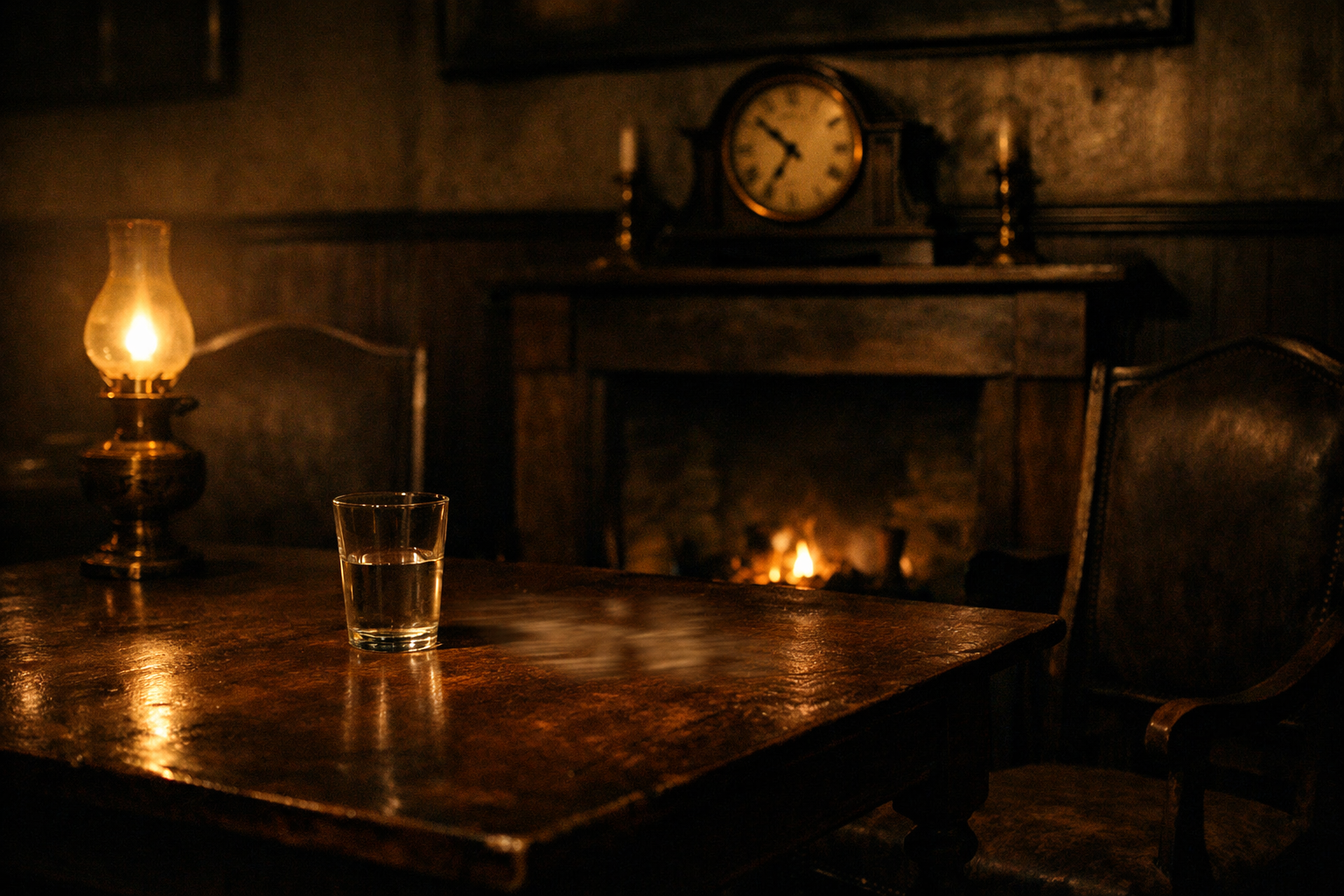
I took the front room because of the parlor—if you can call it that when it’s as small as a ship’s lounge, with low ceilings, beadboard, and a narrow hearth kept barely alive through the chill evenings. It was early autumn, the shoulder season that leaves rooms empty and staff with time to talk. The inn had mahogany railings rubbed smooth by the same hands that signed old registry ledgers now displayed in a glass-topped case by the door. I arrived just before the light thinned to blue and was steered toward a quiet chair in the parlor with the offer of tea or something stronger, and the feeling that I had stepped into a postcard whose ink was still damp.
We were six guests that night, all gathered in the parlor because the innkeeper had left out a decanter of sherry with a little card that read “Help yourselves” in a hand that looked like a good mood. There was a couple thawing out after a long drive, a woman with a paperback and a blanket around her legs like a shawl, a retired music teacher named Cal who told stories in a voice too gentle for the table behind his elbow, and a grad student whose name I’ve lost and whose laughter I haven’t. We passed the time in that companionable way of strangers—plucking at the threads of other people’s days until they frayed into our own.
It began as a joke because the mantel clock could be heard between our words. It had the sort of disciplined tick that invites keeping time with it. The grad student, June, started tapping a simple two-beat on the low table with a teaspoon—tap…tap—syncopating against the clock until it sounded like there were more people in the room than there were. Cal answered with his knuckles from the arm of his chair, off by half a breath so it made a pattern that pulled us all into it whether we wanted to be pulled or not. “Call and response,” he said. “Don’t look at me, look at your knees. Follow the sound.”
We did, one after another, setting little rhythms and trying to repeat them from across the room without watching hands. The rules were only implied: no speaking, no counting out loud, wait for silence, then answer. When it went well, the knocks overlapped so perfectly you could feel them in your teeth—small vibrations traveling the length of the table into your elbows, spreading through the floorboards, sounding like a language you might have known and forgotten. When it went badly we broke into laughter, and the inn felt warmer for it. The couple invented a limping waltz that made June spit her sherry. Cal played five-beat measures until the clock seemed to frown.
The innkeeper stopped by once to tell us not to rouse the house, and then again later to take away the decanter and leave us a bowl of walnuts as if that would slow our hands. “They say the beams carry music,” he said, almost apologetically, glancing at the ceiling as if he hadn’t nailed it up himself. When we finally stood, we said goodnight like we’d say it to friends we had known longer than a single evening, promising a rematch that none of us really expected to keep.
The corridor to my room was a long runner of faded blue with a floral print gone ghost-pale from sunlight. The bannister was a rail-road of dark wood, faintly sticky from beeswax polish. My room had a narrow brass bed high off the floor, and a little table by the bedside with a water glass and a book of matches under the shade of a lamp. There was a mirror over the mantel, and in it I could see the small sway of the window curtains with each breath I took. Somewhere below, the fire pinned its own weight to the grate, and the mantel clock, even muffled by a ceiling, kept faithfully on.
I undressed with the sort of relief that comes from putting one more town behind me and sat on the bed to tug off my shoes, and without thinking I tapped the side of the bedside table with two knuckles—twice, pause, then three: tap-tap…tap-tap-tap. I thought of June’s metal spoon and Cal’s soft hands and the silly seriousness of our rule about not looking at the knocker, and I smiled to myself at my own private little encore.
The reply came from the wood directly beneath my hand, echoing up through the grain as if the table had learned the trick and wanted to show me it had learned it well. Tap-tap…tap-tap-tap. The exact tempo I had set, the pause so clean it sheared my breath in half. I went still with my fingers resting on the edge of the table, and for a moment I believed I had done it to myself—that I had tapped and that the after-sound, traveling, had tricked me. But there is a proud thing in wood, and this was so clear and so separate from the first that my mind rejected my first thought as soon as it formed.
I leaned closer, the top sheet soft against my knees, and tapped again—a different pattern, a little run of three and three and two I’d used earlier in the parlor because I had liked the way it sat in my hands. This time I waited longer after I finished. The wall lamp hummed faintly. The curtains breathed me in and out. The clock downstairs stepped forward into the next minute. The answer came like a train hitting a crossing exactly when you know it should: the same rhythm, metronomically sure, returning from the inside of the table with the patience of someone content to be asked.
I said, “Hello?” before I remembered the rule about not speaking that we had invented and had no reason to hold. I spoke softly because there were other people in rooms at my elbow and the next, and some of the quiet in that house felt loaned out to me with the key.
From the far side of the wall, a headboard creaked in somebody else’s sleep. A pipe ticked somewhere as it remembered water. When I set my knuckles down again, I decided to stop being polite about the thing. I drummed a little bar that Cal had shown us with a hitch in it, the kind that works against your expectations, chirped like a bird’s call through a fence. I made it clumsy on purpose in the middle, misplacing a beat, moving it a fraction sooner than it should have gone to see if the next sound would correct me.
It did. The reply landed where the measure wanted it, the place I’d nudged it away from. If the first returns had been echoes, this was not. This was an answer. I heard it in the chisel-sharp clarity of those tiny percussive sounds, in the soft give of old wood used and cared for, answering like any person who has been asked the same question twice in slightly different ways and chooses to answer truly rather than literally.
I stood and pressed my ear to the table. It smelled faintly of lemon and an older scent beneath it, that penny-and-wool smell of used hands. I tapped again, slower, blinking to match the beat to my own pulse, and the reply came back in a shade faster than mine, as if, without seeing me, it had a way to keep time that did not slip with breath or blood. I tried the wall. Silence. I tried the footboard of the bed. The table answered anyway, like a person at a doorway refusing to shout to you from the stairs.
I opened the hall door and found June in stocking feet, hugging her sweater around her shoulders. She looked both foolish and accusatory in the way people look when they have decided to ask for help and still want to pretend they haven’t. “Did you hear—” she began, and then didn’t finish, because the faintest little knock came from behind me in my room, as if to answer her in English and in manners both.
We did not whisper about rules or games, but the instinct was there. She came in. I shut the door. We looked at the table as one of us might have looked at a sleeping child about to give itself away by moving in a dream. I tapped a crisp, old-fashioned cadence that belonged to no one in that house and to everyone in every house that has held a clock. The reply fitted itself to mine like a key returning to a lock. June smiled and put her hand over her mouth like it had gone there by itself.
We fetched the others because that is what you do when something becomes too true alone. The couple stood in the doorway, unwilling to step inside, faces made odd by the single lamp. Cal came in last and sat on the bed like it was a bench and he was about to run a chorus. He listened with his head down and his eyes up, and when he played his little five-beat measure on the table, almost spoiling it with pride, the table answered him with patience and without complaint. We did not speak over the answers. We did not look at one another while we tapped. We kept time for the clock and the clock kept time for us.
It began to change without any of us declaring that the game had changed. The table stopped waiting for us to finish. We would set two beats and a third would arrive in their stead, set exactly where we would have put it if we had been a fraction quicker or better. When I tried a run with a pause in the middle to be clever—the kind of dumb trick you learn early and think will fool every ear—the reply was there ahead of the pause, filling it in like grout, not claiming, only completing. The sense of being taught to nod came over me the way you feel an ocean when you step backward and let the next wave find your calves.
“Listen,” the woman with the paperback said, and her voice came thin and dry the way a whisper comes when you are thirsty. “It knows endings.” She reached toward the table and didn’t touch it, and the table tapped once, not loudly, not timidly. Once. A period at the end of a sentence we hadn’t finished composing.
Cal turned his head toward the hall even though the door was shut, and he frowned a frown so gentle it looked like sympathy. “Half a beat ahead,” he said. “It’s anticipating the resolution.” He played a different rhythm, one of those military ones he might have known from parades or school recitals. The reply came before the last measure did, a figure-of-eight sort of thing that made the couple look at each other like they had done something wrong on a day that turned out wonderful.
“That’s a dead march,” the woman with the paperback said, both hands around her chest the way people hold in laughter or grief. “That’s a funeral. My mother—she worked for the funeral home when I was a kid. At processions, they put mufflers on the drum. It was like that. Slow-slow—rest—slow.” She tapped it with her fingertips, and the table answered her before she could lay down the last slow, making her drop her hands and cross herself without knowing what she was doing until she had done it.
It’s remarkable how quickly a room can fill and empty itself. We were suddenly too many. We left like we were late to an appointment we all had separately, backs straight, nodding at each other in the tight way people nod when they have to pass in a narrow space and do not want to touch. In the hallway, the runner ate the sound of our feet. Someone’s door clicked too sharply. Someone whispered, and the whisper died in the turn of the stair.
Before I turned down my lamp, I heard a single, soft touch from the bedside table, too gentle to call a knock. I lay on my back and watched the square of the window become a less dark square, the first wash of pre-dawn like smoke. The mantel clock below kept time for us all. If I held my breath, I could separate its tick from the rest of the old house’s tiny sleep-sounds, the rise and fall of what I had taken to calling, privately and without permission, its breathing. I slept at last like a person in a waiting room who pretends to read and doesn’t turn a page.
At breakfast, the innkeeper brought eggs in small dishes and bacon that bent rather than broke. The decanter had been replaced by a sugar bowl. We were quieter than the night before, which might have meant nothing at all. When someone finally told him, he arranged his face the way a person arranges a display between polite interest and not wanting to feed a thing you are not sure is safe to keep around. He had a list of possibilities ready—pipes, settling timbers, the framed pictures on the far wall coming into the wall’s own rhythm with the heat. “The mahogany talks when the night shifts on the foundations,” he said, and patted the wainscoting, and the way he said it told me he used the phrase as often as he used napkins.
He wasn’t unkind. He didn’t smirk. He offered us a tour of the attic where beams the size of a tall man’s waist met at odd angles like knuckles against knuckles. He offered to change our rooms for the next night as if we had simply slept on a bad pillow. Behind the register a guestbook yawned, flipped open to a page where someone had drawn a pair of small circles with lines radiating out of them like the sort of eyes you’d doodle while on the telephone. In smaller writing under that: Heard tapping. Answered? And then a heart someone had tried to disguise as a clover leaf.
I don’t know how long the notes have been there. I suspect as long as the decanter and the bowl of walnuts, and I can’t decide if that makes me feel more foolish or more seen. The inn carries itself on in the way houses do: it hosts wedding parties who clap off-beat and fall into bed together and wake early for blueberry pancakes, and fishermen who go out before dawn and come back quiet and wet-haired, and couples who take the front room because they like the notion of a parlor. Sometimes a person will wake and hear a knock from the wood softer than the breath at their shoulder, and sometimes they will choose to tell the innkeeper, and sometimes they will not. The staff have good manners and good stories, and their explanations—pipes, varnish, the heartbeat of an old clock that travels up the spine of the banister—are all good explanations. And yet the guestbook has more drawings than it used to.
I wrote this the way you write something down to keep it from getting brighter in your head every time you are alone with it. On my last morning, when I folded the quilt back and touched the little table farewell without knowing I was doing it, I thought of pretending the whole thing had been a trick of congeniality, a night warmed by sherry and the encouragement of a clock, a house clearing its throat at inconvenient times. I could have let it be that. I almost did.
I stayed one night more. I did not tell anyone. I did not sit in the parlor because the lamplight in there felt too much like a listener. I kept my door propped with a shoe and watched the hallway breathe its slow way into darkness and into a dimness that comes later, when darkness begins to have shapes in it again. I did not plan to play another game. I did not plan to be taught the shape of answers.
Close to midnight, I reached for the lamp and missed. My knuckle brushed the table. I froze, that ridiculous, theatrical freezing we all do alone. I thought, Not tonight. I thought it not as a rule or a plea, but as a sentence I might have spoken aloud to a friend as I rose from a chair in another city, another life. The room had the feel of a place about to speak.
I tapped once by accident—it was nothing, barely sound at all, the weight of my hand on wood confessing itself. From the table came back a single knock, so exactly in time with the exhale I had not realized I had been holding that for a strange, airless instant I felt the odd pride I had felt the night before: included in something I had not invented, answered as if I had been expected to say what I had not yet said. I let my hand rest. I listened. In the silence, something polite and patient kept the beat without needing a clock, and I found myself leaning in, half about to say, “All right then,” when I realized that whatever would have come next had been heard already, and the table, like someone finishing my sentence gently, tapped twice and then waited.